Has the Nvidia crisis in the US stock market really been resolved? Wall Street may have made a fatal mistake.
Wall Street, which was celebrating Jensen Huang's triumphant return just on Monday, has begun re-examining the unresolved legal, regulatory and corporate governance risks behind this reinstatement in the past two days, which precisely exposes a problem worthy of investors' vigilance: Now that Jensen Huang is back, is NVIDIA's crisis really over?
After combining the underlying order flow data of US stocks and carefully sorting out the recent undercurrent of policies in Washington, our US Stock Investment Network has discovered an objective reality easily covered by fanatical sentiment: this is not the end of the crisis at all, but only a transformation of risk forms.
As investors, we need to calmly recognize an extremely critical point: NVIDIA today is no longer a pure tech stock whose pricing solely depends on computing power demand, product iteration and technological moat as it used to be.
In today's in-depth and hardcore analysis, I will act as your external investment research brain, leading you to peel off the appearance of this 31% skyrocketing layer by layer, and restore the truth behind this incident with objective data and underlying industrial logic.
After reading this article, you will thoroughly understand four core issues directly related to the capital in your account:
1. What exactly did the market get wrong in pricing? Why is the essence of Wall Street's carnival mispricing "crisis deferral" as "crisis resolution"?
2. The two parties in Congress have rarely launched fierce attacks on NVIDIA at the same time, but why did we find after in-depth disassembly that what they want is actually completely opposite results?
3. The reshaping of the underlying valuation. What kind of power swap has been reached among the White House, Congress and the NVIDIA board of directors? Why must a new variable called "political beta" be forcibly added to NVIDIA's valuation model from now on?
4. Finally, it is an exclusive quantitative deduction for the future. The storm is far from subsiding. On the upcoming December 3, Jensen Huang will be the only named witness, facing the public Senate hearing broadcast nationwide alone.
Combined with the political game, we deduced the probabilities of four end scenarios for Jensen Huang's retention or departure in the next 12 months. Why is the calculated expected return actually negative? What does that implied 10% to 13% political discount mean?
This article contains a huge amount of information. We suggest you like and collect it first, and digest it slowly with our train of thought. Don't wait until the risk track change is completely completed to realize that NVIDIA has changed.
What exactly did the market misprice in this 31% surge?
Let's answer the first question first. I will point out three pricing errors.
Pricing error 1: Mispricing "administrative opinion replacing investigation conclusion" as "Jensen Huang has been cleared".
Let's add some background first. On November 12, Jensen Huang was involved in a national security turmoil and resigned. The board of directors hired an independent legal team to conduct a special investigation. Therefore, the market generally believed at that time that he could not return until the investigation reached a conclusion. But what was the result? He has already returned before the investigation is over.
The announcement clearly states: In the process of making the decision, the board of directors listened to the opinions of senior U.S. government officials. Based on these opinions, the board of directors believes that his reinstatement does not pose a national security risk.
The problem with this sentence lies in the legal aspect. NVIDIA is subject to the Delaware General Corporation Law, which has a rule called the Business Judgment Rule.
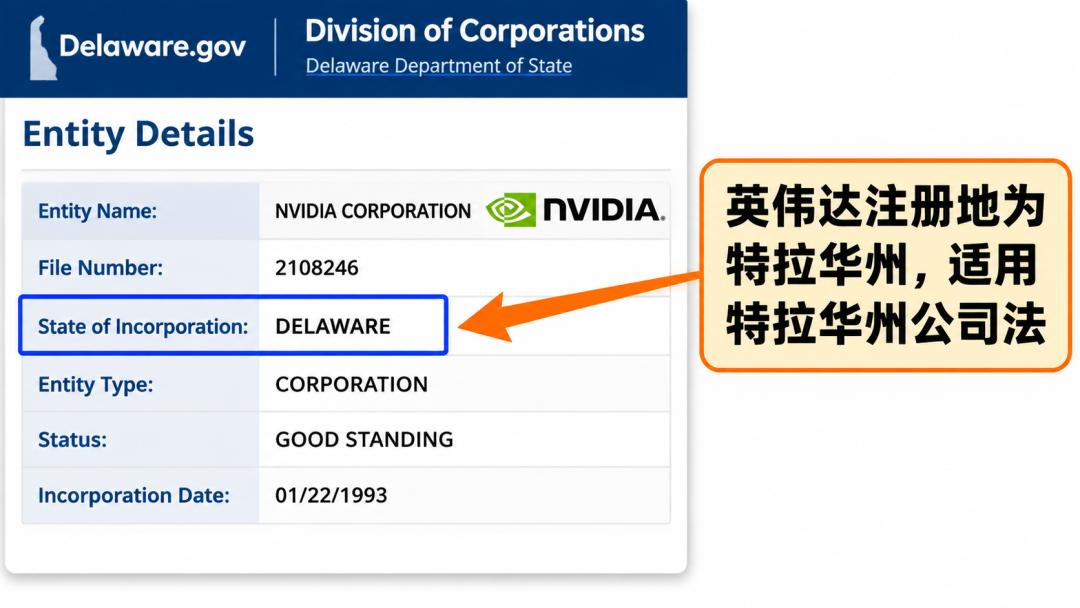
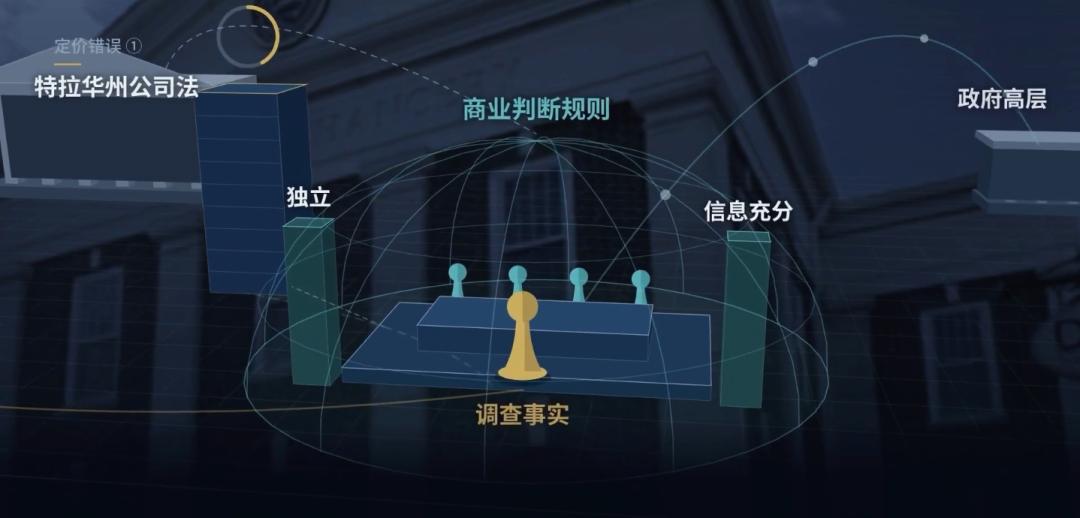
To put it simply, the court by default respects the board of directors' own business decisions and does not easily pursue accountability. But there is a premise: this decision must be made independently by the board of directors, and the information must be sufficient.
This time, the most critical basis has been changed from the facts found out through the investigation to the opinions of government officials. For example: before the exam results are released, the principal receives a phone call and announces that this student can graduate. No matter who asks later, the school can hardly explain clearly: is this your own judgment, or were you told to make that judgment by your superiors?
What does this mean? For every decision the board of directors makes about Jensen Huang in the future, Congress and litigators will keep asking this question. For people holding NVIDIA stocks, this is an unexploded mine.
Pricing error 2: Mispricing "decision-making circle fragmentation" as "the company has returned to stability".
NVIDIA is well-known for its management feature: Jensen Huang directly manages more than 60 executives, with few hierarchical levels and quick decision-making.
But according to reports from U.S. media, the interim CEO and the executive team did not know about this reinstatement in advance, and were not informed of the result until the last moment.
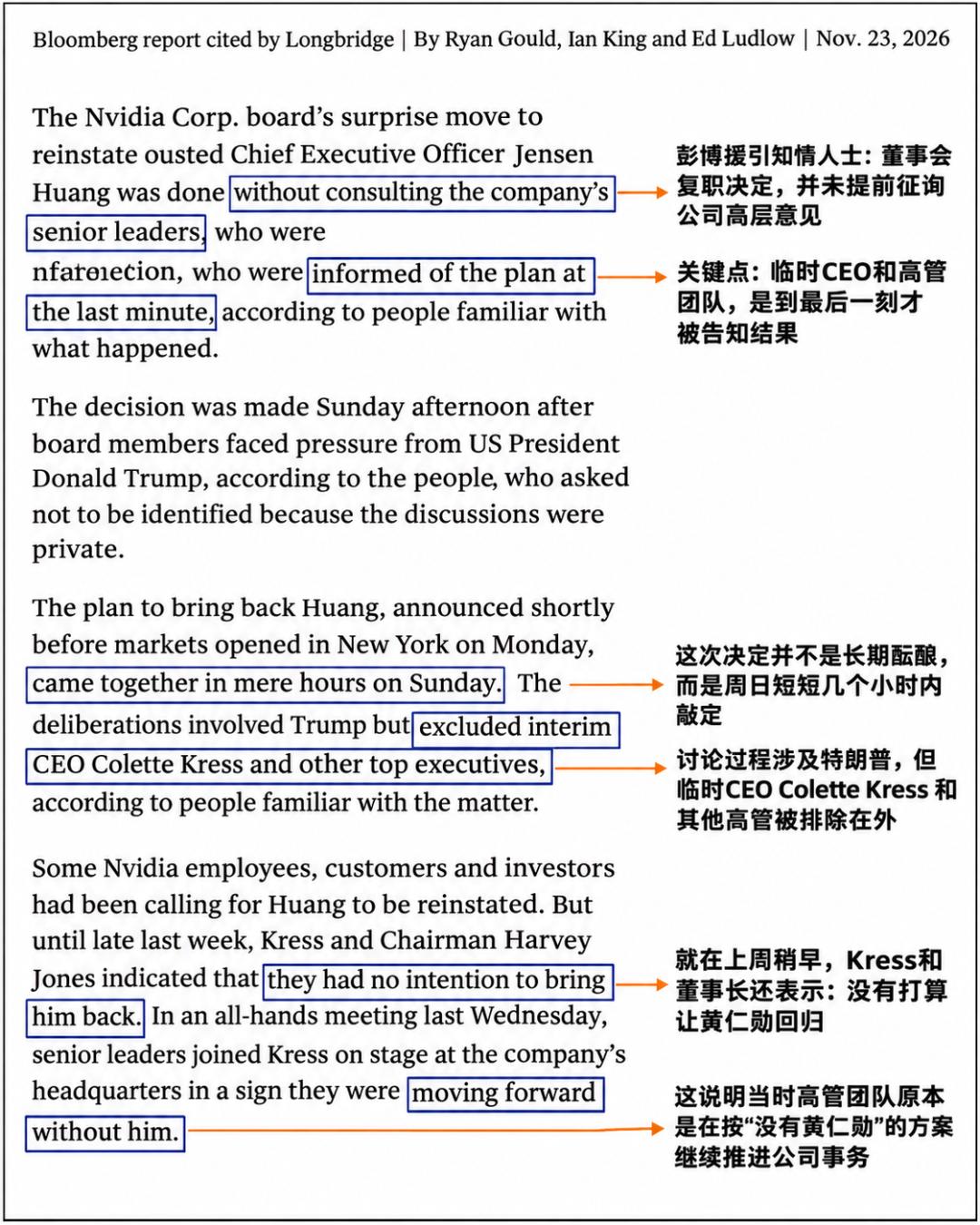
For example: a restaurant brings back its old head chef. The boss negotiated this with outsiders, and the store manager and chefs only found out at the last moment.
What does this mean? This reinstatement was negotiated between the board of directors and the White House. The group of people who manage the company's operation on a daily basis are not in the decision-making circle. That is to say, NVIDIA now has two centers: one makes decisions, and the other does the work. The goals of the two sides are not completely aligned.
What does this mean? As soon as Jensen Huang comes back, he has to take on three major tasks immediately: consecutive hearing schedules in December, pressure on revenue in regulated markets, and the capacity ramp-up of the new-generation chip Vera Rubin. All of these tasks rely on the team's desperate execution. If the team has grudges, the impact may eventually be reflected in the company's performance.
Pricing error 3: Mispricing "the start of procedural consumption" as "political risk landing".
There is a transaction with a very sensitive time point. Before the reinstatement announcement, someone spent 3.4 million US dollars buying NVIDIA call options, with a strike price of 160 US dollars, and the expiration date is exactly November 23, the day the announcement was released.
Call options can be regarded as a coupon. On the expiration day, you have the right to buy the stock at 160 US dollars. If the stock price is lower than 160 US dollars, this coupon will become invalid. On the trading day before the announcement, NVIDIA closed at just over 125 US dollars.
According to common sense, these coupons are basically waste paper. But at the close of trading on the 23rd, the stock price rose to 165 US dollars. It is estimated that the value of this position exceeds 312 million US dollars, with a book yield of nearly 9000%, earning almost 90 times the profit.
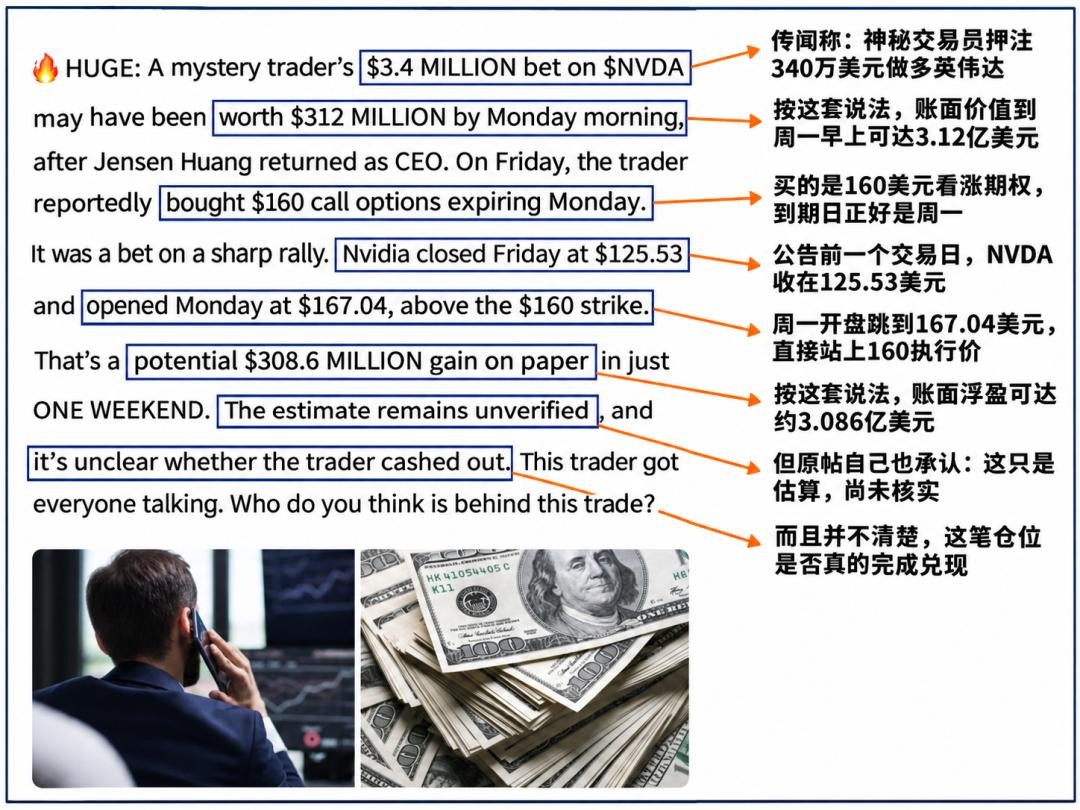
I have to make it clear: this transaction does not prove insider trading, nor does it prove that Jensen Huang or NVIDIA executives violated regulations. It is only a fact with a coincidental time point and extremely exaggerated profit.
But its weight lies in the political aspect. On the day of the announcement, Senator Gallego publicly requested an investigation into the stock position transactions before the announcement was released. On the same day, Senator Reed expanded the issue to ethics, misconduct, corruption and national security. He also asked a question: Does Jensen Huang have too much power, so much that no one can fire him?
What does this mean?
Congress no longer needs to prove that Jensen Huang violated export control regulations if it wants to continue investigating him. This option transaction alone is enough to open a new topic.
Subpoenas, closed-door inquiries, public hearings, one after another. Each round brings a piece of negative news. To put it bluntly, Congress has not obtained evidence for conviction, but it has obtained a reason to keep investigating. For your position, each such news may cause the stock price to fluctuate.
Putting these three pricing errors together, the conclusion is clear.
Before November 12, NVIDIA's risk was a personal matter of Jensen Huang. This kind of risk can still be managed through lawyers, public relations and board procedures. After November 23, the risk has become: the White House can directly decide the retention or departure of the CEO of a $4 trillion company. This kind of risk has no rules to follow, and no one can calculate it accurately.
Therefore, my judgment is: this 31% surge regards crisis deferral as crisis resolution. Unquantifiable risks will eventually turn into discounts. To put it bluntly, for the same one dollar of profit, the market will be willing to pay a lower price for NVIDIA than before. This is the political discount.
So here comes the question: Congress is clearly exerting pressure, why does the White House insist on bringing Jensen Huang back? You don't need to remember what the two parties said respectively, you only need to know three facts:
First, the reinstatement announcement acknowledges that senior government opinions were listened to, and the decision basis is no longer the conclusion of an independent investigation;
Second, the $3.4 million option transaction before the announcement gave Congress a handle to continuously launch investigations without first proving that Jensen Huang is guilty;
Third, there will be consecutive hearings in December, and the control of Congress will change in 2027. That means, political risk is not a one-time event, but a continuous timeline.
The White House protects him because the White House needs him as the industrial fulcrum of "open weight". But the amulet is also a yoke.
If you find this article helpful, like and collect it first, it can help you at critical moments. U.S. hotline: 626 378 3637
Why does the White House insist on protecting him?
Let's start with the conclusion: what the White House protects is not Jensen Huang as an individual, but the industrial fulcrum of "open weight". But this is also the other side of the problem: the amulet is open weight, and the yoke is also open weight.
Many people simply attribute the White House's motivation to "market rescue". This is not complete. Reports from Reuters and The Washington Post have given a more specific policy logic: Trump and Vance believe that Jensen Huang is the most important industrial fulcrum of the "open weight model" camp.
The so-called open weight, in short, means that the model weights are publicly available for download, and anyone can deploy and fine-tune them on their own. What the White House is worried about is not NVIDIA's stock price, but that the AI industry will be locked up by three or four closed-source model companies.
Once the industry is locked, the White House will lose the fulcrum of industrial policy. Therefore, it needs someone who has the ability to build open ecological infrastructure and is willing to keep this infrastructure open. And this person can only be Jensen Huang for now.
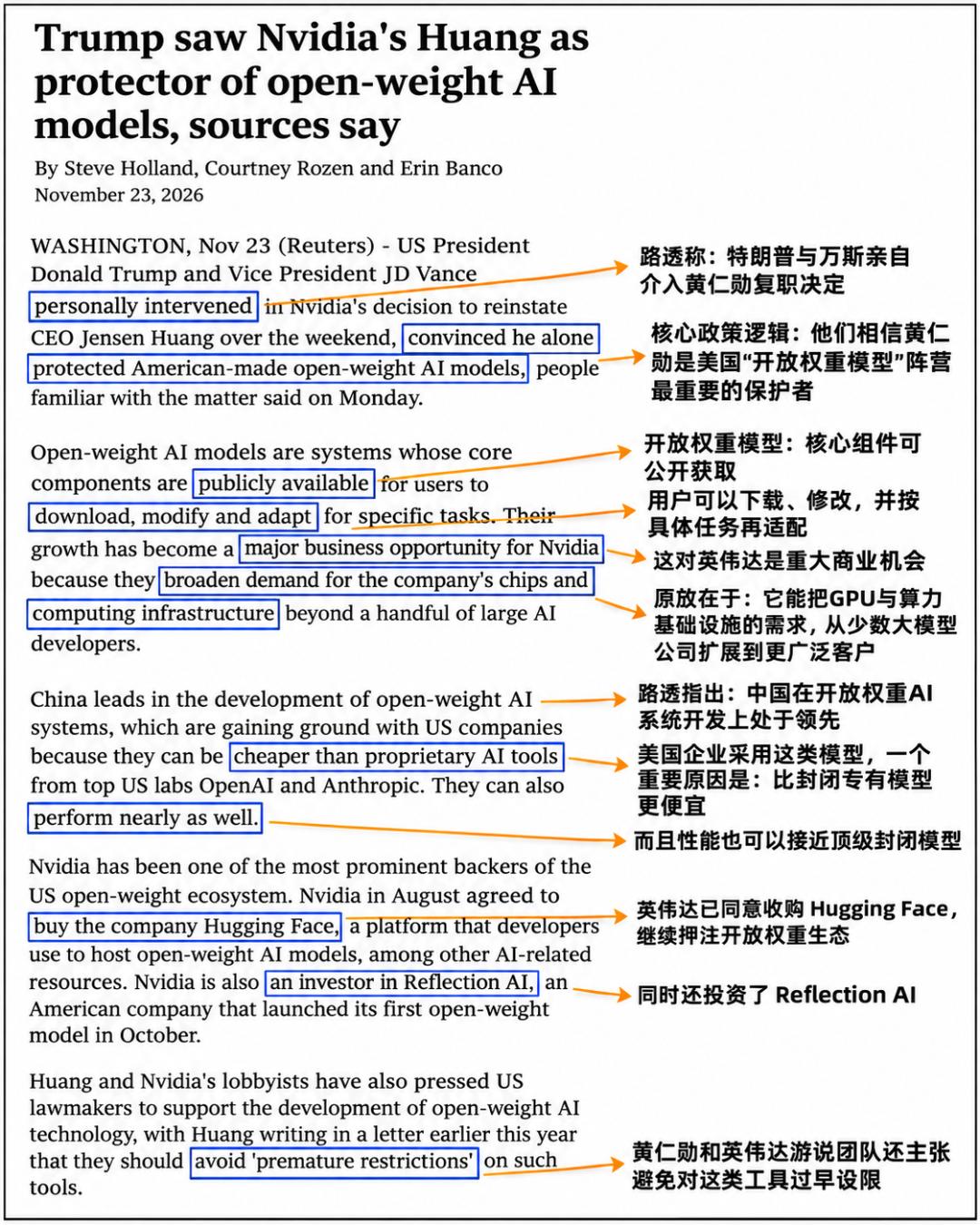
This logic is not empty talk, it is supported by industrial facts.
In August 2026, NVIDIA agreed to acquire Hugging Face, the world's largest open weight model hosting and distribution platform; in the same year, it was also an investor in Reflection AI, which released the first U.S. local open weight model in October.
Connecting these two events, NVIDIA's role has changed: it is no longer just a "shovel seller", but the distribution infrastructure of the open ecosystem. Whoever controls distribution defines the boundary of "openness".
So the White House's logic is very clear: it needs someone who can build this infrastructure and is willing to keep it open. The White House Communications Director's public statement is: "President Trump was involved throughout the process, this is a great decision made by the NVIDIA board of directors. We must protect our genius."
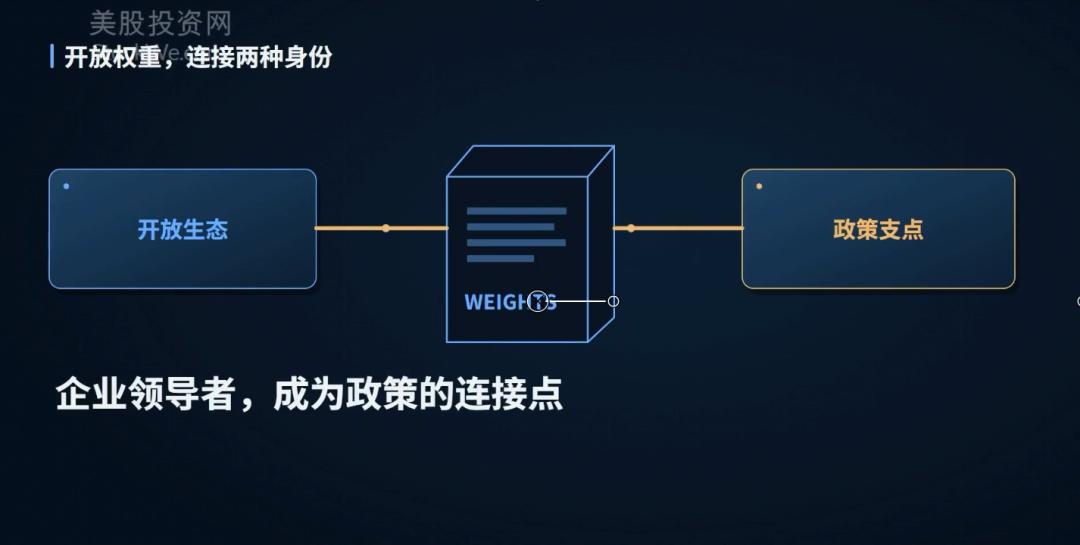
But note that this sentence also exposes the risk. When the White House defines you as "the genius we must protect", you are no longer just an entrepreneur, but a policy tool. The retention or departure of a policy tool is determined by the policy cycle, not by performance. The valuation of a CEO defined by policy should also be determined by the policy discount rate.
This is the meaning of "the amulet is also a yoke": open weight makes the White House need him, but it also turns him from an "enterprise leader" to a "policy fulcrum". When the policy needs you, you are an amulet; when the policy cycle changes, you become a replaceable pawn.
Let's look at the three governance puzzles supplemented in NVIDIA's reinstatement announcement: the independent director investigation committee will continue to advance; the new "National Security and Export Control Committee" will be established; the chief compliance officer will be publicly recruited and report directly to the Board Nominating and Corporate Governance Committee.
These actions are necessary, but they only repair the "compliance capability", not the "decision-making independence". The position reversal within five trading days has left three more difficult gaps to repair.
The first gap is the traceability of decision-making basis.
The announcement acknowledges that senior government opinions were listened to, but does not disclose which officials provided what information and in what form — verbal or written.
Warren has formally requested the White House to clarify on this matter. This means that the resolution on November 22 is an "incomplete record" at the document level. Once Congress obtains subpoena power, this incomplete record will become the first target to be attacked.
The second gap is the vacuum of the successor mechanism.
On November 17, the board of directors hired Heidrick & Struggles to launch a formal CEO selection process, and on November 22, it unanimously reinstated the original CEO, and the selection process was actually suspended. A $4 trillion company has gone through a complete cycle of "launching selection — suspending selection — reinstating the original CEO"