White Paper on the Development of China's Legal Technology Industry 2026
Abstract
China's LegalTech industry is currently in the transition stage from tool-based efficiency improvement to trusted process-based operation. It is estimated that the market size will reach 24.14 billion yuan by 2030, among which the enterprise end accounts for more than 60% with 15.65 billion yuan, and batch dispute handling has become the main source of growth. At the same time, compliance requirements are tightening synchronously: data security, personal information protection, as well as the applicable boundary and responsibility identification of AI-assisted justice are continuously being tightened. Although the contribution rate of AI in LegalTech has reached 20.8%, independent pricing and responsibility attribution are still difficult to implement.
After the implementation of the Commercial Mediation Regulations, the mediation track has ushered in compliance reshaping: two-level approval is implemented for practice licenses, thresholds are set for mediators at different levels, fees are independently priced and disclosed to the public, and mediation agreements are enforceable after judicial confirmation, and existing organizations must complete supplementary procedures within a time limit. The division of labor of "licensed organizations collecting mediation fees and technology companies collecting technical service fees" has thus changed from industry convention to a regulated formal arrangement. Unqualified entities are accelerating their exit from the market, licensed resources are becoming scarce, and the positioning of technology companies has also shifted from replacing mediation to supporting mediation. However, the imbalance of "high technical value but slow commercial realization" still exists: data silos and model hallucinations will be amplified along the process, and inconsistent regional standards push up costs.
Therefore, joint efforts from all parties are still needed to build a compliance ecology based on licensing and supported by technology through manual authorization at key nodes, strengthening process traceability and responsibility boundaries, and promoting independent AI pricing, so as to ensure the healthy and sustainable development of the industry.
Overview of LegalTech
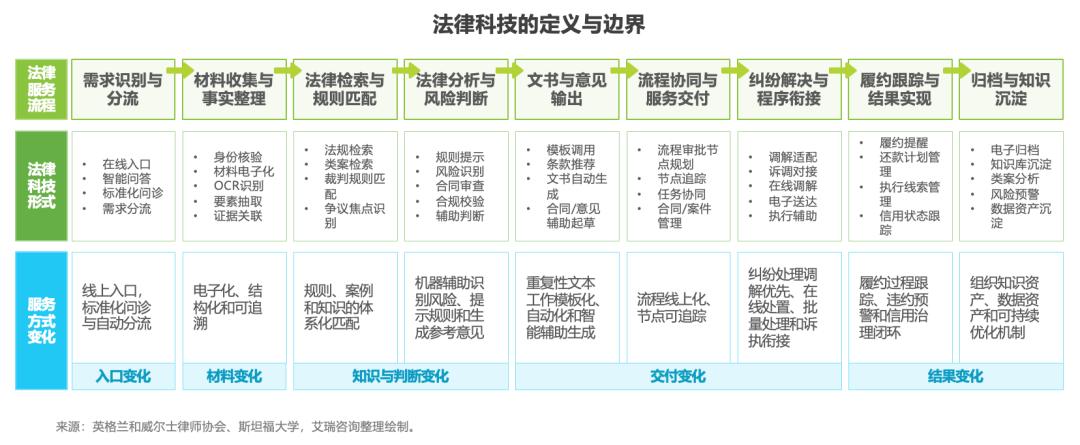
Definition and Boundary of LegalTech
The essence of LegalTech is to embed capabilities such as digital technology, data processing, automation and AI into the processes of legal services, judicial operation and compliance governance
LegalTech refers to products, systems and service modes that embed digital technology, data processing, automation, AI and process collaboration capabilities into legal services, judicial operation and compliance governance processes, transform the standardized, processable, data-based and auditable links therein, so as to improve efficiency, reduce costs, expand service accessibility, and strengthen compliance traceability and governance capabilities. In the whole process of legal services, technology undertakes the functions of entry diversion, material sorting, rule matching, process collaboration and traceability audit.
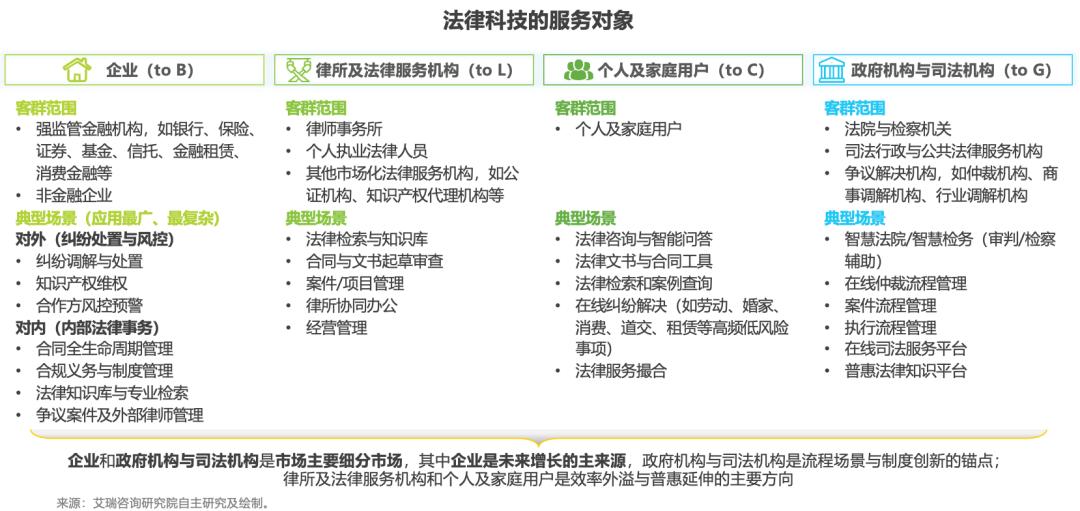
Classification of Four Service Objects and Scenarios (BLCG)
The service objects of LegalTech are mainly divided into four categories: enterprises, law firms and legal service institutions, individual and family users, government agencies and judicial institutions
This study takes service objects as the main classification, mainly because the same product capability may serve multiple ends at the same time, but the purchasing entity, usage process, payment method and responsibility boundary are different. Therefore, there are great differences in the number of scenarios, payment capacity and institutional constraints of the four types of service objects. Among them, enterprises (to B) have the widest application and the most complex scenarios among the four types of service objects, and are also the main growth source of LegalTech in the future.
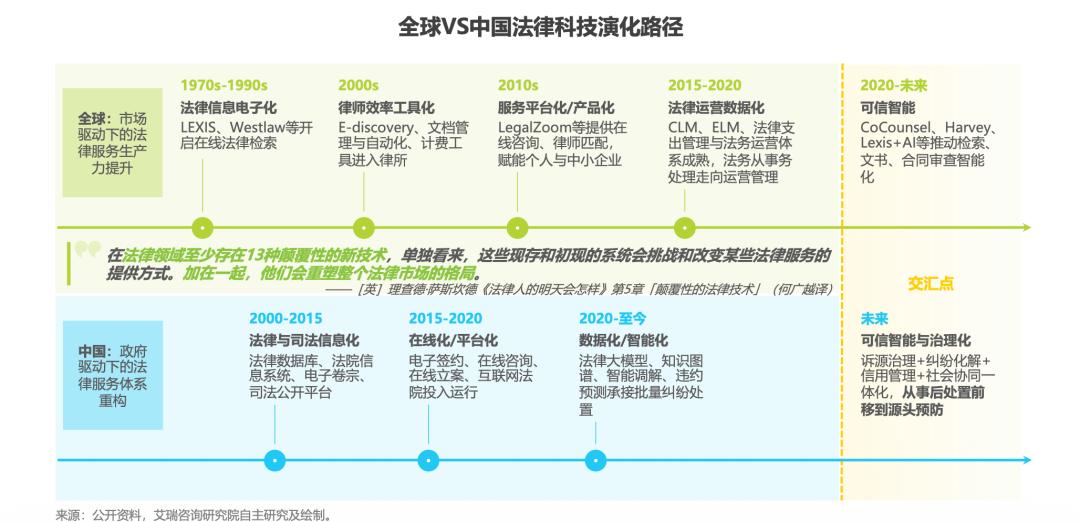
Evolution Path of Global and Chinese LegalTech
The starting points and driving forces of the global and Chinese markets are different, and they are accelerating convergence in the era of large models; the characteristic direction of China is extending to source governance
The development of LegalTech is supported by technological development as the capability base, and the implementation path is jointly determined by market demand, judicial system construction and regulatory environment. The global main line is the improvement of legal service productivity driven by the market, while the Chinese main line is the transformation of the legal ecology under government guidance, focusing on realizing the upgrading of social governance through LegalTech technology. The two paths have different starting points and driving forces, and enter the same stage of trusted intelligence.
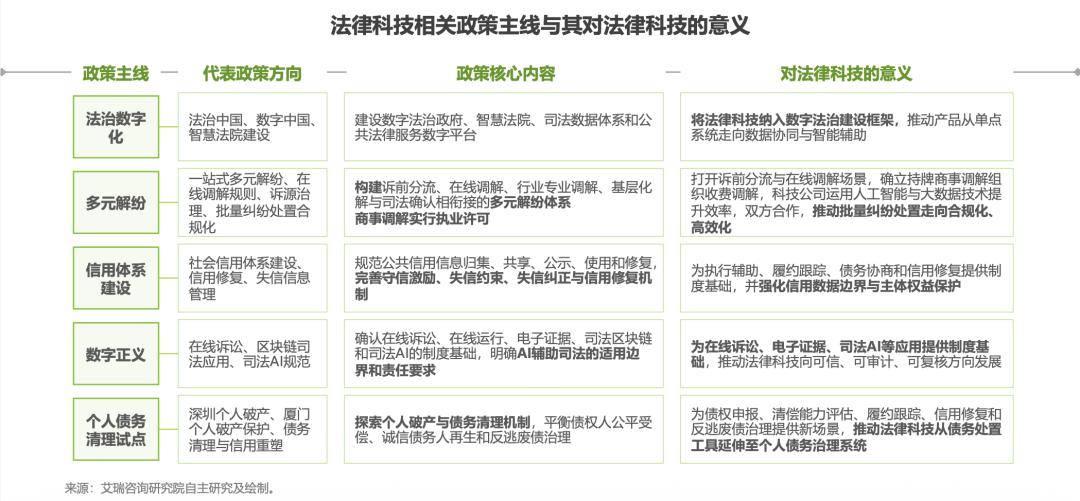
Development Environment: Policies
Policy guidance is shifting from information construction to systematic governance capacity building
Focusing on five practical issues: rule of law digitalization, dispute governance, credit governance, digital justice and debt clearance, policies define the scenario entry, institutional basis, data usage boundary and responsibility requirements of LegalTech. Compliance requirements are tightening synchronously, focusing on four aspects: judicial responsibility, personal information protection, credit data usage and the applicable boundary of AI-assisted justice.
Development Environment: Economy and Society
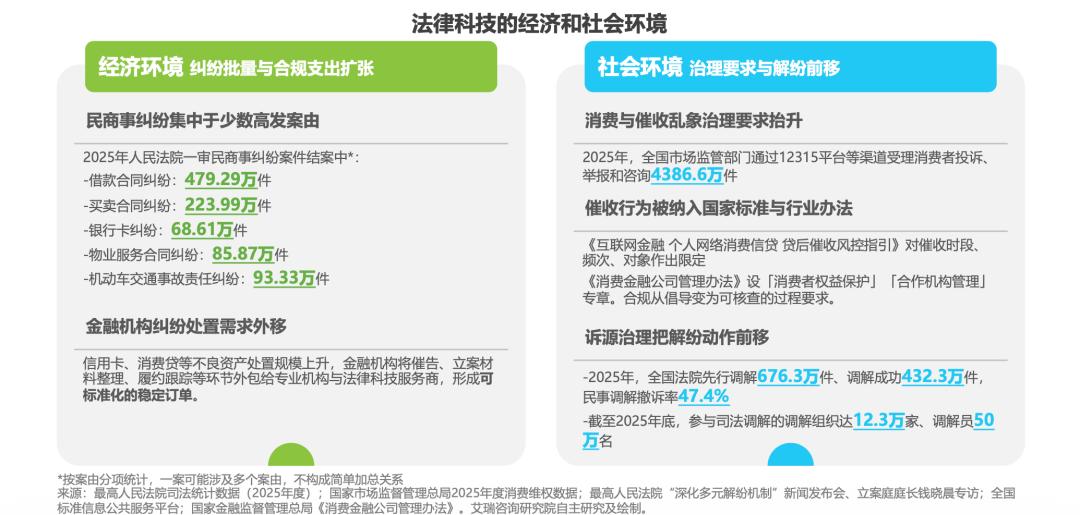
Judicial supply is relatively rigid, while disputes and governance tasks continue to expand — economic demand comes from batch disputes, and social demand comes from governance requirements
The source of demand is two groups of pressures of different natures. The economic environment generates volume: civil and commercial disputes are growing in large scale with high frequency, repetition and similar elements, and courts and legal service institutions cannot absorb them according to the current supply rhythm. The social environment sets standards: the compliance bottom line in links such as collection, outbound calling and evidence retention is rising, and meanwhile, litigation source governance requires dispute resolution actions to be moved forward from the court hearing to before case filing. Therefore, the entry point of LegalTech falls at the intersection of the two areas: regularized diversion of batch cases, and process traceability of compliance and dispute resolution links.
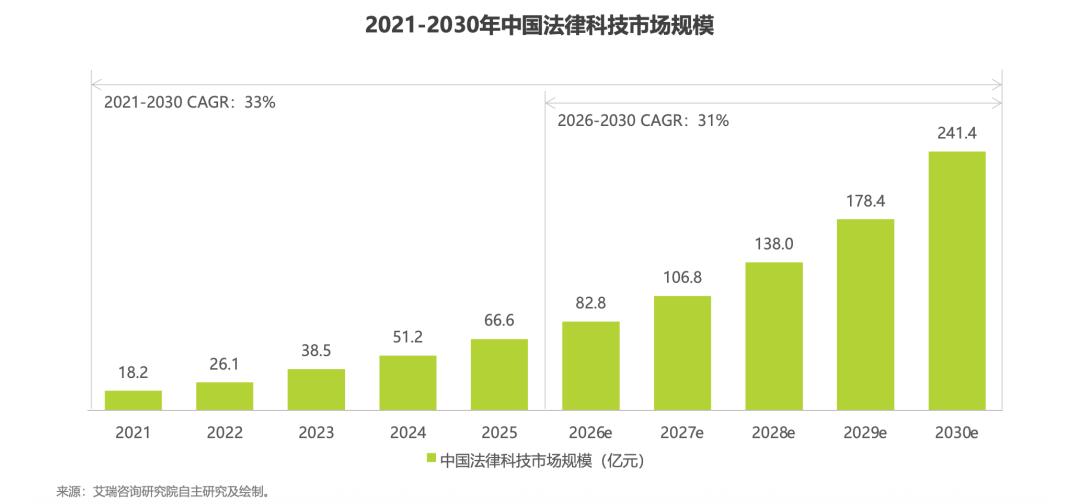
Overall LegalTech Market Size
It is estimated that the size of China's LegalTech market will be about 24.14 billion yuan by 2030, with an average annual growth rate of about 33% from 2021 to 2030
China's LegalTech market covers application scenarios such as enterprises, law firms, individuals and families, and judicature. Driven by policies, enterprise digitalization and deepening AI applications, it is estimated that the size of China's LegalTech market will reach about 24.14 billion yuan by 2030, with an average annual growth rate of about 33% from 2021 to 2030.
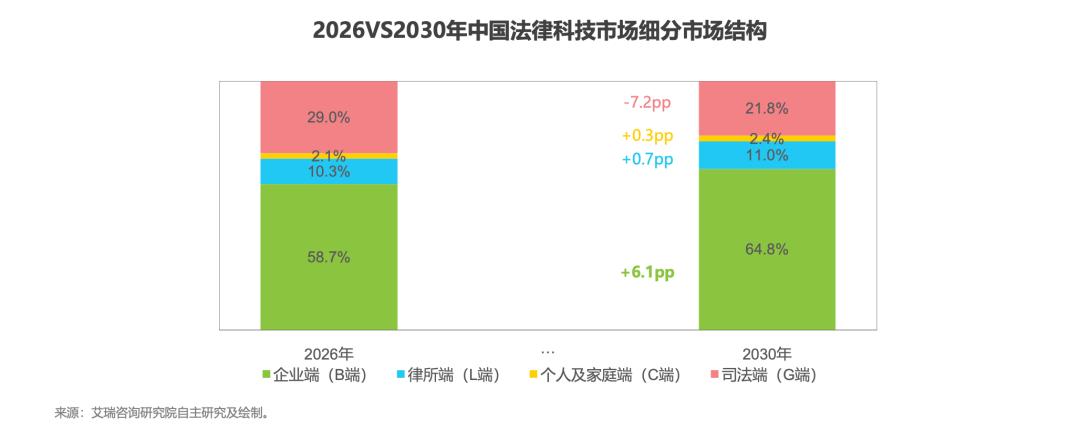
LegalTech Segmented Market Structure
The proportion of the enterprise end increases by 6.1 percentage points, and the judicial end decreases by 7.2 percentage points, and the market structure is concentrated on the enterprise side
From 2026 to 2030, the shares of the four segmented markets are expected to rise and fall: the proportion of the enterprise end (B-end) LegalTech market size is expected to rise from 58.7% to 64.8%, and the judicial end (G-end) is expected to fall from 29.0% to 21.8%. The demand for enterprise compliance and dispute handling has entered the period of large-scale procurement, while the growth rate of judicature is lower than the overall industry due to the influence of integrated procurement and budget rhythm.
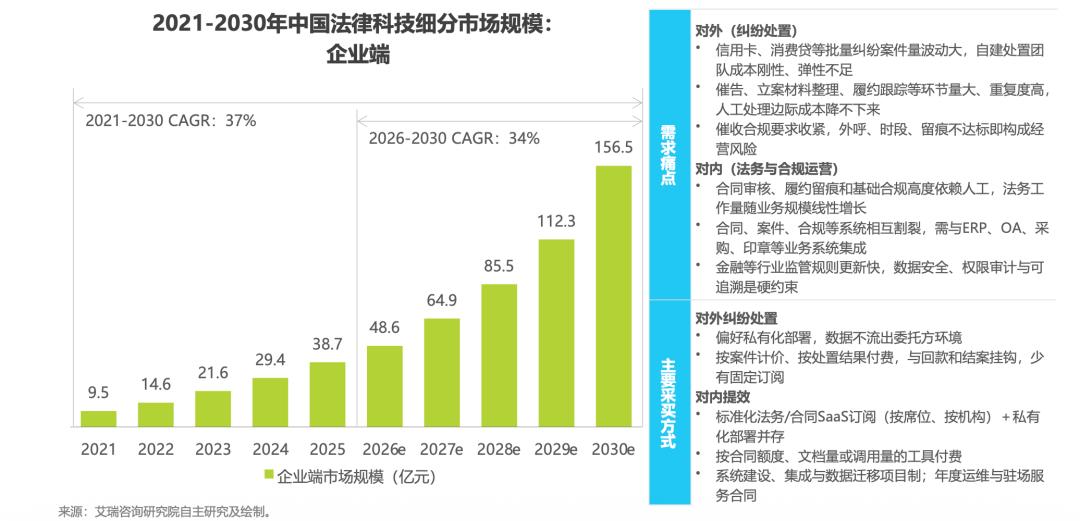
Segmented Market: Enterprise End (B-end)
Driven by external dispute handling and internal efficiency improvement, the China market size will reach about 15.65 billion yuan by 2030, accounting for more than 60% of the industry
The enterprise end market is divided into two lines: external dispute handling undertakes batch cases from financial institutions, and payment is linked to the handling results; internal efficiency improvement focuses on the daily operation of contracts and compliance, and payment is mainly based on subscription and project system. The two lines have different pain points and procurement methods, and together constitute the main body of the B-end market. The market is expected to reach about 15.65 billion yuan by 2030, with an average annual growth rate of about 37% from 2021 to 2030.
Segmented Market: Enterprise End — External Dispute Handling Part
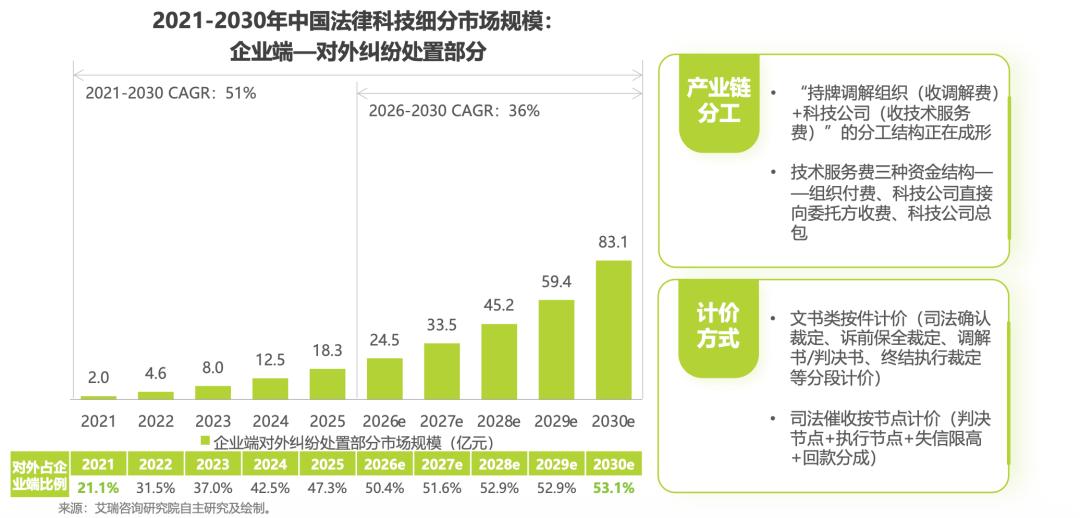
The proportion of external dispute handling in the enterprise end rises from 21.1% in 2021 to 53.1% in 2030, which is the fastest growing part of the enterprise end
External dispute handling undertakes batch cases such as credit cards and consumer loans from financial institutions, with a large number of cases and similar elements. It only accounted for 21.1% of the enterprise end in 2021, then rose rapidly, exceeded 50% in 2026, and is expected to reach 53.1% by 2030, with an average annual growth rate of about 51% from 2021 to 2030, higher than the overall 37% of the enterprise end. In terms of revenue structure, licensed mediation organizations collect mediation fees, and technology companies collect technical service fees, among which there are three capital structures for technical service fees: organization payment, direct charging to the entrusting party, and general contracting.
Segmented Market: Law Firm End (L-end)
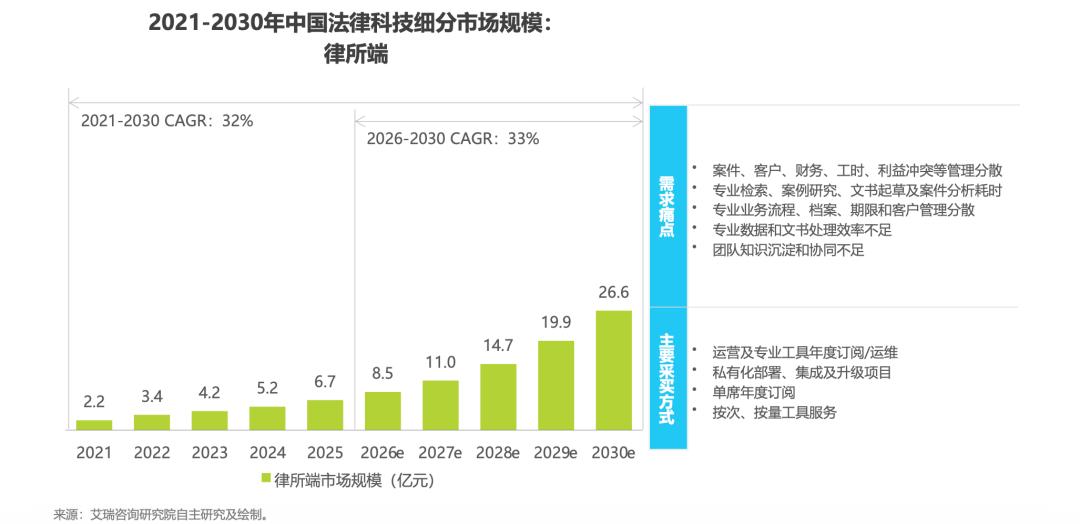
Payment habits restrict revenue scale, and the China market size will reach about 2.66 billion yuan by 2030
The pain points of the L-end lie in the scattered management of cases, customers, finance, working hours and conflicts of interest, and the time-consuming professional retrieval, document drafting and case analysis. Procurement is mainly based on single-seat or institutional annual subscription, supplemented by private deployment and pay-per-use and pay-per-volume. The decision-making is decentralized and sensitive to cost performance. It is estimated that the L-end market will reach about 2.66 billion yuan by 2030, with an average annual growth rate of about 32% from 2021 to 2030.
Segmented Market: Individual and Family End (C-end)
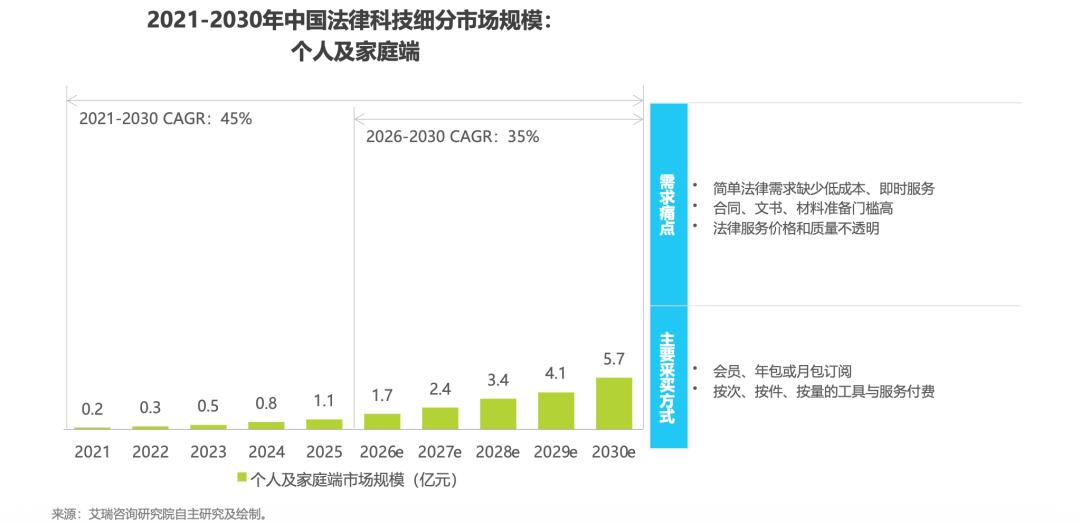
The fastest growing but with the smallest base, the China market size will reach about 570 million yuan by 2030
The pain points of the individual and family end are the lack of low-cost and instant services for simple legal affairs, high thresholds for contract and document preparation, and opaque service prices and quality. Procurement is mainly based on membership, annual package or monthly subscription, supplemented by pay-per-use and pay-per-item. It is estimated that the C-end market will reach about 570 million yuan by 2030, with an average annual growth rate of about 45% from 2021 to 2030, the highest growth rate among the four markets, but with the smallest base. It is difficult to become the main revenue source in the short term, and it mainly undertakes the functions of initial problem screening, self-service document processing and lawyer referral.
Segmented Market: Judicial End (G-end)
Affected by the pace of integrated procurement, the China market size will reach about 5.26 billion yuan by 2030
The demand of the G-end focuses on trial execution assistance, legal aid and case management, and the pain points are concentrated in the compatibility of existing systems, cross-level collaboration and high security and compliance requirements. Procurement is mainly based