At what stage is the "destocking cycle" of the Baijiu industry?
In April 2026, Wuliangye released an "Announcement on Prior Accounting Error Correction", bringing the widely known inventory problem of liquor enterprises to the public. Since the beginning of this year, the Baijiu industry has in fact entered a rather extreme destocking cycle.
Views on the consumption side vary from person to person, and it is hard to reach a consensus on whether young people drink Baijiu or whether business scenarios will fully recover. Judging from the fundamental of investment, the judgment is rather straightforward — only when the fundamental repair driven by destocking is completed, can the Baijiu sector form a relatively clear bottom, and long-term investment can have a coordinate for value evaluation.
Such a coordinate has to be found in the financial statements.
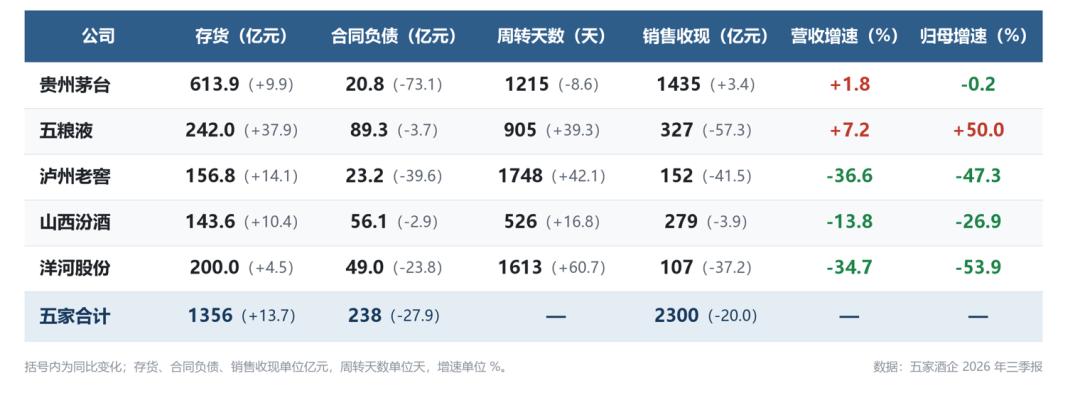
(Key indicators of the 2026 Q3 financial reports of five leading Baijiu enterprises in one chart, unit: 100 million yuan. All data are sourced from Wind and corporate financial reports, collated by Financial Statement Records)
To cut to the chase: We believe that the essence of this round of active destocking in the Baijiu industry is the de-financialization of channels, and the "off-balance-sheet assets and liabilities" of distributors are undergoing balance sheet shrinkage. That is: stable batch price → contract liabilities stop falling → financial statement clearing stage. At present, on the surface, only Moutai has completed the whole process of batch price stabilization, only Yanghe has seen its contract liabilities stop falling, the five leading enterprises show differentiation on the financial statement side with obvious partial effect, and the fundamental inflection point has not arrived yet.
The specific analysis is as follows.
01 Only Moutai has passed the step of batch price stabilization
In the previous boom cycle, the Baijiu industry was endowed with strong financial attributes. Distributors and scalpers paid for goods to liquor factories to hoard goods (forming high contract liabilities in the financial statements of liquor enterprises), and added leverage outside the system to stock up. As long as the batch price kept rising, this "passing the parcel" game could be maintained.
When the industry enters the deep cycle bottoming stage, this logic has reversed.
In the first three quarters of 2026, the decline in revenue and contract liabilities of most liquor enterprises indicates that the channels are "actively shrinking their balance sheets". What prevents this balance sheet shrinkage from evolving into a systemic collapse is the all-out batch price defense battle launched by all enterprises in the third quarter. In the current process of batch price stabilization, only Moutai has gone through the whole process after repeated verification.
The fundamental reason for Moutai's stable batch price is the pricing power brought by its super high-end mindshare occupation.
The batch price of Feitian Moutai is the psychological bottom line of the Baijiu sector. Since the third quarter, Moutai's moves have only one goal, which is to anchor this "ultimate peg" above 1700 yuan.
In July 2026, Kweichow Moutai adjusted its retail price and sales contract price (the retail price was raised from 1539 yuan to 1639 yuan, and the contract price was raised from 1269 yuan to 1369 yuan). By the end of October after the holiday, the batch price reached about 1700 yuan, which did not drop but rose year on year, and the post-holiday plunge pattern in previous years did not repeat.
The reason lies in the tightening of the supply side. Moutai's channel inventory has been reduced to less than half a month, the inventory-to-sales ratio is less than 1.0, and the goods that could be used for price undercutting have been physically removed. After the price increase in July, the batch price stabilized above 1700 yuan. The ex-factory price adjustment was not eroded by the channel spread, but instead raised the batch price center. With little remaining Q4 quota and active supply tightening, Moutai still has follow-up measures in hand.
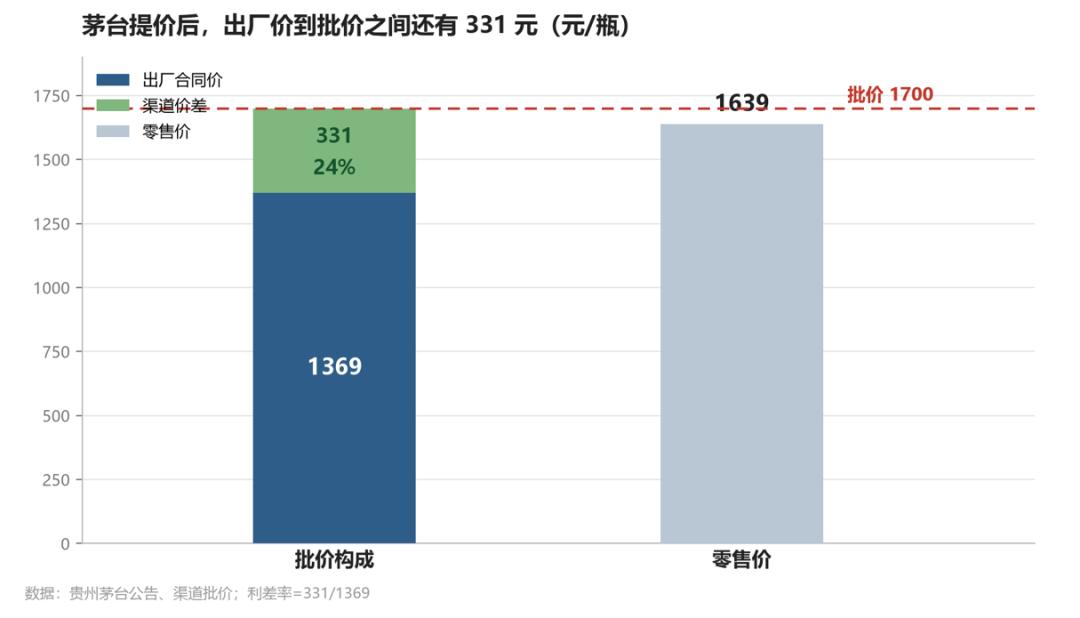
Figure 1: The price difference between ex-factory price and batch price after Moutai's price increase, there is still 331 yuan left for the channel (yuan/bottle). Data source: Kweichow Moutai announcement, channel batch price
The price inversion of the remaining four liquor enterprises has improved slightly year on year, but has not yet ushered in a reversal.
The batch price of Wuliangye's Pu Wu dropped from 780-790 yuan at the beginning of the year to around 750 yuan. Calculated at the batch price of 750 yuan, it is inverted by 269 yuan compared with the ex-factory price of 1019 yuan, with an inversion rate of 26.4%. During the Double 11 event, the price of a whole case was 3800 yuan, equivalent to 633 yuan per bottle, and the red line was broken through by e-commerce subsidies. Contract liabilities decreased by another 1.514 billion yuan month on month to 8.927 billion yuan, and the channel is still in the process of balance sheet shrinkage.
The payment price of Guojiao 1573 was reduced from 910 yuan at the beginning of the year to 850 yuan. In September, the 70 yuan per bottle subsidy originally scheduled to be paid at the end of the year was issued in advance, making the actual goods acquisition cost 840 yuan. The price of a whole case at Zhengzhou Bairong Market is equivalent to 826.67 yuan per bottle, and the price on Pinduoduo's 10 billion subsidy event is 735 yuan, which is more than 100 yuan lower than the payment price. The inversion has narrowed from a loss of 70-80 yuan per bottle to 10-20 yuan.
Thanks to its dominance in Shanxi province and northern markets, Fenjiu's Blue and White series maintains a stable batch price. On November 19, the average retail price of Blue and White 20 was 380 yuan, but the cost of this strategy is geographical limitation. The batch price of Yanghe M6+ has recovered from inversion to 540-550 yuan, with an average retail price of 597 yuan on November 19, which is still in a weak rebound trend.
All the five leading enterprises have submitted the answer sheets of "actively decelerating and cutting contract liabilities" in their Q3 financial reports, indicating that the de-financialization of channels and balance sheet shrinkage have entered the deep water zone.
02 Only Yanghe has completed the process of stopping the decline of contract liabilities
"The traditional industry model of 'collecting advance payments to force distributors to stock up' can no longer adapt to the profound changes on the consumption side. With the in-depth advancement of the company's market-oriented operation, the scale of advance receipts is no longer the main indicator to measure the market supply and demand situation."
At the Q3 performance meeting, this sentence from Wang Li, the management of Moutai, itself is an admission that the advance receipt indicator has lost its explanatory power for Moutai.
The reason lies in the change of Moutai's channel model. Moutai's contract liabilities dropped from 8.007 billion yuan at the beginning of the year to 2.084 billion yuan at the end of the third quarter, a decrease of 74%. Self-operated channels directly reach consumers, and the "consignment" model without transfer of property rights is implemented in social channels. Neither of these two parts of sales forms advance receipts. In the same period, the direct sales proportion rose to 56.36%, the revenue of i Moutai liquor reached 58.562 billion yuan, and the net operating cash flow of 84.059 billion yuan more than doubled year on year. The capital return channel has been changed from "distributors paying in advance" to direct real-time settlement.
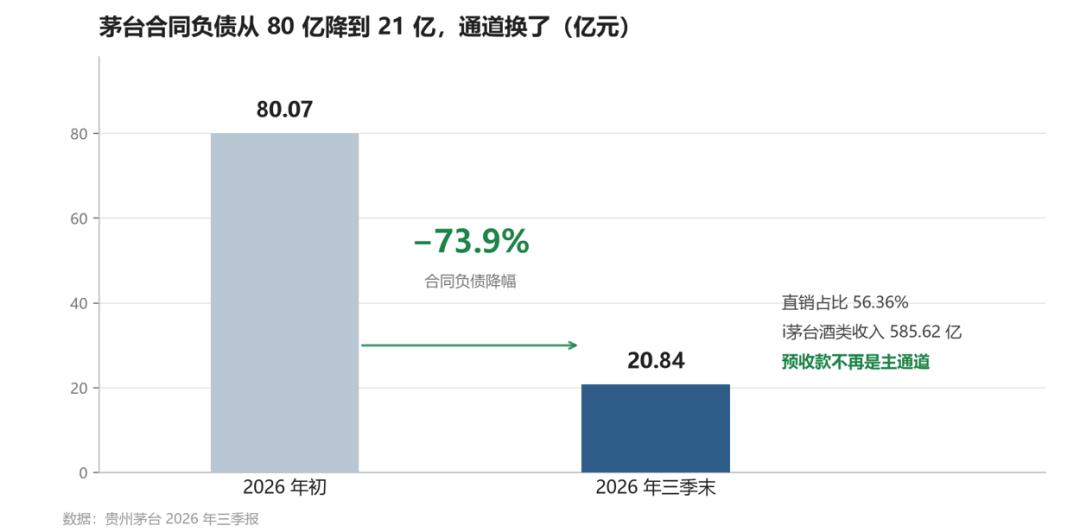
Figure 2: Moutai's contract liabilities dropped from 8.007 billion yuan at the beginning of the year to 2.084 billion yuan at the end of the third quarter, and the direct sales proportion rose to 56.36% (100 million yuan). Data source: Kweichow Moutai 2026 Q3 Financial Report
For most other liquor enterprises, contract liabilities are still the yardstick to measure channel bargaining power.
The only one that has completed the stop of decline in this round is Yanghe, with a month-on-month increase of 14%.
This result is not unexpected. Yanghe was the first one to lose momentum in this round of adjustment, its revenue first declined in 2024, and its channel inventory was cleared first, so its channel inventory was the first to drop to a safe level. This stop of decline and turning positive cannot be taken as a signal of the industry inflection point. After all, what contract liabilities lock in is ultimately the willingness of channels to finance and store funds, which cannot directly measure the real terminal sales.
The rest of the enterprises are still squeezing out the moisture. Among them, Wuliangye's contract liabilities decreased by about 14.5%, while other current liabilities (supervision of commodity payments) reached 23.767 billion yuan in the same period, a further decrease of 582 million yuan month on month, and the two "reservoirs" shrank simultaneously.
Through the deconstruction of contract liabilities in the Q3 financial reports, it can be found that except for the partial pulse-style tentative replenishment, the large-scale and trend-wide "stop falling and rise" of contract liabilities across the whole industry has not yet arrived.
03 Financial statement clearing has not ended, with partial improvement and overall pressure
The growth rates of revenue and net profit submitted by leading liquor enterprises in their Q3 financial reports have generally declined.
Looking at individual enterprises, the year-on-year revenue growth rates are Moutai +1.8%, Wuliangye +7.25%, Luzhou Laojiao -36.58%, Fenjiu -13.80%, Yanghe -34.65%; the year-on-year net profit attributable to shareholders growth rates are -0.25%, +49.98%, -47.30%, -26.90%, -53.90%. Only Wuliangye has both indicators positive.
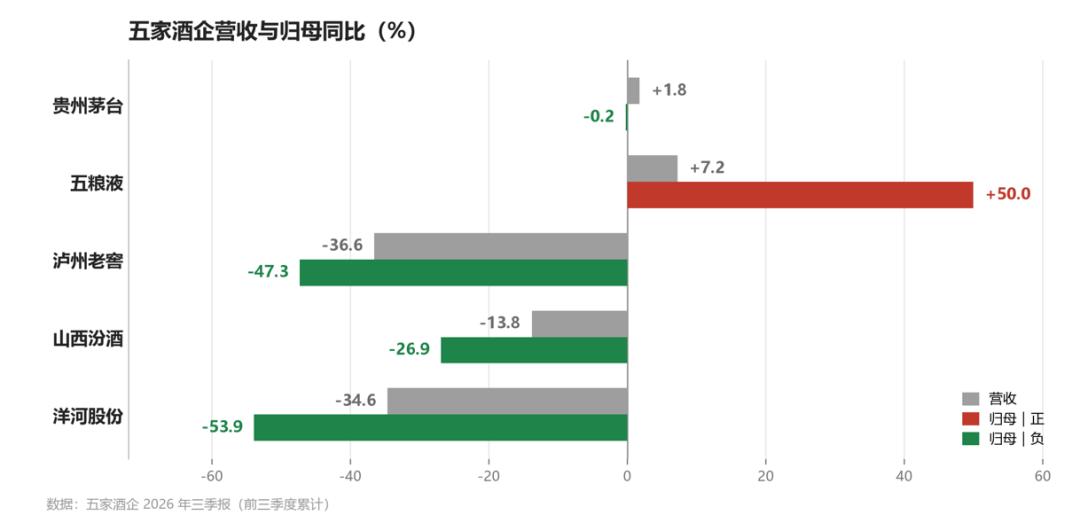
Figure 3: Year-on-year revenue and net profit attributable to shareholders of the five Baijiu enterprises. Data source: 2026 Q3 Financial Reports of the five Baijiu enterprises
In terms of gross profit margin, Wuliangye's gross profit margin increased by 4.17 percentage points, Yanghe's rose slightly by 0.31 percentage points, and the other three all declined.
Judging from the Q3 financial reports, Wuliangye is the only one that has achieved double growth in both revenue and profit. Breaking it down, this double growth has little to do with the clearing process. The taxes and surcharges in the third quarter dropped from 9.116 billion yuan in the same period of the previous year to 4.859 billion yuan, a reduction of 4.257 billion yuan, which is almost the entire source of the 3.24 billion yuan net profit increment, caused by the retrospective adjustment of the financial statements after the 2025 accounting error correction. The improvement of gross profit margin comes from the improvement of product structure, the revenue of the main brand increased by 72.84%, while the revenue of series liquor decreased by 60.17%, and the low gross profit margin part shrank.
On the cash flow statement, Moutai performed the best. The net cash flow generated from operating activities of Moutai in the first three quarters was still as high as 84.059 billion yuan, a year-on-year increase of 120.07%. Both the company's Q3 financial report and the performance briefing on November 10 made it clear that this growth mainly came from the maturity recovery of interbank deposits that cannot be withdrawn at any time in the group's finance company, and the net increase in deposits of member units. The cash flow of the liquor business itself basically matches its performance, with only a slight year-on-year increase.
In the process of actively decelerating and giving benefits to channels, the cash collection ratio of the remaining four liquor enterprises is generally below 1, which proves that the channels have not resumed advance payment.
Among them, Wuliangye has the largest cash collection deviation, the cash received from sales was 32.7 billion yuan, a year-on-year decrease of 57.3%, while the revenue is still growing positively, and the cash collection ratio dropped by more than half; Fenjiu's cash collection ratio is recovering, with cash received down 3.9% and revenue down 13.8%; Luzhou Laojiao and Yanghe declined synchronously with revenue, and their cash collection ratios decreased slightly.
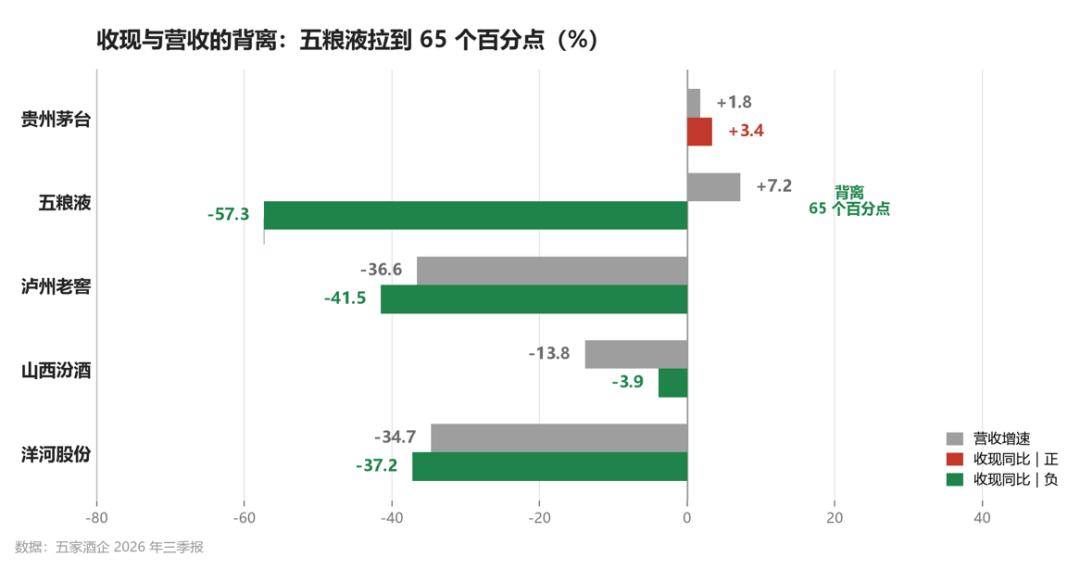
Figure 4: Year-on-year cash received from sales and revenue growth rate of the five Baijiu enterprises, Wuliangye has a 65 percentage point deviation (%). Data source: 2026 Q3 Financial Reports of the five Baijiu enterprises
Looking at the balance sheet, the total inventory of the five enterprises rose from 119.3 billion yuan to 135.6 billion yuan, up 13.7% year on year. By individual enterprise, Moutai +9.9%, Wuliangye +37.9%, Luzhou Laojiao +14.1%, Fenjiu +10.4%, Yanghe +4.5%, all five enterprises saw inventory increase.
We need to distinguish two sets of accounts first. The destocking mentioned by the market refers to the goods in the distributors' warehouses; the inventory on the financial statements refers to the goods in the manufacturers' own warehouses. These two sets of accounts have moved in opposite directions in the past two and a half years: manufacturers control the output, channels do not purchase new goods, channel inventory drops, and the goods that should have been delivered remain in the factory. The cleaner the channel inventory is cleared, the more inventory accumulated on the manufacturer's books, which indicates that the industry is currently in a mismatch stage of "channel destocking has taken effect, while financial statement destocking has intensified", the terminal consumption has not kept up, and the clearing is far from over.
