Has another AI language learning app achieved the ARR milestone of tens of millions of US dollars?
The founder of Fluently posted on LinkedIn the other day, announcing that the product has hit an ARR of 10 million USD. Although quite a number of new AI oral language learning products have emerged in recent years, very few of them have achieved this milestone — the number is only around 5, which is closely related to the high difficulty of customer acquisition.
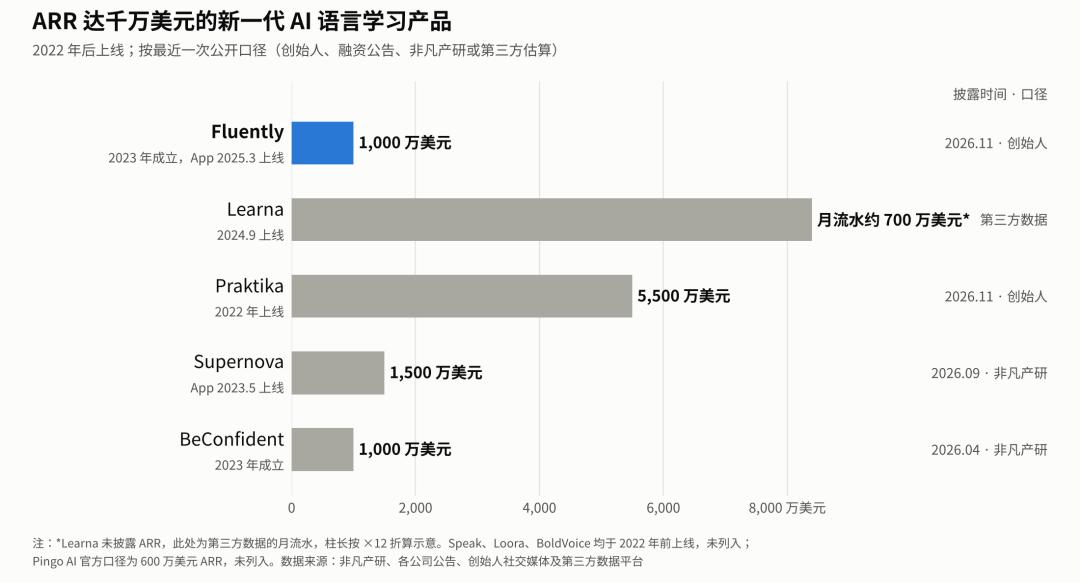
In the post, founder Yurii Rebryk revealed that Fluently mainly acquires customers through social media, having accumulated 12 million followers and 3 billion total views across all platforms in the past year. However, almost all products that acquire users through viral social media content follow the same trajectory: the content goes viral, downloads surge, but once the hype fades, downloads and revenue data drop accordingly.
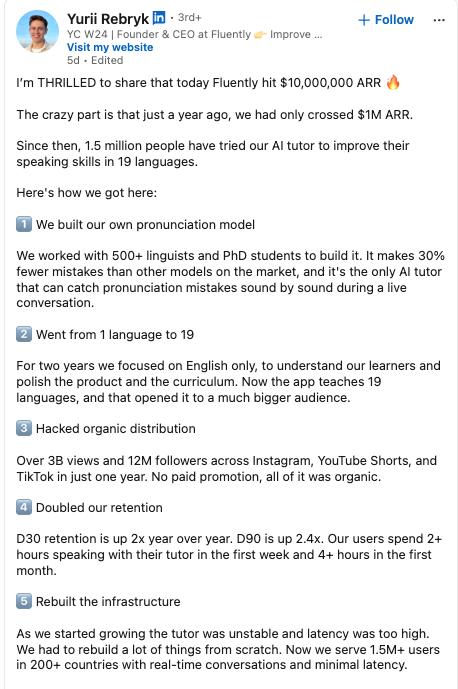
The founder's LinkedIn post | Image source: LinkedIn
Pingo is a recent example. This AI oral practice product rose to fame on TikTok with short emotional videos of "being scolded to tears by AI", but its in-app revenue peaked in May this year and then declined, dropping by more than 50% from its peak.
In contrast, Fluently seems to have taken a different path. The founder disclosed that its ARR has increased 10 times in about a year and a half. More importantly, after the business scaled up, Fluently's D30 retention doubled year-on-year, and D90 retention increased to 2.4 times the previous level.

It should be noted that in addition to app stores, Fluently also supports Stripe subscription on the web. According to data from Diandian, the average monthly revenue from app stores is only around 100,000 USD, which is far from the number disclosed by the founder. The gap is mostly likely contributed by web-side payments
Both of them opened up the market through viral social media content, but one saw decline while the other kept accelerating. How did Fluently turn fleeting hype into a sustainable growing subscription business?
I. From "Crying Over English Learning Frustration" to Pronunciation Correction Teaching
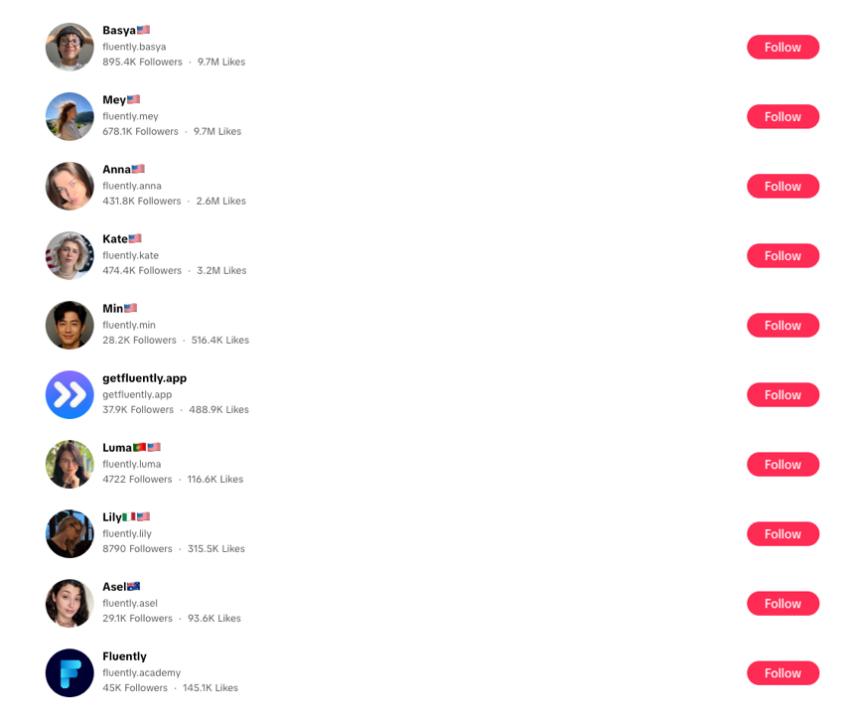
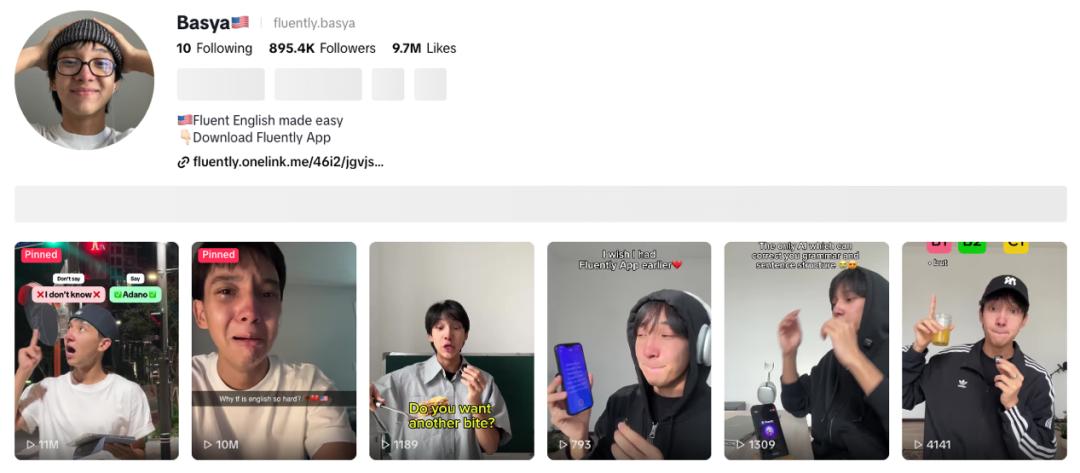
Fluently's matrix accounts on TikTok (top), one of its high-follower accounts (bottom)
Founder Yurii once mentioned when reviewing the growth: "It is almost impossible to predict viral content, so we need to spread bets on multiple accounts. Even if only 10% of the content performs well, it is more than enough." To implement this idea, Fluently's social media customer acquisition has two features: matrix account strategy and collaboration with small creators.
Searching for "Fluently" on TikTok, you can find a large number of "suspected" real-person accounts with real avatars and named in the format of "Fluently.XX". The total number of followers of these accounts exceeds 2 million. To maintain a high update frequency and expand the base for potential viral hits, each account releases 1-2 pieces of content per day, and the total number of content published by all matrix accounts across platforms reaches over a hundred. After content is released, the team keeps adjusting the scripts, actors and hooks, and once a piece of content goes viral, it will be replicated to multiple platforms. To this end, Fluently chooses to cooperate with small creators with fewer than 5,000 followers. The founder said: "Big creators charge high prices and work slowly, which cannot support high-frequency updates."
At the same time, the assessment of creator marketing has been transformed into a performance-based marketing model. The team not only checks whether a creator can produce viral content, but also evaluates subsequent conversion and payment performance through "tagged links". If a piece of content only gets exposure but fails to bring good downloads and revenue, the creator will be decisively dropped.
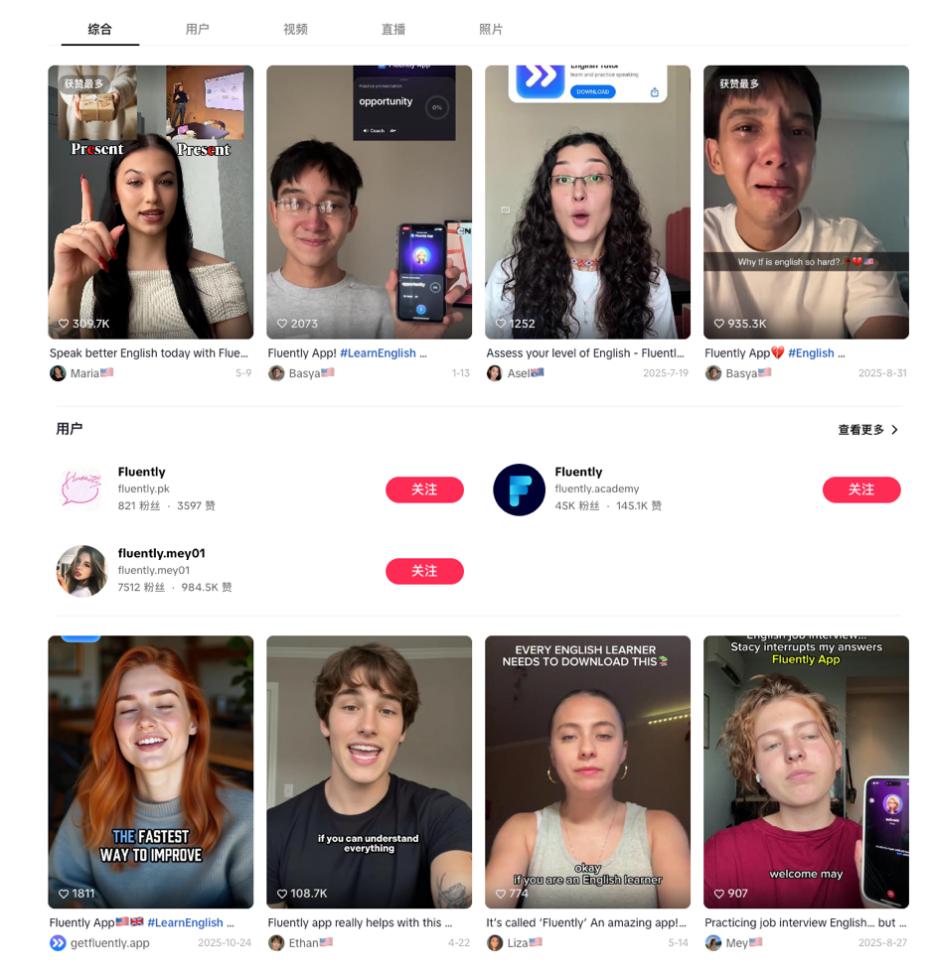
Highly-liked content of Fluently on TikTok | Image source: TikTok
This assessment model is very likely one of the key reasons why Fluently's download and revenue data shows a different trajectory from Pingo after massive customer acquisition through social media.
Just like Pingo, Fluently's early viral materials also relied on emotional output. The most-liked video on TikTok so far is a piece of content about "crying over the frustration of learning English", which has got 935,000 likes. But when you enter the creator's homepage, you will find that this type of emotional content has almost disappeared since this year, replaced by three new types of content.
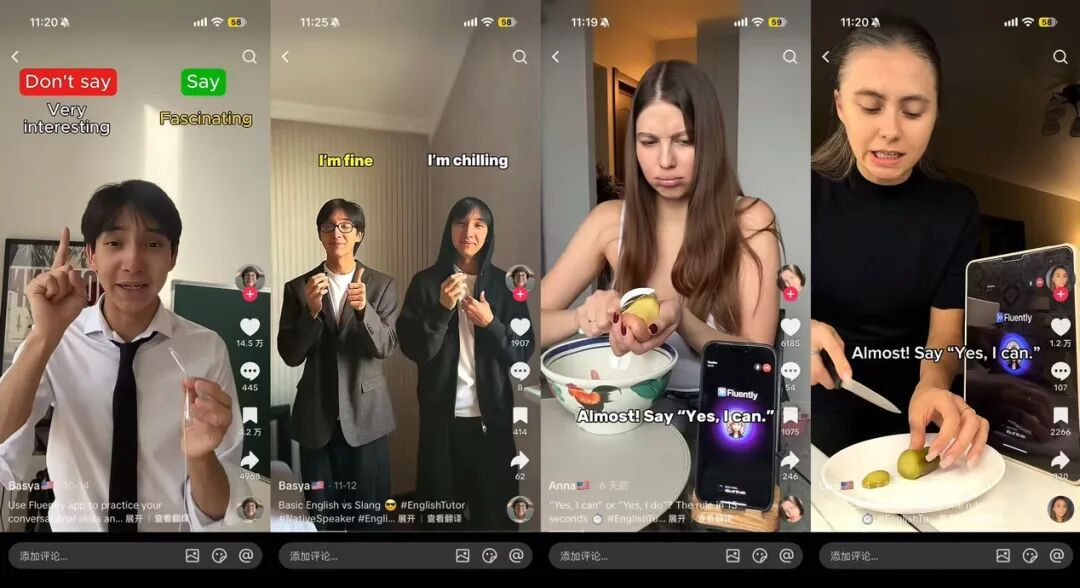
"Don't say / Say" style materials (Figure 1, 2), life scenario error correction materials (Figure 3, 4) | Image source: TikTok
One type is the "Don't say / Say" style expression replacement (Figure 1, 2 above), for example, using "fascinating" to replace "very interesting"; the second type is putting AI error correction into daily life scenarios (Figure 3, 4), where AI corrects when to use "Yes, I can/do/am" respectively when cooking; the third type directly demonstrates Fluently's pronunciation correction capability (as shown in the following figure).

Materials demonstrating pronunciation correction capability | Image source: TikTok
The shift from "crying over English learning frustration" to "Don't say / Say" seems to be a change in material style on the surface, but the underlying customer acquisition logic is completely different. "Being scolded to tears by AI" creates emotional stimulation: users laugh or get shocked after watching, and download the app out of curiosity. Short knowledge-based videos provide specific English learning points, as well as the expectation that "if I use this app, I can learn more". People who are willing to finish watching the latter type of content have stronger demand for oral English improvement, so the content completes a round of user screening while reaching the users. If you only observe the display volume of the materials without looking at the further data after users watch the content, it is very difficult to break away from the "traffic curse" of emotional content.
Another reason why the two took different paths after acquiring customers through social media is the difference in user experience after opening the app.
II. Being Forced by AI to Speak for 10 Minutes Every Day
After opening the app, users go through an onboarding process with dozens of questions, and are matched with a suitable AI Tutor based on their level, preferences and other factors. The core learning is completed through conversations with the AI Tutor, with learning points and vocabulary integrated into the dialogues, which is different from products like Speak and Learna that let users learn sentences first and then practice through conversations.
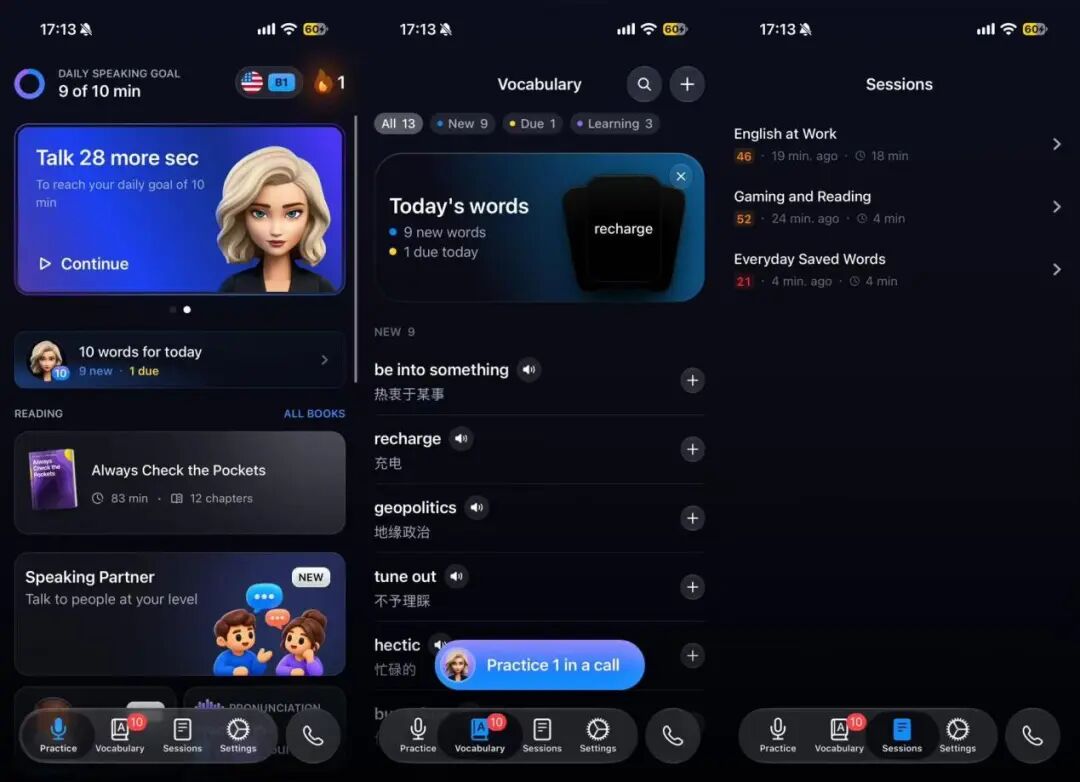
Fluently's three core tabs: "Practice", "Vocabulary", "Sessions"
A differentiated design that centers on conversations and runs through the whole learning process is that "users must speak for a full 10 minutes every day" (according to a test by another colleague, users can choose to set the daily target to 2, 4 or 8 minutes), which is displayed in the most prominent position at all times. Users can click the blue box in the center of the screen to start the conversation. What's more, if users do not actively click in, with their permission, the AI tutor will "call" them at a fixed time every day. Many users feedback that this strong reminder at fixed time is extremely effective when they feel tired or are not in the mood to study.
The logic of this design is consistent with habit formation research. Speaking English itself is a task that requires people to overcome inertia, and if it completely relies on self-discipline, most people will quit sooner or later. The daily fixed AI call changes the active decision of "whether to study" to the response of "whether to answer the incoming call", lowering the activation cost from making a decision to simply responding. According to the founder's disclosure, users speak for more than 2 hours in their first week, and more than 4 hours in the first month.
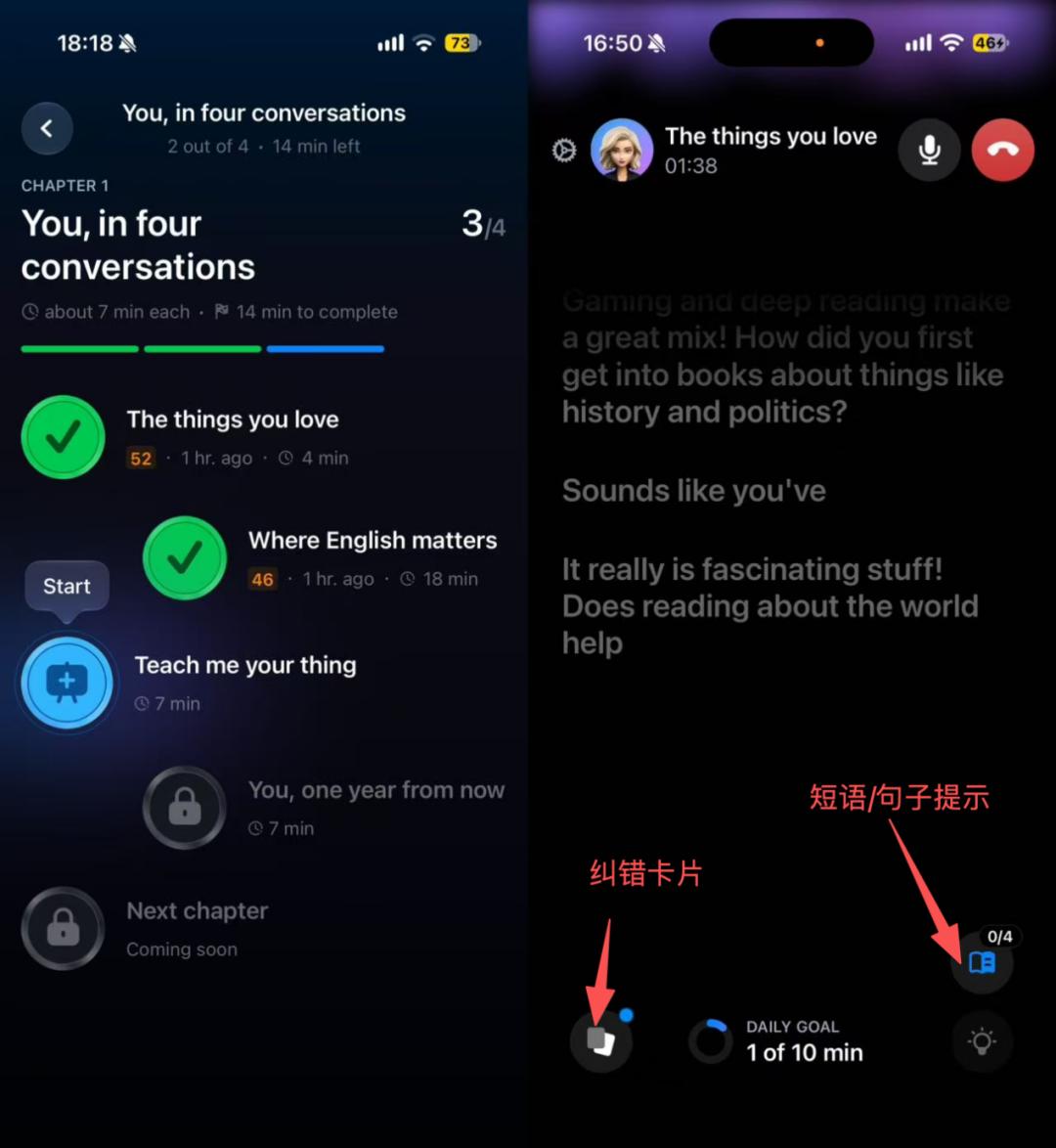
Fluently's course page (left), practice page (right)
After entering the call, users can talk to the AI just like making a phone call, no need to press any button to speak, and can interrupt the AI at any time. The AI will wait for the user to finish speaking, and then continue the conversation with follow-up questions based on the content. The conversation topics are quite broad, such as "The things you love", "Where English matters" and so on, and the difficulty is controlled by AI according to the user's level. From my own experience, the AI's responses are relatively stable, and interruptions are handled naturally. But sometimes it is too sensitive: when you stop in the middle of a sentence to think for a word, or even just take a breath, the AI will think you have finished speaking and start replying. Some users have complained about this, saying "the AI does not leave time for thinking".
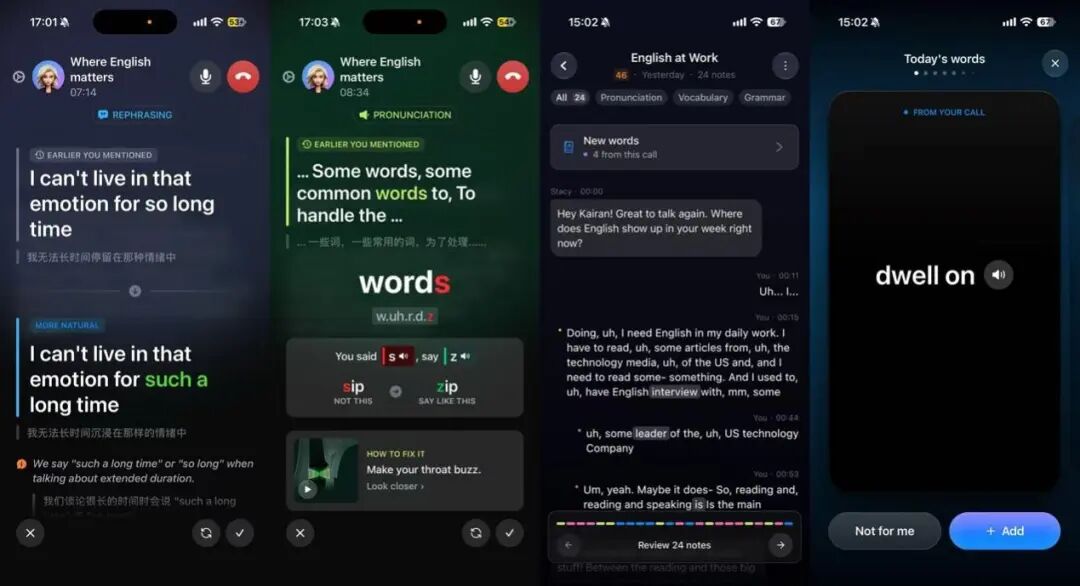
Error correction cards: grammar or pronunciation errors and optimized expressions are marked in different colors (1st and 2nd from left), users can review wrong vocabulary and error correction cards in the "Vocabulary" and "Sessions" tabs
The two selling points of "pronunciation correction" and "expression optimization" on social media are also integrated into the conversation. After the user finishes speaking, the AI will put the identified pronunciation errors, grammar errors and optimizable expressions in the "error correction card" at the bottom left of the screen. The AI will prompt users to click in to check, and after learning, users can review the wrong words and error correction cards in the second and third primary tabs "Vocabulary" and "Sessions".
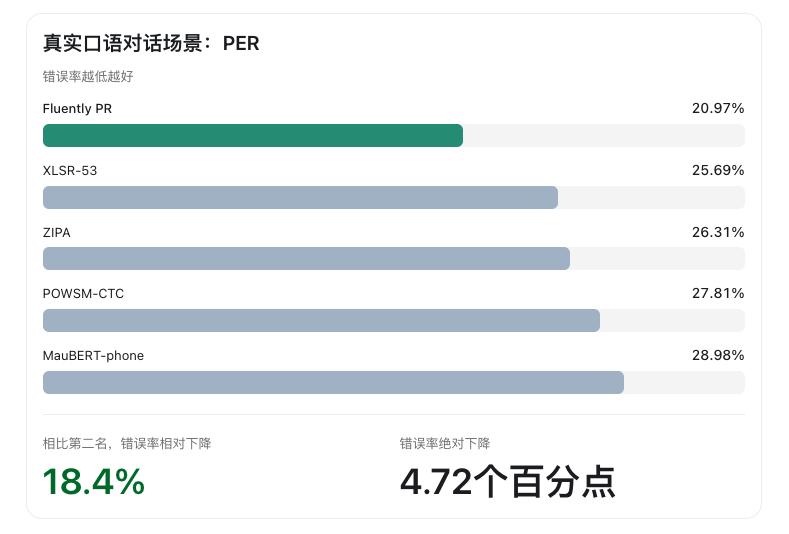
Benchmark test of Fluently PR and other speech recognition models published on Fluently's official website | Data source: Fluently official website
From my own experience, Fluently performs quite well in pronunciation correction. Founder Yurii Rebryk has stated on multiple occasions that the team trained a speech recognition model called Fluently PR with real users' voice data. According to the explanation on the official page, ordinary speech recognition models will "guess" the word the user wants to say based on the context for transcription, which leads to inaccurate recognition. But the training data of Fluently PR comes from real conversation recordings, and has been labeled one by one by professionals, so it can accurately identify common pronunciation errors such as mispronouncing the phoneme /θ/ as /s/.
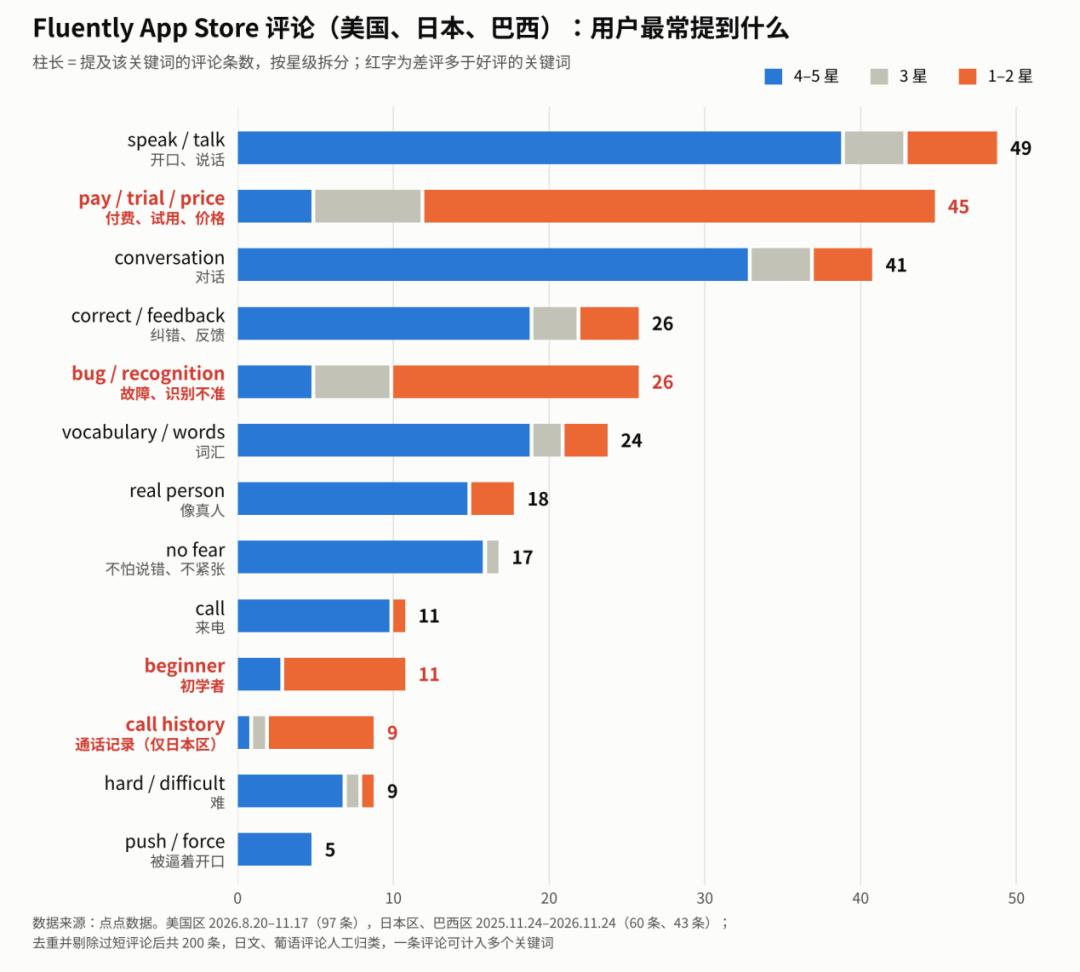
Negative reviews mainly focus on three aspects: payment issues, malfunctions and unfriendliness to new users | Drawn by Baijingchuhai based on Diandian data
Overall, after the trial, pronunciation correction and grammar error correction are both integrated into the conversation , and because users are "forced" to speak, they get a stronger sense of achievement compared with other oral learning