Personal Agent is a business outside the attention track
The concept of Personal Agent is extremely popular right now.
Overseas there are Grok Bot and Muse, while in China we have Lingguang from Ant Group, and on November 24, Xiaodou from ByteDance also launched its public beta test.
I'll cut to the chase and share my judgment first: The remarkable part of this type of product is that it may turn a large number of demands that were previously not worth paying others to handle into a viable business.
01
Zhu Xiaohu once said a quite interesting sentence: "Do you have a secretary? The vast majority of people don't, and don't need one."
I thought about it for a while and found it totally true. Which family would specially hire a person just to handle a few trivial matters?
In daily life, there are some things that feel too troublesome to do by yourself, yet not cost-effective to ask others to handle, so in the end you can only keep them on your mind all the time.
I have a cat. I took it to get the feline trivalent vaccine before, and there needs to be an interval between each dose. I still remember when I got the first dose, but it is easy to forget the time for the second and third doses.
Once after the vaccination, I planned to set a reminder on my iPhone after getting home, but I got busy for more than ten minutes and completely forgot about it.
Later when I started using AI assistants, whenever I thought of this matter, I would directly assign it to the AI, and ask it to remind me when the time comes.
Look, mobile phones already have the reminder function, why do I still need to use AI? Because even the act of setting a reminder itself is something I have to remember to do.
For daily schedules and meeting times, I am also used to directly assigning them to AI. There are still some things that it cannot help with for the time being.
For example:
My home's utility bills do not have a fixed payment date, so I don't know when to ask it to remind me. It first needs to know when my home has an overdue bill, which requires it to be able to access external information.
Then think about the older generation like my parents: as they get older, there are more things in life that they need to keep track of.
When is the follow-up visit scheduled? How many days are the medicines at home enough for? Is it time to arrange a physical examination again? The same goes for families with children: school notifications, vaccine appointments, interest class schedules, every single one of these things needs to be remembered by someone.
I looked up the time use survey from the U.S. Bureau of Labor Statistics:
In 2025, people aged 15 and above in the United States spent an average of about 10 minutes per day on household management, which adds up to more than 60 hours a year.
This is only the actual time spent on handling household management matters. A task that only takes a few minutes to complete may occupy your mind for several days.
What AI assistants can save us is not only the time spent on handling tasks, but also the energy consumed on keeping track of these matters.
Back to Zhu Xiaohu's words: not needing to hire a full-time person is completely different from not needing help to handle a single matter.
I checked the data:
Lingguang once released a set of data: half a month after the launch of its 2.0 version, as of November 11, the total number of delegated tasks exceeded 3 million, and the total number of executed tasks exceeded 11 million.
Compared with how many people have opened Lingguang, I am more curious about how many of these 3 million tasks are things that people never even thought they could assign to others to handle?
From this perspective, the size of the PA market is probably not only calculated by how many secretaries it can replace.
A large number of personal affairs have long had demand for help, but these matters are too trivial to afford to hire a person, and it is not even worth hiring someone for them. AI has the opportunity to take over all these demands.
Reminders are just the beginning. For example, managing membership subscriptions: AI can not only remind me before my membership expires, but also further help me cancel the auto-renewal.
But what if it cancels a membership that I still want to continue using? I bet I am not the only one who has thought about this scenario.
02
In my opinion, there is a quite big difficulty in building personal AI assistants: The degree to which an AI understands a person is completely different from the degree of authority it has to make decisions for that person.
When we ask AI to answer a question, we mainly judge it by how good the answer is. But when we ask it to handle a task for you, the final result alone is far from enough.
AI making a mistake in handling a task and AI doing something you never asked it to do are two different types of errors. Sometimes, even if it handles the task perfectly, you may still not be happy about it.
At this year's IEEE Symposium on Visual Languages and Human-Centric Computing (VL/HCC), there was a research paper discussing exactly this problem.
The researchers recruited 20 college students, and asked them to use the general AI assistant OpenClaw to complete 5 small daily tasks, including finding files, sending emails to professors, comparing job offers, arranging schedules, etc.
The thing that participants were most worried about was unexpectedly sending emails to their professors.
Scored on a five-point scale, they rated the email content at 3.7 points, but their trust level in AI handling this task was only 3.1 points. Their willingness to check the email content before it is sent reached 4.65 points.
Think about it: if you find the wrong file, you can search again; if the schedule is not arranged properly, you can adjust it. But once the email is sent out, the recipient may have already seen it, and it will be very difficult to take it back.
The researchers discussed a phenomenon called "delegation regret". Simply put, the task may be handled well, but you regret giving the decision-making power to the AI.
The sample size of this research is small, and it cannot represent all users.
Last year, Zendesk commissioned YouGov to conduct a global consumer survey. When asked if they would like AI to help manage their schedules and to-do lists, 64% of respondents said yes. When it comes to financial planning and decision-making, only 39% of people are willing to let AI help.
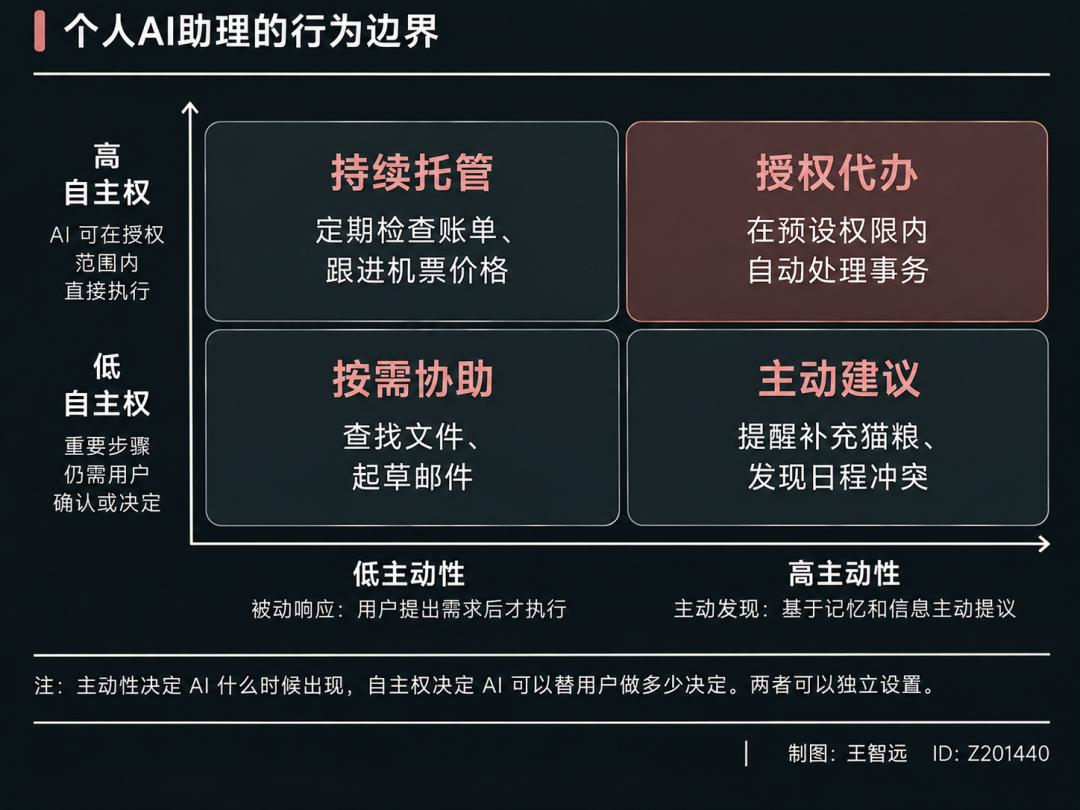
When designing an AI assistant, at least two things need to be considered:
- Initiative: When should it come to me and help me think of things I might miss?
- Autonomy: What matters can it make decisions on my behalf, and what matters need to ask me for confirmation first?
Take my cat-raising experience as an example: if the AI knows that the cat food at home is almost used up and takes the initiative to remind me, I will definitely be happy. But whether to buy more, which brand to buy, and how much to spend, I probably still want to decide by myself.
On the other hand, it can check for new meeting arrangements for me every day, and only notify me when it finds conflicting schedules. There is no need to ask for my permission every time it checks.
Muse, launched by Meta in September this year, is also working on this issue: it will actively give users suggestions based on its memory, and for operations like sending emails and shopping, it will ask users for confirmation first.
Users may want AI to think more things for them, but at the same time make fewer decisions on their behalf.
Lingguang and Xiaodou have different priorities in this regard.
When we ask others for help in daily life, there are roughly two scenarios. One is that you know exactly what you want, but you just don't want to keep tracking it all the time; the other is that you haven't thought of the thing yet, and you hope someone can help you keep an eye on it.
Lingguang puts more emphasis on managing the tasks assigned by users well.
I saw someone do a real test: the user asked Lingguang to go through two years of Alipay bills to find those auto-renewal subscriptions that he forgot to cancel, and after finishing the task, the user added a note to check every half month. This instruction then becomes a long-term ongoing task.
Open the "Manage for Me" section of Lingguang, and you can look back to see what tasks are being processed, what progress they have made, and what tasks still need to be handled by yourself.
Xiaodou has put a lot of effort into actively discovering user demands. In addition to the chat interface, it has designed three sections: Recommended for You, Follow Up for You, and About You.
The official once demonstrated a scenario:
Xiaodou estimates that the cat food at home is almost used up, and takes the initiative to ask the user if they want to restock; there are also journalists who did real tests: when a colleague's draft was not modified according to the comments, Xiaodou actively pops up a reminder, and the user can directly send a message to urge the colleague.
Of course, Lingguang can also actively discover problems, and Xiaodou can also continuously follow up on the tasks assigned by users.
Both companies are working on these two things, but with different focuses: one puts more emphasis on managing tasks well, and the other puts more emphasis on actively discovering user demands.
This is related to the product personality.
When talking about AI personality, many people will think of its speaking tone, avatar, and whether it can provide emotional value. All of these are very important. The personality of a personal AI assistant has a deeper layer, which is reflected in how it participates in a person's life.
When to show up, when to stay quiet, when to make decisions for you, and when to give the decision-making power back to you.
After using it for a period of time, you will naturally know clearly in your mind which things you can safely assign to it, and which things you can count on it to think of for you.
This kind of personality is more like an agreement that is slowly negotiated between a human and AI.
When choosing an AI assistant, you also need to think about what role you want it to play. Do you prefer someone who manages all the tasks you assign well? Or do you prefer someone who can think of more things for you?
The two types of demands are not conflicting, and the key lies in how you want it to participate in your life.
For companies that develop AI assistants, whether they can build this stable relationship with users is also related to another account book.
03
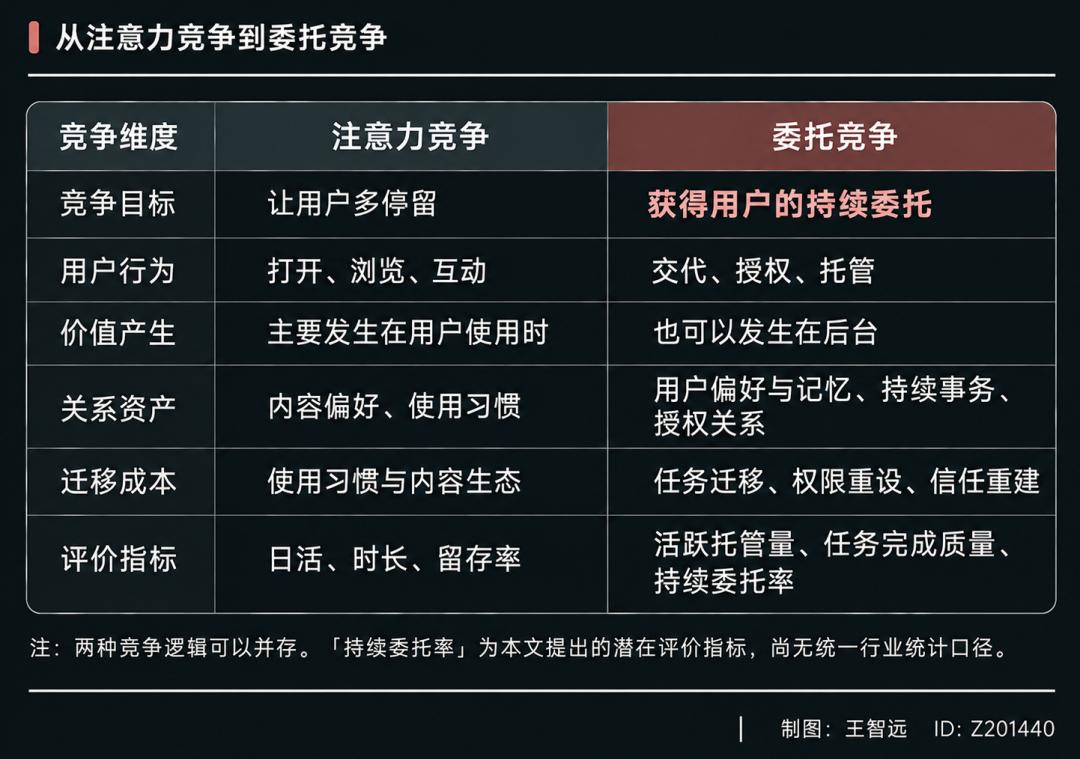
I have a judgment: if the PA market really takes off, in addition to competing for users' attention, internet companies will also compete for another thing: how many long-term tasks users are willing to assign to them.
What is the difference between these two things?
Think about it: when you are scrolling through short videos, even if you spend two hours continuously, once you close the App, this consumption ends. But if you ask AI to help track the price of a flight ticket, this task may last for a week, or even a month.
During this whole month, you may not open the App very often, but it has been providing services for you all the time.
In September this year, the Grok Bot design team published an article with a sentence inside:
"Chats are disposable". The general idea is that conversations are meant to be discarded after use.
You can start a new conversation to ask a question, and leave right after you get the answer. But when you assign a long-term task to AI, even if you close the conversation window, the task still needs to be processed.
Therefore, Grok Bot began to design products around continuously existing assistants, and each assistant has its own memory, tools and operating environment.
This change is worth thinking about: chat tools accumulate the words you have said, while personal assistants also accumulate the tasks you have assigned.
If I have used a personal AI assistant for half a year, three things may have been accumulated in it:
- Its understanding of me: my living habits, consumption preferences
- The tasks I assigned to it: checking bills regularly, following up on schedules
- The permissions I gave it: what information it can access, what matters it can handle directly
When these three things are combined, it becomes quite meaningful.
To switch to a new chat tool, I may only need to re-introduce myself; but to switch to a new personal assistant that I have used for half a year, I also need to consider what to do with those ongoing tasks, and whether I need to reset all the previous permissions.
If in the future, memory, tasks and permissions can be easily migrated between different products, this switching cost will also be reduced.
I checked specially today: the UK Competition and Markets Authority also paid attention to similar issues in a report about Agentic AI.
As AI assistants accumulate more and more user data and preferences, whether users can conveniently switch to another service provider may become a new market competition issue.
Model capabilities can be a reason for users to try a product, while a continuous service relationship may be the reason for users to stay.
This can also explain why the Lingguang team pays attention to indicators such as delegated task volume and task activity rate.
I remember that Cai Wei, the person in charge of Lingguang, once shared a detail, he roughly said:
If the team's only assessment goal is to boost daily active users, everyone may use some methods unrelated to the product's core proposition to achieve this goal, because there are always easier ways to do it.
This statement is quite thought-provoking in the internet industry.
For content products, if a user does not open the App for a week, the team may have to find ways to bring the user back; but for personal assistants, if a user does not open the App for a week, you still need to check whether all the tasks assigned by the user have been handled properly.
However, the deeper the delegation relationship is, the more complex the business problems enterprises will face.
For example, if I ask AI to help me manage membership subscriptions for a long time, and it finds a membership that I have not used for half a year, logically, it should suggest me to cancel it.
But what if this membership service provider happens to be a commercial partner of the AI company? How will the AI handle this matter?
After AI can handle tasks for people, users have more necessity to figure out whose interests the AI is considering.
In the future, when evaluating a company that develops personal AI assistants, in addition to looking at how many users it has and how smart its model is, we may also look at how many people are willing to assign their personal matters to it for a long time.
After all, gaining a person's attention and gaining a person's delegation are two completely different types of business.