An AI mental health product has survived thanks to the "Win Back Your Ex Challenge"
AI cannot replace psychotherapists.

Interview | LIU Sijie, LIU Ziyan
Text | LIU Sijie
Editor | ZHANG Wei
Cover Source | Unsplash
In June 2026, the angel round funding Tess secured a year and a half earlier was nearly exhausted.
"If we cannot see more valid data, we are not sure whether we can continue to invest in you," the investor told Tess, with a clearly hesitant attitude. A FA told Tess that she could craft a story combining AI mental health and hardware, which would make it far easier to raise financing.
In 2024, Tess launched Moor AI, an AI mental health software focused on anxious attachment and taking emotional support as its core entry point. She did not build this product just because the track was popular and easy to raise capital, but because her mother suffered from bipolar disorder, and she herself had been consistently receiving psychotherapy. She did not want to fabricate stories purely for financing, but the team had to survive.
All team members gathered for meetings to explore all kinds of methods to acquire new users and improve retention. In July, they launched a "Reunion Challenge" on social media. This challenge had little to do with formal psychotherapy: it was a set of relationship tests wrapped in MBTI and constellation frameworks. Users would choose how they would respond to their "ex" in various situational questions, and the system would judge whether they had a chance to "get back together" with a certain type of person.
Eventually, this challenge gained over 10 million views on Douyin, with nearly 4 million people participating in the "challenge", bringing nearly 60,000 new users to Moor AI. For comparison, the app had only 40,000 users after running for more than two years before that.
Thanks to this challenge, Moor AI achieved its first break-even point since its establishment that month.
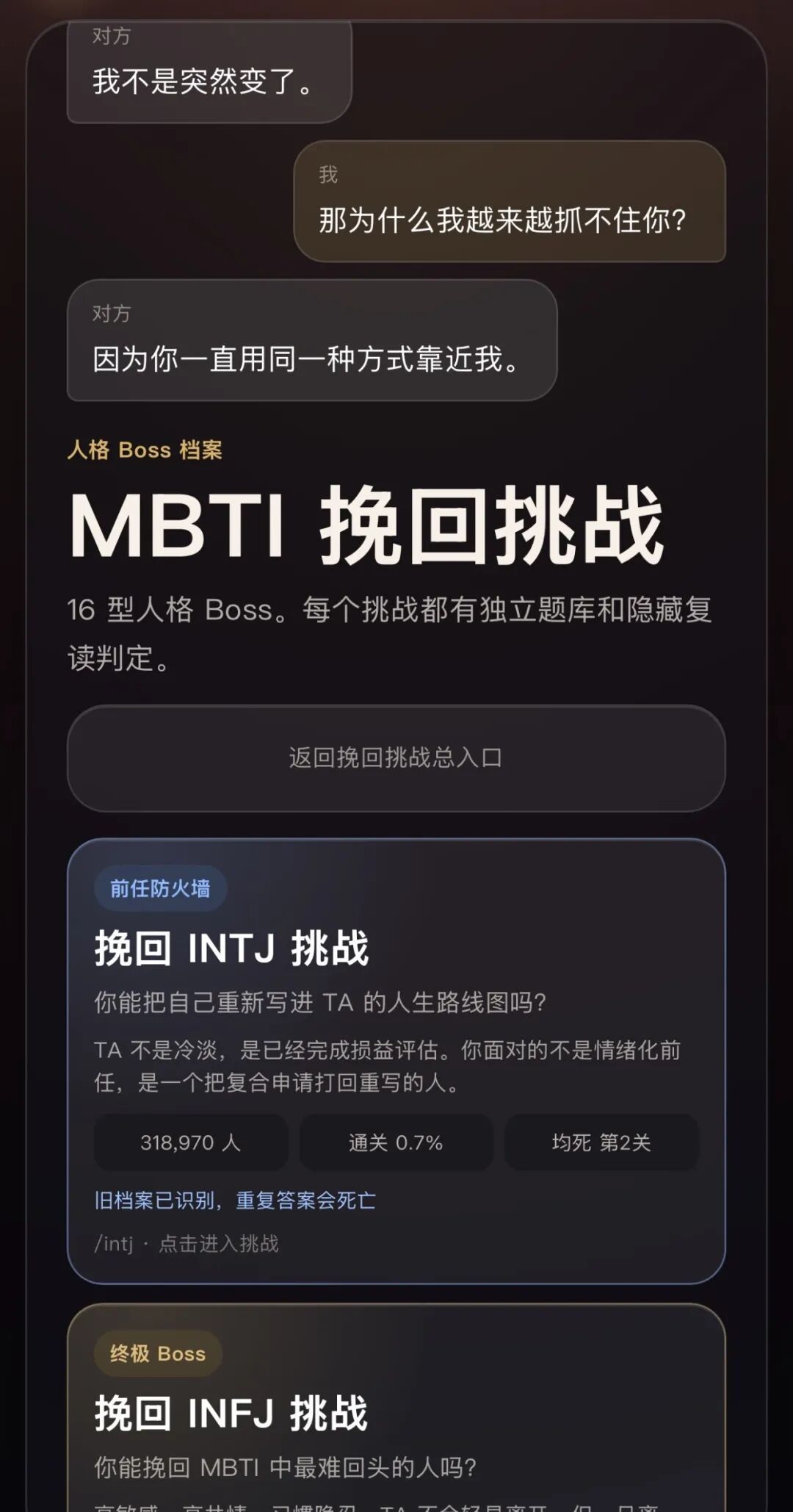
The Reunion Challenge launched by Moor AI
An AI mental health product turned around by launching "not-so-psychological" emotional tests. Is this strange? But these tests are exactly the real demands of users.
Whether users need AI mental health products is not actually the real core problem facing the AI mental health track.
An exploratory study published in the *Journal of Public Health* shows that among the 500 respondents surveyed from January to June 2025, 17.2% of the total sample and 23.1% of ChatGPT users stated that they had used ChatGPT as a mental health management resource.
At a time when people are increasingly used to confiding in AI, the real infinite challenge for AI mental health products is to attract users through low-threshold and even interesting methods, and then retain them with verifiable solutions instead of generic meaningless chatting.
Or we can rephrase it into the following two questions:
Can AI really replace real human psychotherapists? Do AI mental health products have to be presented in the form of standard psychotherapy?

Pivot to AI, No More Broad and Generic Positioning
Tess started her entrepreneurial journey in 2023.
At the very beginning, she built a platform that matched international students with real human psychotherapists.
In 2021, when Tess was pursuing her postgraduate degree in the US, her mother had a severe bipolar episode, and her own mental state also became very poor. She got through the hardest few months with the help of a remote Chinese-speaking psychotherapist. It was this experience that inspired her to start her business in the mental health field.
In 2024, she realized that the development ceiling of running a real human consultation platform was not high enough. Some users also gave feedback that their experience of booking human therapists on her platform was similar to that on other platforms, but the AI auxiliary function worked surprisingly well. This was a feature integrated with large language models, with a simple chat mode, which was only responsible for chatting with visitors while they were waiting for their assigned human therapist.
Tess thought at that time that for a startup to survive and develop sustainably, looking at the next 3 to 5 years, AI capabilities would become stronger and stronger. If her team did not make progress in this field, other companies would seize this window of opportunity.
So the real human consultation platform was suspended, and the team fully pivoted to AI.
Around the COVID-19 pandemic, the mental health track once saw a widespread financing boom.
Data from Arter Orange shows that the domestic digital mental health financing amount reached 186 million US dollars in 2021, which was about 6 times that of 2020. Arter Network also mentioned in its 2021 annual review of the mental health industry that since March 2021, 14 companies in the industry had completed 17 financing rounds, with a total amount of over 1 billion RMB. Projects such as Haoxinqing, Zhaoyang Health, Jiandanxinli, and Yidianling all received single financing rounds of over 100 million RMB.
It is not only limited to internet psychotherapy. Companies like Westlake Xinyun, which builds vertical large models for the mental health field, also received nearly 10 million US dollars in angel round financing. Investors bet that the pandemic amplified public demand for mental health services, and digitalization and AI could effectively reduce the cost of mental health services.
In January 2025, Tess secured an angel round of investment from Yidianling.
At the very beginning, the product was just an entrance for casual AI chat. Tess found that it was very easy for it to become "no different from general large language models".
For a period of time, the team was too eager to prove their professionalism in the AI field: when users chatted casually with Moor AI, their attachment patterns, deep-seated fears and traumas would be analyzed immediately. This drove away many users. "Many users said they were still stuck in their intense emotions, and they were not ready to be analyzed like this. Then they left, and some even complained angrily about our product."
In January 2026, the product was officially renamed Moor AI, and its positioning gradually narrowed from general AI mental health to emotional relationships, and then further to a smaller specific attachment type: anxious attachment.
In terms of promotion, the team no longer talked about "mental health" in a vague general way, but started to produce popular science content, practical tips and emotional soothing content around anxious attachment, directly positioning Moor AI as a product that helps people with anxious traits relieve their anxiety. The product allows users to choose their own attachment type, and provides chat functions and targeted exercises around issues such as sense of security and relationship anxiety.

Main interface of Moor AI
This is because Tess found that intimate relationships are the window where many people's suppressed emotions and traumas break out. Compared with the broad and vague concept of "mental health", users are actually more likely to be troubled by specific problems in relationships, which makes them think of seeking help from psychotherapy.
Choosing anxious attachment as the core entry point is because Tess herself has anxious attachment, so she understands the pain and specific demands of this attachment type far better.
Cai Weihong, who has been engaged in psychotherapy for more than 20 years, also went through the entrepreneurial process from "broad and generic" to continuously narrowing down the service targets.
In 2019, she cooperated with an AI PhD and raised tens of millions of RMB, aiming to build a vertical large model for the mental health field. But soon she found that the capital required for this path far exceeded their affordability. They changed their mindset: instead of letting AI provide consultation services for a wide range of users through generative dialogue, they chose to serve B-end users, and the product was adopted by government departments. They developed a small robot connecting mobile phones and computers for a certain government unit. Staff in the unit could talk to the robot, and the system would judge what problems they encountered based on the conversation.
In the system designed by Cai Weihong, the first thing AI needs to do is to identify where the user's problem lies. The initial conversation and screening are exactly what AI is good at.
In her view, a person may just feel "uncomfortable all over", but behind this may be problems such as emotional expression, intimate relationships, workplace pressure, or the need for assessment or referral to human professional help. The system will tag users according to their answers, and then recommend corresponding articles, audios, assessments, tools or consultation paths.
Cai Weihong has been in the industry for 20 years, and she has only served 500 visitors in depth. The number of samples she can see in her whole life is limited, but AI is different. It can learn a large number of consultation cases, make triage judgments, help users identify what problems they are facing, and recommend appropriate tools and therapists of appropriate schools.
Cai Weihong found dozens of professional psychotherapists like her, turned years of consultation experience into sets of standardized scripts, and fed them to AI, so that AI can say the right words at the right time. For the first time, these therapists also systematically sorted out their years of accumulated experience.
This is also the reason why investors were willing to bet on AI mental health in those years. AI does seem to be able to make up for the expensive, inefficient and difficult-to-scale parts of real human mental health services.

How to Achieve Both Popular Acclaim and Commercial Success?
The demand exists, and the pain points are also prominent. But it is not so smooth to turn the capabilities of real human mental health services into a scalable C-end business with the help of AI.
User acquisition, growth, payment and repurchase, every link needs to follow strict product logic.
With limited funds and slow product development, the product faced the dilemma of failing to get off the ground in the cold start stage. Without investment in promotion, the product could not be seen by users. Tess described this as a closed loop: "Less capital, fewer team members, slower development speed, fewer product features, fewer users, bad user data, and harder to get follow-up financing."
But more importantly, the specific pain in relationships and the urgency for people to seek help do not necessarily directly translate into rapid growth of the product.
Tess reflected that when she was developing the product in the past, she wanted to tell users that this is a product that can make you mentally healthier. But users would think: Why should I use your product? Drinking, singing K, or chatting with friends can also make me feel better.
To develop a product, you have to make users interested in it first. AI mental health products need to put more effort into user acquisition and retention.
Now, when users open Moor AI, they may find it a little strange: an AI mental health product with all kinds of emotional tests inside.
"Test how people-pleasing you are in relationships", "Test your true self in relationships", "End NPD Challenge". The Moor AI team also cooperated with fan groups of celebrities, until the "Reunion Challenge" went viral, bringing a large number of new users.
Marriage reunion was once the most profitable part of the mental health related industry. Some people were willing to pay millions of RMB for a set of reunion services to save their marriage and assets.
People's emotions are often hidden in those trivial daily things. Cai Weihong found that it is specific problems that push people into the consultation room and make them willing to pay for psychotherapy. Before the pandemic, it was marital relationship problems. In recent years, it is children's school refusal: after their children refuse to go to school, parents are willing to buy hundreds of "courses" at one time, with a single charge of thousands of RMB.
Metaphysics is also a very effective hook. When people are in anxiety and pain, they are more likely to turn to metaphysics for help. Since users have such demands, the team added this function.
As a result, the Tarot function appeared on Moor AI, which is also one of the reasons why many users are attracted to Moor AI. Moor AI also runs gift-giving activities to encourage users to promote this function on Xiaohongshu.
Some users said they wanted a place similar to Moments to vent and post their moods, so Moor AI launched an "Inner Monologue" section, and set up AIs with different personalities to reply to users' "random ramblings".
Tess's personal Xiaohongshu account keeps updating every day, and she found that every time she posts content related to "manifestation", the video performance is exceptionally good. So the team combined the psychological concept of mindfulness with the concept of manifestation, and launched the "Mindfulness Manifestation" function on the APP.
Tess realized that product development needs to be streamlined. Through continuous exploration, the team summed up a methodology of prioritizing social media operations and letting data speak, so as to capture users' real pain points and demands.
The AI mental health project Meerkat also realized very early that AI mental health products for C-end users can hardly survive only by lofty vision.
Meerkat does not do open-ended casual chat, but splits psychotherapy methods such as CBT, mindfulness and behavior training into independent training modules, trying to help users deal with problems such as tinnitus, insomnia, anxiety and somatization.
This industry has long been "praised by all but not commercially successful", Gong Yongmou, founder of Meerkat, described it like this.
Users think the product is useful, and some are willing to pay, but the payment scale, repurchase and growth all need to be verified slowly. Their tinnitus course, based on Cognitive Behavioral Therapy (CBT), is sold for 1499 RMB. Among the first batch of more than 200 users, more than 50 completed the payment, with a conversion rate of just over 2