Amodei made his original intentions clear: I never intended to let AI take power.
In the 15th year of Jian'an, Cao Cao reigned supreme in the north, and most people across the realm suspected that he harbored the intention of usurping the Han Dynasty. Cao Cao simply started recounting the aspirations he held in his youth, listed his achievements over half his life, laid bare his true intentions, and could hardly conceal his indignation when talking about the speculations people held towards him: "People make unfounded guesses about me, which has long weighed on my mind."
This is the later quite famous *Order on Renouncing Fiefs to Declare My Original Aspiration*.
1816 years later, Dario Amodei, far away in Silicon Valley, also wrote a long essay to "declare his original aspiration".
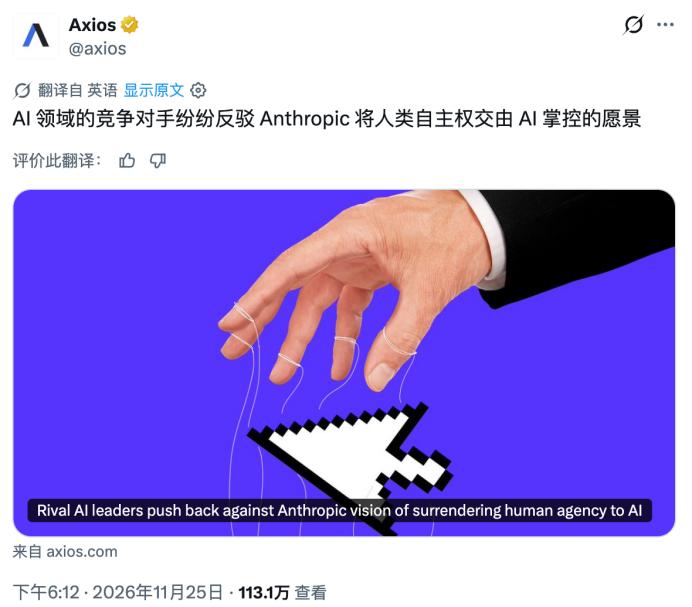
On November 25 US time, media outlet Axios cited multiple people familiar with the matter as saying that some employees within Anthropic have formed a consensus: when superintelligence far outperforms humans, humans should cede part of their decision-making power to AI. Axios also dug up a series of Amodei's past remarks, linking this ideological tendency to the founder's worldview.
Amodei directly denounced the absurdity of this interpretation in a long post on X. He reaffirmed his long-held propositions, listed the efforts Anthropic has made for AI safety, and did not forget to criticize his peers who hold high the banner of "human autonomy".
However, what Axios exposed was the ideological tendency inside Anthropic, while Amodei spent a lot of space proving his absolute loyalty.
He did not respond to the biggest problem at all.
"I have never had such an intention"
The storm has actually been brewing for some time.
Since November, several AI company executives in Silicon Valley have talked about human autonomy almost simultaneously. OpenAI CEO Sam Altman said that humans should always hold the initiative to shape the future; Meta's chief AI officer Alexandr Wang also emphasized in a recently published long essay that humans should not accept that the whole society is handed over to AI.
Although they did not explain who these remarks were targeted at, Axios did not care about that, and directly made it clear in its report on November 25.
According to people familiar with internal discussions at Anthropic, some employees inside the company have reached a consensus: when superintelligence arrives, humans will not only cede decision-making power to AI in many scenarios, but also deserve to do so.
One example they often use is autonomous driving: when statistical data fully proves that AI drives more safely than humans, humans insisting on holding the steering wheel becomes a rather irrational behavior instead.
Following this logic, when AI also far outperforms humans in treating diseases and saving lives, preventing disasters and other fields, insisting on letting humans make decisions may even become an immoral act.
Axios also cited a series of Amodei's past public remarks, arguing that this ideology is closely related to Amodei's own worldview.
Amodei obviously strongly disagrees with this interpretation, and directly wrote more than a thousand words on X, even citing philosophers from ancient Greece and ancient Rome.
"No, I don't think we should 'surrender human free will' to AI systems. It is absurd to think that I hold such a view."
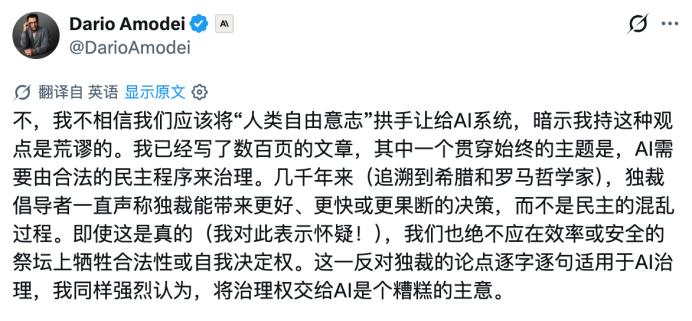
Excerpt from Amodei's long post
To prove this point, Amodei dug up four long essays he published in the past, as well as remarks he made in a previous interview with CBS.
He said that he has written hundreds of pages of articles, and a consistent theme running through them is that AI must be subject to legal democratic governance. He even wrote a special article discussing the danger of AI labs seizing power, and explicitly stated his opposition to it.
Amodei said that in his view, even if dictatorship can really bring higher decision-making efficiency, humans should not sacrifice the right to make independent decisions for this, and this logic also applies to AI governance.
He emphasized in the long post that Axios confused two concepts: handing over the governance power of human society to AI, and letting AI independently complete more and more complex specific tasks.
Amodei is much more open to the latter. He believes that letting AI independently drive cars, design anti-cancer drugs, and complete software development can create huge economic and social value.
On issues such as AI independently developing the next generation of AI, and large-scale automation impacting employment, Amodei also advocates imposing certain restrictions on the degree of automation.
As for those peers who have repeatedly emphasized human autonomy recently, Amodei is somewhat dismissive. In his view, everyone is launching products with increasingly strong automation capabilities, and everyone claims that they have taken corresponding safety measures. Anthropic is even more active than other companies in facing up to and dealing with these risks.
Some AI company CEOs are just shouting slogans like "AI should only be a tool" to seek a favorable commercial and political position for themselves.
After this self-explanation, Amodei not only clarified his own aspirations, but also listed the merits of his own company, and incidentally criticized his peers for their faults.
However, in the early morning of Beijing time on November 26, Axios published a second report.
In the report, Axios faithfully relayed Amodei's defense, and then reaffirmed: Although Amodei insists that he has always advocated that humans maintain control, according to people familiar with the company's internal discussions, the idea that AI will take over part of human decision-making functions is quite common within Anthropic.
Obviously, Amodei's long essay that declares his original aspiration did not respond directly to the problem pointed out by Axios.
Amodei's "Little Blue Book"
In addition to writing short essays from time to time, Amodei also likes to make PPTs and hold small meetings in his spare time.
Both of Axios' reports mentioned a product vision PPT from Anthropic several years ago. This PPT was made public in a lawsuit, which writes Anthropic's vision for a better world —
"utopia ruled by god in a box".
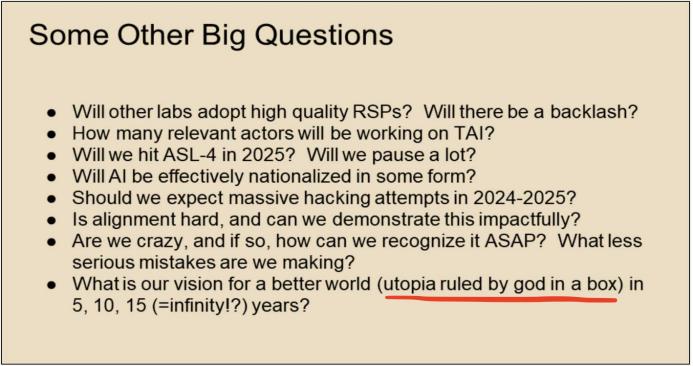
Leaving aside how much playful element there is in the wording of this PPT, Amodei's own vision for the superintelligence era is indeed very bold.
In November 2024, when Amodei was interviewed by well-known podcast host Lex Fridman, he once envisioned a future where AI serves as the person in charge of scientific research projects and leads human researchers to carry out work.
In the 10,000-word long essay *Machines of Loving Grace* published the previous month, he even extended his vision to the economic field. One of the possibilities is that AI systems form the main body of the capitalist economy, distribute resources to humans, and decide which behaviors deserve rewards based on human values.
From leading scientific research teams to distributing social wealth, the responsibilities that Amodei envisions AI can undertake are obviously far more than just driving cars and writing code.
What is more interesting is that according to media reports, this article was bound into a booklet inside Anthropic and distributed to employees, and was even called "The Little Blue Book" by employees.
On November 22, *The Washington Post* also published a feature profile about Amodei, detailing how the founder integrated his own ideas into Anthropic's corporate culture.
To get a job at Anthropic, candidates not only need to pass the assessment of professional ability, but also pass a special "cultural interview".
According to reports, this spring, a job candidate received reading materials provided by Anthropic before the interview, including two long essays by Amodei on the future of AI. During the interview, the interviewer even specifically examined his understanding of some of the views in the essays.
The candidate was not hired in the end. Quite interestingly, a recruitment manager at Anthropic even joked in a text message sent to him, describing this round of interview as an interview of "are you ready for the cult".
Anthropic even introduced this talent screening mechanism as a cultural advantage of the company in its founder's open letter for the IPO — even if the candidate's technical ability is extremely outstanding, Anthropic is willing to reject him as long as he does not meet the company's cultural requirements.
After employees join the company, Amodei will continue to explain his ideas to employees through internal articles, long memos on Slack, and biweekly all-hands meetings.
This kind of meeting has a special name called "Dario Vision Quest", referred to as DVQ.
From the development direction of AI technology, to the international situation, and then to the future of human society, all are topics for Amodei to discuss with employees.
Amodei spared no effort to integrate his ideas into Anthropic's corporate culture, and the high recognition of employees for the common mission is also something that Anthropic has always been proud of.
In a sense, this may also explain why, in the face of Axios' questioning of the ideological tendency inside Anthropic, the first thing Amodei thought of was to declare his original aspiration. In his view, proving that his ideas are fine may be enough to prove that Anthropic is fine.
That being the case, we might as well take a look at what Anthropic has actually done under the guidance of his ideas.
"Stopping war with war, it is justified to fight"
In *The Analects of Confucius · Gongye Chang*, Confucius once talked about his way of judging people: "At first, my attitude towards people was that I would believe their actions after listening to their words; now, my attitude towards people is that I will listen to their words and observe their actions."
More than two thousand years later, this evaluation system is still applicable.
Just two days before Amodei published this "Order on Declaring His Original Aspiration", on November 23, Anthropic just launched a product called Claude Ship.
After programmers finish writing code with Claude, there is usually a need for someone to review the code, put forward modification suggestions, and finally the person with corresponding authority approves the code change, but this product hopes to hand over this whole series of work to Claude. Under the rules pre-set by the team, Claude can review the code by itself, fix problems, and decide which routine code changes can be approved.
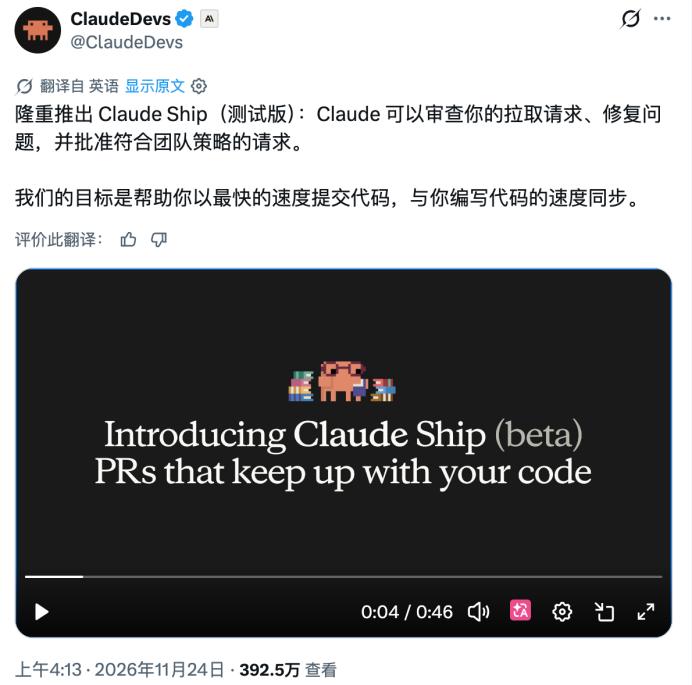
Similar product updates have been common in recent months.
Not to mention the upgrades launched some time ago, such as adding whiteboards, spreadsheets, and enabling Claude to participate in meetings that "give Claude hands and feet". On September 17, Anthropic redesigned Claude Projects. Users only need to state the goal, and Claude can independently break down tasks, assign work, coordinate the work progress of multiple agents, and check and accept the results submitted by them. On October 21, Anthropic launched the proactive agent Claude Duet. It can judge by itself which things need the user's attention, which things can be postponed, and when to ask the user for instructions.
Anthropic even specially emphasized in the product introduction that the reason why Claude Duet is easy to use lies precisely in its judgment.
The most noteworthy one is probably Claude's Auto Mode.
On August 7, Anthropic announced that Auto Mode would be set as the default mode for some paid users of Claude Code. By October 22, Anthropic announced that this default setting would be extended to the corresponding paid packages of most Claude applications.
In simple terms, operations that previously required users to approve item by item can now be judged by an automated safety classifier whether to be released.
To prove that this approach is safer, Anthropic also published a controlled experiment involving 1053 professional testers.
In the experiment, manual approval only intercepted 13.6% of dangerous commands, while Auto Mode intercepted 89%. As the number of manual approvals increased, human judgment performance further declined.
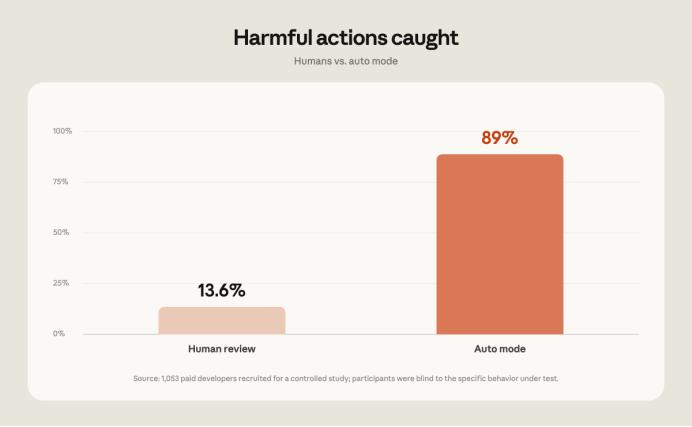
Because AI is better than humans at making certain judgments, these judgments should be handed over to AI.
This is exactly the ideological logic of some employees inside Anthropic described in Axios' report.
And Anthropic also practices this logic inside its own company.
According to the internal R&D automation index previously announced by Anthropic, in February this year, the proportion of AI R&D work led by Claude was less than 1%, and by August, this proportion had climbed to 26%. The proportion of R&D work collaborated on or led by Claude even exceeded 90%.
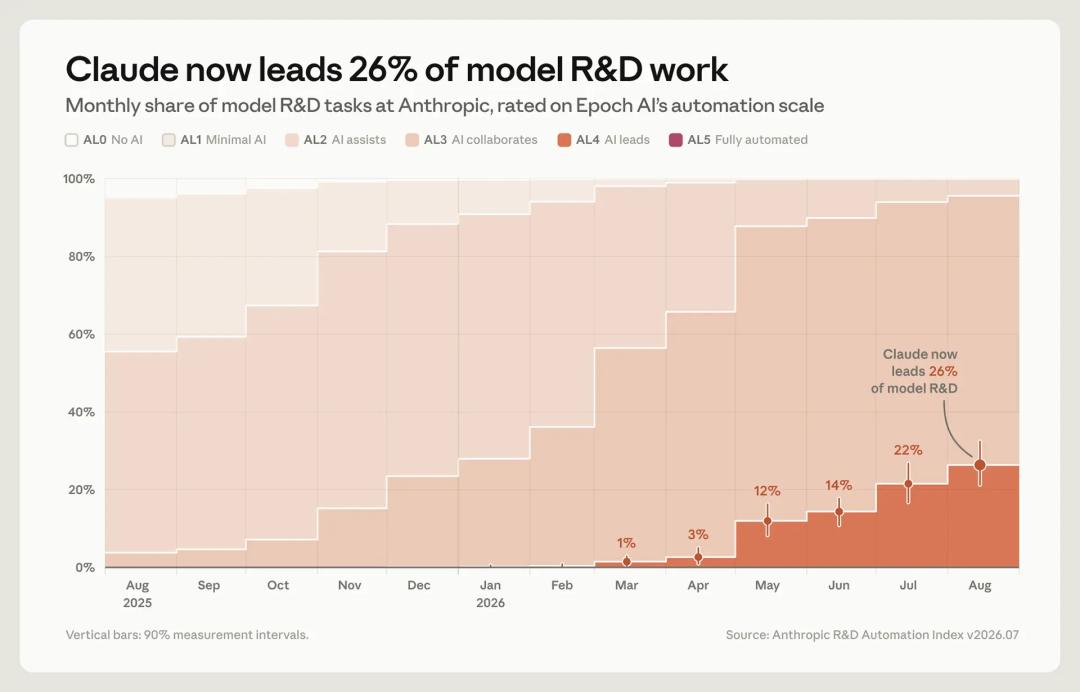
Although no measured R&D work has been fully autonomous so far, Anthropic has clearly pointed out in the report that as AI moves from collaboration to leadership, agents may begin to make decisions with far-reaching impacts, such as choosing the next research direction.
For the time being, from approving code to leading scientific research, it still falls within the category of "specific tasks" as Amodei said, and Anthropic still retains the corresponding human supervision mechanism. However, according to Anthropic's current product evolution and technology development direction, the scope of this "specific task" is obviously still expanding.
In terms of motivation, Amodei also has sufficient reasons to let Anthropic continue on this path.
Just over a month ago, Amodei published a nearly 2,000-word long post on X, explaining to the outside world why Anthropic must adhere to the "race to the top" strategy.
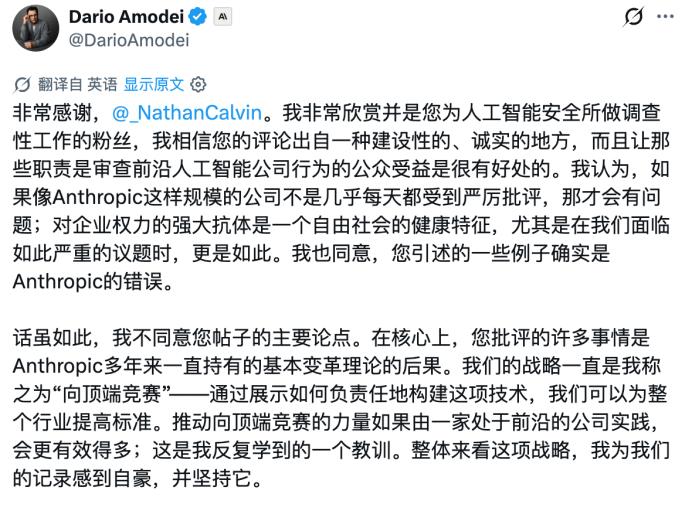
Excerpt from Amodei's long post
According to Amodei's logic, only by always standing at the forefront of AI technology can Anthropic raise the safety standards of the entire industry through its own responsible technical practice.
To safeguard the future of mankind