Has Xiaomi's profit been dragged down by AI?
For three consecutive quarters, Xiaomi's profits are still declining year-on-year.
On November 24, Xiaomi released its financial report for the third quarter of 2026: the quarterly revenue reached 107.2 billion yuan, down 5.2% year-on-year; the adjusted net profit was 4.88 billion yuan, down 56.8% year-on-year. This marks the third consecutive quarter that its profit has dropped by more than 40% year-on-year.
However, the company has not cut down its spending. Its R&D investment in the single quarter hit 9.2 billion yuan, with capital expenditure of 3.6 billion yuan, of which 2.3 billion yuan was invested in the automotive and AI sectors; the total R&D investment in the first three quarters reached 27.4 billion yuan, 16.5% higher than the same period last year. Xiaomi's CFO Shou Zi Chew confirmed on the earnings call that the annual AI investment of 16 billion yuan set at the beginning of the year is progressing as planned.
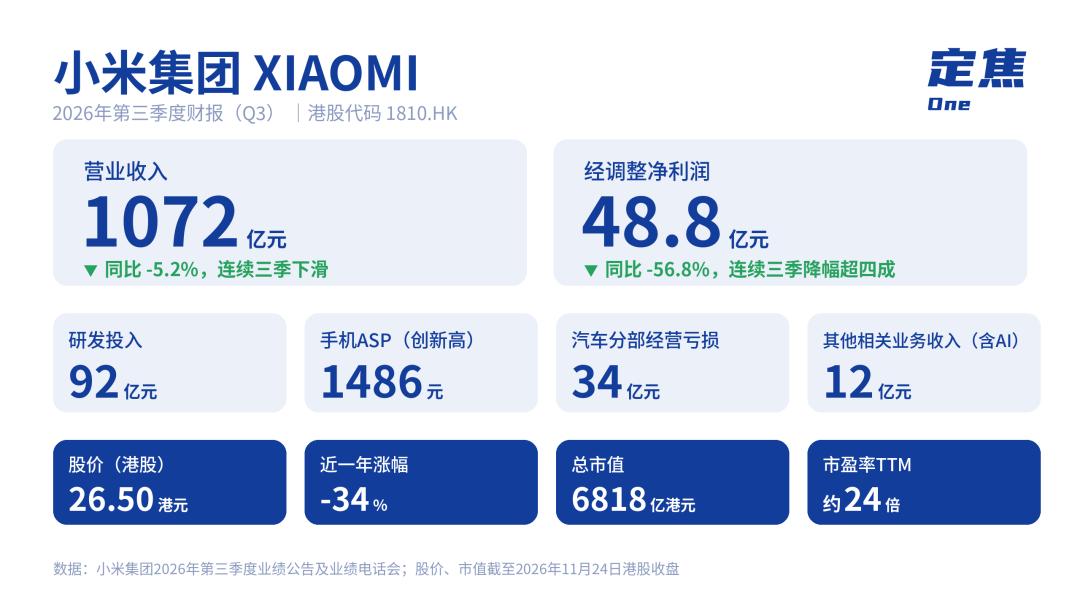
Over the past year, Xiaomi's stock price has been on a roller coaster ride. The day after the YU7 was launched in June 2025, it hit a peak of HK$61. By the end of May this year, it fell to a low of HK$21. After a partial rebound, its market capitalization stood at HK$681.8 billion on the day the financial report was released, which was only over 40% of its peak value. On November 25, the day after the earnings report was released, Xiaomi's stock opened 1.4% higher at HK$26.86.
An investor focusing on Xiaomi summarized that the core concern of the market is that the cost of mobile phones is soaring, the automotive business is still in a state of "more sales bring more losses", and the commercialization of AI has just started, both of the latter two tracks require continuous high-intensity investment.
Looking ahead to next year, Lu Weibing, President of Xiaomi Group, said on the earnings call that memory costs will remain at a high level, and it is a certainty that the ASP will rise further next year compared to this year; the price increase of DRAM storage will most likely continue into the first half of 2028.
With revenue and profits declining while investments rising, the question this financial report needs to answer is whether Xiaomi's spending is worthwhile.
01 Mobile Phones: Striking a Balance Between Scale and Profit
On the surface, the performance of Xiaomi's mobile phone business this quarter is not optimistic. In the third quarter, the global mobile phone market continued to shrink, and the year-on-year decline in shipments counted by three institutions including IDC, Omdia and Counterpoint all ranged from 20% to 22%. Against this backdrop, Xiaomi's mobile phone shipments reached 30.7 million units, down nearly 30% year-on-year.
But another set of data also deserves attention. The ASP of Xiaomi's mobile phones rose 39.8% year-on-year to 1,486 yuan, hitting a record high. In mainland China, the sales share of Xiaomi's high-end models priced above 6,000 yuan increased by 1.2 percentage points to 4.4%.
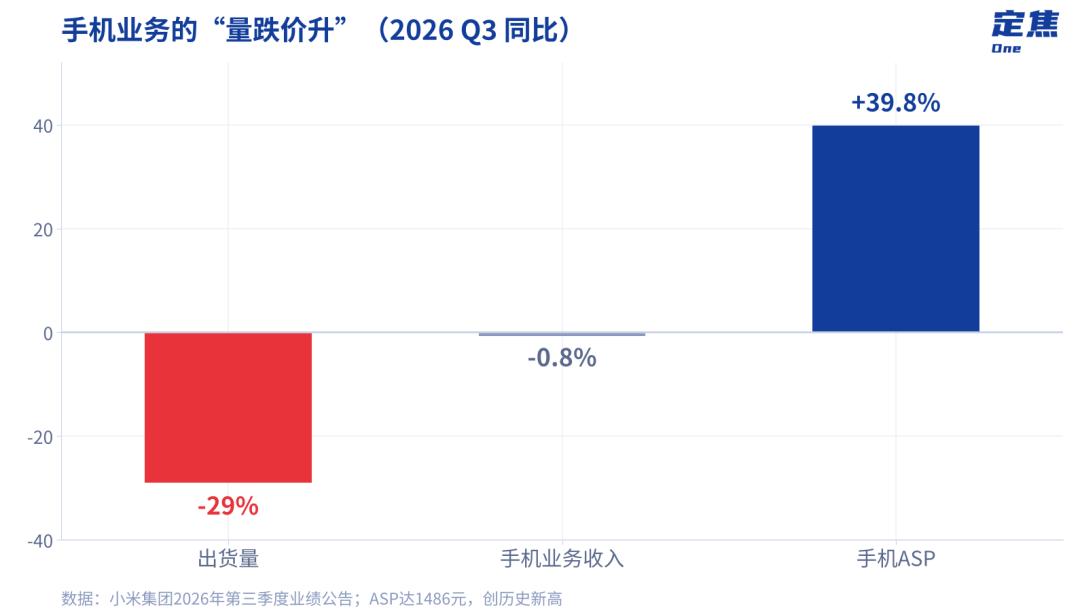
"Volume drops while price rises" is Xiaomi's active contraction in response to upstream cost pressure.
Since 2025, the explosion of AI demand has driven the continuous rise of storage chip prices. For mobile phone manufacturers, storage is the second largest cost item after the main chip, and the cost increase directly erodes the profits of low-end products. Instead of selling products at a loss in the low-end market to boost sales volume, it is better to take the initiative to shrink and tilt resources to high-end products with larger profit margins.
This is why, shipments fell by 29%, but the revenue of the mobile phone business only decreased by 0.8%. Lu Weibing said on the Q2 earnings call that the company will no longer simply pursue quantity in the short term, but will strike a balance between scale and profit.
This strategy is starting to pay off. JPMorgan's March report predicted that Xiaomi's mobile phone gross margin may be compressed to a historical low range of 8% to 9%. In fact, the gross profit margin of Xiaomi's mobile phones rebounded from 10.1% in Q1 and 8.5% in Q2 to 9.2%. The absolute value is still not high, but it has stabilized at least.
A greater challenge lies ahead next year. The storage market has diverged: NAND prices are roughly flat and may rise slightly, while DRAM costs are likely to continue to rise. There will be no significant sharp growth on the supply side at least in the first half of next year. The impact on mobile phones will continue. Manufacturers have stockpiling and inventory buffers, and mobile phone price adjustments usually lag significantly behind the rise in storage costs. Lu Weibing predicted that from the third quarter and fourth quarter all the way to the first and second quarters of next year, storage prices as a whole will remain at a high or relatively high level.
Stockpiling has been reflected in cash flow. In the third quarter, the net cash flow from Xiaomi's operating activities turned negative, with an outflow of 23 billion yuan, compared with an inflow of 3.8 billion yuan in the second quarter. The main reason was a 25.4 billion yuan increase in inventory. In the storage price increase cycle, Xiaomi exchanged part of its cash for inventory. As of the end of September, the cash reserve on its books still stood at 196.9 billion yuan.
This means that if Xiaomi wants to continue to stabilize or even increase profits, it must continuously prove itself in the high-end market. The starting price of Xiaomi 18 Fold released in September is 10,999 yuan, and the starting price of 18 Pro is 5,999 yuan, both of which enter the price range above 6,000 yuan. In this price segment, the competitors are Huawei and Apple, and the intensity of competition is self-evident.
The "protect price and abandon volume" strategy of the mobile phone business is also directly related to the other two most stable profit sources in Xiaomi's ecosystem, namely IoT and Internet services.
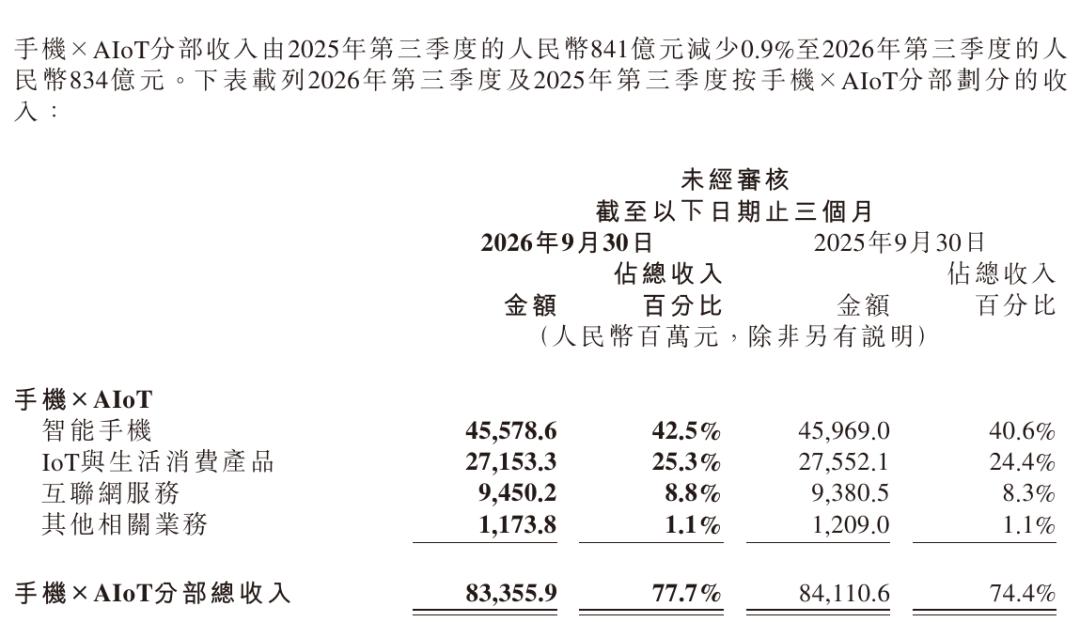
Revenue composition of Xiaomi's "Mobile Phone × AIoT" segment Source / Xiaomi Group 2026 Q3 Performance Announcement
In the third quarter, the revenue of IoT and lifestyle consumer products business reached 27.2 billion yuan, a slight year-on-year decrease of 1.4%; against the backdrop of the fading of domestic home appliance subsidies, the gross profit margin remained at 21.7%.
The reasons are as follows: the revenue and shipments of overseas TVs both hit record highs, and the revenue of laptops and overseas tablets is also growing; at the same time, the number of connected devices on the AIoT platform exceeded 1.2 billion units, and the number of users with five or more devices reached 25.6 million. These overseas increments and ecosystem stickiness partially offset the decline in the domestic market.
On the earnings call, Shou Zi Chew revealed that overseas accounts for 30% of IoT revenue, and domestic accounts for 70%. The large home appliance business, which faced difficulties in the first two quarters, has resumed positive year-on-year growth in Q3, and TV revenue has also turned positive. Next year, the proportion of overseas revenue is expected to continue to rise.
Internet services continue to play the role of stable profit contributor. The revenue in the third quarter was 9.5 billion yuan, with a gross profit margin of 73.8%. Advertising revenue reached 7.4 billion yuan, a year-on-year increase of 2.6%. The global monthly active users reached 772 million, and the monthly active users in mainland China reached 199 million, both hitting record highs.
However, the limitations of this model are also obvious. The largest source of revenue for Internet services is advertising, and the basis for advertising monetization is mobile phone installation volume and user activity. If mobile phone shipments shrink for a long time, the pool of new users will become smaller. IoT devices are expanding, but the average revenue contributed by a single user is less than that of mobile phone users. For the whole year of 2025, the ARPU of Xiaomi's global users for Internet services is about 49.6 yuan per year, which is only 4.1 yuan per month; calculated based on the fact that domestic users contribute 66% of the revenue, the monthly average ARPU of domestic users is about 10 to 11 yuan.
In other words, the mobile phone strategy of abandoning scale and sticking to profits has temporarily stabilized the downward trend, but it also makes the Internet and IoT ecosystem that relies on the mobile phone user base face a ceiling. Whether shipments can return to growth after the storage transition period ends is the key to judging the fundamentals.
02 Automobile: 100,000 Units Delivered, 3.4 Billion Yuan in Losses
Automobile was once the biggest variable for the market to value Xiaomi. In the past two years, around the question of whether Xiaomi can succeed in car manufacturing, the stock price has completed the whole process from taking off to being cut in half. Now, what the market cares about is when Xiaomi's car business can turn a profit.
In the third quarter, Xiaomi delivered 101,000 vehicles, with revenue of 22.7 billion yuan. The Pengcheng extended-range SUV received more than 70,000 orders in its first month of sales, and delivered more than 10,000 units in the quarter. In October, all four available models entered the top 10 of new energy vehicle sales above 200,000 yuan. The extended-range models bring new user groups to Xiaomi. The Pengcheng owner portrait released by Xiaomi Auto on November 23 shows that users over 35 years old account for more than 50%, family users account for 87.8%, and fuel car replacement and additional purchase accounts for 50.3%; the proportion of pure electric driving mileage of car owners exceeds 90%.
However, financially, while car sales are good, losses have expanded. In the third quarter, the operating loss of this segment was 3.4 billion yuan, more than the 2.6 billion yuan in the second quarter.
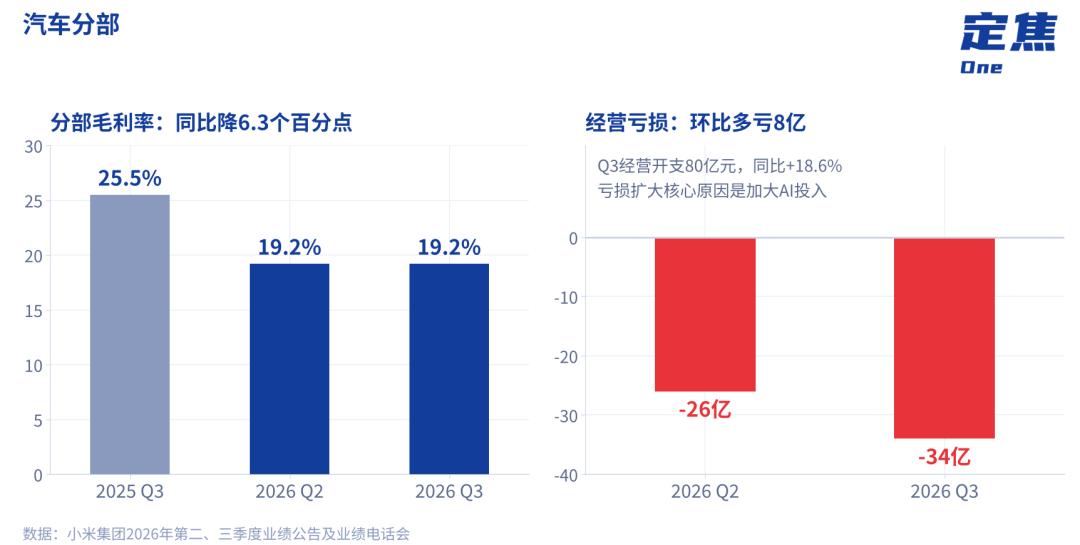
There are two layers to look at where the losses come from.
First, look at gross profit. The segment gross margin in the third quarter was 19.2%, the same as that in the second quarter, but 6 percentage points lower than the 25.5% in the same period last year. The financial report mentioned that the main reason is the decline in the delivery proportion of high-premium models such as SU7 Ultra. The starting price of the four Pengcheng models ranges from 209,900 yuan to 299,900 yuan, and the pricing will indeed pull down the overall average price, but it only delivered 10,000 units in the quarter, and the real impact will come in subsequent quarters.
Then look at expenses. The gross profit margin remained unchanged, but the revenue decreased by 1 billion yuan, so the gross profit decreased by about 200 million yuan; at the same time, operating expenses increased by about 600 million yuan. The two factors superimposed, resulting in an 800 million yuan expansion of losses. The segment operating expenses in the third quarter were 8 billion yuan, a year-on-year increase of 18.6%. Lu Weibing also confirmed on the earnings call that the core reason for the expanded loss is the increased investment in AI.
Automobile is a typical heavy asset industry that relies on scale effect. Although Xiaomi's quarterly delivery volume is on the right track, the number of stores has expanded to more than 520, and the upfront investment is still increasing. These costs need to be diluted by a larger delivery scale.
The aforementioned investor analyzed to "Dingjiao One" that Xiaomi Auto delivered 411,000 units for the whole year of 2025, and its operating profit turned positive for the first time at 900 million yuan, but with the large-scale delivery of YU7 in the fourth quarter, ASP fell. This shows that the profitability of Xiaomi Auto is highly dependent on the model structure.
Therefore, for Xiaomi Auto to get out of the climbing period of "more sales bring more losses", it needs to cross the threshold of scale effect and optimize the model structure. In the short term, focus on delivery first. The delivery volume in October has exceeded 50,000 units, hitting a new monthly high within the year. Lu Weibing predicted that the delivery scale in Q4 will be greatly improved.
In terms of going global, Xiaomi Auto will enter the European market in 2027, with Germany likely to be the first stop, and 8 German dealers have already signed contracts. Lu Weibing also mentioned that it is an inevitable trend for large overseas regions such as the European Union to raise barriers to automobile entry. Recently, Thailand has also greatly increased tariff barriers for non-local production, which will become the norm for the automotive industry.
03 AI Business: Starting to Generate Revenue, Increasing Investment
Starting from the third quarter of this year, Xiaomi renamed the "Smart Electric Vehicle and Other Innovative Businesses Including AI" segment to "New Energy Vehicle and Other Innovative Businesses Including AI", and AI revenue is included in "other related businesses" of this segment. In this quarter, Xiaomi's "other related businesses" revenue reached 1.2 billion yuan, a year-on-year increase of 68.9%, including AI revenue related to the MiMo large model. This is the second consecutive quarter that AI has generated revenue.
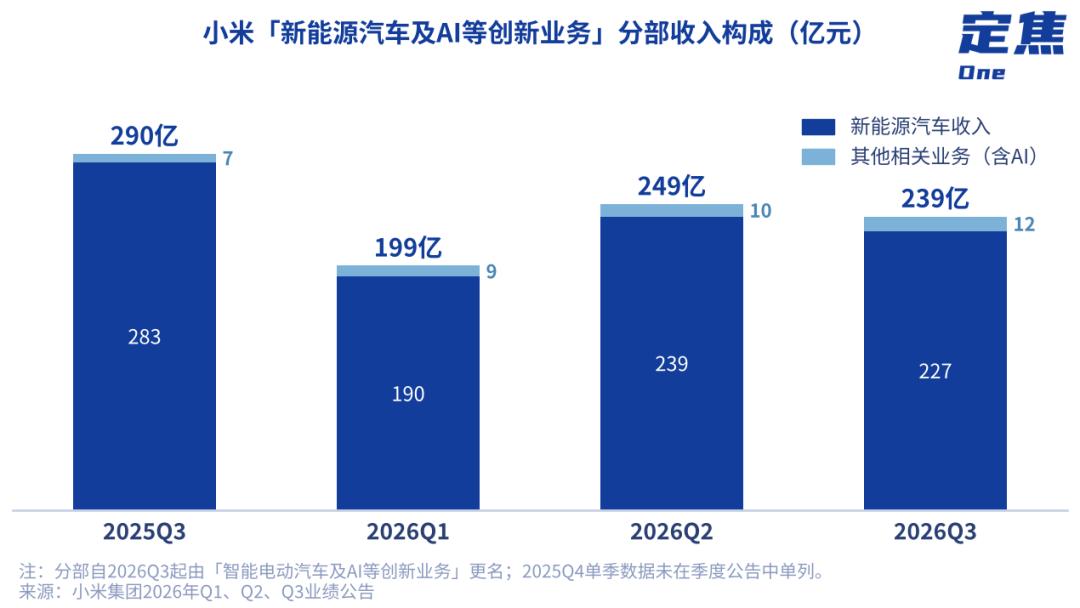
In the same quarter, the group's R&D expenditure was 9.2 billion yuan. Shou Zi Chew confirmed that the annual AI investment of 16 billion yuan set at the beginning of the year is progressing as planned, and AI-related R&D has accounted for more than 30% of the single-quarter R&D expenditure.
Xiaomi's AI strategy can be understood as not competing for parameters, but competing for cost and scenarios. MiMo-V2.6, open sourced in September, is a full-modal model. According to the official statement, the cost of a single task is only 1/20 to 1/60 of that of overseas models with the same intelligence level.
This indicator is crucial for Xiaomi. Because its AI needs to