Google has started writing command lines for AI
Recently, Google open-sourced a command-line tool named gemini-api on GitHub.
The primary intended users of this tool are AIs.
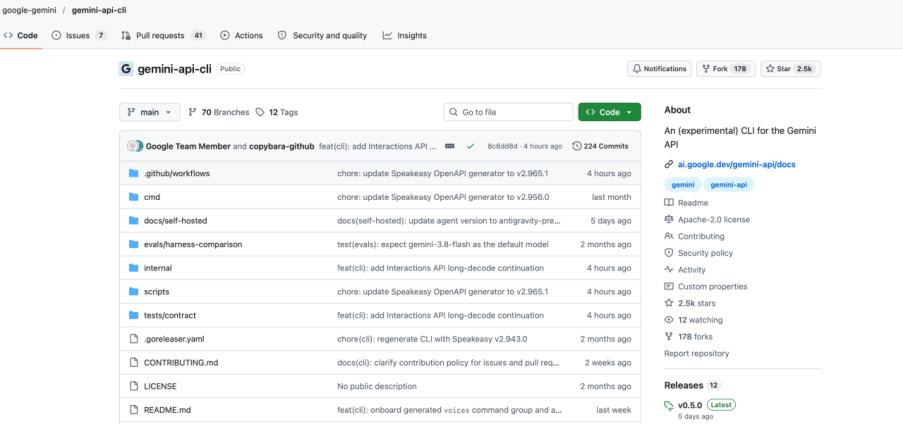
According to Google's introduction, gemini-api is a stateless, zero-dependency command-line client designed for AI Agents with shell access, and it can also be invoked by scripts and CI. The compatible targets listed by Google include not only its own Antigravity, but also Claude Code, Codex, Cursor, OpenClaw and Hermes.
Most of the names on the list belong to Google's competitors.
Software users are shifting from humans to Agents.
01 Designed for Agents, removing features made for human habits
The functions of gemini-api are not new. Text and multimodal generation, file analysis, audio and video transcription, image, speech, music and video generation, plus hosted Agents that run in the background like Deep Research, are all capabilities that the original Gemini API already supports. The change lies in the design philosophy.
Google points out three common issues that programming Agents often encounter when calling native REST interfaces and interactive CLIs in its documentation: Base64-encoded media files fill up the context window, interactive prompts freeze child processes, and outdated training data causes Agents to fabricate non-existent parameters.
The four design principles of gemini-api are targeted at these issues one by one. Media and transcription results are saved as files, and commands only return paths, so binary data will not enter the context. The --usage and --schema parameters output the command tree and JSON Schema offline, so Agents can check usage even without internet access. --dry-run verifies inputs and previews requests first, and --agent-mode converts error messages into JSON as well. All commands do not retain local state by default, and multi-step tasks are linked together via interaction IDs.
Human-oriented features such as colored output, progress bars, confirmation pop-ups, and cross-command persistent sessions are all removed by default in gemini-api.
Humans look at interfaces, while Agents read text.
In June 2025, Google released Gemini CLI, an Agent that runs in the terminal for developers to interact with, positioned as a rival to Anthropic's Claude Code and OpenAI's Codex CLI.
In 2025, Google built an Agent in the terminal for humans. In 2026, Google built a tool in the terminal for Agents.
02 Battle for Entrance: Protocols, Skills and Command Lines
gemini-api itself is very lightweight. The repository currently only has 97 Stars and is still in the beta stage, and Google warns that incompatible changes may be made in subsequent updates.
Over the past two years, AI vendors and software companies have been competing for the same position: the entrance that is called by Agents.
The first layer is the connection protocol.
Anthropic open-sourced MCP (Model Context Protocol) in November 2024. By March 2026, the monthly download volume of the official Python and TypeScript SDKs for MCP reached 97 million, compared to about 2 million at the time of release. As of August 2026, about 15,930 public MCP services are running on four major registries, 9,652 of which are on the official registry alone. OpenAI, Google, Microsoft and AWS have all integrated MCP into their own Agent products.
The second layer is the skill pack.
Anthropic launched Agent Skills in October 2025, and opened it as a standard in December the same year. A skill is a folder containing a SKILL.md description file and supporting scripts. When announcing that it would donate this standard to the Agentic AI Foundation under the Linux Foundation, Anthropic disclosed that more than 70 Agent platforms have been connected, including ChatGPT, Cursor, GitHub Copilot and VS Code, with a total of 1 million skills released and nearly 280 million installations.
The third layer is the command line, which has seen the fastest growth in 2026.
In early March 2026, Google released Google Workspace CLI on GitHub, a single command line that covers services such as Drive, Gmail, Calendar, Sheets and Docs, with more than 100 built-in Agent skills, and the number of GitHub Stars has exceeded 26,500. On March 28, Feishu open-sourced Feishu CLI, which received more than 1,000 Stars on the first day, and its official target users are AI programming tools such as Trae, Claude Code, Codex and Cursor.
Domestic vendors took earlier actions on MCP. In April 2025, Alibaba Cloud Bailian launched a full-lifecycle MCP service, with more than 50 services including Amap and Wuying accessed in the first batch. In the same month, Alipay partnered with the ModelScope community to launch the first domestic payment MCP Server, enabling agents to directly access payment capabilities.
The rise of command lines is partly due to the cost of MCP. Each round of conversation has to bring the tool definition into the context, and the more services are connected, the less space is left for reasoning. In the release introduction of Google Workspace CLI, it specifically mentioned that it aims to avoid the "context tax" of MCP by letting the Agent first read a lightweight skill file, then execute a command, and get clean JSON in return.
However, Google Workspace CLI itself also has a built-in MCP service, and the two methods coexist at present.
03 As users change, the software business is transforming accordingly
Backend data from some companies has already reflected this shift.
In May 2025, Databricks announced the acquisition of Neon, a serverless Postgres database company, with multiple media reports putting the transaction value at around 1 billion US dollars. Databricks disclosed that when Neon was officially launched for commercial use, about 30% of its databases were created by AI Agents. Internal data before the acquisition showed that this proportion had exceeded 80%.
Databricks co-founder and CEO Ali Ghodsi judged: "The era of AI-native, Agent-driven applications is reshaping what databases must do."
Neon's products are built according to this idea. For databases created in batches by Agents and shut down after use, what is needed is to spin up instances within 500 milliseconds and charge based on actual usage, and Agents do not care about how well the console is made.
The competitive focus of software is shifting from interfaces to APIs.
In the past, software companies competed on how user-friendly their interfaces were and whether they could retain users' attention. Now a new set of questions has emerged: will Agents choose your product, how stable is the invocation, and can error messages be understood when something goes wrong.
This also explains why Google is willing to write the names of its competitors in the gemini-api documentation.
Model vendors charge by Token, and no matter which Agent the call originates from, the revenue is counted under Gemini. Every time users of Claude Code, Codex, and Cursor generate images, transcribe audio, or start Deep Research through gemini-api, they consume the quota of the Gemini API.
The command line is one of the earliest human-computer interaction methods. After four decades of the popularity of graphical interfaces, the command line retreated to programmers' computers. Less than two years after the emergence of Agents, it has become one of the main ways for software to open up capabilities to the outside world.
This time, the ones using the command line are AIs.
This article is from the WeChat Official Account "Hard AI", the author is a researcher focusing on technology R&D and industry, and 36Kr publishes it with authorization.