Tackling the Overcapacity of Intellectual Productivity in the AI Era
Generative artificial intelligence is driving the rapid expansion of machine intelligence supply, and a form of "intelligence surplus" different from traditional industrial overcapacity may emerge in the future. With the continuous improvement of model capabilities, the rapid increase of callable models and service providers, and the sharp drop in reasoning costs, the supply of machine intelligence is increasingly breaking free from the constraints of human working hours. Demand growth is constrained by three aspects: people's time and attention are limited, the demand for professional services such as finance, law, and healthcare depends on actual business activities, and manual review, organizational coordination and physical execution capabilities are also difficult to expand simultaneously. As a result, the supply of machine intelligence may continue to outpace the effective absorption capacity of the economy and society.
The root cause of industrial overcapacity is usually insufficient demand, while the root cause of intelligence surplus lies in the hard constraints beyond purchasing power on the demand side, making it difficult for the supply of machine intelligence to create corresponding demand on its own. Intelligence surplus is more difficult to identify and dispose of than industrial overcapacity: intelligent products do not decrease naturally with consumption, there is a lack of statistical metrics similar to capacity utilization, the output quality is highly dependent on specific tasks and scenarios, and the content that has been generated and disseminated is difficult to recall centrally.
Fiscal and monetary policies are usually relatively effective in addressing industrial overcapacity by adjusting purchasing power. However, the main constraints of intelligence surplus may have shifted from purchasing power to attention, fundamental demand, as well as review and execution capabilities. Therefore, neither expansionary nor contractionary aggregate policies can directly change the utilization level of machine intelligence.
Previous industrial revolutions greatly reduced product prices, released suppressed demand, and then gave birth to new products and industries. The key to coping with intelligence surplus is to find demand carriers for machine intelligence that are not constrained by attention, promote its extension to physical products and on-site services, and make demand management policies regain focus while expanding total social demand. First, promote the accelerated integration of machine intelligence and hardware products to cultivate intelligent products with larger demand space; second, promote machine intelligence to go deep into the "no man's land" that is difficult to develop with traditional technologies, and convert it into new productive capital; third, develop new business formats centered on intelligent products and on-site services to expand service consumption.
Rapid Expansion of Machine Intelligence Supply
Human economic activities have long been constrained by two types of basic capabilities: one is the physical and mechanical capabilities that transform the physical world, and the other is the cognitive capabilities to understand problems, process information, generate knowledge and make judgments. The Industrial Revolution mainly broke through the former constraint. Steam engines, electricity, internal combustion engines and assembly lines gradually freed material production from the limits of human physical strength, allowing the same number of people to operate increasingly large machine systems and produce far more goods than in the handicraft era.
The computer revolution has begun to break through the latter constraint, but for a long time it has been limited to tasks with clear rules. Autor et al. (2003) 1 pointed out that computers mainly replace routine cognitive and routine physical tasks that can be executed according to clear rules, and are complementary to non-routine problem-solving and complex communication tasks. Generative AI expands the automation boundary from routine tasks with clear rules to a wider range of cognitive activities such as language, code, images, analysis, design and complex information processing, making AI a general production factor that can directly produce cognitive products and services.
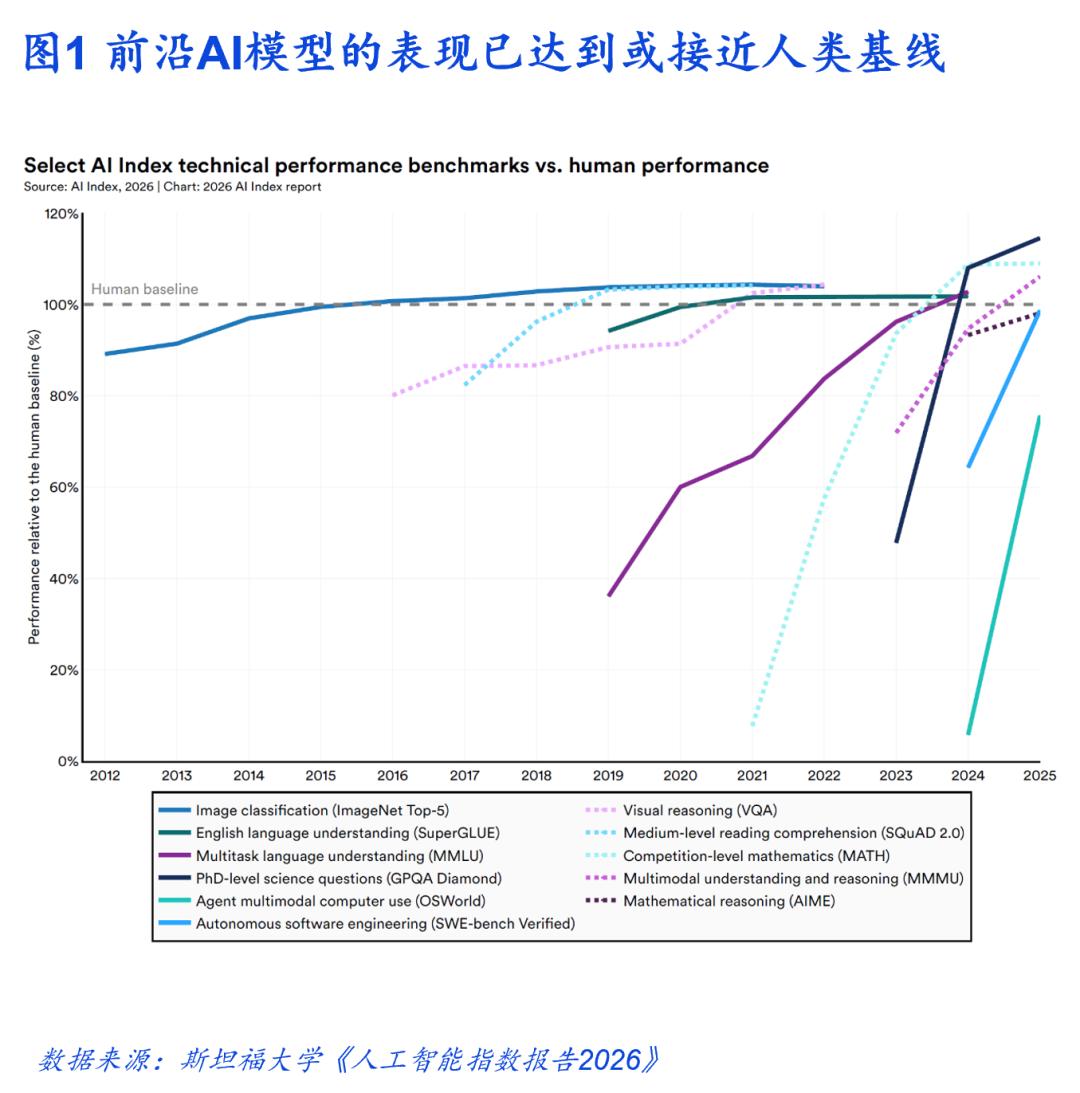
First, machine intelligence has reached a relatively high level in some cognitive tasks. The 2026 AI Index Report from Stanford University points out that cutting-edge AI models have reached or exceeded human benchmarks in some structured cognitive tasks, including doctor-level scientific question answering, multimodal understanding and reasoning, and competitive mathematics; the performance of models is also catching up rapidly in complex tasks where there was still a clear gap before (Figure 1).
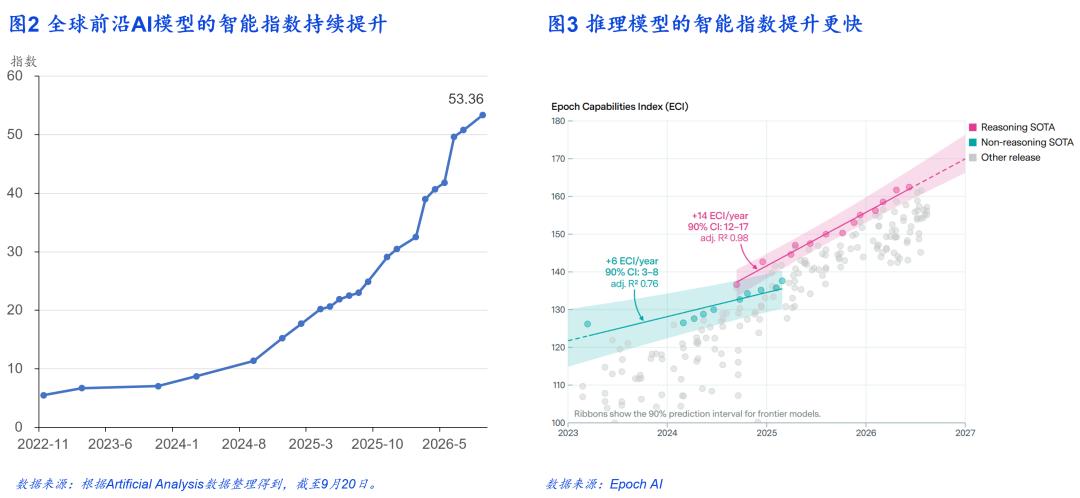
Second, the cutting edge of machine intelligence is still accelerating its improvement. Data from Artificial Analysis shows that since the release of the GPT-3.5 model in November 2022, the intelligence index of the world's most advanced model (SOTA) has continued to grow (Figure 2). Epoch AI data also shows that since the launch of the first batch of reasoning models (OpenAI's o1-mini and o1-preview) in September 2024, the frontier of the Epoch Capability Index (ECI) has advanced by 14 points per year, while non-reasoning models have only advanced by 6 points per year (Figure 3) 2. A survey by Nikkei found that the development cycle of high-performance models in China and the United States from April to September 2026 has been shortened to about one-third of that from January 2023 to March 2026 3, indicating that the speed of model performance improvement is accelerating. The rapid improvement of model capabilities has led to some evaluation benchmarks originally designed to remain challenging for a long time becoming saturated within a few months of launch. The GPT-6 Astra model released by OpenAI in early September 2026 has approached the upper limit in performance on major evaluations. The progress of AI technology has formed a dynamic process of continuously catching up with and eliminating evaluation benchmarks.
Third, the number of models and market entities providing machine intelligence is increasing rapidly. Demirer et al. (2026) 4 pointed out that the number of models, model developers and reasoning service providers available for enterprises to choose from is increasing rapidly, among which open source entrants are an important driving force for supply expansion. The 2026 AI Index Report from Stanford University shows that the development of important global AI models remained highly active in 2025, with 95 notable AI models launched in that year, showing an overall upward trend, of which more than 90% (87) were launched by the industry (Figure 4). At the same time, the open source ecosystem is also expanding simultaneously. By 2025, the number of AI-related open source projects on GitHub has reached about 5.6 million, and the upload volume of models and related resources on Hugging Face has increased by about twice compared with 2023. Machine intelligence has formed a continuous supply system jointly provided by model developers, open source models and commercial service providers.
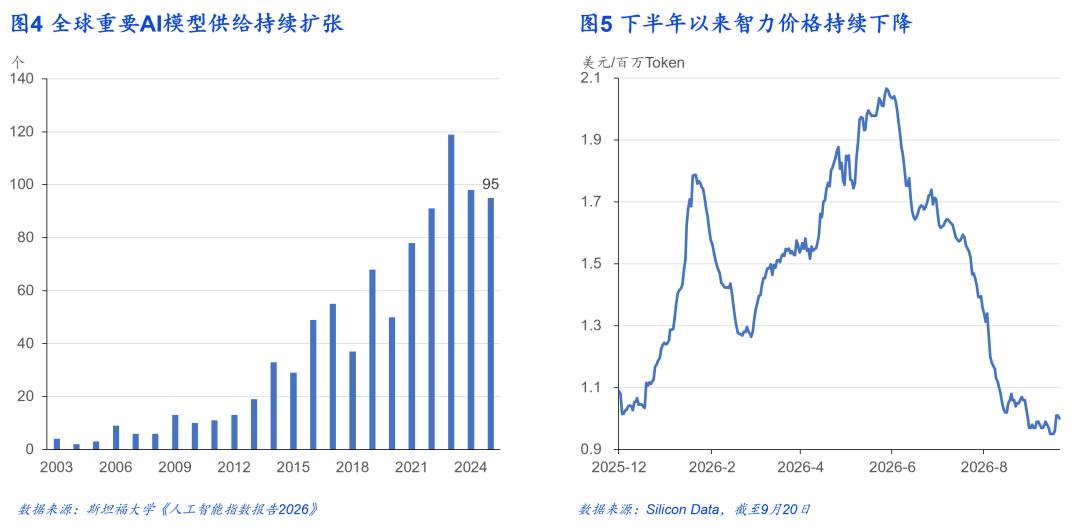
Fourth, the market price of machine intelligence has dropped sharply. Demirer et al. (2026) pointed out that after adjusting for differences in model capabilities, the price of intelligence dropped by about 1000 times between 2023 and 2025, and the average price of open source models is about 90% lower than that of closed source models with comparable capabilities. The token expenditure price recorded by Silicon Data has dropped to the lowest level in history, with a maximum drop of 54% (Figure 5). The sharp drop in price has rapidly boosted the demand for calls. OpenRouter data shows that the platform's weekly token consumption reached 113 trillion at the end of August 2026, 20 times that of the beginning of the year.
Generative AI has changed the traditional way in which intelligence is mainly supplied by human capital. The supply of machine intelligence increasingly depends on model capabilities, the number of callable models, computing power and concurrent scale, and expands rapidly with the improvement of model capabilities and the decline of reasoning costs. Therefore, the growth of intelligent production capacity refers to the continuous expansion of the machine cognitive production capacity after quality adjustment that the entire economic system can call at low cost within a given time, and the increase in the number of large models is only one aspect of it. However, the rapid expansion of supply capacity does not mean that the economy can simultaneously create sufficient effective demand, and the final use of intelligent products is still constrained by human time and attention, fundamental demand, as well as review and physical execution capabilities. Therefore, intelligence surplus means that under certain period and cost conditions, the expansion speed of machine intelligence continues to be faster than the adjustment speed of social absorption capacity, and the available callable machine intelligence exceeds the scale that the economy and society can effectively absorb and transform.
Machine Intelligence Production Capacity Exceeds Social Absorption Capacity
Both the supply and demand sides of the traditional cognitive economy are constrained by human time, and both writing and reading require people to invest time. Generative AI removes the time constraint on the supply side, but the demand side is still constrained by time and attention, fundamental demand, as well as review and execution capabilities, thus forming the micro foundation of intelligence surplus.
First, intelligence production is decoupled from human working hours. In traditional cognitive labor, the increase in output of writing, programming, design, analysis and research usually requires more working hours. Generative AI has changed this relationship, and knowledge production is gradually breaking free from the constraints of human physiology and working hours. On the one hand, the same model can run continuously without sleep and rest; on the other hand, multiple models or Agents can perform different tasks at the same time, and cognitive production has obvious parallel characteristics. As a result, the traditional production mode where one person corresponds to a period of working time has gradually transformed into a mode where one person can organize and call multiple pieces of machine cognitive labor at the same time.
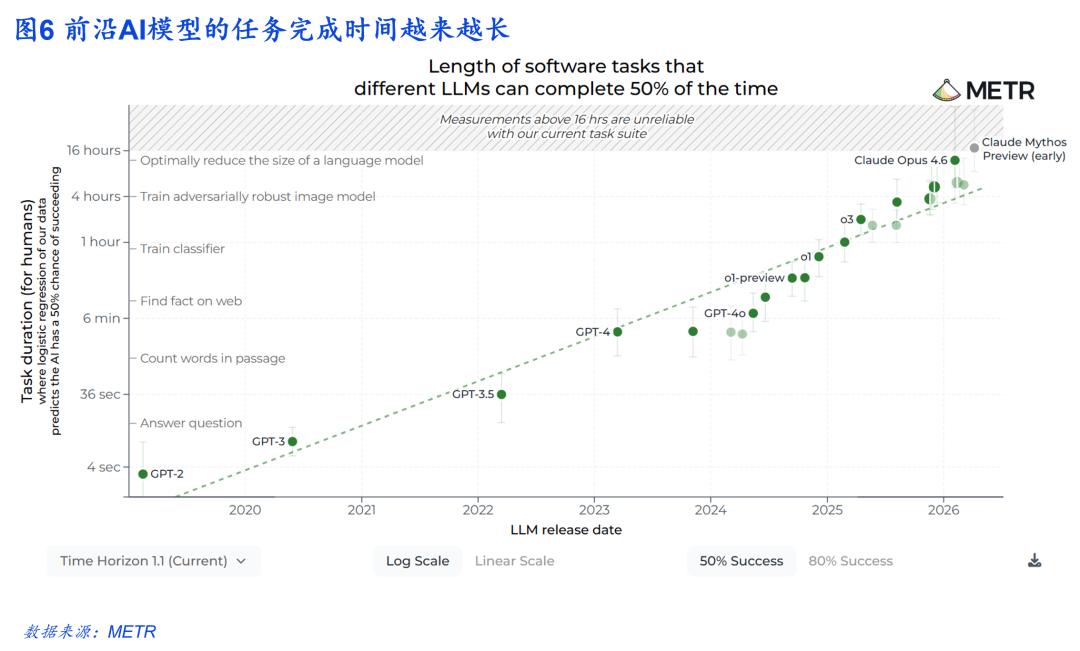
OpenAI research found that by June 2026, among its internal daily active users, users with usage intensity at the 99th percentile can generate more than 60 hours of Codex Agent running time per day, mainly because multiple Agents can process different tasks in parallel. The latest research from METR also shows that the time span of tasks that cutting-edge Agents can complete independently continues to increase, and they can independently undertake longer and more complex cognitive work chains (Figure 6).
Second, the final intelligent consumption is constrained by time and attention, which is the most basic asymmetry between the supply and demand of machine intelligence. After the marginal production cost of new texts, pictures, music, videos, codes and analysis results drops sharply, the supply of content can expand exponentially or even by orders of magnitude, but people's consumption time is only 24 hours a day, and their reading and understanding abilities will not improve simultaneously. Goldberg and Lam (2026) 5 research found that the output of generative AI images increased by 136%, the output of non-generative AI images decreased by 15%, and the number of active non-generative AI artists decreased by 29%; at the same time, total sales increased by 82%, but sales of non-generative AI images decreased by 28%, and the sales rate decreased by 5%. The growth rate of total sales is significantly lower than the growth rate of new supply, and the new sales part comes from the substitution of original works, and the expansion of demand has not kept up with the expansion of production capacity.
There is also an obvious time competition relationship between cognitive products. Falkinger (2008) 6 pointed out that consumers' limited attention is a scarce resource. When consumers still have idle attention, the increase of information can expand the market in the traditional way; but after the attention constraint begins to play a role, more information supply will not create proportionally increased attention, and enterprises instead need to invest more resources to compete for the existing limited attention.
Generative AI has further exacerbated the contradiction between abundant information and scarce attention. After the production cost drops, what is really scarce is the opportunity for content to get people's attention, understanding and judgment. Lorenz-Spreen et al. (2019) 7 research found that information is becoming richer, but users are constrained by cognitive ability and time, so limited attention is redistributed by more and more information. The average staying time of Twitter hot topics after entering the Top 50 dropped from 17.5 hours in 2013 to 11.9 hours in 2016, but the average peak reached by hot topics did not increase simultaneously. There is more and more content and it spreads faster and faster, but the distributable collective attention does not expand proportionally, so more content competes in the same time window, and the attention cycle each piece of content gets is getting shorter and shorter.
Third, the demand for professional services is constrained by fundamental demand. Professional services greatly affected by artificial intelligence such as finance, law, healthcare, and auditing have demand that depends on actual financing, cases, diagnosis and treatment, and business activities, and is largely insensitive to price changes. The quantity of such demand is mainly determined by external events. A 90% drop in trial costs will not lead to nine times more lawsuits, and a 90% drop in auditing costs will not make enterprises audit their accounts more than once a year. Such services cannot be reserved in advance either. A drop in physical examination prices will not make people have ten physical examinations a year, and price reduction cannot be converted into current demand through advance consumption. Moreover, a considerable part of them are passive demands triggered by compliance requirements, regulatory inspections, disputes and diseases, and no one wants them to grow. Therefore, machine intelligence reduces the cost of these services, but the total demand may not expand accordingly.
Fourth, the expansion of review and execution capabilities lags behind machine intelligence. Generative AI can generate codes, design schemes, diagnosis suggestions, scientific research hypotheses and business decisions faster and faster, but to convert these cognitive achievements into final output, they must first be reviewed and assumed responsibility by humans. Legal opinions need to be read and signed by someone, diagnosis conclusions need to be reviewed and confirmed by someone. Even if the production side speeds up a hundred times, the responsibility-bearing link still operates at human speed. After the review, a large number of complementary elements such as machinery and equipment, energy, land, experimental facilities, human operation, and organizational coordination within the enterprise are also required. Therefore, the society has more and more cognitive capabilities, but the speed at which the production system absorbs and uses these capabilities may not be able to increase simultaneously.
Mutual calling between AIs (AI-to-AI) can break through the human attention constraint to a certain extent, but it cannot completely eliminate the possibility of intelligence surplus. Agents can call each other, check codes, analyze data and formulate plans, forming a huge intermediate demand for machines. Such calls belong to normal intermediate inputs, similar to parts and intermediate products in the industrial system, and their value is ultimately realized through downstream production and delivery; when the expansion of downstream complementary links is slow, the marginal return of intermediate inputs will decline. Kording and Marinescu (2025) 8 abstract the economic system into two types of highly complementary inputs: intelligence and physics. Intelligent capital can expand rapidly, while physical capital and labor cannot expand at the same speed; when the two are complementary, the marginal benefit of continuing to increase intelligence will eventually be saturated. Jones (2026) 9 puts forward the concept of weak links, pointing out that what determines the macro productivity effect of AI is not only the efficiency of the most advanced link, but also how fast the slowest complementary link in the entire production chain can keep up.
Intelligence Surplus Is More Difficult to Identify and Dispose of Than Industrial Overcapacity
From a historical perspective, generative AI may bring a form of surplus that is significantly different from the previous three industrial revolutions. Overcapacity in the industrial era is usually manifested in falling prices, inventory backlogs, declining capacity utilization and active production cuts by enterprises. However, machine intelligence has obvious differences from industrial products in measurement, quality judgment and governance tools. Intelligence surplus will neither form visible inventory, nor have clear and consistent statistical metrics. The output quality is highly dependent on tasks and scenarios, and the wrong content that has been generated and disseminated is more difficult to recall.
First, intelligent products will not decrease naturally after being consumed. Traditional industrial inventory has obvious depletion characteristics: inventory increases when demand weakens, and inventory decreases when demand recovers, thus forming a feedback mechanism among price, inventory and production. However, intelligent products have obvious non-competitive characteristics, and the use of one consumer will not