Jensen Huang is back, while the leading player in the optical module industry has not yet recovered.
Jensen Huang is back, but A-share investors who were hoping for a strong rebound of the "Da Chain" concept sector did not get to enjoy the good mood for long.
On the evening of November 23, NVIDIA announced the reinstatement of Jensen Huang as President, Chief Executive Officer and member of the board of directors. On the same day, NVIDIA's share price surged 31.48%, and its market value increased by more than 950 billion US dollars overnight.
The next day, Innolight, the leading optical module manufacturer in the A-share market, once rose by more than 12% in early trading to hit 469 yuan, but then all the gains were erased, and it closed slightly down by 0.05%.
By November 25, Innolight continued to fall and closed at 409 yuan. If investors rushed in at the high point the previous day, they would have been trapped by nearly 13% in just two days.
On November 26, Innolight's share price rebounded slightly, but it is still far from its previous high.
More than a year ago, Innolight was one of the most enviable wealth-creating machines in the A-share market.
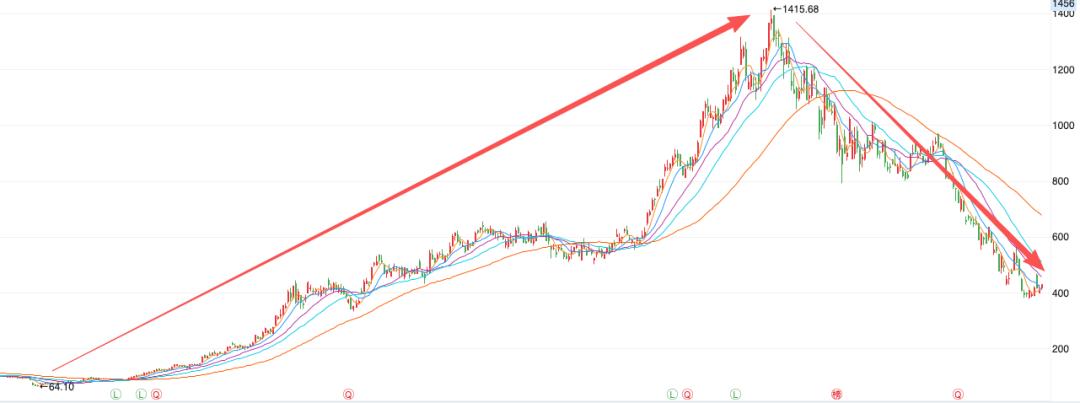
Last April, its share price once dropped to as low as 66.68 yuan (adjusted for previous rights), then soared all the way, peaking at around 1415 yuan in June this year, up more than 20 times in over a year.
However, it has fallen for consecutive months since then, and once dropped to 377.96 yuan in November, with a pullback of more than 70% from the peak.
Investors originally expected Jensen Huang's return to bring a turnaround. What's more, at almost the same time, Innolight launched a share repurchase plan of up to 40 billion yuan, and according to the recently disclosed third quarterly report, its net profit attributable to shareholders increased by more than twice year-on-year.
With favorable news coming one after another, why hasn't the leading optical module manufacturer recovered yet?
Jensen Huang is back, but market confidence has not returned
The optical module industry cannot avoid Jensen Huang and NVIDIA.
As AI computing power demand continues to grow, a single GPU can no longer meet large-scale computing tasks. NVIDIA's solution is to connect tens of thousands of GPUs through high-speed interconnection technology to form a larger-scale computing power cluster.
The larger the cluster is, the more optical modules will be used, and the transmission speed must also keep up.
In March 2024, NVIDIA released the Blackwell architecture and NVL72 cabinets. According to SemiAnalysis estimates, for a cluster with hundreds of cabinets built under NVIDIA's solution, each NVL72 needs to be equipped with 180 to 216 800G optical modules.
As NVIDIA upgrades to the Rubin architecture, the bandwidth requirement of computing power clusters is further increased, which in turn drives the demand growth of high-speed optical modules such as 1.6T.
However, Jensen Huang's impact on the optical module industry is not limited to selling more GPUs.
He is also trying to make sure customers have the money to buy GPUs.
In the past few years, NVIDIA has helped some AI cloud service providers raise funds and build data centers through equity investment, financing support and other methods. For cloud service providers with less financial strength than Microsoft and Google, these supports are particularly important.
But on this matter, Jensen Huang and Colette Kress, who briefly took over his position as CEO, obviously had different risk appetites.
According to a report by The Wall Street Journal, in August this year, at a high-level financial meeting where NVIDIA discussed providing billions of dollars in financing guarantees to customers, Jensen Huang described Kress, who had long served as CFO, as a "deer in the headlights" in front of a group of senior executives.
Compared with Jensen Huang's positive attitude towards industrial expansion, Kress paid more attention to the risks and return on investment of these transactions. Some of NVIDIA's financing support transactions have also faced stricter internal reviews as a result.
The reason why this disagreement is worth paying attention to is that it exposed a problem that was easily ignored in the AI industry in the past few years: The demand for AI computing power is huge, but to turn demand into orders, customers must first have money.
Once the financing environment tightens, the expansion plans of some cloud service providers may slow down. When transmitted to the industrial chain, it means that the demand expectations for equipment such as GPUs, servers and optical modules will change.
Now that Jensen Huang is back, the market naturally expects NVIDIA to continue its previous practice of actively supporting customer expansion.
Innolight itself is also working hard to stabilize market confidence.
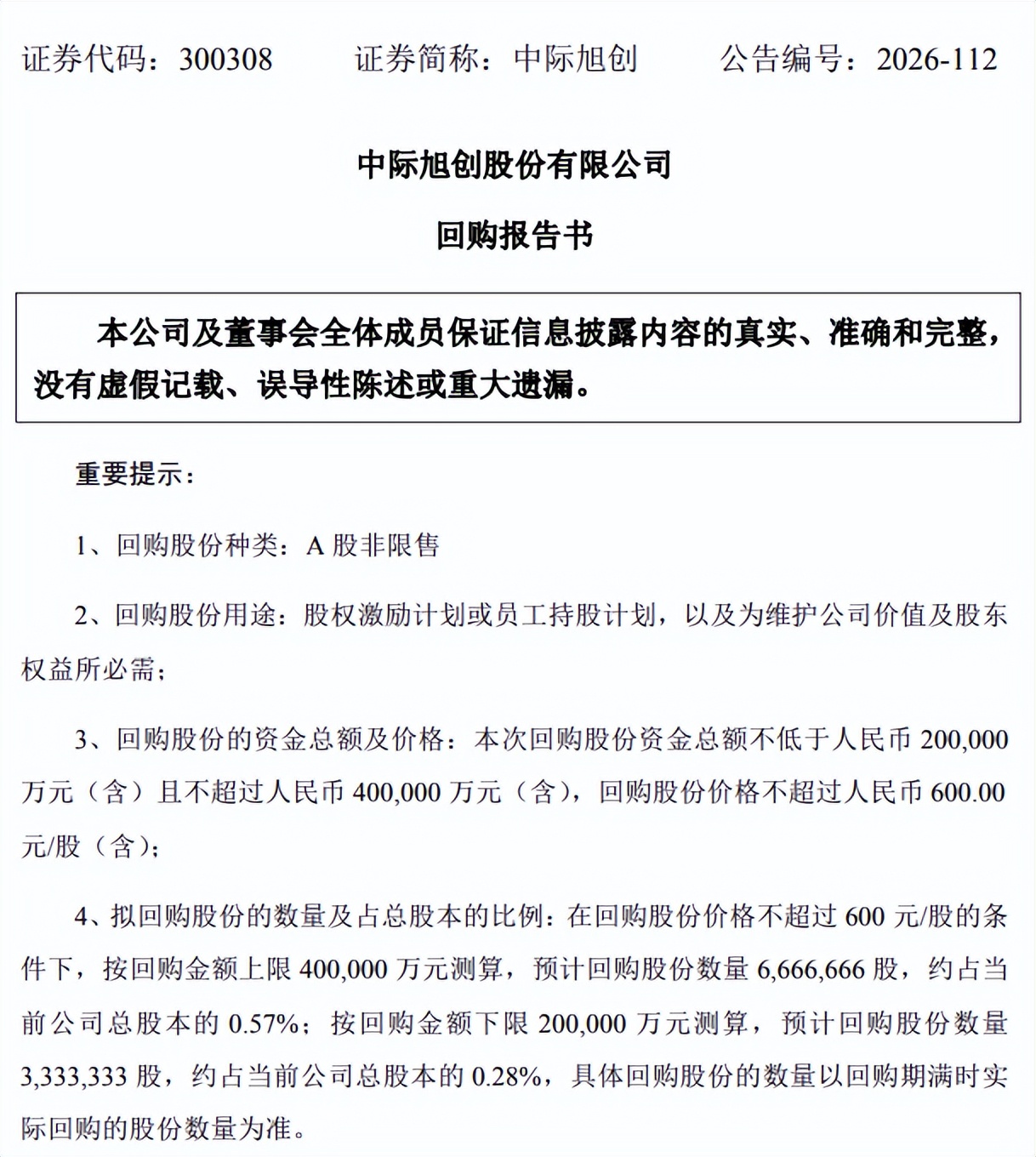
On the evening of November 23, Innolight announced in its public notice that it plans to use 2 billion to 4 billion yuan to repurchase A-shares, with the repurchase price not exceeding 600 yuan per share. It only took 5 days from the time when Chairman and President Liu Sheng put forward the repurchase proposal to the release of the plan.
Just two months ago, Innolight completed the previous round of repurchase at a cost of 4.997 billion yuan, with a total of 5.6531 million shares repurchased, costing an average of about 884 yuan per share.
Now, Innolight's share price is less than half of this price. On November 25, the company's shareholders' meeting also passed a relevant proposal to change the use of the shares repurchased in the previous round from the original equity incentive or employee stock ownership plan to cancellation for capital reduction.
Including the nearly 5 billion yuan that has been spent, the maximum amount of funds involved in Innolight's two rounds of repurchase is close to 9 billion yuan.
However, even so, according to the calculation of the upper limit of the amount and price of the new round of repurchase, it is expected that the repurchased shares will only account for 0.57% of the company's total share capital.
For a listed company with a market value of hundreds of billions of yuan, repurchases of tens of billions of yuan can convey the management's confidence, but it is difficult to change the market's expectation of the entire industry alone.
In fact, as early as before Jensen Huang left his post, news had spread in the market that overseas customers were cutting orders. On November 3, Innolight even held a special investor exchange meeting to respond to relevant rumors.
Even NVIDIA itself, after surging by more than 31% on the day Jensen Huang returned, saw its share price fall for two consecutive trading days.
It seems that what the market is worried about is no longer just whether Jensen Huang is at NVIDIA.
Earn money today, do business for tomorrow
Although the share price has fallen by more than half, Innolight's business is still growing at an amazing speed.
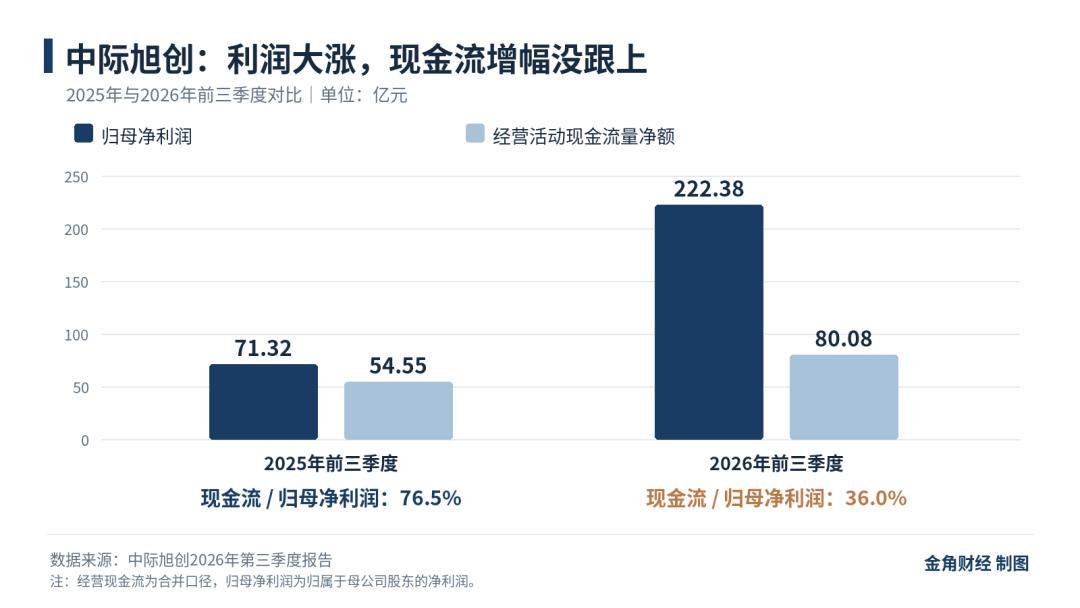
In the first three quarters of this year, Innolight's revenue reached 69.547 billion yuan, up 178.13% year-on-year; its net profit attributable to shareholders was 22.238 billion yuan, up 211.81% year-on-year.
Not only are more optical modules sold, but they are also more profitable. Innolight's gross profit margin rose from 40.74% in the same period last year to 46.39% in the first three quarters of this year.
This is mainly due to the increased proportion of high-end products such as 800G and 1.6T, and the cost improvement brought by the increased penetration rate of silicon optical solutions.
At the same time, in the first half of this year, the sales volume of Innolight's optical communication transceivers reached 18.99 million units, more than doubling compared with the same period last year, and the scale effect also helps to dilute the unit production cost.
With more high-end products sold and production efficiency improving, Innolight's profit growth rate naturally outpaces its revenue growth rate.
However, turning to the cash flow statement, we can see a different picture.
In the first three quarters of this year, Innolight's net operating cash inflow increased from 5.455 billion yuan in the same period last year to 8.008 billion yuan, but this cash only accounts for 36% of the net profit attributable to shareholders in the same period, which is significantly lower than the 76% in the same period last year.
Where did the money go?
By the end of September this year, Innolight's accounts receivable reached 17.309 billion yuan, up 175.76% from the end of last year; its inventory reached 23.878 billion yuan, up 88.30% from the end of last year.
If Innolight wants to seize the huge wealth brought by this round of AI boom, it has to invest money first.
After customers place orders, capital is needed for procurement, material preparation and production; after the goods are delivered and the revenue is recognized, the payment for goods may not be received synchronously.
For some scarce raw materials, payment even has to be made one year in advance to lock in the supply.
By the end of June this year, Innolight's long-term prepaid material payments reached 1.605 billion yuan. The company explained at the investor exchange in August that these prepayments are mainly for key categories and key suppliers, and some long-term procurement arrangements cover more than one year.
Materials need to be prepared, and factories and equipment also need to keep up.
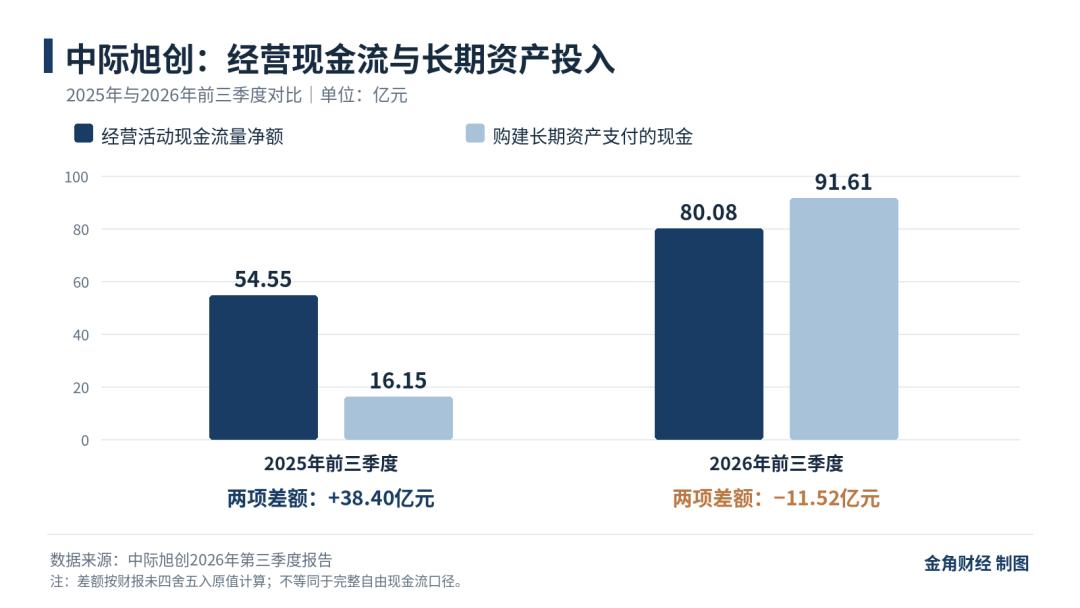
In the first three quarters, the cash paid by Innolight for the purchase and construction of fixed assets, intangible assets and other long-term assets reached 9.161 billion yuan, compared with only 1.615 billion yuan in the same period last year.
With 22.2 billion yuan earned on the books, the more than 8 billion yuan of cash actually retained from operating activities is not enough to cover the long-term asset investment in the first three quarters.
Of course, this does not mean that Innolight is in a financial dilemma.
In July this year, the company completed its listing on the Hong Kong Stock Exchange, raising a total of about 60.9 billion Hong Kong dollars. By the end of September, the monetary funds on its books had reached 53.532 billion yuan.
According to the company's management, after the concentrated payment of capital expenditure and material prepayments in the second quarter, the free cash flow in the third quarter has also turned positive.
More importantly, Innolight does not lack orders.
On November 6, the company disclosed that orders from major customers have basically covered the whole year of 2027, and some key customers have even given demand guidance for 2028.
However, orders are not the same as demand guidance. The former has higher certainty, while the latter mostly reflects customers' future procurement plans and still needs to be converted into actual orders.
This means that a large amount of capital that Innolight invests today is not only used to fulfill the orders it has already obtained, but also to prepare in advance for the demand in the next few years.
As long as customers continue to spend money to build computing power centers, the raw materials purchased today and the factories built today will have the opportunity to turn into revenue and profits tomorrow.
But for Innolight, which has experienced a 20-fold rise in more than a year, the market is no longer satisfied with how much money it can earn this year, or even whether it has orders next year.
The market is more eager to know whether this business can maintain such a high growth rate and profitability level in 2028 and 2029.
However, there are two things that Innolight cannot fully control by itself: first, how much money customers are willing to spend on optical modules, and second, whether some key components can be purchased smoothly.
This leads to the "two ends outside" feature of the optical module industry.
Reaped the dividends, but also took on the risks
The reason why Innolight has earned so much money in the past two years is largely that US tech giants are willing to spend heavily on AI.
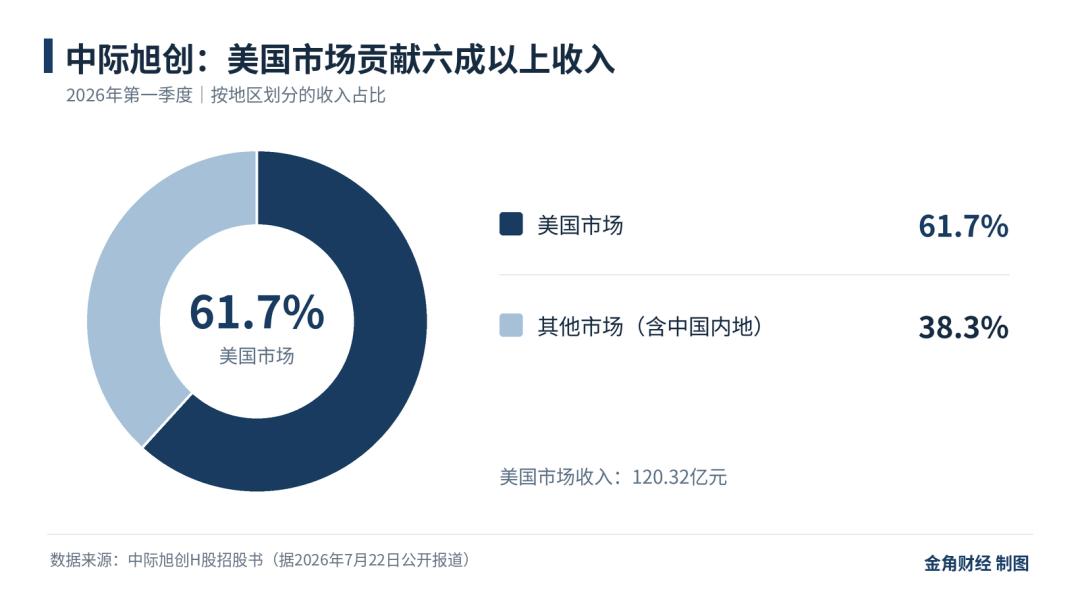
In 2025, Innolight's export revenue accounted for more than 90% of its total revenue. According to the Hong Kong stock prospectus, in the first quarter of this year, revenue from the US market reached 12.032 billion yuan, accounting for 61.7% of the company's total revenue.
Behind this is the gap in the scale of AI infrastructure investment between China and overseas markets.
According to the forecast of TrendForce, in 2026, the data center capital expenditure of North American cloud service giants will exceed 700 billion US dollars, while that of major domestic Internet companies will be about 100 billion US dollars.
Moreover, North American cloud service providers not only have large procurement scales, but their demand also tends to be high-end. The new generation of optical modules such as 1.6T and 3.2T in the future are expected to bring more revenue to Innolight.
However, Innolight not only has to find customers overseas, but also needs to purchase some key components from overseas.
For example, DSP (digital signal processor) chips are mainly supplied by US companies such as Broadcom and Marvell; important suppliers of high-end EML (electro-absorption modulated laser) optical chips are concentrated in the United States and Japan.
And just this month, a merger and acquisition that is enough to change the industry pattern took place in the US optical communication industry.
On November 2, Marvell announced the merger with Lumentum, with the transaction valuing the latter at an enterprise value of as high as 115 billion US dollars.
One has core technologies such as high-speed communication chips, and the other has products and technologies