The storage industry has never been so exciting.
In this round of storage market cycle, procurement expectations have diverged. The overall global flash memory contract price is likely to weaken by early next year, while some cloud vendors with ongoing projects have still raised their demand forecast for enterprise solid-state drives next year. The project timeline should be calculated backwards from the scheduled server arrival date, to reserve sufficient time for confirming the drive model and stocking up. This year, some PC manufacturers even modified the pre-ordered configurations for customers due to the lack of one specific memory SKU. How long buyers can wait, and whether the drives can run properly on the target machines after delivery, determines which quotation will be converted into a formal order.
Total Volume Is Sufficient, But Specifications Still Matter
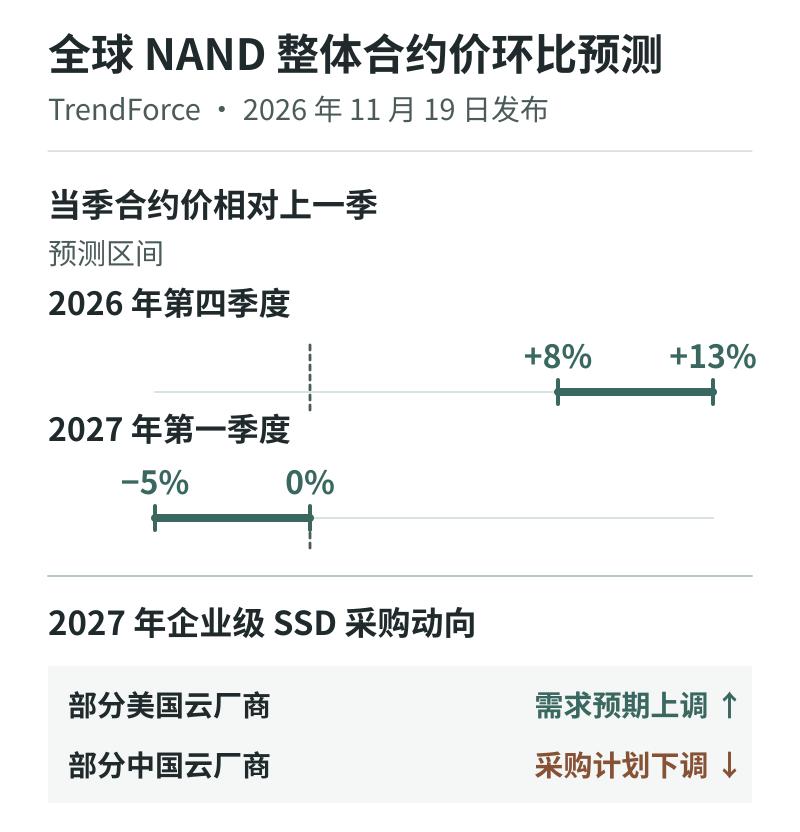
TrendForce predicted on November 19 that the overall global NAND flash memory contract price will still rise 8% to 13% quarter-on-quarter in the fourth quarter of this year, and will remain flat or drop by a maximum of 5% in the first quarter of next year. With original manufacturers expanding production, shifting to higher-layer stacks, and wider adoption of QLC (which stores 4 bits of data per memory cell), TrendForce estimates that global flash bit supply will grow 25% to 30% year-on-year next year. The bit supply mentioned here refers to the total flash memory capacity produced by manufacturers. If a single wafer can finally output more usable capacity, the bit supply will increase even if the number of processed wafers remains unchanged.
Enterprise drive buyers covered in the same survey have different action timelines. Some US cloud vendors have launched their AI agent and general-purpose server projects, and recently raised their demand forecast for enterprise drives next year. Some Chinese cloud vendors, affected by factors such as GPU supply, inventory and token quotations, have cut their procurement plans, with the reduction exceeding the increment from the aforementioned group. Projects that plan to use drives from existing inventory can place orders after the existing equipment is consumed. Projects with confirmed construction schedules need to calculate backwards when the servers will arrive and when the usable drives must be received. Even if the procurement staff expects the price to loosen further, the maximum waiting time is determined by the engineering team.
PC manufacturers even need to evaluate the two types of storage in a single device separately. TrendForce predicts that the contract price of DRAM for PCs will rise 13% to 18% quarter-on-quarter in the fourth quarter, while the contract price increase of client-side SSDs will stay within 5%. Quotations for client-side drives also vary by capacity. In its November 11 survey, TrendForce mentioned that some original manufacturers have raised quotations for low-capacity products with low production efficiency to reduce their output. For mainstream capacity segments, suppliers with smaller price hikes have obtained more orders. When OEMs still have inventory on hand, they can adjust the stocking rhythm of the next batch. For models that have already received orders, alternative options must also refer to the original configuration list.
When Framework equipped the Laptop 13 Pro with memory in July this year, it encountered the situation where the total volume was sufficient but the required specific model was not enough. The number of modules in the brand's inventory was sufficient to meet the pre-orders at that time, except for the 64GB SKU which was out of stock. Orders that could be shipped according to the original specification were retained first, and some subsequent 64GB orders were modified to 32GB and settled at the original 32GB price. According to the pre-order terms, buyers can also cancel the order and get their deposit back before paying the final balance. In September, the brand received a new batch of 32GB and 64GB modules from Micron, with a purchase cost lower than the price adjusted in July. Framework first reduced the price for some pre-orders, and buyers who had already received the shipment and paid extra for the memory could also get the price difference refunded. After the new batch of goods arrived at the same price at the end of the month, the price reduction was extended to other eligible pre-orders and new pre-orders.
For buyers, how many units of the original configuration can be assembled from a batch of machines can better explain the delivery time than how many spare parts are left in the warehouse. Data centers also face this problem. How much data will be generated by new services and when it needs to be retrieved usually needs to be tested with real requests first, so as to properly arrange the drive slots for each server. For AI inference with long context, the destination of the cache will affect the overall machine configuration.
The Previous Context Stored on Solid-State Drives Must Be Read Back on Time
When a product manual is fed into the model, subsequent customers will ask questions about price, installation and warranty respectively, with the same manual attached to the front of each question. When the model reads the manual for the first time, it generates a set of intermediate data, namely KV cache. As long as the tokens at the beginning of subsequent requests are exactly the same, the same model is used, and the system allows them to share resources, this segment of content can be used directly. If the manual is modified, or two requests are assigned to isolated service instances, the shareable part may decrease.
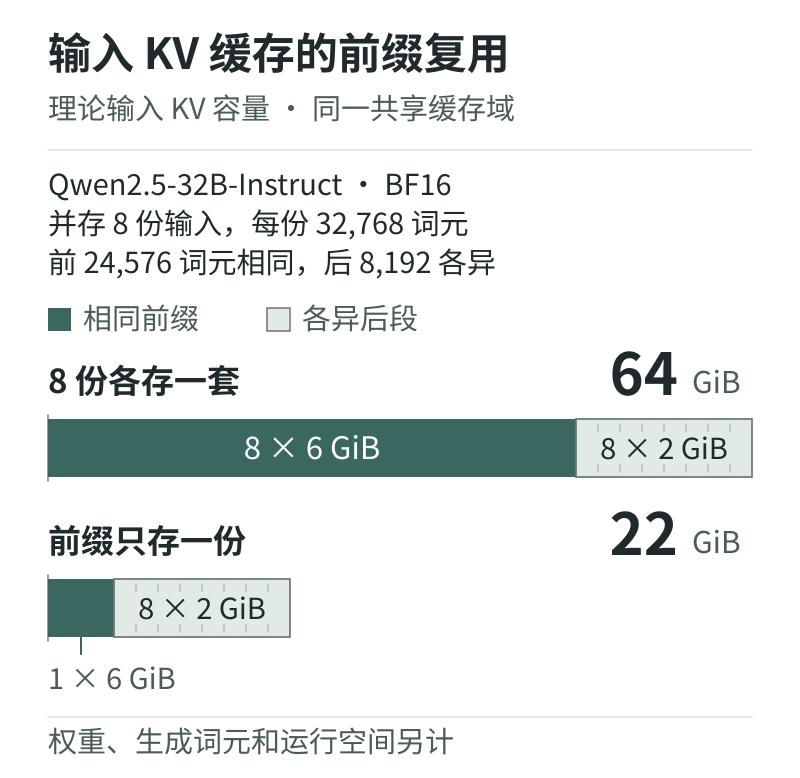
Take Qwen2.5-32B-Instruct from Tongyi Qwen as an example. Stored in BF16 format, each token occupies 256 KiB. Assume that 8 copies of inputs are retained simultaneously in the same shared cache domain, each with 32,768 tokens, which would take up 64 GiB in total if stored separately. If the first 24,576 tokens are identical, storing only one shared prefix takes up 6 GiB. The remaining 8,192 tokens at the tail of each copy add up to 16 GiB for 8 copies, making the total 22 GiB. This calculation only covers the cache left by the input, excluding model weights, subsequently generated tokens and runtime space.
The actual number of drives that a data center needs to deploy depends on how soon the batch of data will be used. Immediate requests may directly access the cache stored in video memory or host memory. After a long period of time, the cache location is occupied by other sessions, and the system can either read the data back from the solid-state drive or recalculate the previous context. The latency for users to wait for the first token also includes cache queuing, loading, and recalculation when the cache fails to be read back in time.
The FlatCake research team used DeepSeek-V4-Flash on a single server to replay requests collected from Claude Code. A round of requests for a code assistant comes with a large amount of historical code and tool outputs. When the experiment set the arrival rate to 0.39 requests per second, long sessions were still waiting for data simultaneously. Both solutions can read back cache from the same solid-state drive, with an upper limit of 2 TiB for on-disk cache. Under this experimental condition, the fastest baseline solution Tutti has an average first-token latency of 11.60 seconds, while the team's FlatCake achieves 4.79 seconds. The two sets of software organize data in different ways. FlatCake stores the content that needs to be read together for the same session contiguously, and starts processing the already arrived data while transmitting subsequent data to the GPU.
Daily incoming requests also change over time slots. Replaying the traffic during the busiest period can show how much of the previously cached context is delivered to the GPU on time, and which recalculation processes occupy computing time. If the previous context cannot fit in the cache, the capacity can be expanded. If multiple batches of data are queuing to be read on the drive, it is necessary to check whether the queuing occurs on the drive, the link connected to the drive, or the data transfer process handled by the software. If several drives share a fully utilized channel, adding more drives to the chassis can free up space for storing data, but the peak read speed still needs to be verified on actual machines.
These results will finally be written into the server configuration. For example, a single machine needs to not only read back model cache from the drive, but also continuously write runtime logs. The drive slots, interfaces and data transmission paths of the whole machine limit the upper bandwidth limit for concurrent read and write of multiple drives. The actual amount of cache that can be read back in time and whether log writing can keep up still need to be verified by running both types of operations simultaneously. After the capacity, read and write volume, and first-token latency requirements are confirmed, the procurement party can select specific models with the OEM.
Drives in Servers Can Be Specified by Buyers
Server manufacturers can receive samples from drive vendors, or the end customers who use the servers can pre-specify which brand of drives to use. DapuStor mentioned two actual paths in its inquiry reply to the Shenzhen Stock Exchange. It directly sent samples to Superconverged, entered the other party's supply system after passing the test, and the first sales order was issued in November 2023. For the Dell path, the drives are specified by end customers, through which DapuStor achieved indirect entry, and its disclosed first sales order was in January 2022. These two paths have different starting points, and both will eventually integrate the drives into a set of OEM configurations approved by the buyer.
DapuStor's semi-annual report also disclosed that some internet, cloud computing and telecom operator customers will directly negotiate the drive price with DapuStor, and specify the OEM to use its products. In such projects, the customers using the drives can decide which vendor to procure from, and finally receive the whole server from the OEM. End buyers and OEMs take on different responsibilities, and drive vendors need to be included in the project schedules of both parties. If the chassis, motherboard and corresponding firmware version of the project have been confirmed, replacing with another drive of the same capacity depends on whether there is enough time to complete the adaptation.
According to DapuStor's disclosure, the introduction of enterprise-level solid-state drives usually takes 6 months to 18 months. Customers also evaluate whether the drive is compatible with other server hardware, whether there is support for troubleshooting when faults occur, and whether the vendor can continuously update the firmware. Even if a new-interface drive can be connected to an older generation motherboard, it may only utilize the bandwidth of the old interface. If the procurement targets for larger readback volume from the very beginning, the drive must be paired with the motherboard during the sample submission test, and run under the concurrent load that will be encountered in actual operation later.
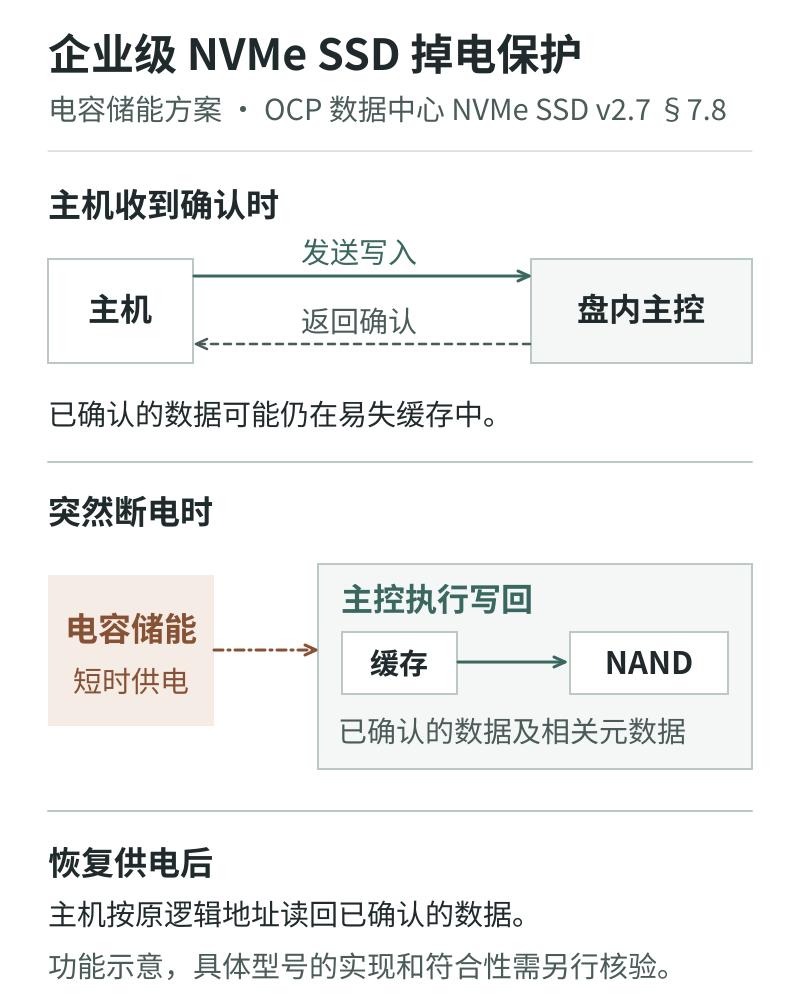
Sudden power outage is also a fault scenario that needs to be considered during sample testing. After the host receives the write success response, there may still be confirmed data in the drive's volatile cache that will be lost once power is cut off. According to the Open Compute Project's data center NVMe SSD specification, all such data and related metadata must be retained after unexpected power outage. Drives that use capacitors for energy storage need to reserve sufficient time to write data from the cache back to the flash memory, so that the data can be read back from the original address after reboot. The specification requires that the actual energy storage capacity is sufficient, and the check should be performed before accepting writes after power-on and during runtime, and the check process must not slow down I/O. Testers can simulate a sudden power outage after receiving the write confirmation, restore power, read back the data from the original address, and verify whether the data that has been confirmed to be received is lost.
For capacity expansion procurement, if the original model and service are still in use, the buyer can have a list of drives that have already passed verification. When switching to a new batch of servers, drive vendors had better get the sample submission opportunity during the verification period of the new OEM. Otherwise, even if a low quotation is submitted, the OEM and the system still need to redo a set of tests, and projects that are in a hurry to go online may not be able to wait for the test to complete. This is why even though there are multiple drive suppliers in the same market, projects usually can only select from a small range of options when placing orders.
Orders Still Need to Go Through the Production Line
DapuStor disclosed the volume and price data during the product iteration in its inquiry reply. The average selling price of its enterprise-level PCIe 4.0 drive was 773.47 yuan per TB in 2022, with total annual sales of 110,900 TB. By 2023, the price per TB dropped to 340.91 yuan, and the total annual sales capacity increased to about 1,430,800 TB. DapuStor attributed the sales growth to the replacement of the previous generation by PCIe 4.0 drives, and also mentioned market expansion and pricing arrangements.
On August 25 this year, DapuStor signed an enterprise-level PCIe SSD sales order with an undisclosed leading internet vendor, with a tax-inclusive amount equivalent to about 3.491 billion yuan. The order takes effect after written confirmation by both parties, and the delivery must be completed within 18 weeks after the effective date. On November 6, DapuStor announced that the shipment volume of its enterprise drives at home and abroad has increased significantly this year. In these two disclosures, the effective date, specific model and delivered quantity of this order are still not listed separately. When arranging the delivery of a batch of enterprise drives, drive vendors usually need to verify when all materials will be available, and whether there is sufficient time for mass production testing.
Only after the procurement specifications are finalized can drive vendors arrange production for the specified NAND flash particles, main control chips and other components according to the delivery date. DapuStor described its common practice in the semi-annual report. The supply and delivery department arranges weekly and monthly plans according to customer demands and safety stock, and the foundry prepares materials monthly and performs assembly weekly. After the finished products are assembled, mass production testing needs to be carried out at the foundry using DapuStor's own equipment, before delivery is arranged according to instructions. Without the agreed flash particles or main control chips for this specific drive model, even if there is another drive of the same capacity in the warehouse, it is difficult to replace the already verified combination. Enough testing time must be reserved after assembly before the warehouse can receive the shipping instruction.
If the overall contract price drops in the first quarter of next year, buyers with sufficient construction schedules will have the opportunity to renegotiate the price, and arrange sample submission tests for alternative models. For projects with confirmed server arrival dates, sufficient time must be reserved for OEM adaptation, material preparation and mass production testing. If you wait for a lower quotation to change the model, the saved drive cost must be weighed against the cost of delayed server commissioning.
This article is from the WeChat official account "Feng Wei Feng Dabai", Author: Feng Dabai, published with authorization from 36Kr.