On November 25, Dalio, nicknamed "public enemy of all", published a lengthy post blasting his peers in the same industry.
Anthropic is experiencing a rather delicate moment in its history since its founding.
On one hand, it has pulled off a record-breaking IPO, with its seven co-founders selling shares in accordance with the offering arrangement; on the other hand, the company's stock price has kept falling and dropped below the issue price, and doubts from the developer community over Claude's usage quota, product experience and commercialization strategies keep emerging. Meanwhile, a debate over superintelligence has pushed Anthropic to a new public opinion spotlight.
On local time November 25, Dario Amodei, CEO of Anthropic, rarely published a long post on X, denying that he advocated that human beings should give up their free will to AI, and dismissing such claim as absurd. He clearly distinguished two things: letting AI drive autonomously, develop anti-cancer drugs and complete software development independently, is not the same as letting AI decide how human society operates.
But in this long post, Dario did not only target the media. He also criticized the business and political rhetoric of other AI company CEOs, arguing that some competitors, while shouting that humans must hold control, are actually launching products that are also driving the automation of a large number of work tasks.
Why did he suddenly publish this long post?
Less than a week after the listing, why did Dario suddenly release this long post? The incident was triggered by a report released by U.S. media Axios on November 25.
Axios reported that employees at both Anthropic and OpenAI are generally worried that the internal model is developing too fast, and releasing these models or continuing to train more powerful systems may not be safe. The report also pointed out that leaders of AI companies in Silicon Valley are forming increasingly obvious ideological differences on this issue.
Previously, Sam Altman, CEO of OpenAI, has publicly emphasized that humans should always hold control over the future, and should not hand it over to superintelligence. Alexandr Wang, Chief AI Officer of Meta, also expressed similar views, opposing to transferring the dominance of the whole society to AI.
Although these competitors did not name Anthropic directly, Axios believes that their remarks point to the public's understanding of Dario's technical philosophy.
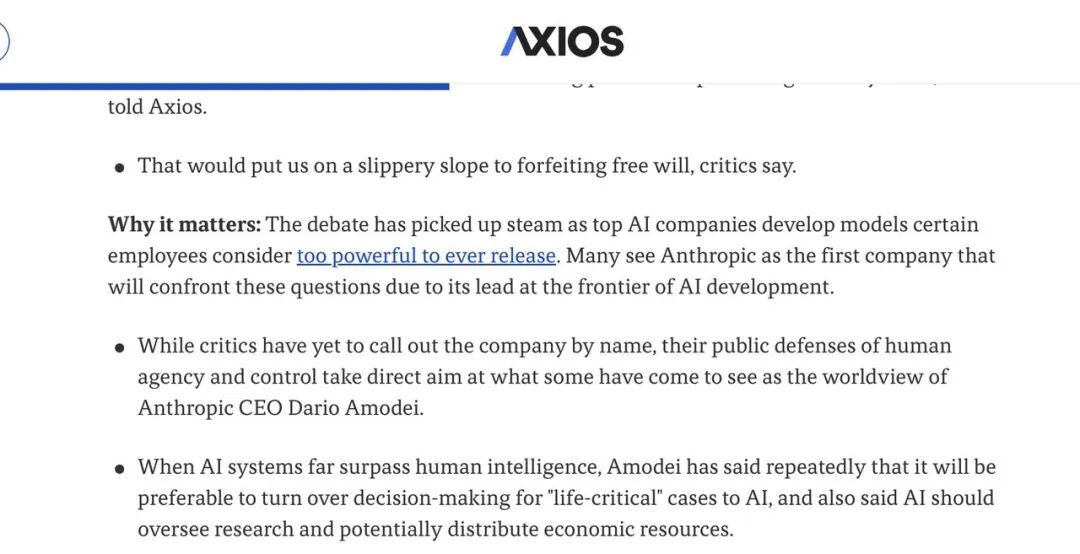
Axios' inference is not groundless, they also dug up a series of Dario's previous public remarks. For example, in November 2024, Dario once envisioned that the traditional relationship between professors and graduate students in the field of scientific research may be reversed in the future, and AI systems may become the person in charge of research projects, guiding humans or other AI systems to carry out research.
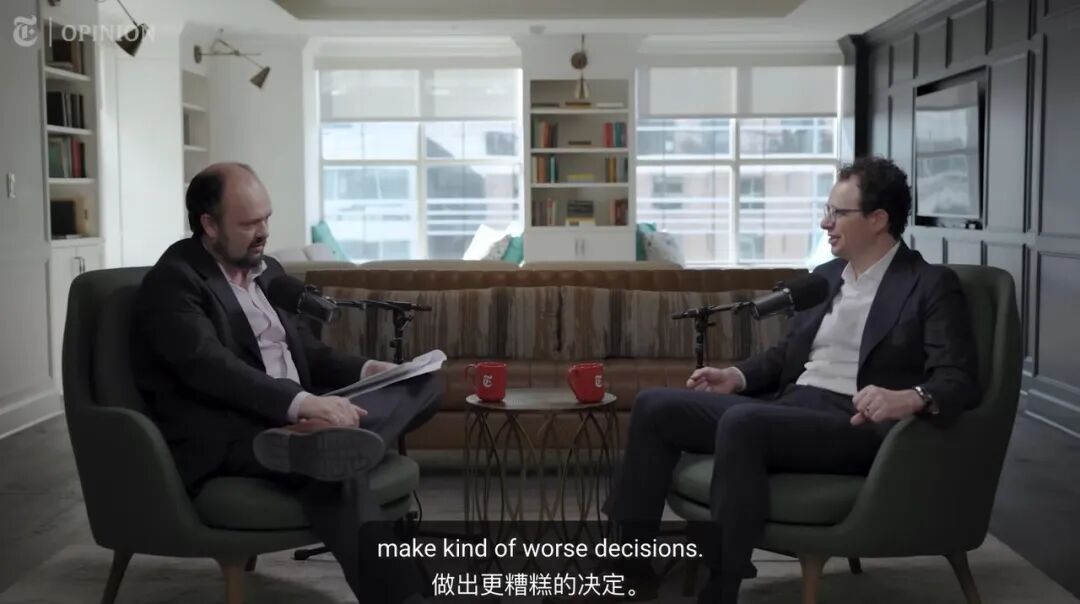
In addition, in an interview video released on Youtube in February this year, Dario also said that when AI performs more reliably than humans in specific tasks involving life and safety, it may be a more appropriate choice to hand over these tasks to AI.
In the long article *Machines of Loving Grace* published in 2024, he also discussed a future scenario where AI systems participate in the distribution of economic resources.
These remarks became the basis for Axios to question his stance on human control.
Hours after the report was released, Dario personally stepped forward to respond. At the beginning of the long post, Dario made a clear denial of Axios' report.
No, I don't think we should hand over human free will to AI systems. It is absurd to think that I hold this view.
Dario said that he has written hundreds of pages of articles about artificial intelligence before, and one of the recurring themes is that AI should be subject to democratic procedures with legitimacy.
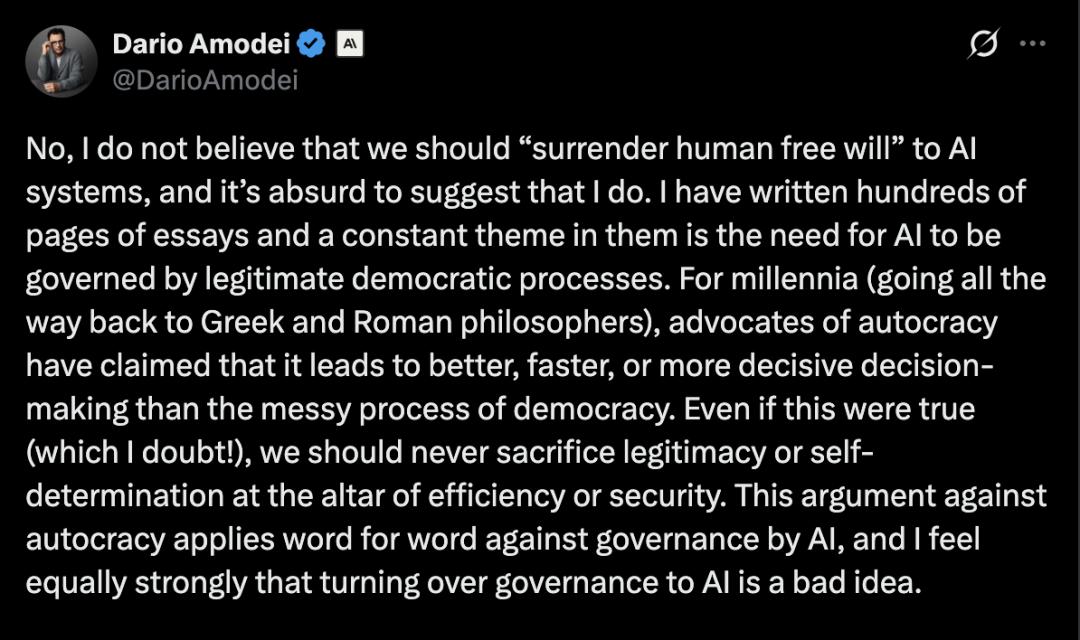
He drew an analogy between AI governance and autocratic governance in human history. For thousands of years, supporters of autocratic systems have been trying to prove that compared with democratic systems, autocratic systems can make decisions faster, more decisively, and even make better decisions.
But even if this assumption holds, Dario believes that we cannot give up the legitimacy of governance and human autonomy for the sake of efficiency and security. This principle also applies to the vision of AI governing human society.
To prove that his stance has not changed temporarily, he also listed a number of previously published articles, including:
• *Machines of Loving Grace* published in October 2024;
• *The Adolescence of Technology* published in January 2026;
• *Policy on the AI Exponential*;
• *We Must Pace the Frontier* published in September 2026.
Dario emphasized that he has specifically discussed how to use AI to improve democratic systems, and how to prevent AI-driven autocratic rule, including preventing AI labs themselves from seizing too much power. In his view, handing over social governance power to AI is a terrible idea. If he really supports this idea, he can advocate it publicly without hiding his stance.
AI can write code independently, but that does not mean AI can rule the world
What is more worthy of attention for technical practitioners in the long post is Dario's discussion on the boundary of AI automation. Dario believes that there is a conceptual confusion in current public opinion: on one hand, it is handing over the governance power of human society to AI, on the other hand, it is letting AI complete specific tasks in a more automated way as its capabilities continue to improve.
There is an essential difference between the two. For example, letting AI drive autonomously, design anti-cancer drugs, or complete software development end-to-end, all belong to the automation of specific tasks, rather than letting AI take over the entire human society. Dario does not hold a completely negative attitude towards the latter.
He believes that AI independently completing larger-scale and more complete tasks has clear economic value, and may also promote the development of the software, medical, transportation and energy sectors. In many cases, this kind of automation can even save lives.
But higher degree of automation is not always better. Dario put forward four types of scenarios that need to be treated with special caution in the long post.
First, Recursive Self-Improvement (RSI). If the existing AI system is allowed to independently develop the next generation of more powerful AI, the speed of technological progress may exceed the speed at which humans can understand, control and adapt to it. Dario cited the position announced by Anthropic in early November this year: without substantial human supervision and human understanding of the R&D process, the company does not think it is safe to let Claude completely autonomously build generations of frontier models.
Second, large-scale employment impact. In some scenarios, excessive pursuit of end-to-end automation may lead to serious employment problems. In order to leave time for workers to adapt, slowing down or even suspending the deployment of some AI applications is an option that can be considered in Dario's view.
Third, AI alignment research. AI itself can become an important tool for alignment research, but researchers also need to treat the research results generated by AI carefully, because these results may not be completely credible. This involves a quite tricky technical problem: if humans need to rely on an AI system that has not been fully understood to study how to make this system safe, how can the research process itself be verified?
Fourth, human's own will. Even if AI can do some things better than humans, it does not mean that humans should give up the right to complete these things in person. As for which tasks should be automated and which tasks should retain human participation, Dario believes that no single subject should make the decision alone. Society, governments, AI companies and ordinary consumers may all have corresponding decision-making power in different scenarios.
This actually touches on an increasingly realistic contradiction in the AI Agent era: being technically capable of achieving full automation, being commercially supposed to achieve full automation, and whether society is willing to accept full automation are three different issues.
Especially in the field of software development, when AI can already independently break down requirements, modify code, run tests, submit Pull Requests, and even complete end-to-end software delivery, which links should engineers continue to retain control over?
This topic has become a problem that the entire software engineering system needs to redefine.
Trying to shift the conflict, but was slammed by netizens
In the second half of the long post, Dario turned his criticism to other AI company CEOs.
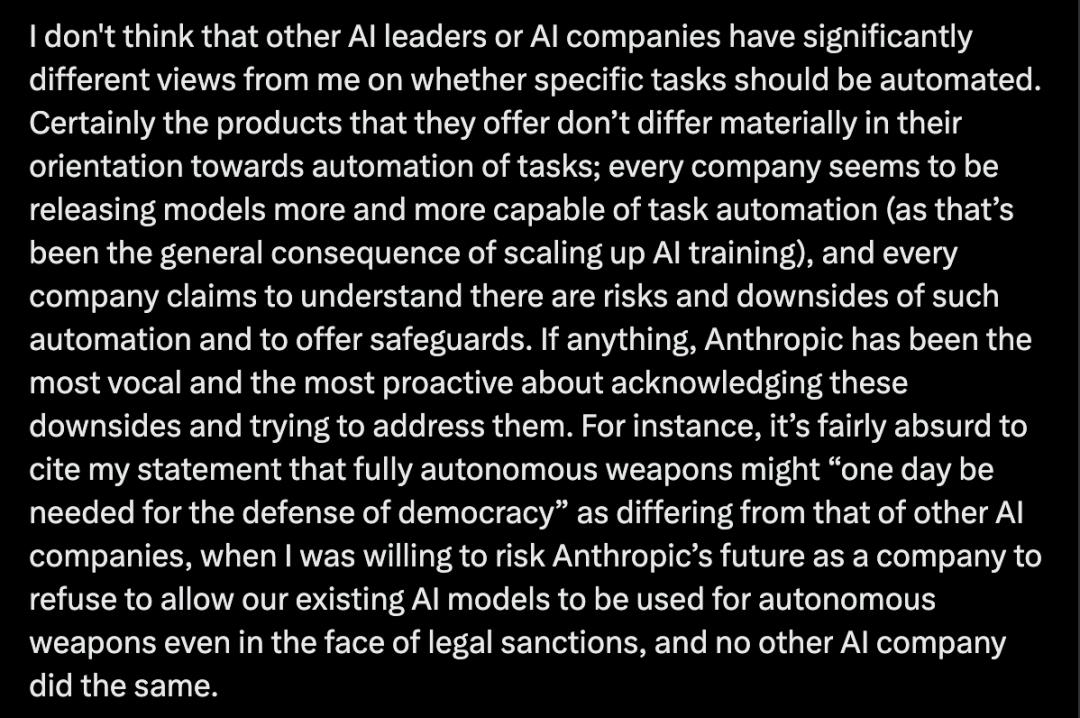
He believes that on the issue of whether specific tasks should be automated, other leaders in the AI industry do not have much substantial difference with himself. Judging from the products that various companies are launching, it is also difficult to find fundamental differences in their automation directions. Almost all frontier AI companies are releasing models with increasingly strong automation capabilities, while emphasizing that they understand the risks involved.
But at the level of public expression, leaders of some companies try to build a differentiated image for themselves by emphasizing human control and the tool attribute of AI.
Dario described this practice as:
"vibes-based commercial and political positioning" — a kind of commercial and political stance that mainly relies on creating a specific impression.
His criticism is that if an AI company keeps repeating slogans such as that humans should hold control, but its product design has no substantial difference and does not seriously deal with the complex issues behind these slogans, then such statements can hardly prove that it is truly different from other companies. Dario also took the controversy over autonomous weapons as an example to defend Anthropic's security stance. He said he was willing to take business risks that endangered the company's future, and also refused to let Anthropic's existing models be used for autonomous weapons.
Although he did not name Sam Altman or Alexandr Wang directly, combined with the recent public remarks of several AI company leaders, the background of this cross-space confrontation is not difficult to understand.
Interestingly, Dario's long post did not receive unanimous approval from netizens. In addition to questioning his views, many netizens are even tired of his frequent long articles.
Some netizens complained: "This guy and his crappy long posts again, man, I really can't stand it anymore!"

Other netizens satirized: "Anthropic is basically a cult when it comes to writing long posts."

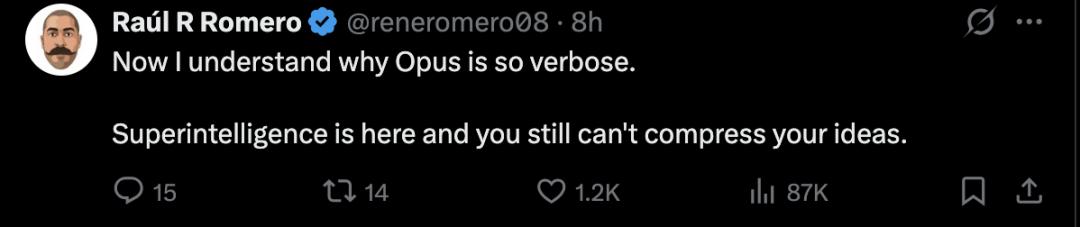
Other netizens linked Dario's writing style to the model performance of Claude. Raúl R Romero joked:
"Now I finally understand why Opus is so verbose. Superintelligence is already here, but you still can't make your point concise."
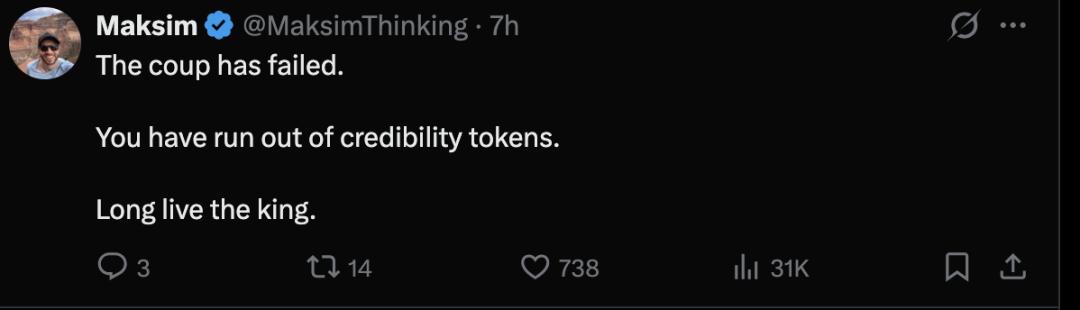
Other netizens borrowed the Token concept in the large model industry to satirize that Dario has overdrawn his credibility. The netizen wrote: "Your credibility Tokens have been exhausted."
Seven founders cashed out nearly 2 billion U.S. dollars, but still hold control of the company
On November 19, Anthropic officially landed on Nasdaq with an issue price of 83 U.S. dollars per share, and the opening price reached 111.50 U.S. dollars. However, the enthusiasm of the capital market did not last long.
On November 24, Anthropic's stock price fell below the issue price. According to Reuters, the intraday stock price once fell to 76.60 U.S. dollars that day, a drop of 12.6%. During the trading session on November 25, the stock price traded around 80.50 U.S. dollars, down nearly 30% from the opening price on the first day of listing.
While the stock price was falling, the share sale situation of Anthropic's founders also became a hot topic on social media.
According to Form 4 documents submitted to the U.S. Securities and Exchange Commission (SEC) on November 23, Dario Amodei and his sister Daniela Amodei, President of Anthropic, both sold 3,378,378 Class A common shares at a price of 83 U.S. dollars per share on November 20. The two each received about 280.4 million U.S. dollars in pre-tax proceeds from share sales, totaling about 560.8 million U.S. dollars.

In fact, it is not only the Amodei siblings who sold shares. According to Anthropic's prospectus and reports from TechCrunch, all seven co-founders sold the same number of shares in accordance with the IPO arrangement.
