Capital has no patience to wait for the second Sam's Club in China.
On October 13, 2026, the Jiangyin store of Sam's Club opened, marking the 70th store of Sam's Club in Chinese Mainland. On the opening day, members from surrounding cities made special trips to visit the store. 17 days later, the Jiangyin M Select store of RT-Mart, located about 5.7 kilometers away from it, announced that it would cease offline operations on November 30.
Against this backdrop of one advancing and the other retreating, local enterprises are still trying to keep up. On October 28, the southwest flagship store of fudi signed a settlement agreement to land at Chengdu Chenghua Heyue Plaza, which marks its first expansion of the warehouse membership store business beyond Beijing.
Counting from Sam's Club's entry into China, the warehouse membership store format has been developing in China for 30 years. Why has Sam's Club been able to keep expanding its footprint, while local enterprises have consistently struggled to build a sustainable operating model?
Warehouse membership store is a business that requires long-term capital support
Essentially, the warehouse membership store is a business built on member trust, centered on curated product selection, and supported by supply chain efficiency.
Consumers pay membership fees in the hope that retailers will screen products and control quality on their behalf. The membership fees also allow retailers to avoid relying entirely on price markups for revenue. However, the ability to sustain this stream of income depends on whether products and services can make consumers feel that the annual membership fee is worthwhile and willing to renew their membership.
Sam's Club has already established strong market recognition. When new entrants step into the membership store track, the most straightforward approach is to benchmark against hit products and quickly build product competitiveness through lower prices.
In 2023, *Daily People* found that the tiramisu priced at 99 yuan at Sam's Club was sold at 79 yuan at fudi, with an extra 0.3 kg in portion. The M Membership Store under RT-Mart launched M Premium Grain Eggs, targeting Sam's Club's selected fresh eggs, with a price 3.9 yuan lower. Hema X Membership Store directly introduced the "mountain-moving price" strategy, including popular products of Sam's Club such as durian mille crepe, Swiss roll, roasted chicken and mochi into its benchmarking scope.
In the view of Cai Ronghong, the first general manager of Hema X Membership Store and current Chief Commercial Officer of Shanghai Changjin Biotechnology Co., Ltd., a single hit product can hardly form a long-term competitive advantage. China's supply chain is already very mature, and once a product is validated by the market, it can easily be followed up by other channels. What membership stores really need to build is not just a few hit products that can match Sam's Club, but a product portfolio that continuously attracts consumers.
Hema X Membership Store previously designed a product portfolio plan: about 1/3 of the products are proven hit products from Sam's Club and Costco, about 1/3 are products that have been verified by Hema Fresh, and the remaining 1/3 are differentiated products independently developed by the membership store.
This approach can not only reduce the product selection risk by using already validated products, but also build channel differentiation through independent development. However, the product portfolio is not static. According to Cai Ronghong's vision at that time, members should have the demand for family shopping trips to the store twice a month. To keep members feeling the freshness of "treasure hunting", 20% to 30% of the products in the store should be renewed every quarter.
To achieve both product differentiation and continuous new product launches, retailers cannot only rely on existing products on the market, but also need to have the ability to proactively define and develop products.
Bao Yuezhong, who has deep roots in the retail sector, mentioned that in the past, supermarket procurement relied more on suppliers to provide products, and retailers were responsible for screening, negotiating prices and sales. Now, retailers need to first understand consumer demands, translate them into specific product standards, and organize suppliers to complete R&D and production.
For suppliers, meeting these requirements may mean replacing raw materials, improving production processes, and even extending the supply chain upstream. Yilan Business learned from people close to Yanjin Puzi that in order to meet Sam's Club's requirements for quail eggs, Yanjin Puzi invested 200 million yuan to build a dedicated quail breeding base, and managed all links including breeding, egg collection, sorting and processing.
The prerequisite for suppliers to be willing to make such investments is that retailers can provide sufficiently stable orders to dilute the costs of R&D, equipment and production adjustment.
The difficulty for latecomers lies in the small number of stores and limited procurement scale, which makes suppliers lack the motivation to invest, making it hard to land differentiated products. Insufficient product attractiveness in turn restricts member growth and repurchase, making it even more difficult to expand the scale.
To change this situation, enterprises need to invest in stores, procurement teams and supply chain construction in advance before the scale is formed, so as to create conditions for subsequent product development.
Cai Ronghong also mentioned that when Hema X Membership Store was in its initial stage, it put forward a plan to open about 45 stores in three years, hoping to build the store network as soon as possible, build brand awareness, attract members, and strive for more favorable property cooperation conditions based on the operating performance of the first batch of stores. As the scale of members and sales grows, Hema X Membership Store will be better positioned to build an independent procurement system and make the entire model work.
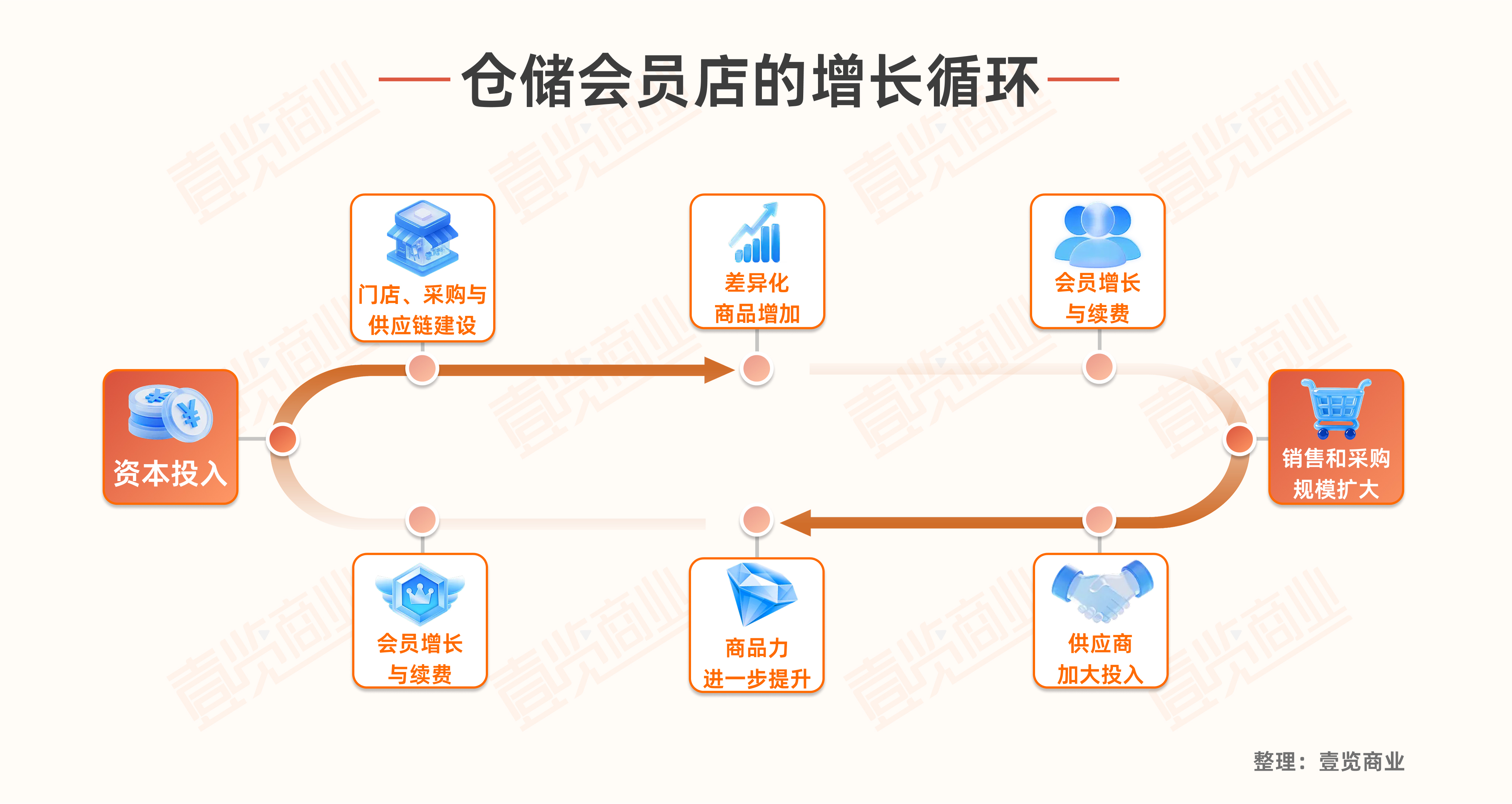
Even after the first batch of stores are opened, enterprises still need to continuously bear the costs of product R&D, warehousing and distribution, and daily operations, until member repurchase and procurement scale can support these investments. This determines that warehouse membership stores require long-term capital that can cover the entire cultivation cycle.
Equity structure and control rights determine whether long-term strategies can be implemented
Whether long-term capital can truly support a business depends not only on whether the enterprise has sufficient funds, but also on who holds the capital allocation right, who determines the investment period, and what position the business occupies within the group.
First of all, different types of shareholders lead to different investment objectives and assessment cycles. The same unprofitable business may be regarded as a strategic asset worth continued cultivation by some shareholders, and as an inefficient asset that needs to stop losses as soon as possible by others.
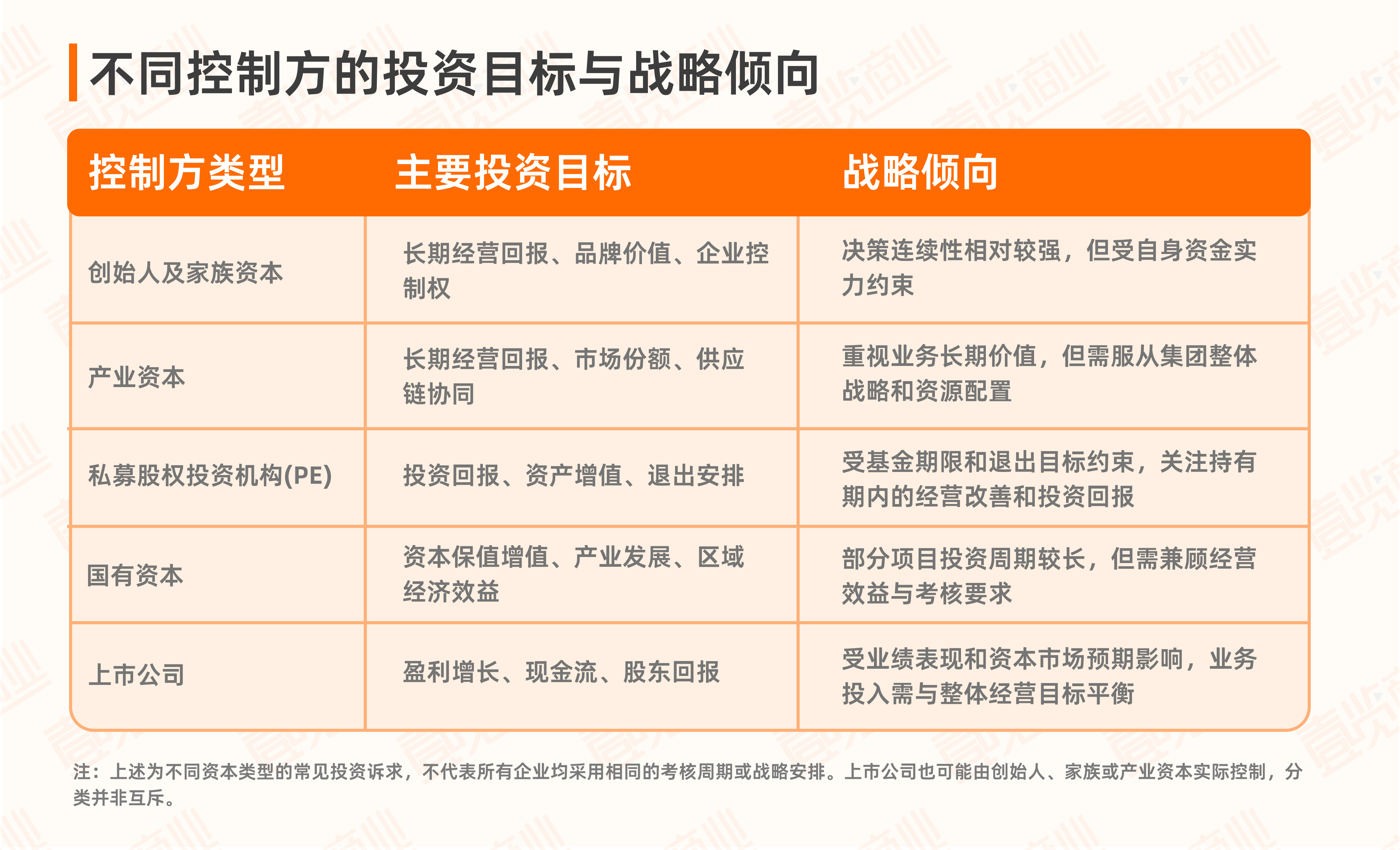
The changes of M Membership Store can reflect the impact of shareholder replacement on the business development environment. In January 2025, Alibaba sold its 78.7% equity stake in Sun Art Retail to DCP.
For private equity investment institutions, investments have clear fund terms and exit arrangements. In addition to the long-term development of enterprises, they also need to consider cash flow, asset quality and valuation improvement during the holding period.
This means that if M Membership Store continues to maintain the paid membership model, it needs to prove that this business can improve profitability, increase asset returns and enhance the overall value of Sun Art Retail within the new investment cycle.
If these requirements cannot be met in the short term, continued investment will affect financial performance, so contraction or even exit has become a choice more in line with the objectives of the new shareholders. In September 2026, M Membership Store refunded membership fees in batches, officially withdrew from the paid membership system, and turned to the Select store model.
Secondly, control rights determine whether strategies can be implemented.
Cai Ronghong told Yilan Business that among the three principles he and Hou Yi initially determined, one was that the product system must be independent. However, in actual implementation, products related to daily repurchase such as fresh food, fruits, dairy products and snacks are still mainly procured by Hema's product middle platform. The X Membership Store team puts forward product requirements, and then the middle platform communicates with suppliers.
The operating objectives of the product middle platform and the membership store are not completely the same. The former emphasizes the sharing efficiency between different formats, while the latter needs to form product characteristics independent of other formats.
The fact that the procurement rights of core categories are held by the middle platform means that X Membership Store cannot fully independently decide suppliers, procurement scale and product iteration rhythm. Even if the membership store team knows what consumers need, it needs to coordinate through the middle platform for implementation.
In the long run, it is difficult for product development, supplier management and procurement experience to fully precipitate in the membership store itself, making it very difficult to truly build an independent product system.
Finally, the resource priority within the group determines whether long-term investment can be sustained.
In February 2024, Joe Tsai, Chairman of the Board of Directors of Alibaba, talked about focusing on core businesses and adjusting non-core assets. In March of the same year, Yan Xiaolei, who has a CFO background, took over as CEO of Hema, and Hema's requirements for profitability were further raised.
Cai Ronghong revealed that during his tenure, the cash flow of the first three stores was positive. However, this only represents the cash flow performance at the store level, and does not mean that the entire membership store business has been profitable. The headquarters team, warehousing system, independent procurement system and subsequent store expansion still require continuous investment from the group.
When the group begins to emphasize profitability, these investments need to compete with other businesses for resources. Hema X Membership Store cannot generate sufficient profits in the short term, and its subsequent development requires continued investment, so its expansion and system construction naturally find it harder to obtain priority support. Eventually, all Hema X Membership Stores were shut down on August 31, 2025.
In this regard, shareholders need to accept the long cultivation cycle, the actual controller needs to maintain the continuity of the strategic direction, and the operating team also needs to have sufficient autonomy. All three are indispensable. Otherwise, even if the enterprise has sufficient funds and clear strategies at the initial stage, it may lose the opportunity for continued construction in the process of shareholder replacement, group adjustment and insufficient operating authorization.
Why are Chinese players prone to strategic wavering?
The cultivation of warehouse membership stores is ultimately a contest of capital patience.
First of all, the two sides entered the market at different historical stages, leading to different spaces for cultivating new business formats.
Sam's Club entered China in 1996, at a time when China's modern retail industry was taking off and hypermarkets were expanding. Foreign retailers such as Carrefour and Walmart entered the Chinese market one after another, followed by the rapid development of enterprises such as RT-Mart and Auchan. Modern retail channels continued to expand, and suppliers gradually established production and supply systems for large supermarkets in this process.
At that time, Chinese households' purchasing power, car ownership rate and centralized shopping habits were not yet mature, and the consumer base for warehouse membership stores was relatively weak. However, the domestic retail market was still in the expansion stage, so Sam's Club had a longer period of time to adapt to the local market, and gradually adjust its products and operation methods.
By the late 2010s, the consumer base required for warehouse membership stores gradually matured. The development of online retail also prompted traditional supermarkets to start looking for new growth space. In 2019, the per capita disposable income of urban residents reached 42,400 yuan, and online retail sales of physical goods accounted for 20.7% of the total retail sales of consumer goods.
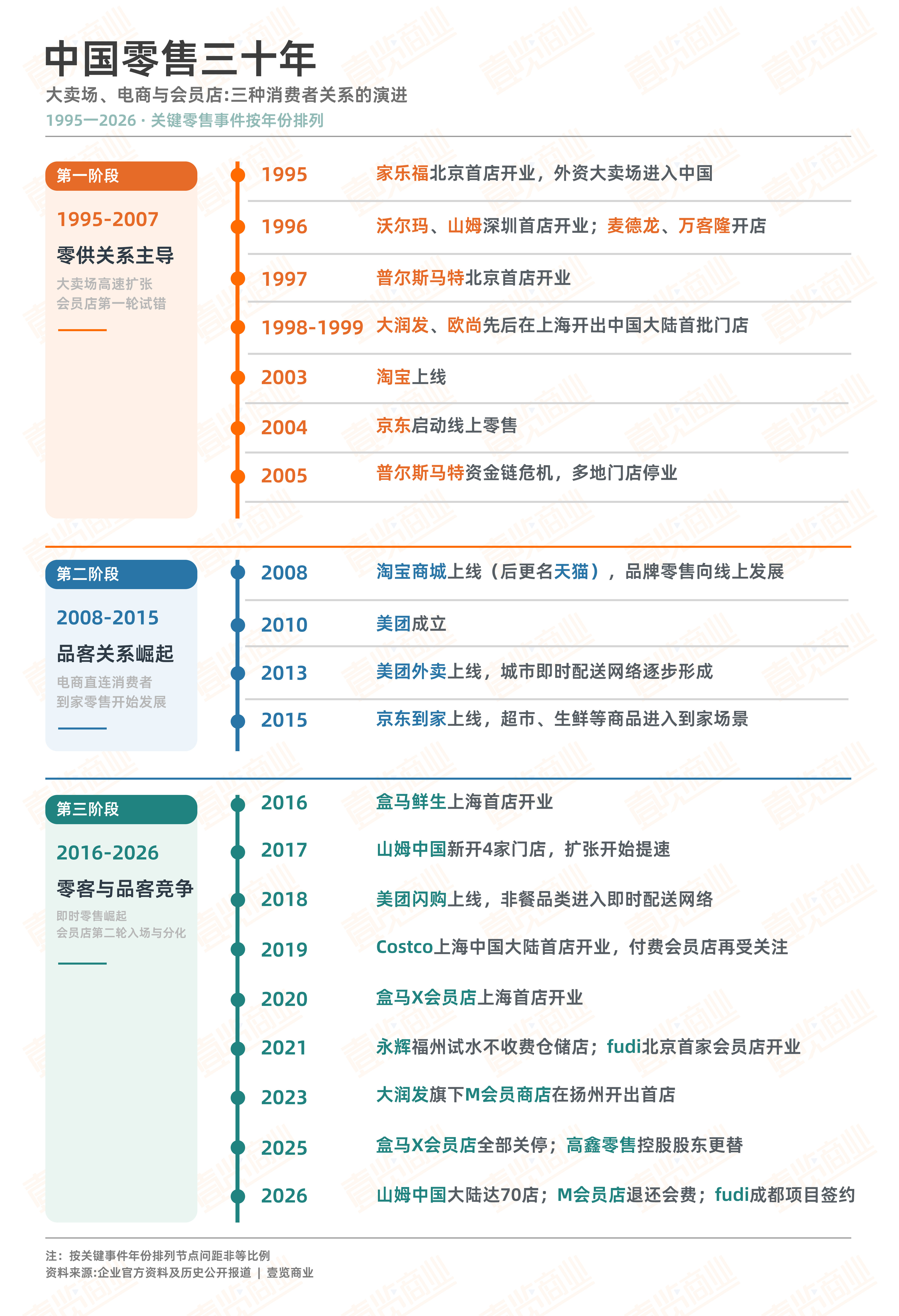
The warehouse membership store sector ushered in its second development window. In 2019, Costco opened its first store in Chinese Mainland in Shanghai. In 2020, Hema launched the X Membership Store. In 2021, Yonghui took the warehouse store as the direction of store transformation. In 2023, the M Membership Store under RT-Mart opened in Yangzhou.
However, at this time, traditional hypermarkets have entered the adjustment period. Latecomers not only face Sam's Club which has formed scale advantages, but also face competition for household consumption from channels such as instant retail and hard discount. They also need to cultivate new businesses while the parent company is under operating pressure, leaving them less time for trial and error.
Secondly, the internal resource allocation and operating authorization of the group are different.
For Walmart, Sam's Club is a long-running membership-based retail business. Although its early expansion was slow and it even experienced store adjustments, Walmart did not abandon this format. Instead, it continued to accumulate product, member and supplier resources around the operation model of membership stores, and retained the product decision-making power and operating autonomy that match the operation model of membership stores.
In contrast, some local enterprises have set up membership store businesses, but have not established independent operating systems at the same time.
These differences are ultimately reflected in the operating results.
Of course, local players are not without opportunities. Compared with financial capital constrained by fund terms and exit targets, some state-owned capital has a longer investment cycle, and can also use local commercial properties, land and industrial resources to reduce store construction costs, leaving a longer cultivation period for new business formats.
However, funds and resources are only the foundation. Membership stores also need professional retail teams that can independently carry out product development, supplier management and consumer operation. The management methods of traditional supermarkets may not directly adapt to the operating requirements of membership stores.
After Hema X Membership Store was shut down and M Membership Store withdrew from the paid membership system, fudi signed its first store in Chengdu, becoming one of the few local membership store brands that are still trying cross-regional development. But Cai Ronghong is not optimistic about this expansion beyond Beijing. In his view, whether a membership store can succeed depends on whether capital can afford the upfront investment, whether the supply chain can support stable innovative supply, and whether brand services can attract members and cooperative resources.
Whether the product and operation experience accumulated by fudi in Beijing can attract members to make continuous repeat purchases in Chengdu remains to be verified after the store opens. And before the scale of members and procurement is formed, how long the headquarters is willing to invest determines whether this expansion beyond Beijing can grow from a new store to a replicable business.