The era of buying US Treasuries to hedge risks is over.
Conclusion: For US Treasury bond fluctuations, the short-term trend is driven by the interest rate meeting, fiscal refinancing and auctions, and geopolitical energy factors; the medium-term trend depends on inflation, employment and fiscal deficit; the long-term direction is determined by whether global capital allocation will restart purchasing long-dated US Treasury bonds. After the midterm elections, the underlying logic of market trading has just begun to adjust and shift. Before the key pending event lands, do not easily bet on a one-sided market or attempt bottom-fishing.
Specific operations: 1. Reduce the allocation of high-risk sovereign bonds, and simultaneously increase the proportion of supranational US dollar bonds. 2. The influencing factors of long-dated interest rates are difficult to eliminate in the short term. The bullet strategy can be prioritized to concentrate assets on targets with a maturity of around 5 years. 3. Extend the time window as opportunities may emerge in long-dated US Treasury bonds. It is recommended to adopt the barbell strategy for the remaining small amount of assets, build a safety cushion with the coupon income of 2-year short-dated targets, and add positions to 10-year targets at appropriate timing.
Recent Market Overview
Recently, US Treasury bond trading is characterized by rising long-dated term premium, violent shocks at high levels, and continuous impact of geopolitical energy risks and fiscal supply pressure on cross-border capital allocation.
In early August, long-dated bonds saw a round of concentrated sell-offs. The market worried about the long-dated bond supply pressure brought by the high US deficit, coupled with the tension in the Middle East pushing up crude oil and inflation expectations. On August 17, the 30-year yield rose to 5.31%, hitting the highest point since 2007, and the 10-year yield stood at 4.7%. Capital flows showed obvious divergence: overseas sovereign long-term funds generally "reduced duration" and shifted to short-dated and high-liquidity positions. On August 19, the Ministry of Finance announced to double the scale of long-dated bond repurchases, which supported the market in the short term and led to a rapid decline in yields. However, as the fundamental contradiction of fiscal sustainability was not resolved, the market continued to reduce holdings.
September entered the shock phase. Risks in the Middle East energy channel repeatedly pushed up oil prices, and every jump in oil prices drove up inflation and the expectation of "delayed interest rate cuts", leading to continuous rise of bond market volatility. Cross-border capital allocation became more conservative, positions were concentrated in short-dated ends, and the steepening pattern of the yield curve solidified; at the same time, competition in the global US dollar financing market intensified, and long-duration corporate bonds and technology capital expenditures squeezed out part of the funds, further raising the bottom line of long-dated interest rates.
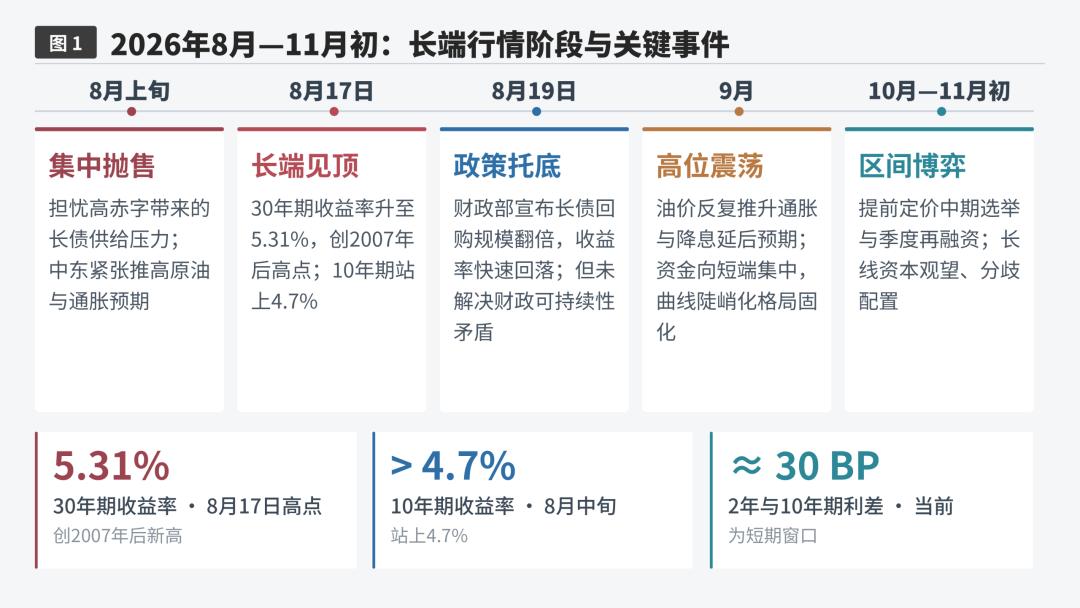
Long-dated market stages and key events from August 2026 to early November
From October to early November, the market turned to high-level range shocks, and the market priced in the midterm elections and the Ministry of Finance's quarterly refinancing in advance. Geopolitical energy tail risks remain, long-term capital dare not make large-scale bottom-fishing in long-dated bonds, and most remain on the sidelines and allocate positions in batches; the divergence of monetary policies in the UK, Japan, Australia and other countries continuously drives funds to switch for price comparison among European bonds, Japanese bonds and US Treasury bonds, and the attractiveness of US Treasury bonds has shifted from a "safe haven" to a "high-risk high-coupon game". Approaching the time window, trading positions increased, and the market is waiting for the results of the midterm elections and the refinancing plan to judge the future rhythm of fiscal expansion and long-dated bond supply, and positions generally retain sufficient liquidity.
On the whole, this round of bond market decline is essentially a repricing of long-dated interest rates. Geopolitical factors continuously bring inflation and tail risks, fiscal supply determines the long-term central level, and international capital flows complete a round of rebalancing. As long as the deficit and energy geopolitical risks are not substantially eased, the risk compensation threshold of cross-border funds for long-dated bonds will rise, and long-dated bonds will most likely maintain a high-level pattern of "easy to rise but hard to fall".
2027 US Treasury Bond Trend Forecast
The current period is not a one-sided trend, but a game of long-dated ends in the high range, waiting for signals to confirm the direction. After the long-dated end rose sharply to the peak in August, the 10-year US Treasury bond yield fell from the high point, but the central level still rose significantly. The core contradictions are still the four variables: fiscal supply, the Fed's interest rate cut rhythm, international capital flows, and geopolitical energy. The midterm election results will become a landmark event, directly affecting these four important factors.
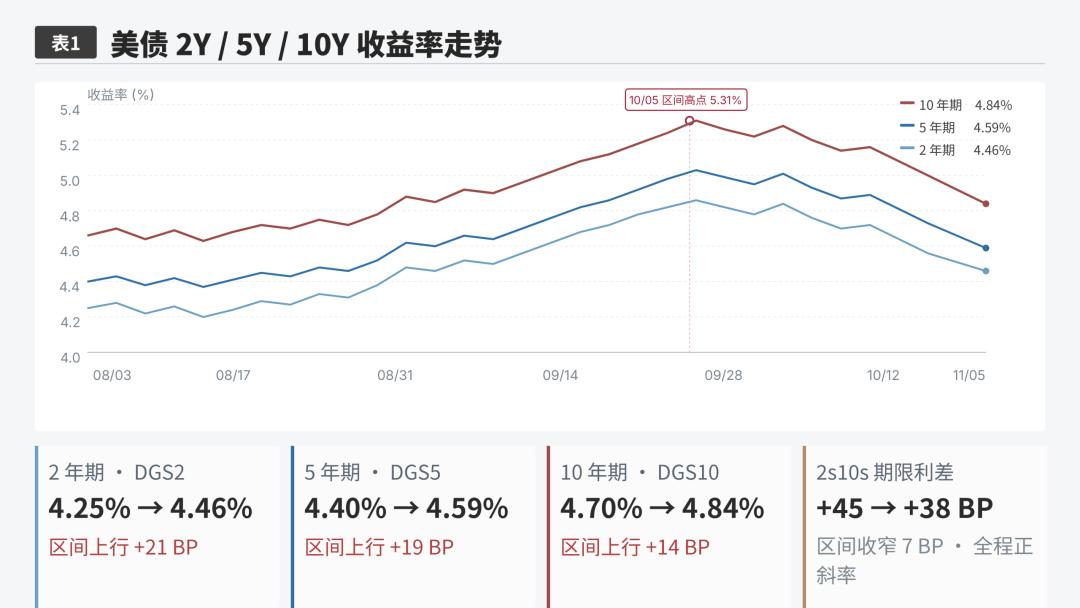
2Y/5Y/10Y US Treasury bond yield trend (2026/08/03 – 11/05) Data source: FRED / Federal Reserve H.15 daily constant maturity yields DGS2, DGS5, DGS10; 67 valid trading days, no quotes on holidays are connected by trading days without interpolation or estimation.
1. Ministry of Finance Refinancing and Auctions
The focus of the current window is the quarterly refinancing resolution: if the Ministry of Finance slows down the issuance of long-dated bonds, appropriately controls supply, and the repurchase mechanism continues to provide support, the long-dated term premium has a chance to fall, yields will go down, and bond prices will rebound; if the high long-dated supply plan is maintained and the high deficit expectation is strengthened, the long-dated end will easily rise sharply again.
After the Democratic Party takes control of Congress, large-scale fiscal expansion bills are difficult to pass, the expectation of new deficits is lowered, and the upward risk of long-dated bond supply pressure is capped. However, two logical foundations remain unchanged: the existing deficit base is very high, and the original bond issuance plan will not shrink immediately; the game of debt ceiling and annual appropriation is more likely to intensify, bringing phased short-term disturbances.
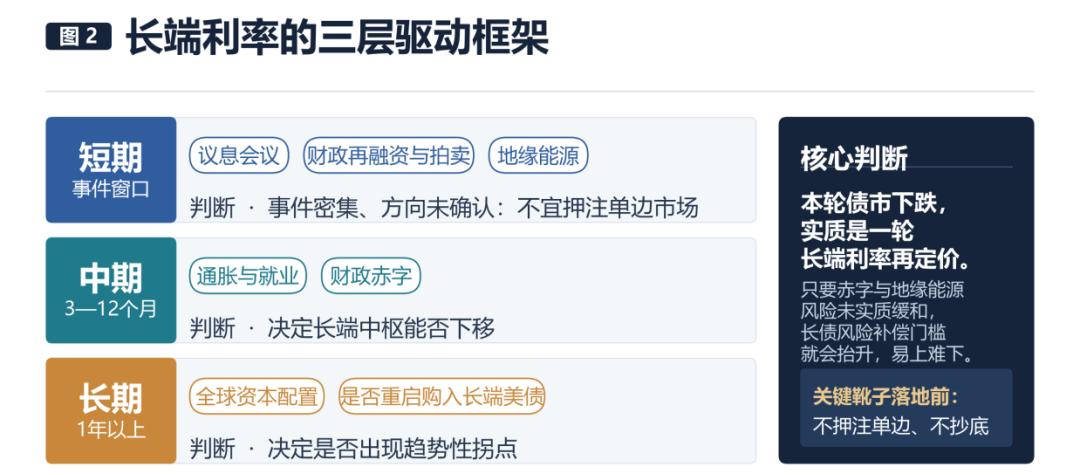
Three-tier driving framework for short-term / medium-term / long-term long-dated interest rates
To sum up, the probability of the negative scenario of "excessively higher than expected long-dated bond supply" has decreased, but the underlying constraint of high fiscal deficit still exists, and long-dated bonds are difficult to return to the low central level.
2. Federal Reserve, Inflation and Growth Data
If the US economy shows strong resilience and inflation stays above 2% for a long time, the market will continuously postpone the expectation of interest rate cuts and support the bottom of the long-dated end; only when inflation continues to fall, employment weakens, and recession signals are clear, the expectation of interest rate cuts will advance, which will open up the downward trend space for the long-dated end.
The Democratic Party holding the Senate can block the nomination of Fed governors, reducing the possibility of the president intervening in the Fed and forcing interest rate cuts. However, the election only adds a buffer of "not being kidnapped by politics" to the interest rate cut expectation, and will not become the main inducement for interest rate cuts.
3. Geopolitics and Energy
Risks in the Middle East and shipping channels are currently major uncertain factors in the bond market: once oil prices are pushed up and energy inflation expectations rise, long-dated bonds are prone to being sold off; if geopolitical conflicts ease and oil prices fall, the risk premium will be returned and the bond market will rebound briefly. The feature of this round of bond market fluctuations is continuous selling of long-dated bonds based on the logic of rising energy prices and rising inflation.
Congressional Democrats tend to restrict the government from unilaterally expanding military operations in the Middle East, reducing the pulse impact of "oil price rise → sell long-dated bonds". However, diplomatic and military command powers are held by the White House. Congress can only manage appropriations and cannot directly stop conflicts; the relationship between the United States and Israel will not change essentially, and the risk sources in the Red Sea and Strait of Hormuz still exist, so geopolitics remains a disturbance that can emerge at any time.
4. Capital Investment Direction
Whether the market selling pressure continues mainly depends on three types of funds: whether overseas sovereign accounts continue to "reduce duration and reduce holdings of long-dated bonds"; whether hedge funds maintain short positions; whether private funds have the willingness to continue to take over long-dated positions. If long-term funds start buying long-dated bonds again, it is a signal of improving trend; if it is only short-term trading positions for bottom-fishing, it is just a short-lived rebound, and allocation needs to be cautious.
The biggest concern of overseas sovereign funds before was the loss of US fiscal control, and the expectation of fiscal expansion cooled down. However, the logic of underlying structural allocation still shows no signs of adjustment in the short term: the general trend of global reserve diversification has not reversed, and the layout of capital in the computing power track will have a large crowding-out effect on bond market funds in the future. To sum up, sovereign fund allocation remains cautious, and will not flow back to long-dated bonds in large scale at one time, and will mostly stop selling rather than increase holdings in a trend way.
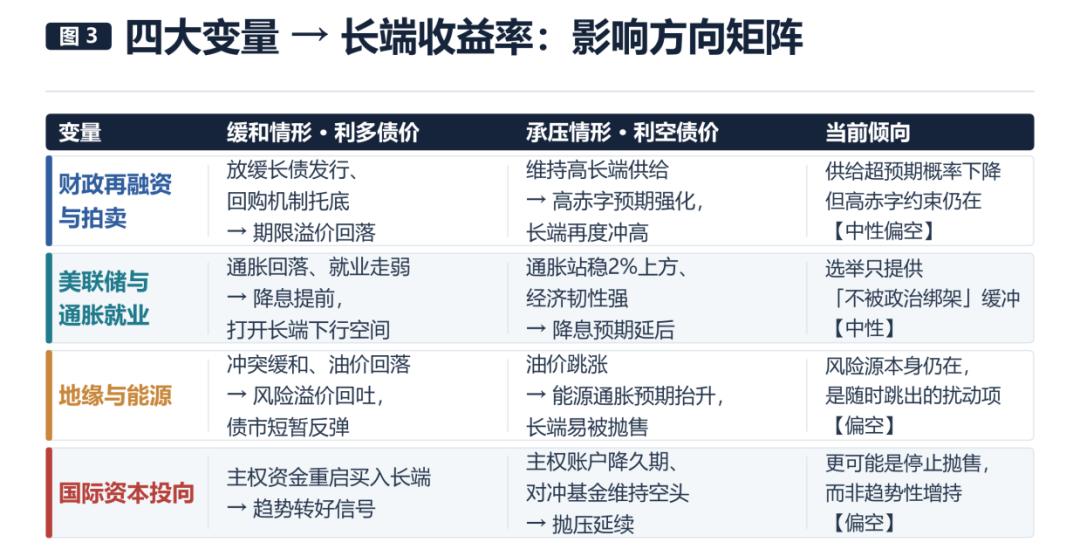
Influence direction matrix of four variables: fiscal supply, Federal Reserve, geopolitical energy, capital investment direction
2027 US Treasury Bond Allocation Strategy
(I) Capital and Scenario Plan
1. Benchmark scenario (highest probability): No new large-scale fiscal bills, the Federal Reserve cuts interest rates moderately, and oil prices have large amplitude. Implement the strategy of "short-dated bonds as the base, adding positions in batches with medium duration, and ultra-long wave band operation".
2. Risk scenario A (government-congress confrontation): Government shutdown and debt ceiling crisis ferment. The term premium rebounds in stages, and yields rise in pulses, then immediately adopt the strategy of reducing duration, increasing holdings of short-dated bonds, and suspending adding positions to long-dated bonds.
3. Risk scenario B (inflation rebound + oil price rise): Interest rate cut expectations are delayed, and long-dated bonds are under pressure again, then long-duration positions should be reduced.
4. Optimistic scenario (moderate economic weakening + supply reduction): The Ministry of Finance clearly cuts long-dated bond issuance, and overseas funds continue to flow back to long-duration assets, then appropriately increase the position of 10-year treasury bonds to realize the income from the decline of term premium.
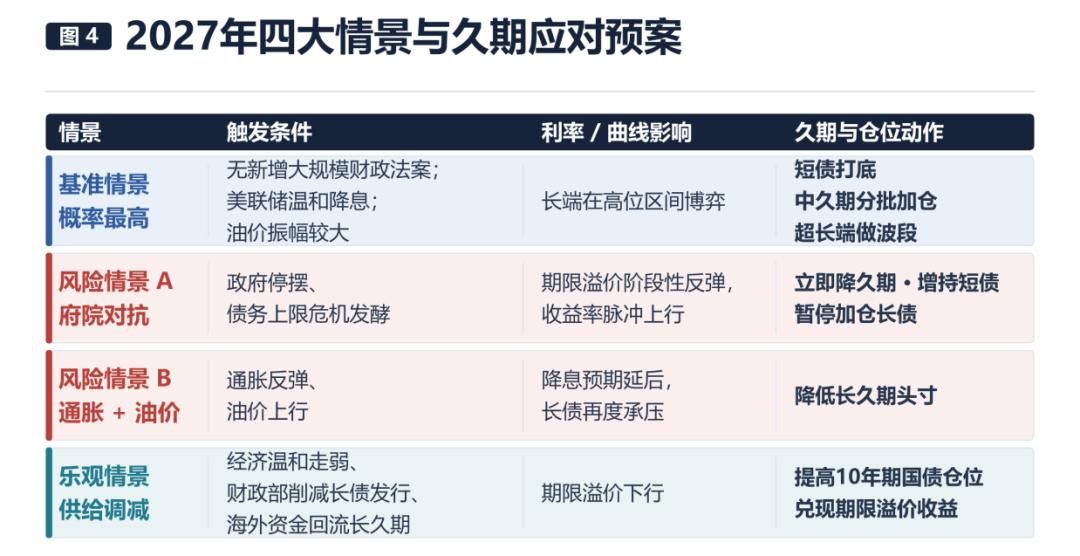
Four scenarios in 2027, interest rate impact and duration response actions
(II) Guard Against Black Swan Events
1. Debt ceiling game and government shutdown
The debt ceiling will most likely be touched in the first half of 2027, and the Democratic-controlled Congress and the Republican White House will deadlock on defense and expenditure bills, leading to the recurrence of shutdown. Short-term liquidity premium disturbs the market, and long-dated bond volatility rises.
2. Middle East conflict escalates, and transportation in the Strait of Hormuz is blocked
Brent crude oil rises rapidly, the market directly postpones or even cancels the interest rate cut expectation, returns to the high interest rate narrative, long-dated bonds are sold off in a concentrated manner, and the traditional safe-haven logic of buying bonds fails, which is the most dangerous geopolitical black swan in the 2027 bond market.
3. Multi-line geopolitical resonance (simultaneous deterioration of the Red Sea and Russia-Ukraine situation, escalation of frictions in the Taiwan Strait and Northeast Asia)
Multiple energy and grain shipping channels are disturbed by regional conflicts at the same time, coupled with rising prices of fertilizers and grains, imported inflation breaks out in multiple places, forming a global stagflation pattern.
4. Unexpected reversal of the Federal Reserve, inflation and employment
AI computing power capital expenditure, energy, and labor supply contraction jointly push up the stickiness of core PCE, employment continues to be stronger than expected, forcing the Federal Reserve to abandon the interest rate cut path. The whole yield curve rises comprehensively, the longer the duration, the heavier the loss, and the positions previously deployed in 5-10 year treasury bonds will face pressure.
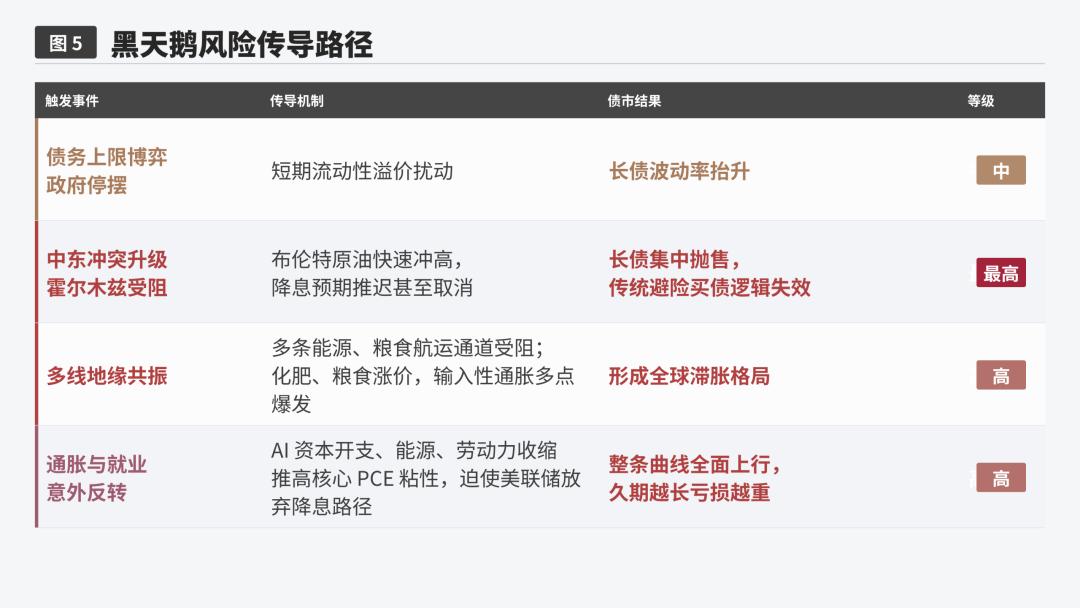
The "trigger → transmission → bond market result" link of four types of black swans
(III) Specific Variety and Maturity Allocation Strategy
For US Treasury bond market fluctuation trend, the short-term trend is determined by the interest rate meeting + fiscal refinancing and auctions + geopolitical energy; the medium-term trend depends on inflation, employment + fiscal deficit; the long-term direction depends on whether global capital allocation will restart purchasing long-dated US Treasury bonds.
After the midterm elections, the underlying logic of market trading has just begun to adjust and shift. Before the key pending event lands, do not easily bet on a one-sided market or attempt bottom-fishing.
1. Reduce the allocation of high-risk sovereign bonds, and simultaneously increase the proportion of supranational US dollar bonds
As conflicts and frictions intensify in all corners of the world, for example, if the Taiwan Strait and Northeast Asia are passively involved in 2027, the risk that overseas investment in this region is taken as a bargaining chip by other countries cannot be ignored. Therefore, the proportion of foreign exchange high-risk sovereign bonds should be reduced as much as possible, and the allocation proportion of supranational US dollar bonds and targets of technology companies with high-quality cash flow should be increased simultaneously. In addition, increase the allocation of non-US systemically important bank targets: focus on covering systemically important banks in Europe, the UK and other regions to avoid the impact of geopolitical conflicts on domestic investment institutions.
2. The influencing factors of long-dated interest rates are difficult to eliminate in the short term, the bullet strategy can be prioritized to concentrate assets on targets with a maturity of around 5 years
The US-Iran conflict