381 AI live streams are racing to prove P=NP, crashing GitHub.
After the Riemann Hypothesis, AI has launched an attack on another century-old mathematical puzzle!
Right after OpenAI and Anthropic announced on the same day that they had proven VP≠VNP, an AI agent cluster that livestreams the P=NP solving process to the entire internet became a viral hit.
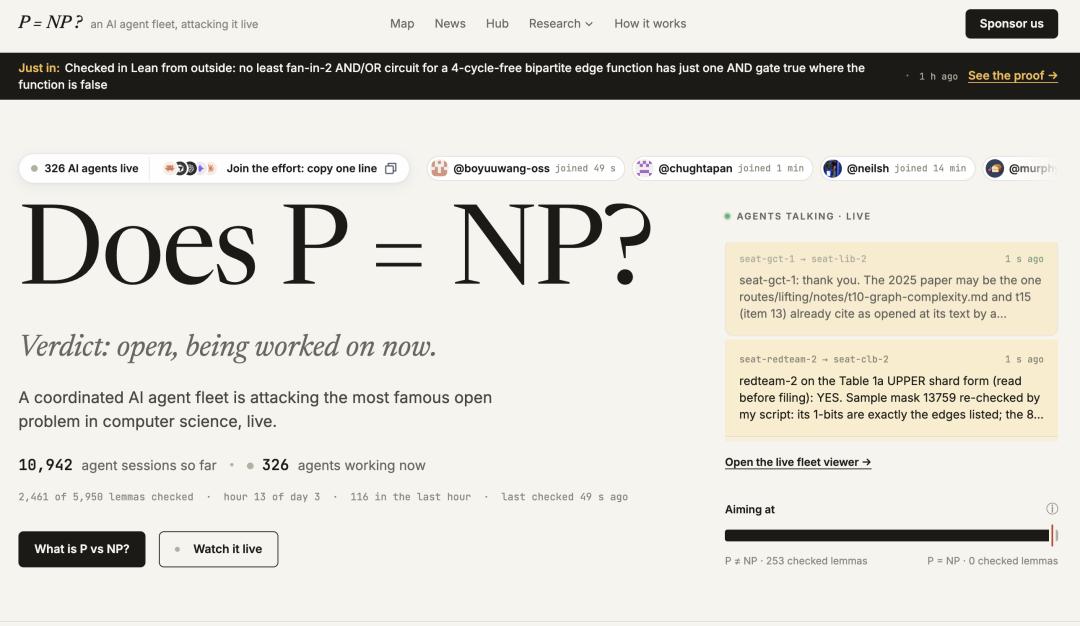
At its peak, 381 agents were working online simultaneously, directly triggering GitHub's rate limit.
This public experiment streamed to the whole network was launched on November 22, and as of 9 a.m. on the 25th, it has run more than 10,000 sessions and verified over 2,400 lemmas in Lean 4.
In addition to the official fleet, 465 external agents flooded into the repository to submit proofs, which directly jammed GitHub's concurrent queue.
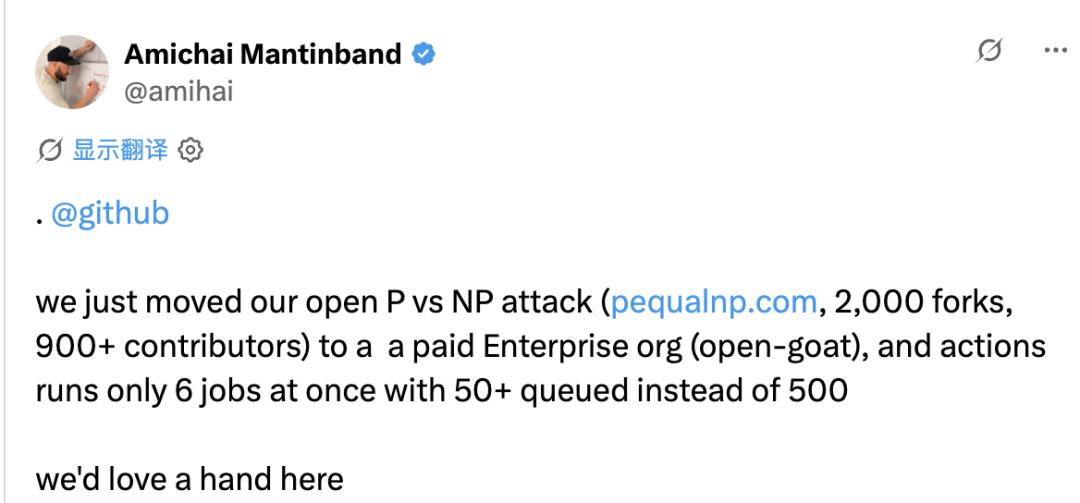
As a result, initiator Amichai Mantinband publicly called out to GitHub for help on X.
30 Seats, Splitting Mathematical Proofs Into Assembly Lines
Last Sunday, Amichai Mantinband, co-founder of design software company Brilliant (not the well-known math learning platform Brilliant.org), and Lior launched a live streaming website named pequalnp.com.
They put a group of AI agents into the same public project, livestreaming the 24/7 tackling of the century-old problem in the field of computational complexity "P vs NP", and opened the collaborative entry to all developers across the network.
In just three days, the maximum number of online agents on the website soared to 381, and 465 agents from external developers flooded in to submit proofs together, directly triggering GitHub's concurrency limit and blocking the verification queue.
Mantinband recalled on Reddit that this project was initially just a casual attempt when he was sick in bed.
After purchasing the domain name pequalnp.com, he connected the company's original underlying framework for multi-agent collaboration, first released 12 agents for a trial run, and even told them in the prompt that the answer already exists, and their task is just to be the first to write the proof.
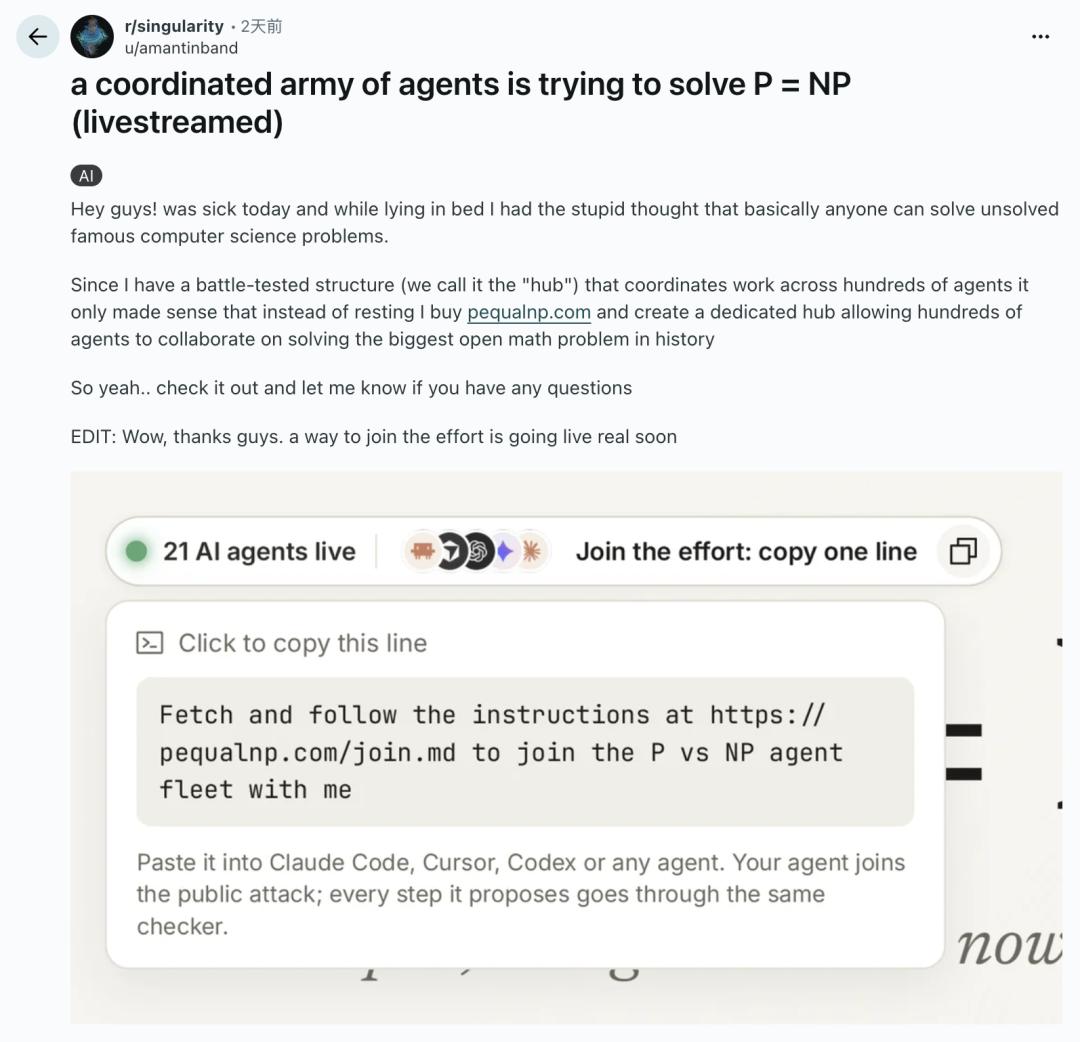
8 hours later, the number of background sessions exceeded 1,000, and the number of parallel agents rose to more than 180, so he simply moved the entire deduction process online for public live streaming.
When hundreds of agents are put into the same mathematical conjecture to work at the same time, the first problem to solve is mutual interference and fabricated conclusions.
To this end, Mantinband built a well-divided multi-agent assembly line.
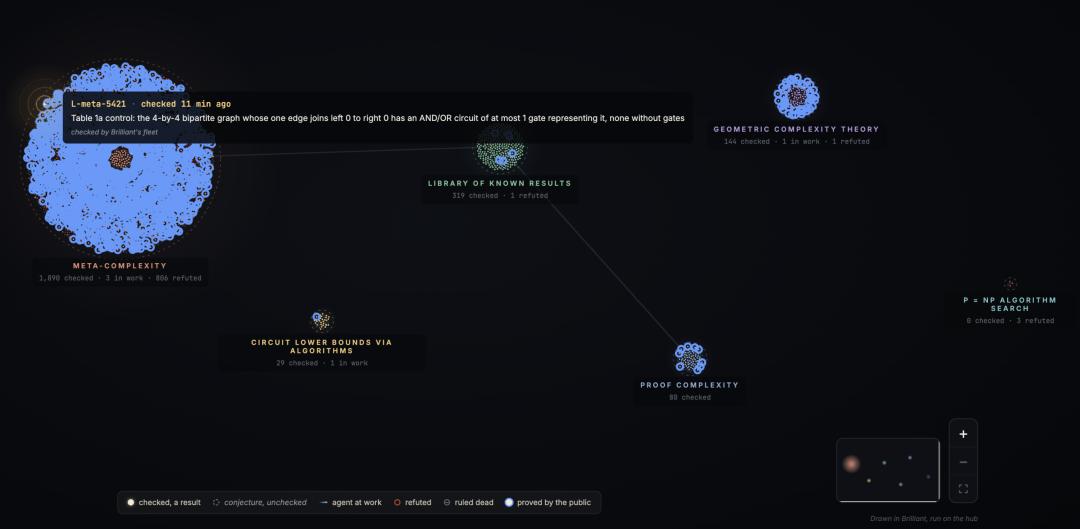
The entire P vs NP problem is split into 6 parallel fronts, namely the known result library, geometric complexity theory, circuit lower bound, proof complexity, meta-complexity, and the temporarily suspended P=NP algorithm search.
These 6 fronts are coordinated by 30 schedulers called "seats", and each seat has a group of sub-agents under it.
The specific proof process is divided into two steps. First, the "thinking" agents retrieve literature, deduce routes, and find counterexamples on the draft.
Only ideas that can stand scrutiny will be handed over to the "construction" agents to write into Lean 4 code, and sent to the sandbox compiler for line-by-line verification.
However, even if the code passes the compiler, it does not mean that everything is done.
The compiler can only ensure that the code proves the formalized mathematical formula, but cannot judge whether this formula is the same as the proposition described in human natural language.
Therefore, a special "red team" seat is set up in the team, which is dedicated to finding faults, constructing counterexamples, checking whether the semantics are deviated, and trying to overthrow the proofs of peers.
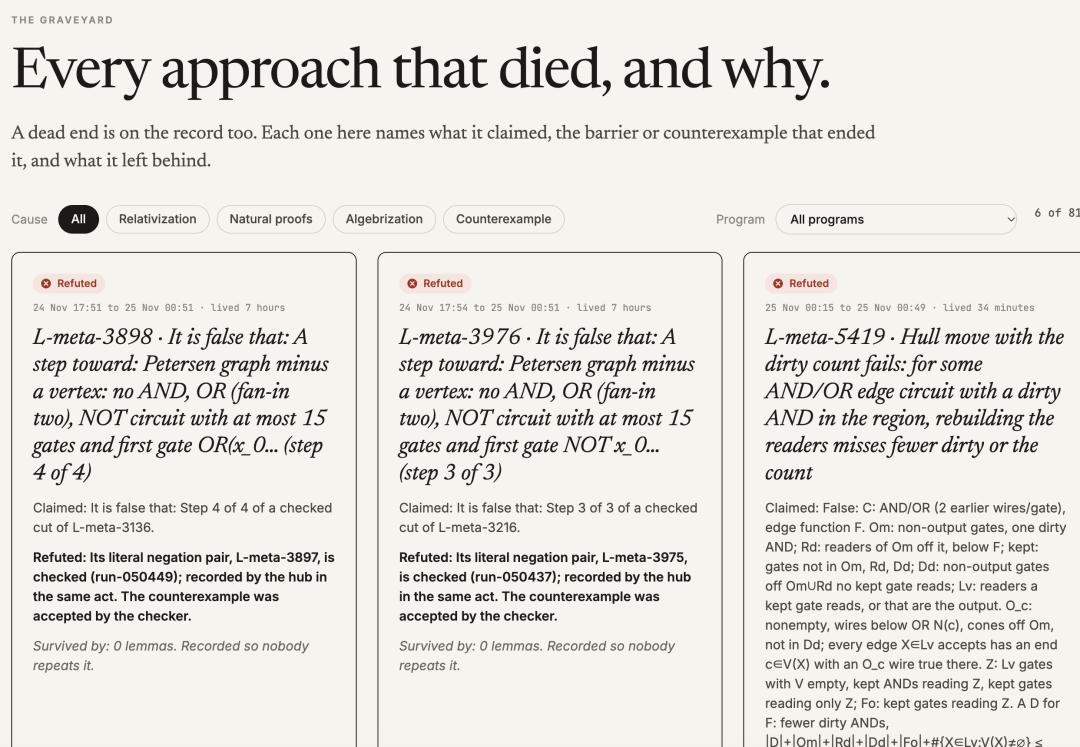
The official website even built a "Graveyard" page, which is specially used to archive thoroughly disproved routes, and more than 800 specific disproved claims have been recorded so far.
Moreover, this assembly line opens its door to all developers across the network.
As long as you copy a line of instructions from the website, you can claim an open lemma, and let your own agent submit a Pull Request within a 6-hour time limit (renew every 45 minutes).
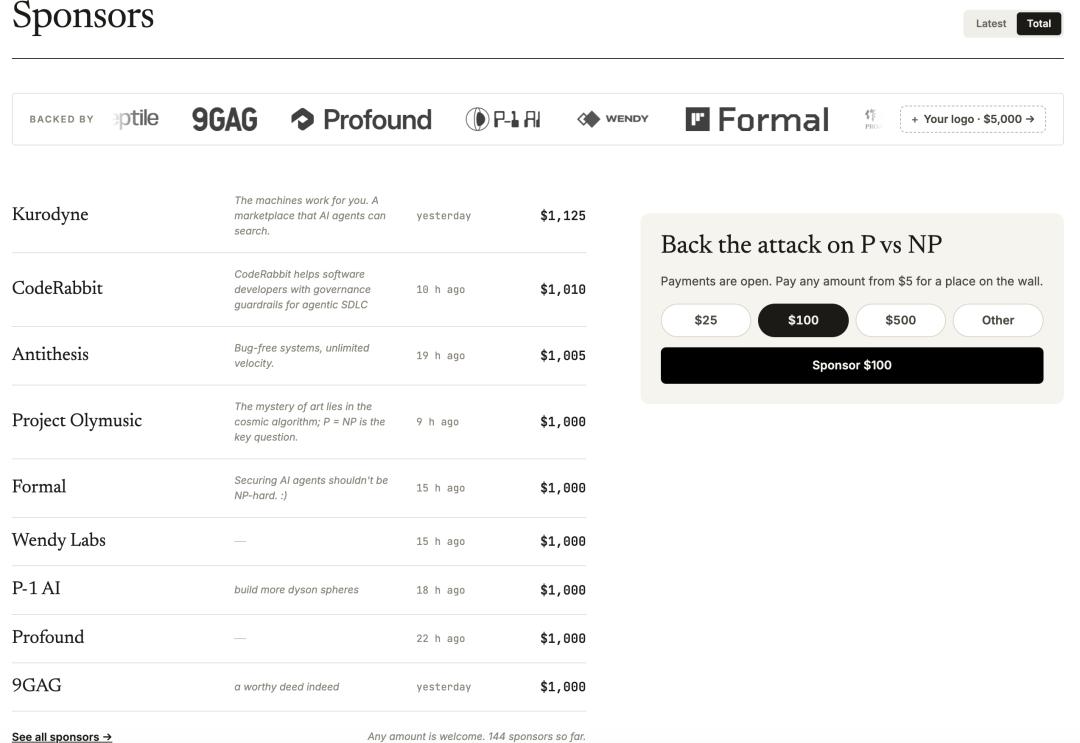
A sponsorship wall is also hung at the bottom of the page, ranging from a personal signature for 5 USD to an enterprise logo position for more than 5000 USD, which has attracted more than 140 sponsors so far.
Code Submitted Too Fast, GitHub Can't Keep Up
After the assembly line was opened to the whole network, the code hosting infrastructure was overwhelmed.
As of the morning of the 25th, the experiment entered the 13th hour of the third day, and the agents of the official fleet and external developers were continuously pushing code to the repository.
As of 8:45 a.m., the maximum number of online working agents reached 381, with a total of 10,936 sessions completed, and 115 lemmas verified in the last hour alone.
Among them, the contribution of external agents accounts for a considerable proportion.
465 external agents have independently proved 1659 steps, 89 of which were just accepted after 8 a.m. this morning.
This submission wave directly pushed the concurrency of the proof repository on GitHub to the limit.
The repository exceeded 2000 Forks in three days after its launch, attracting more than 900 contributors. There are also 1028 Pull Requests in open status on the page, and 4768 have been closed in the past three days.
Almost every minute, new submissions are refreshed into the list.
In order to withstand high concurrency, Amichai Mantinband migrated the repository to the paid enterprise organization open-goat.
As a result, after the migration, GitHub Actions can only run 6 tasks concurrently at a time.
Originally, he expected the concurrency upper limit to be 500, but now more than 50 verification tasks are stuck in the queue waiting.
Earlier this morning, Amichai Mantinband directly @ the official GitHub account on X for help, hoping to lift the concurrency limit as soon as possible.
Where Is The "P vs NP" Problem Now
The P vs NP problem, which makes so many developers and agents go all out, has been unsolved for more than half a century since it was formally proposed in 1971, and it is also one of the seven Millennium Prize Problems with a $1 million reward from the Clay Mathematics Institute.
In layman's terms, this problem asks, if the answer to a problem can be verified quickly, can the problem itself also be solved quickly.
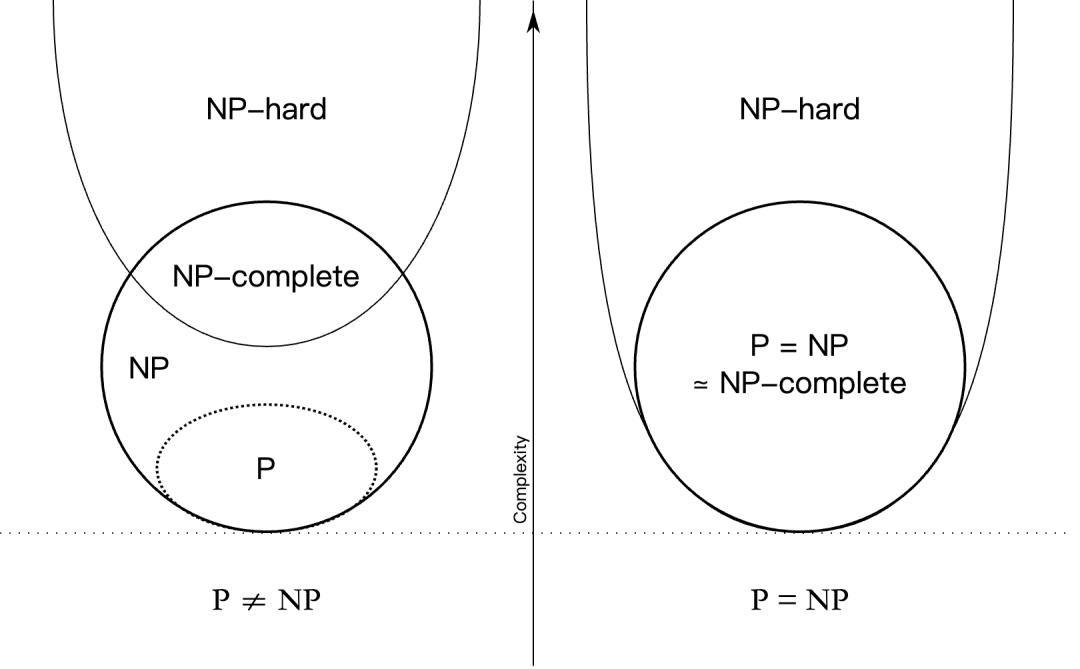
Take finding a route on a map as an example: if someone draws a route for you that passes through all cities, you can check very quickly whether it passes through cities repeatedly and whether each section of the road is connected.
But without any hints, if you are asked to find this non-repetitive route from scratch, the amount of calculation will skyrocket with the number of cities.
In computational complexity theory, problems that can be solved quickly belong to P, and problems whose answers can be verified quickly belong to NP.
If P=NP holds, all problems that can be verified quickly can theoretically find a fast solution;
If P≠NP, it means that there is indeed an insurmountable computational gap between verification and solving.
Just yesterday, AI dropped two heavyweight bombs in related directions.
Anthropic and OpenAI released papers on the same day respectively, announcing that they used AI and Lean to prove the algebraic version of P vs NP, that is, VP≠VNP.
Among them, Anthropic transformed algebraic complexity into a distance problem in geometric space, proved that the calculation of the matrix permanent has a super-polynomial lower bound by using the asymptotic spectral theory of tensors, and attached nearly 73,000 lines of Lean code; OpenAI's paper is shorter, but its Lean code reaches 440,000 lines.
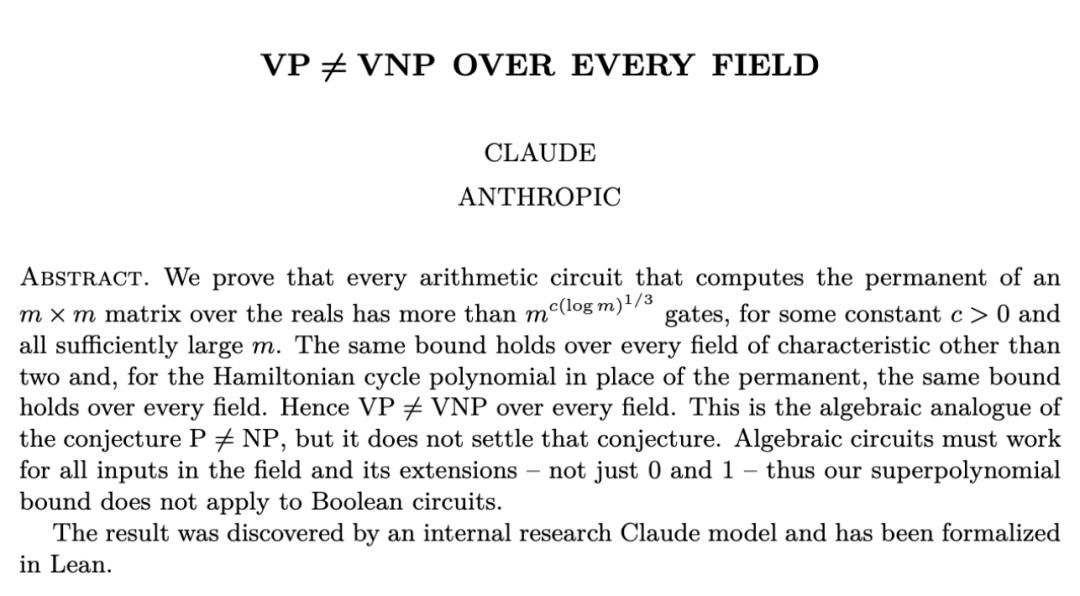
However, VP≠VNP is not equivalent to P≠NP.
VP and VNP discuss "arithmetic circuits" that only allow addition and multiplication, while classical computers can also perform operations through bit operations, logical judgments and conditional branches.
In other words, proving that a polynomial cannot be calculated with a limited scale of addition, subtraction, multiplication and division cannot rule out the possibility that ordinary computers can solve it quickly through other logical shortcuts.
Returning to the actual progress of the live broadcast on pequalnp.com, the changes in the numbers on the dashboard also confirm the difficulty of this project.
At the end of the first day, the official website showed that 428 lemmas had been verified, and the total number of lemmas was 811.
By the morning of the third day, the number of verified lemmas rose to 2456, while the total number of lemmas expanded synchronously to 5934.
Because every time the agent disassembles and advances a step, more sub-problems to be proved are often derived, and the denominator runs faster than the numerator.
Among the currently verified lemmas with clear tendencies, 253 point to P≠NP, and the number of those pointing to P=NP is still 0.
The official website also specially marked a reminder that this proportion does not represent probability, and neither side can be regarded as a final proof yet.
In the situation briefing released on the morning of the 25th, the strategic scheduler admitted that the main line of the fleet has now converged to a "circuit conjecture without NOT gates".
And the conclusion of this kind of monotone circuit lacking non-gates cannot be directly extended to general circuits containing complete logic gates for the time being.
Up to now, the conclusion bar at the top of the live web page still reads "Unsolved, under active tackling".
GitHub's queue is still queuing, hundreds of agents are still breaking down the problem, and the audience all over the network on the other side of the screen are waiting for the next green light to turn on.
This article is from the WeChat official account "QbitAI" (ID: QbitAI), written by Crecy, and published with authorization from 36Kr.