Poly Development plans to issue 20 billion yuan of corporate bonds, and leading real estate enterprises have collectively shifted the purpose of raised funds to projects.
On the evening of November 25, Poly Development (600048.SH) announced that the 3rd meeting of its 8th board of directors has reviewed and approved the public issuance plan of corporate bonds, with a scale of no more than 200 billion yuan and a term of no more than 10 years.
The announcement specifies that the raised funds are proposed to be used for repaying interest-bearing debts, supplementing working capital, project construction, acquiring real estate projects, and other purposes permitted by laws and regulations.
For a central SOE that has completed a total of 81 billion yuan of corporate bond issuance in the first half of the year and reduced its comprehensive financing cost to 2.61% by the end of the period, obtaining the quota is not unexpected. What is more noteworthy is where the money goes: in the past two years, almost all of its corporate bonds were used to replace old debts. This time, "project construction" and "acquisition of real estate projects" have been included in the list of uses.
Capital Diversion
The terms of corporate bond issuance are not complicated in themselves, with a face value of 100 yuan. The term can be a single variety or a mix of multiple terms; the coupon rate is determined through negotiation between the company and the bookrunner within the preset range based on the results of offline inquiry, with simple interest calculated annually. The issuance targets are professional investors, no priority placement to the company's shareholders, the lead underwriter or underwriting syndicate will underwrite the bonds on a standby underwriting basis, and the company plans to apply for listing on the Shanghai Stock Exchange after issuance.
It is worth noting that this bond is an unsecured bond. For AAA-rated central SOEs, unsecured means that pricing relies more on the subject's own credit rather than credit enhancement arrangements.
According to the announcement, the plan still needs to be submitted to the 3rd interim shareholders' meeting of the company in 2026 for review, and registered and approved by the China Securities Regulatory Commission, before it can be issued in one tranche or in installments. The scale, term structure, interest rate range, and specific amount for each use shall be determined by the board of directors or its authorized persons authorized by the shareholders' meeting before issuance.
Another point worthy of attention is the time point. On August 28, the China Securities Regulatory Commission issued the *Opinions on the Capital Market Supporting the Construction of a New Real Estate Development Model*, which clearly supports real estate enterprises to issue corporate bonds with "raised funds mainly used for real estate projects that meet policy requirements", allows the rolling renewal of existing corporate bonds, and further improves the review efficiency.
The first batch of samples after the implementation of the policy has emerged.
At the beginning of November, China Resources Land's 200 billion yuan corporate bond obtained the CSRC's registration approval, of which 115 billion yuan is used to repay maturing corporate bonds, and 85 billion yuan is invested in policy-compliant residential projects in cities such as Beijing, Shanghai and Hangzhou; China Merchants Shekou was approved for 166 billion yuan, with 55.5 billion yuan invested in 7 "high-quality housing" standard projects in Beijing, Shanghai, Hangzhou and Xi'an; China Overseas Land & Investment's 200 billion yuan small public offering was approved by the Shenzhen Stock Exchange on October 28, and 93 billion yuan is planned to be invested in 5 real estate projects or repay project interest-bearing liabilities.
The three central SOEs have applied for a total of 566 billion yuan, of which about 233.5 billion yuan is clearly invested in projects. The shift of funds from "borrowing new to repay old" to "partially entering projects" has appeared in the accounts of leading central SOEs.
If you unfold Poly Development's own accounts, the weight of this shift becomes clearer.
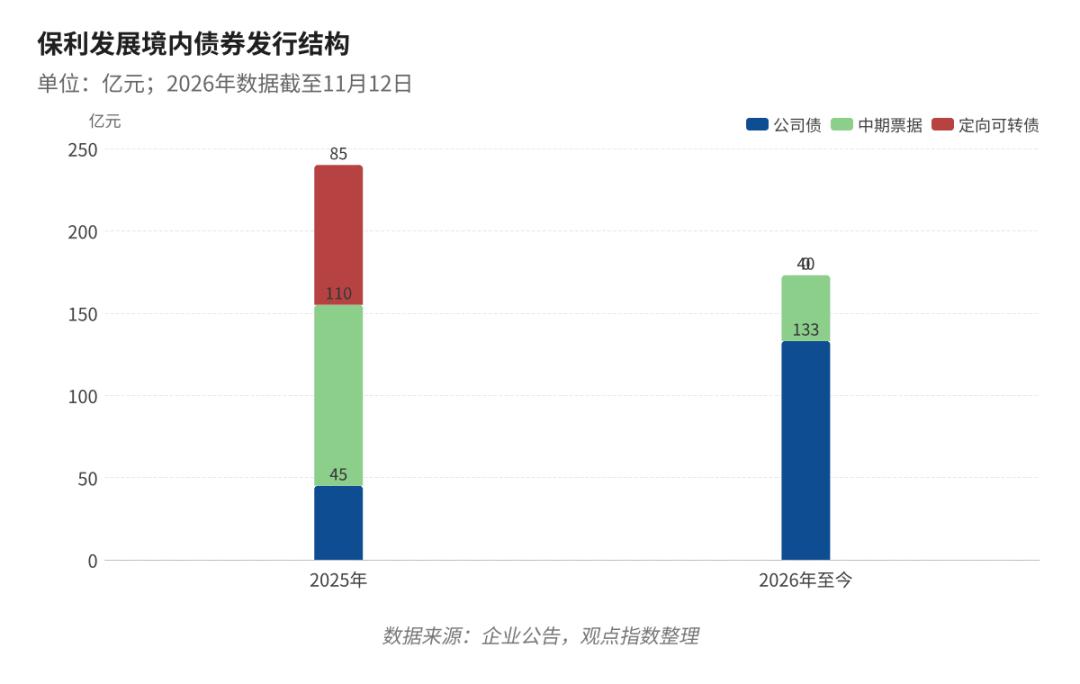
In 2025, Poly Development issued 240 billion yuan of bonds domestically, including 110 billion yuan of medium-term notes, 45 billion yuan of corporate bonds, and 85 billion yuan of targeted convertible bonds; since 2026, it has issued 173 billion yuan, including 133 billion yuan of corporate bonds in 5 tranches with 7 varieties, with a coupon rate ranging from 1.85% to 2.50%, and 40 billion yuan of medium-term notes.
The 45 billion yuan in 2025 and 108 billion yuan in 2026, totaling 153 billion yuan of corporate bonds, have consistent use descriptions in the announcements of each tranche, which is "repay or replace the principal of maturing or puttable corporate bonds".
In other words, its corporate bonds in the past two years are basically on-balance sheet circulation: replacing old bonds with a coupon rate above 3% with new bonds at around 2%, extending the account period and reducing the interest burden. The only funds that actually entered the projects were the 85 billion yuan targeted convertible bonds issued in May 2025, which were invested in 15 projects for "ensuring building delivery and safeguarding people's livelihood".
This plan includes "project construction" and "acquisition of real estate projects" in the list of uses at the same time, and leaves the specific amount to be determined by the board of directors. The flexibility is very large: it can continue to repay debts, or invest in projects.
Safety Cushion and Constraints
The balance sheet supports this quota. As of the end of September, Poly Development's asset-liability ratio was 71.68%, down 0.55 percentage points from the end of last year; its monetary funds reached 1189.02 billion yuan, covering about 1.6 times of short-term interest-bearing liabilities. According to the calculation of securities firms' research reports, the scale of interest-bearing liabilities is about 3400 billion yuan, a slight decrease from the beginning of the year.
In terms of operation, the operating revenue in the first three quarters was 1549.56 billion yuan, down 10.80% year on year; the net profit attributable to shareholders was 23.32 billion yuan, down 16.03% year on year. The contracted sales amount in the first half of the year was 1351.06 billion yuan, down 6.93% year on year, still ranking first in the industry, with an equity ratio of 84%. Sales cash collection in the first three quarters reached 1609 billion yuan, and the net cash flow from operating activities was 77.2 billion yuan.
The financing cost is a rare favorable factor.
The average cost of new interest-bearing liabilities of Poly Development in the first half of the year was 2.44%, down 27 basis points year on year; the comprehensive financing cost at the end of June was 2.61%, down 28 basis points year on year.
But can the low-cost quota be converted into construction progress on the site? Judging from the progress of the previous 85 billion yuan targeted convertible bonds, the speed of fund arrival is faster than the speed of capital expenditure on construction sites. As of the end of June, the 85 billion yuan targeted convertible bonds had accumulated an investment of 51.28 billion yuan, with a progress rate of 60.5%. The completion time of 15 projects is scheduled from October 2026 to March 2029.
Poly Development's financing moves are more than this one. It issued one tranche of medium-term notes in September and October respectively, totaling 40 billion yuan, with interest rates of 2.20% and 2.30%; the shareholders' meeting passed the registration of 85 billion yuan medium-term notes on November 12; 50 billion yuan of targeted convertible bonds have been approved but not yet issued.
On the same day, Huaxia Poly Development Commercial Real Estate REITs was listed on the Shanghai Stock Exchange, raising 17.96 billion yuan. The rolling renewal on the debt side and the conversion of commercial properties into cash on the asset side are proceeding in parallel.
The real context of this 200 billion yuan quota may be that it is not only the ammunition for debt replacement, but also a test of whether the project financing function can be restored. If the funds still mainly flow to debt repayment, it will continue the logic of borrowing new to repay old; if the "project construction" part is actually implemented, it will be a substantial repair of the financing function.
This article is from the WeChat official account "Viewpoint", the author is Viewpoint New Media, and it is published by 36Kr with authorization.