Women should not be "Muggles" in the tech world.
"Muggle" originally refers to a concept from Harry Potter, meaning "ordinary people who have no magical abilities and know nothing about the wizarding world". Here, we use it to refer to people who are locked out of the tech world, considered to have no knowledge of technology, and thus find it difficult to participate in technological creation.
With the continuous emergence of AI, Agents, programming and various new technologies, we seem to be entering a new tech era.
But does technology really belong to everyone?
In the discussions after the release of this episode of the podcast, we found that quite a number of people believe that "technology is neutral", and it is difficult for them to understand the exclusion that women face in the "technology" industry.
However, the neutrality of technology itself does not mean that the opportunities to participate in the tech world are equally distributed. Who is more likely to be encouraged to get in touch with technology, who is more likely to be regarded as a talented programmer, and who can gain recognition in tech communities are all affected by cultural and social environments.
According to the United Nations 2024 Sustainable Development Report, in the AI era, 3.7% of women's jobs worldwide (about 150 million people) are expected to be replaced by AI in the next 30 years. This proportion is 2.8 times that of men (1.4%), and more than 160 million women need to switch to careers requiring higher digital skills. In China, we have a remarkable base proportion of women working in the tech field, but the number of women is still very small in informatics competitions, AI laboratories and the senior management of tech companies.
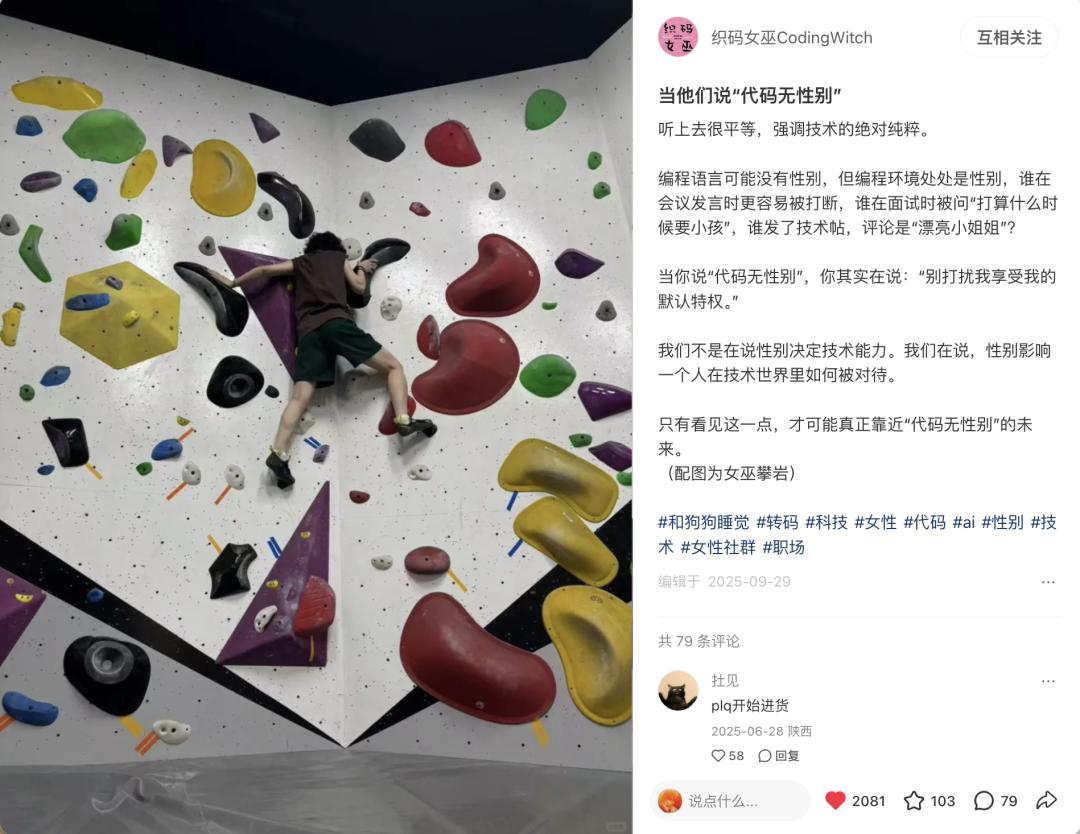
We want to talk about how ordinary girls who feel unfamiliar with, or even a little afraid of technology, can step into this world?
In this episode of Problematic Youth, we have invited two founders of "Code Weaving Witches": programmer Xiao Tian and media professional Chestnut.
They started their cooperation from an experience of using an AI tool, and in just one year, they built a women's tech community with nearly 100,000 followers, and jointly launched the world's largest women's hackathon so far. They have been trying to do one thing: make technology no longer something out of reach and full of thresholds, so that more women can naturally enter the tech world.
We talked about the neglected historical connections between women and technology, the gender barriers in the tech industry, the power of female role models and peer relationships, as well as the new tech anxiety in the AI era: do ordinary people need to master programming? Does not being able to use Agents mean falling behind? When mobile phones have long been an extension of the human body, how should we understand technological literacy?
Perhaps women do not have to be "Muggles" in the tech world, nor do they have to be shaped as goddesses opposed to technology. We can become cyborgs, learn to use tools, participate in creating tools, and have the right to define how technology serves ourselves.
Guests of This Episode of Problematic Youth
Chen Chen: Writer aka "had a little bit of alcohol", a "Muggle" who marvels at technology and magic
Xiao Tian: @Co-founder of Code Weaving Witches, the most ridiculous centrist in the world
Chestnut: @Co-founder of Code Weaving Witches, a tech blogger who is not interested in technology
Witches, Weaving and Code: Technology Was Once Women's "Craft"
Chen Chen: You gained nearly 100,000 followers in just one year, and built a women's tech content community with thousands of members. What made you want to create such an account back then?
Xiao Tian: We actually started this account because when DeepSeek was first launched last February, Chestnut wanted to deploy a local instance and came to ask me, since I was the only programmer she knew. After I taught her, she found that it was not as difficult as she had imagined.
Chestnut: Most of the time, online tutorials make people feel that the threshold of technology is extremely high, but after someone around you explains it to you face to face, you will find that it is not that difficult at all. So we created this account, hoping to gather more girls who are interested in technology.
Xiao Tian: I studied civil engineering before. When I switched to computer science, I felt many artificial barriers. People would use jargon to explain other jargon, which artificially raised the threshold of technology. I really wanted to do this kind of popular science work, so that the learning curve for all beginners could be as gentle as possible, which was also one of our original intentions.
Chen Chen: Why did you name your account "Code Weaving Witches"?
Xiao Tian: I happened to read Caliban and the Witch around that time. In my mind, witches are a group of women who master crafts and technology. In the Middle Ages, people considered to be witches were probably women who knew herbology and medical skills, and they had a lot of life experience. So the word "witch" in my heart is the pronoun for this kind of women.
As for the first part "Code Weaving", first of all, the world's first programmer was a woman, Ada Lovelace, who once said, "The Jacquard loom weaves patterns through punched cards, and the Analytical Engine writes code through punched cards." I think weaving and coding have a certain origin in history, and they are very similar.
At the same time, it is also a craft belonging to women. Weaving has always been regarded as a women's craft, and the original intention of our account is to make coding also a women's craft, so we combined the two and named it "Code Weaving Witches".
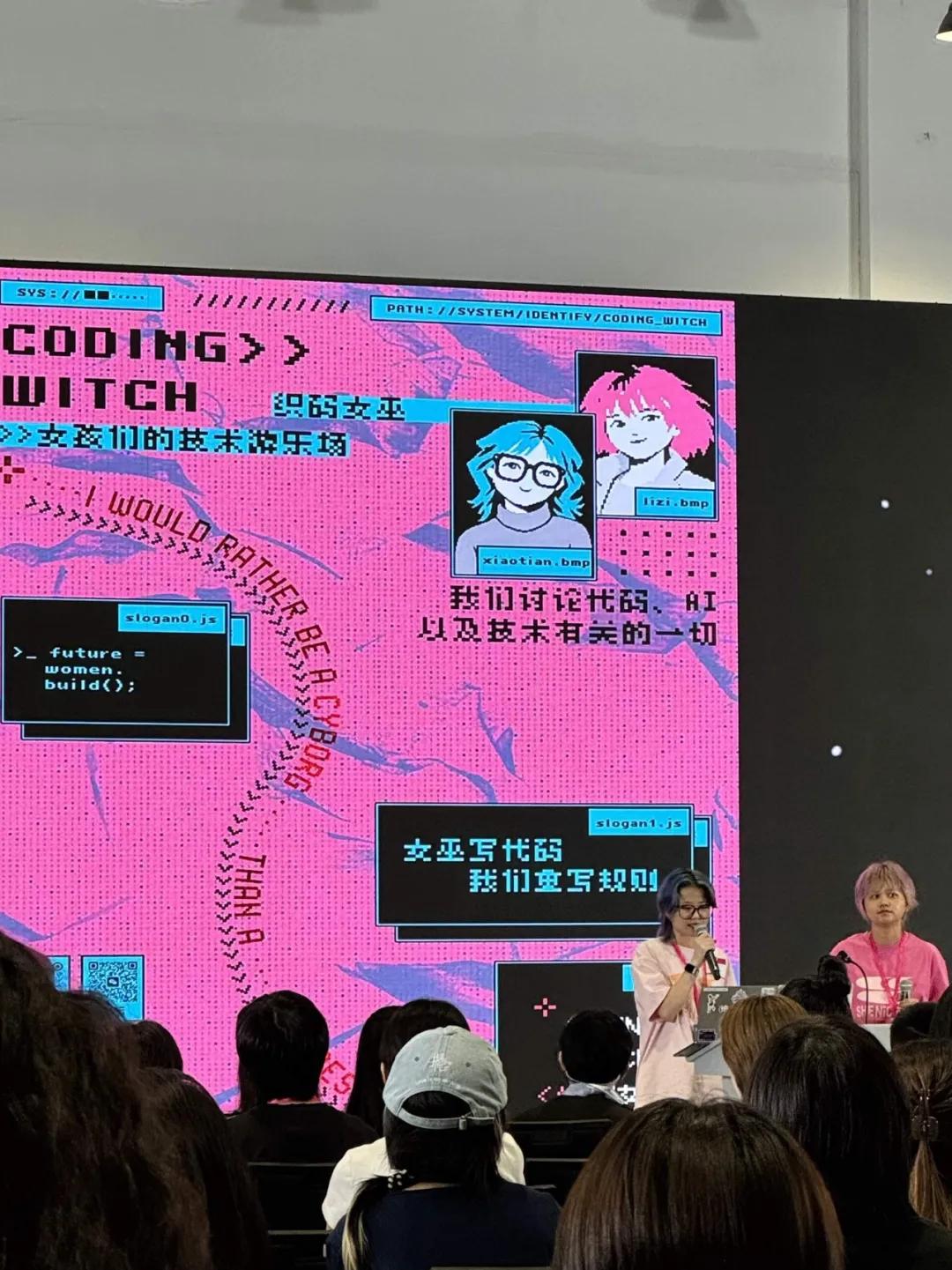
Xiao Tian and Chestnut at the opening ceremony of the 1000-person hackathon.
Chestnut: I think the distinction between "craft" and "technology" was also made artificially later, as if technology is superior to craft, or craft is manual labor while technology is mental labor. For example, now weavers are only considered to weave cloth, which has nothing to do with programming, and seems to be a kind of production activity inferior to programming, but in fact their original thinking may share the same origin. "Code Weaving" also implies a relatively equal value.
Xiao Tian: When computers were first invented, in fact, many of the early programmers were women. Back then, there was a lot of manual work, such as making punched cards and putting the cards into the machine. Everyone thought programming was a job that required great patience, so it was considered a women's job, which had a lot in common with all the jobs we now consider as women's work, such as secretarial work, weaving, and punching, these operational crafts. Before high-level programming languages were invented, John von Neumann once said, "There is no need to invent high-level languages above assembly language, because these tasks can all be done by women."
Chen Chen: It reminds me of an explanation I read before, that the English words text, texture and context are all etymologically related to the root "text" which means weaving. Weaving is highly related to the generation of meaning, and you also consciously connect women's historical manual labor with today's technology.

Figure caption:
What Kind of Technological Environment Do Women Need?
Chen Chen: Have you ever experienced moments when you felt that you were not accepted by the tech world?
Chestnut: I haven't, but I once spent a period of time wondering why I just wasn't interested in this thing?
Later I found out that some of the courses on the market are very boring. Around 2020, when I was in graduate school, I tried to learn programming for a while, and searched for introductory teaching videos. Those courses often made misogynistic jokes, such as using a lot of metaphors related to girlfriends, like "make it understandable even for your girlfriend", which made me feel unable to fit in.
Xiao Tian: I studied civil engineering in college. Around 2020, I wanted to switch careers because the prospect of computer science was better. At the very beginning, there was no AI. When you are a beginner, the most terrifying thing is that after you follow others' steps, the system reports a sea of red errors. You have no idea what to do, especially when you are a beginner setting up the environment, there will be many voices saying, "If you can't even set up the environment, you are not suitable for this line of work." In fact, that's not true. It's very normal to fail to set up the environment, especially for beginners, every computer has different configurations. Some computers have native dependency packages that are just incompatible, which is completely normal.
I remember when I was a beginner, I was hit quite hard. Maybe everyone who switched to coding has this feeling. This industry is just like this, very unfriendly to beginners.
Chestnut: A lot of "information gaps" do not exist publicly on the Internet, but flow in interpersonal relationships and small-scale communities. Those people on online forums say, "If you can't set up the environment, you don't deserve to learn this line of work." But they won't say that to their roommates, or if everyone in their dorm fails to set up the environment, they will think it's no big deal.
Chen Chen: I think of the women's hackathon at the end of August, Xiao Tian also helped me deploy workbuddy. At that time, I was preparing to leave my job and wanted to back up the data in Feishu, and found that Feishu did not have a convenient function to directly export the contents of the folder to local. Xiao Tian helped me write a Skill next to me, used WorkBuddy to scrape all the files, organize them into folders, and also generate HTML and image formats.
When she was operating next to me, I observed that she just described to her AI in natural language what permissions needed to be opened and how to download and deploy. Then I found that as long as there is someone next to you, in this atmosphere, you will feel that, oh, maybe this thing is not that difficult.
I previously scrolled through a video of your account. In that video, Chestnut said she was still using ChatGPT, and Xiao Tian was very shocked. There were two main points of shock: one was that you could use conversational AI, ChatGPT, to complete all your current work, and the other was that Chestnut was not using Agents yet. I immediately sent a message to Chestnut and said, "Hey, what to do? I'm still using ChatGPT now."
Technology will always bring an inexplicable impact to people like us who study humanities and social sciences. Soon after, I scrolled through a post, which roughly said that as long as you learn slowly, you don't have to learn at all. The gist is that after GPT 5.6 comes out, it's good to just use it. Every time I see these posts, my mood fluctuates. For ordinary girls, it is often easy to over-mystify technology and imagine it as something out of reach.
At what moment did you realize that you might have a kind of technological power that ordinary people don't have?
Xiao Tian: Quite a lot. I often feel that I live a very distinct life, my work and life are two separate worlds. Few of my friends understand technology, especially since I started cooperating with Chestnut. There are always things that I think are very simple to do, which can be completed by an Agent, but Chestnut will say, "It's amazing, this is so awesome."
Chestnut: It's the first time I understand what the Muggle world is like. (Laughing :D)
Xiao Tian: I think communicating with people who don't know much about technology keeps refreshing my cognition. For example, when I explained some software usage methods to Chestnut before, I found that some things were default to me, but she didn't know them at all. I used to take it for granted that others knew the things I knew.
I think this also keeps me humble: don't assume that every word you say does not need context, and don't use jargon to explain jargon. Many times, these things will form artificial barriers. Some people may do it to show off, but some people just don't realize that their words will cause obstacles to others' understanding.
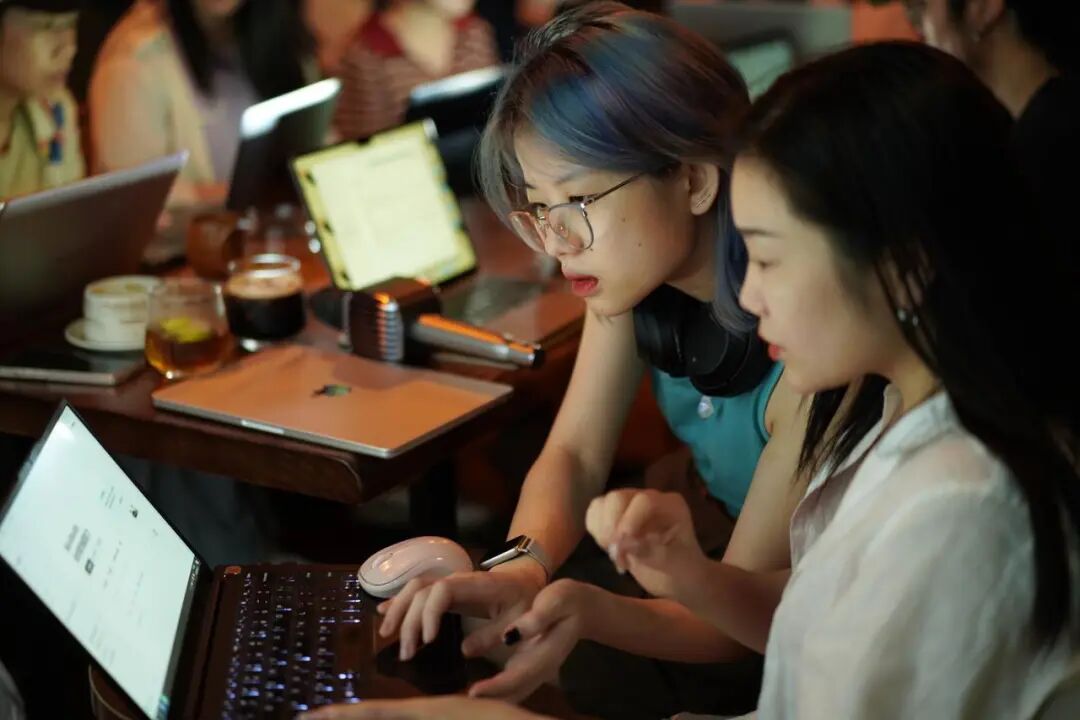
Xiao Tian teaching girls at a workshop
I remember I was actually afraid of computers when I was a child. I was the slowest typist in my class. At that time, there was a narrative about internet addiction, and my mom thought children shouldn't surf the Internet, so I hardly had the chance to touch a computer when I was young. In computer class, the teacher would teach some typing games, and I was typing one letter at a time, I couldn't type at all.
Later, a primary school classmate of mine influenced me a lot. She was the only girl around me who was very good at using computers. Her mom was doing software development at that time, and several of her cousins studied computer science, so she was very good at using computers. She taught me a lot of things, like Tieba and games. Playing with her, I realized that there were so many things I had never seen on the computer.
I think this is very important. Because among other people I knew, the people who could use computers were all boys. They had already started playing games by themselves in computer class, and I had no idea where those games came from, or what each key was for. I was very afraid of clicking the wrong button and getting something that I didn't know how to exit.
Having a female role model is different from having a male role model. Because of this friend, I felt that it was normal for girls to be good at using computers. Later, she studied computer science, and I thought that then I could also study computer science, "She can do it, so I should be able to do it too."

The covers of Xiao Tian and Chestnut are often their daily photos
Chen Chen: This reminds me of a draft I wrote in cooperation with friends last year about women, technology and educational inclusion. An organization called Coding Girls that went deep into county towns to teach programming courses found that little girls often needed two or three more days to adapt than boys when learning computer science. The founder said that they didn't do anything special during those three days, they just ate with the girls, got to know and familiarize themselves with them. But at the end of the course