When a laptop packs the "most powerful brain" of a Grade A Tertiary Hospital
Text by Wang Yi
Late at night, patients keep pouring out their troubles to "Dr. Mao Hongjing": "Why can't I fall asleep again?" "Am I suffering from depression?"
The "Dr. Mao Hongjing" on the other end of the dialog box does not give a conclusion immediately, but keeps asking follow-up questions: "How long has this emotion lasted?" "Do you have difficulty falling asleep, or do you wake up too early?" "Do you feel depressed during the day?" After several rounds of communication, a pre-consultation process close to the initial psychiatric consultation gradually takes shape through detailed questioning.
"Dr. Mao Hongjing" is the AI avatar of Mao Hongjing, vice president of Hangzhou Seventh People's Hospital, whose cumulative service volume has exceeded 7.4 million person-times. But Mao Hongjing admitted that before he made up his mind to create an "AI version of himself", he also had concerns: "Can AI really think like a psychiatrist?"
This kind of doubt is not uncommon among medical practitioners. Medical consultation relies heavily on the communication process between doctors and patients. Doctors need to extract key information from patients' scattered descriptions and make judgments combined with professional knowledge. General AI that has not been trained on a large number of medical texts can quickly give a seemingly complete answer, but it may not know what follow-up questions to ask, nor can it identify hidden disease risks beyond language.
But this does not mean that doctors are naturally averse to AI. On the demand side, doctors not only need to complete high-intensity clinical and scientific research work, but also need to continuously update their knowledge system. They generally hope that AI tools can "lend a helping hand". The question is whether AI is a generalist who "knows a little about everything" or a professional assistant who understands medicine.
This judgment standard has also continuously attracted global AI giants to apply their most cutting-edge model capabilities to scenarios such as consultation rooms, hospital wards and out-of-hospital health management.
On November 23, Ant Group centrally released the LingSante medical and health large model family, which is one of such attempts. This series covers directions including medical professional reasoning, multi-modal understanding, disease risk prediction, safety protection and real-time agents, forming a capability chain from "being able to understand" to "thinking deeply", and then to "being able to prevent risks and interact naturally".
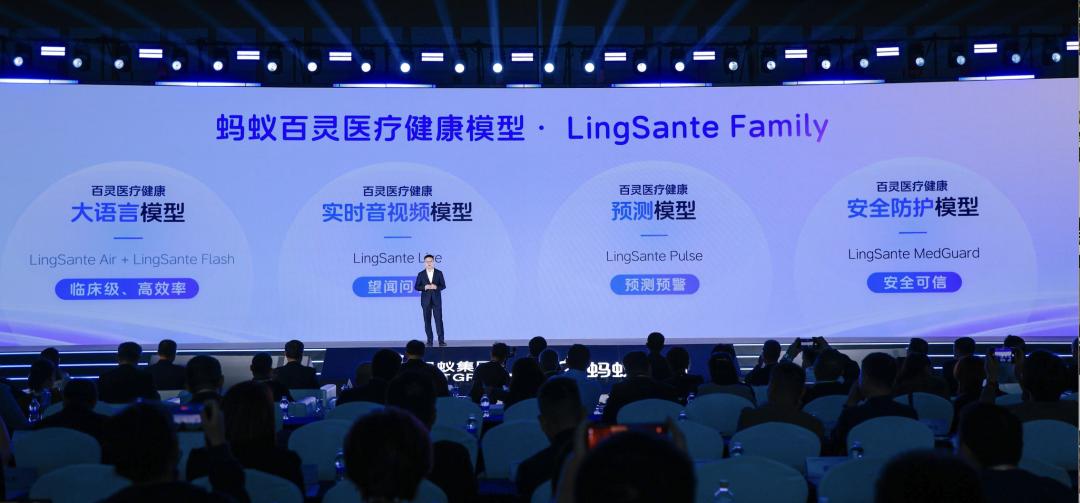
Among them, two core models, LingSante-3.1-air-VL focused on multi-modal information understanding and LingSante-3.1-flash for complex medical reasoning, have been open-sourced simultaneously.
Previously, the most intuitive impression of Ant Group's layout in the medical and health field from the outside world is "Afu". As an AI health application, "Afu" has more than 150 million monthly active users, with nearly 20 million daily health consultations on average. The LingSante series of models released this time is actually the technical base that supports the medical capabilities of "Afu". This is also the first time that Ant Group has fully demonstrated the technical capabilities hidden under its applications.
He Zhenyu, CTO of Ant Group, made an analogy: AI is glass, but it should not only be made into cups, but also into microscopes. In the medical context, this means that AI should not stop at "better cups" such as triage and report interpretation, but also move towards "microscope-level" applications with higher difficulty, such as new markers for early imaging screening.
"No one may have walked down this road, and there must be a possibility of failure, but our attitude is very firm. Open-sourcing LingSante is also to hand over this piece of 'glass' to more doctors and developers first. We believe that the 'microscope' will not be built all at once, but someone has to start first." He Zhenyu said.

Professional models that "think like doctors"
In the past two years, there are no shortage of AI application products focusing on medical and health scenarios on the market, including "Afu". Both doctors and ordinary users can more or less perceive the subtle differences between them and general AI. One of the differences is how AI understands the information provided by users, asks follow-up questions continuously, and gives clear judgments.
Chi Chenfei has a deep understanding of this. He is an attending physician in the Department of Urology, Renji Hospital Affiliated to Shanghai Jiao Tong University School of Medicine. He has tested general models before. For example, when asking "what should I do if the PSA (prostate-specific antigen) index is on the high side", general models can only give an encyclopedia-style introduction to PSA.
"But when a urologist hears 'PSA elevation', he should subconsciously start to ask follow-up questions: Is it free PSA or total PSA? What is the ratio? Do you have dysuria or bone pain, etc. These questions can gradually turn the vague chief complaint into the information needed for clinical decision-making."
This is exactly the capability that doctors expect AI to demonstrate. Chi Chenfei thus believes that the ideal professional model for the medical field should have at least two layers of capabilities that are "superior" to general models:
The first lies in the "organization method of knowledge": professional models need to understand the correlation paths between symptoms, examinations and diseases. The other layer is "sense of propriety", that is, to know the boundary of its own capabilities. When it is time to advise patients to see a doctor, it will never give random guidance. "This sense of propriety is actually more important, it is the bottom line. Because wrong directional judgment may make patients miss the best treatment window, this sense of propriety is not an unnecessary bonus."
The LingSante series of models released this time is an attempt to endow the model with the "doctor's way of thinking".
Several models have their own responsibilities: for example, the professional reasoning model is responsible for analyzing complex medical problems, the multi-modal model helps AI understand pictures and reports, the real-time agent makes communication closer to face-to-face consultation, and the health prediction and safety protection models extend the capabilities to risk identification and answer boundaries... They do not fight alone, but are more like a systematic technical layout of Ant Group around professional medical and health services.
Take the two open-source core models as examples: LingSante-3.1-air-VL is a native multi-modal model that supports text, image and video understanding, and can conduct comprehensive analysis combined with information such as skin photos and diet pictures. It has only 124B total parameters and 5.5B activation parameters, and can be deployed on local devices such as laptops.
LingSante-3.1-flash is oriented to complex medical reasoning, with a total parameter count of 560B, supporting a maximum context of 1M tokens. It can process medical records, examination reports and medical literature, and complete complex tasks through multi-round retrieval, evidence verification and tool invocation.
According to Ant Group, LingSante-3.1-flash ranks first among open-source models in the comprehensive index of InclusionMed, a global medical AI evaluation platform. In the comprehensive evaluation covering medical reasoning, safety alignment and agent tasks, the two models have reached the open-source SOTA level.
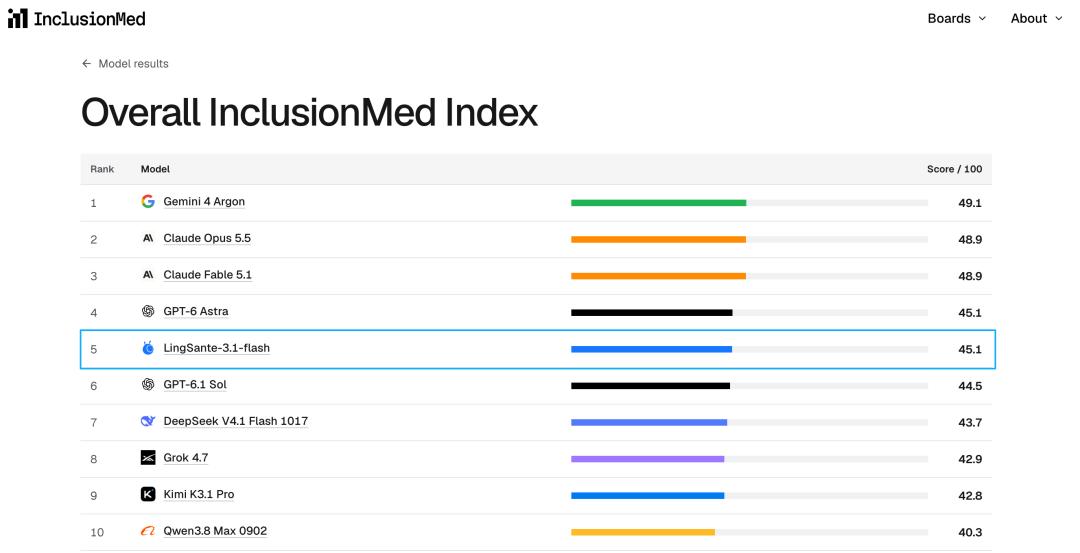
The reason why this can be achieved is that when training the model, Ant Group has integrated the idea of "being born for professional medical and health scenarios".
Zhou Jun, head of the LingSante large model, introduced that conventional vertical medical models usually conduct post-training based on the base model, but the LingSante team added a large amount of medical professional data from the first day of pre-training, and the base model team and the medical team jointly designed the data ratio. In the post-training stage, continuous alignment is carried out around evidence-based capabilities, real-scene tasks and clinical feedback.
In this process, the quality of the data fed to the model is the most basic and also the most tedious link. Gu Jinjie, CTO of Ant Group Health Business Group and head of the LingSante medical and health large model, mentioned that the information on drugs, reagents and treatment plans on the Internet is mixed. For the model to understand drugs, it first needs clean and standard drug instructions and authoritative medical knowledge. At the same time, training should not only tell the model a standard answer, but also let it see the evidence and reasoning path behind the answer.
This is also the reason why Ant Group invites doctors to deeply participate in model training. Doctors can not only provide high-quality data, evaluation questions and cases for the model, but also precipitate their own professional judgment logic, decision-making paths and standards in this process. Chi Chenfei introduced that, for example, in the consultation scenario, what exactly is "asking the right question" and what is "missing a question" will first be defined by doctors, then write questions and give answers according to the actual situation, and record the reasoning basis for AI.
In the words of Gu Jinjie, "What matters is not the result, but the path to achieve the result." For the medical field where there is often no single standard answer, multiple reasonable solutions and their applicable conditions have more training value than an isolated conclusion.
Gu Jinjie believes that no matter how professional the model is, it cannot promise zero errors, but the probability of AI hallucinations can be reduced through credible data and evidence-based processes. In addition, reinforcement learning should also be used to make the model more cautious. If the evidence is insufficient or the risk is too high, the model should stop in time and leave the judgment to doctors.
On the product side, the team retains the entrance to connect to real doctors for "Afu". The first thing medical AI may need to learn is not to "know everything", but to know when it "does not know".

Moving the experience of top-tier hospitals to "grassroots level"
Of course, the value of professional capabilities ultimately falls on patients.
Mao Hongjing once met a 24-year-old young patient who had been troubled by symptoms such as "sleeping too much, experiencing sleep paralysis at midnight, and easily falling down during the day" for 6 years, and failed to get a diagnosis after visiting many hospitals. "In the end, our AI agent identified that he had narcolepsy in a few minutes of conversation, guided him to seek medical treatment and finally confirmed the diagnosis."
Mao Hongjing believes that this case also shows that the places that need professional medical resources the most are often the places with relatively weak medical resources. AI models may not be able to replace doctors to issue diagnosis certificates for patients, but they can help patients complete pre-consultation symptom assessment, report interpretation, guide them to seek medical treatment correctly, and even identify disease risks earlier. "If this professional capability can benefit more grassroots hospitals, how many similar patients can avoid detours?"
On the other hand, the particularity of the medical field is that it needs to process the most sensitive patient data, serve clinical scenarios with extremely low fault tolerance rates, and also face a series of links such as regulatory access, hospital procurement, information system connection, and manual review. In addition, if the maintenance cost of a certain model after procurement is very high and it cannot be adjusted according to the needs of the hospital, no matter how strong its capability is, it cannot be put into use.
All these factors have led to the need for more open technical sharing in the medical industry.
"We think a good model should be 'not too big and not too small'. With the improvement of the model's efficiency ratio, using appropriate models to solve appropriate problems, and considering both model capabilities and usage costs, medical AI can expand its service scope. Just like the 124B air version, it can allow medical institutions of small scale to have the conditions to own their own reasoning capabilities." Gu Jinjie said.
For example, hospitals can deploy models locally and carry out secondary development combined with specialist knowledge, clinical data and existing work processes; scientific research institutions can also verify algorithms and carry out research on the same base. Compared with only being able to call a closed interface, open source gives medical institutions more control, and also allows the model to adapt to the differences of different regions and different departments.
Mao Hongjing introduced that his team has built a vertical large model for psychiatry and psychology based on the base of Ant LingSante medical large model, adopting the technical path of domain secondary pre-training and SFT (supervised fine-tuning), and developed a "sleep disorder assisted treatment software", which has now obtained the medical device registration certificate for digital therapy.
"We compared our model with some overseas models, and the specialist advantage is quite obvious, exceeding more than 10 percentage points," Mao Hongjing mentioned: "So I fully agree with open source. This is not just a technical choice, but also related to medical equity."
For Ant Group, internally, the model will continue to support the upgrade of Afu; externally, the medical industry chain is complex and cumbersome, and it is difficult for a standardized product to cover all scenarios. The base verified by real scenarios is handed over to more institutions, which may derive specialist applications that Ant Group will not necessarily develop by itself.
For example, the medical urology professional question-and-answer reasoning dataset RJUA-QA jointly constructed by Renji Hospital and Ant Group has been open-sourced on the OpenKG open knowledge graph. This dataset opens part of the specialist knowledge and diagnosis and treatment logic of top-tier hospitals to researchers and developers in a structured way. "We believe that the joint opening of models, data and clinical experience may achieve stronger 'capability spillover'." Chi Chenfei said.
"Open source is also a kind of commitment." Gu Jinjie believes. It means that the team will continue to invest resources in medical and health models, and work with partners to solve problems in deployment, network and operation and maintenance. Its ecological value will gradually appear as more participants join in.

Making technology return to inclusive benefits
Ant Group's layout path in the field of medical and health AI has gradually become clear: first define model capabilities starting from real health needs, continuously iterate and polish in application scenarios, and then open the verified base capabilities to the industry.
According to Gu Jinjie, about 16%-17% of users are still using "Afu" after midnight. Late-night consultations include physical discomfort, as well as anxiety and helpless emotions. How to respond to users' emotions without delaying necessary medical treatment reminders. These real needs are difficult to solve only by standard question banks, and have become an important basis for continuous iteration of models and products.
From this, it can also be seen that compared with other large AI manufacturers, Ant Group's layout in the medical and health field is not looking for nails with a technical hammer. On the contrary, a large number of real needs promote the optimization of model capabilities, and the improvement of model capabilities in turn supports product function innovation, forming a two-way cycle. After the model is open-sourced, this capability is extended to more health scenarios.
To a certain extent, this path choice also affects Ant Group's current business priorities. Today, when "tech maniacs" all want to use AI to eliminate cancer and fight aging, Gu Jinjie still believes that the ultimate value of technology should be fulfilled through "who is served".
"AI needs to fall back to the immediate reality first, for example, to help doctors cope with the heavy daily clinical tasks,