Why Does the Team Slow Down After Pursuing Speed: Reinventing Product Processes in the AI Era
A while back, I had dinner with an old friend who works on B2B products, and he poured out all his troubles to me.
His team has fully equipped all members with AI programming and prototyping tools this year. Looking at each individual, their work speed is indeed astonishing: a product manager can churn out a clickable prototype in half an hour, a front-end developer can deliver three pages in one day, and the number of lines of code submitted by back-end developers every day has directly doubled. But when they did the end-of-month review, the actual launch time of the major version was not advanced at all, but was a week later than last year. The test environment was always backed up with queues, and the number of online rollbacks hit a new record high.
He held his teacup and asked me: "The tools have clearly become more powerful, and everyone is using AI to work. Why does everything slow down when we work together?"
This is by no means an illusion unique to his company.
Over the past year or so, several leading domestic technical teams and large internet companies have successively released their AI R&D review data. Putting all these pieces together, the logic is very clear: it is not that AI is not good enough, but that we are still using the old processes from ten years ago to match the huge production capacity suddenly released by AI, resulting in people rushing forward at full speed while the back end is completely blocked.
I picked three cases to talk about how we can specifically improve the product R&D process that product managers are using now.
Case 1: The Real Review of DolphinDB
The first very thought-provoking story comes from DolphinDB, a domestic time-series database team.
They have been using AI for in-depth code writing for half a year, and it was extremely smooth at the beginning. In the past, a medium-sized requirement would take weeks to complete, from reviewing old code, checking materials, determining solutions to delivering a Demo. After adopting the Coding Agent, the whole process can be finished in one or two days, and it can even output 20,000 to 30,000 lines of C++ code in one go. During that period, the whole team was wondering if in the future, people only need to put forward requirements, and all code writing work can be handed over to AI.
But soon they hit a wall. They assigned a core requirement to the latest generation of model-driven Agent at that time: to make part of DolphinDB's Join operators support cross-time partition computing, which is used to adapt to 7×24-hour non-stop trading scenarios for crypto assets. According to the previous manual practice, this matter involved the underlying execution logic and partitioning mechanism, which could not be completed in less than a few weeks. However, the Agent delivered all the code, tests and usage documents in less than two working days, and no errors were reported in the initial test run. Everyone was extremely excited at that time.
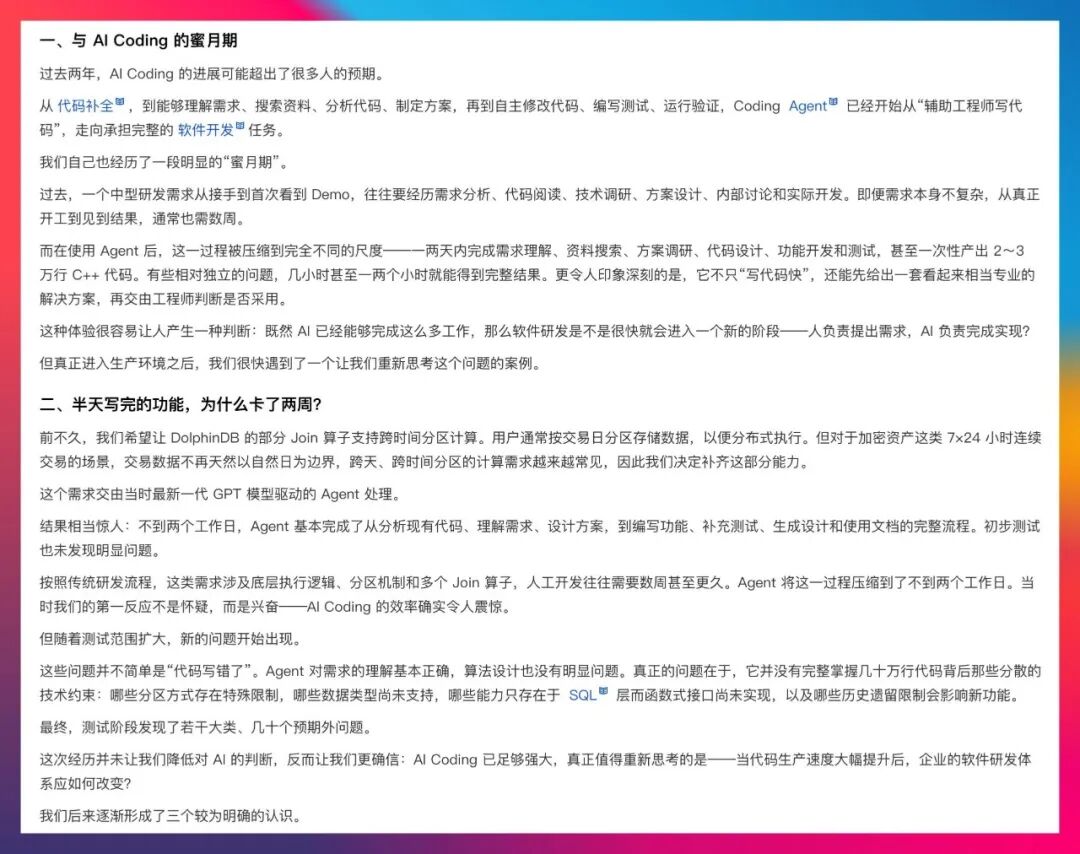
The problem emerged after expanding the test scope.
After in-depth testing, dozens of unexpected bugs of several major categories were directly exposed. The work that was completed in two days was stuck in the testing and repairing phase for two whole weeks.
After the review, the team found the most critical point: these problems were not caused by "AI hallucinations" at all.
The Agent's understanding of the requirements was basically correct, and there were no major problems with the algorithm ideas. What really trapped it was that in this old system that had been running for many years with hundreds of thousands of lines of code, there were a large number of unwritten implicit rules that were not recorded in the documents: which partitions had special restrictions, which functions only existed at the SQL layer but had not been implemented in the functional interface, and which pieces of code were specially reserved protection logic to prevent previous online incidents.
Even if veteran employees can't remember all the details, they at least know "where the potential pitfalls are and who to ask for help"; but the Agent is like a new recruit who just joined on the first day with extremely fast hands speed. No one told it about these hidden traps, so it naturally stepped right into them.
They also stepped into another pit: after code writing became extremely cheap, AI was very keen to "reinvent the wheel". If the computing engines, middleware and internal components accumulated by the company over the years are not clearly exposed to AI, it will not know where the existing ready-made components are, and will directly rewrite a whole new set, adding a lot of duplicate code to the system.
DolphinDB team finally summed up a very insightful point: AI Coding solves the problem of "producing code", but what the company really needs to solve is "digesting code". If AI allows developers to submit ten merge requests a day, but your review, testing and release process can only handle two per day, the company will not get ten times the efficiency at all, but eight semi-finished products stuck in the queue unable to move.
Case 2: 310,000 Lines of Code Refactoring by Meituan Technical Team
If the problems DolphinDB encountered were rework caused by hidden traps in the old system, the Meituan technical team clearly explained what would happen after "more than 90% of the team's code was written by AI" and how to fix it.
Meituan's business R&D platform has an Agent evaluation system. In June, it had less than 50,000 lines of code, and later it grew all the way to 310,000 lines of code, supporting about 16 requirements every month. In one year, the size of the team tripled, with members from all kinds of backgrounds, including high-concurrency development specialists, offline algorithm training engineers, back-end developers, and interns all working together.
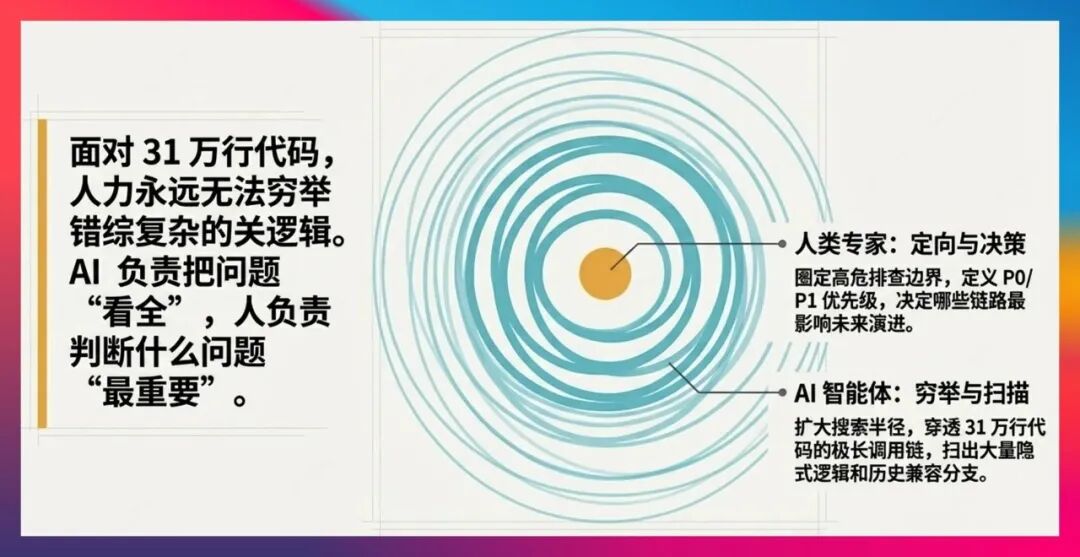
With mixed team members, urgent and vague requirements, and more than 90% of the code written entirely by AI, these three factors combined soon caused problems in the code base.
The Meituan team later reviewed in their article: AI writing code will not automatically help you clean up the mess. Large language models pay great attention to the current context. If the old code already has messy layering and everyone has inconsistent understanding of the specifications, the code written by different people directing AI will be "different from person to person". The system will not become easier to maintain, but will quickly turn into a mass of "spaghetti code" that is impossible to maintain.
Immediately after that, the second big trouble emerged — Code Review became the most congested short board in the whole process. The time for writing code was drastically shortened by AI, and all the pressure suddenly flooded to the downstream review session. If the review cannot keep up, all the time saved in code writing will be wasted.
They also took a real detour in the testing phase. At first, the team wanted to save effort, and tried to let AI automatically generate all test cases, with humans only checking them at the very end. But it soon failed: AI has no global business perspective, and relies heavily on the quality of the PRD, often missing those deeply hidden high-risk linkage scenarios, while generating a large number of useless edge cases, making manual review even more tiring than before.
In the end, the Meituan team did not blindly replace more expensive models, but honestly modified the collaboration process in four parts:
First, align the rules within the team before managing AI. They call this "align all people first, then align human and AI". Everyone first clarifies and finalizes the code layering and module boundaries, instead of leaving the specifications untouched in documents that no one reads. They directly turn the specifications into AI Rules and Skills that are forcibly loaded when AI writes code.
Second, the refactoring work is not explored separately by the whole team. The lead person first runs through the two most difficult modules in person, writes the operation steps into a set of Standard Operating Procedures (SOP), and then distributes it to the whole team to let AI work in parallel.
Third, they established a Pre-PR pre-review mechanism before submission. Before developers submit code, they must first let AI check against the team specifications for several rounds, even use a high-spec model to review the code written by a low-spec model, and let models from different manufacturers check each other for problems, to filter out format errors and common bugs first, so that manual reviewers can only focus on checking whether the business logic is correct.
Fourth, they gave up the fully automatic AI test case generation, and changed to "humans define the scope and risks, and AI is responsible for filling in the steps". Humans decide which interfaces to test and how deep the test should be, and AI is responsible for scanning code changes, using decision tables to reduce the number of cases and write execution steps in batches.
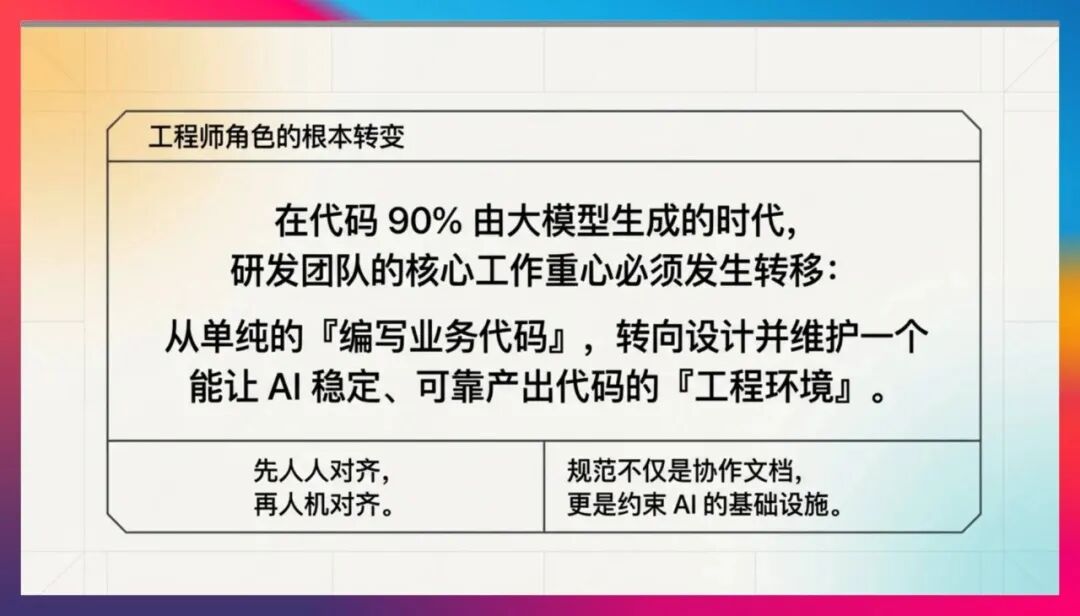
With these four measures, they did not apply for a dedicated refactoring schedule from the business side, and took the opportunity of completing daily business requirements to digest technical debts, smoothly sorting out the 310,000 lines of code.
Case 3: 2025 Tencent R&D Big Data Report
After looking at a single system and a single business team, let's look at the largest data from a large domestic internet company — the *2025 Tencent R&D Big Data Report* released in October 2025.
R&D personnel account for 76% of Tencent's total employees, adding an average of 325 million new lines of code and completing 370,000 requirements every month. The report states that more than 90% of Tencent's engineers are using the AI programming assistant CodeBuddy, and 50% of the new code is generated with AI participation, which means that for every two new lines of code written, one of them is generated by AI.
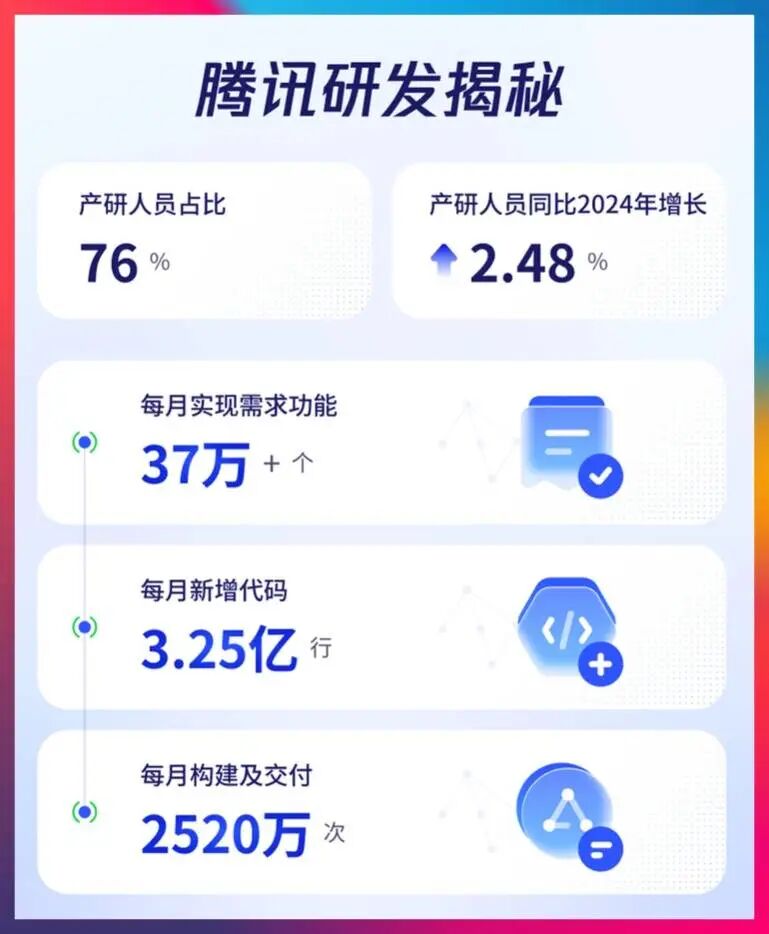
There are two figures in this report that are particularly interesting when viewed together: after using AI, the average time engineers spend writing code is reduced by 40%, but the overall R&D efficiency improvement of the company exceeds 20%.
Think about the gap between "40%" and "over 20%". Code writing is originally only one part of product development and version release. A 40% faster code writing speed can never automatically make the whole project 40% faster. Many small and medium-sized teams only see the "faster writing speed" in the front end, but the downstream review, testing and joint debugging are all blocked, and the overall efficiency even drops.
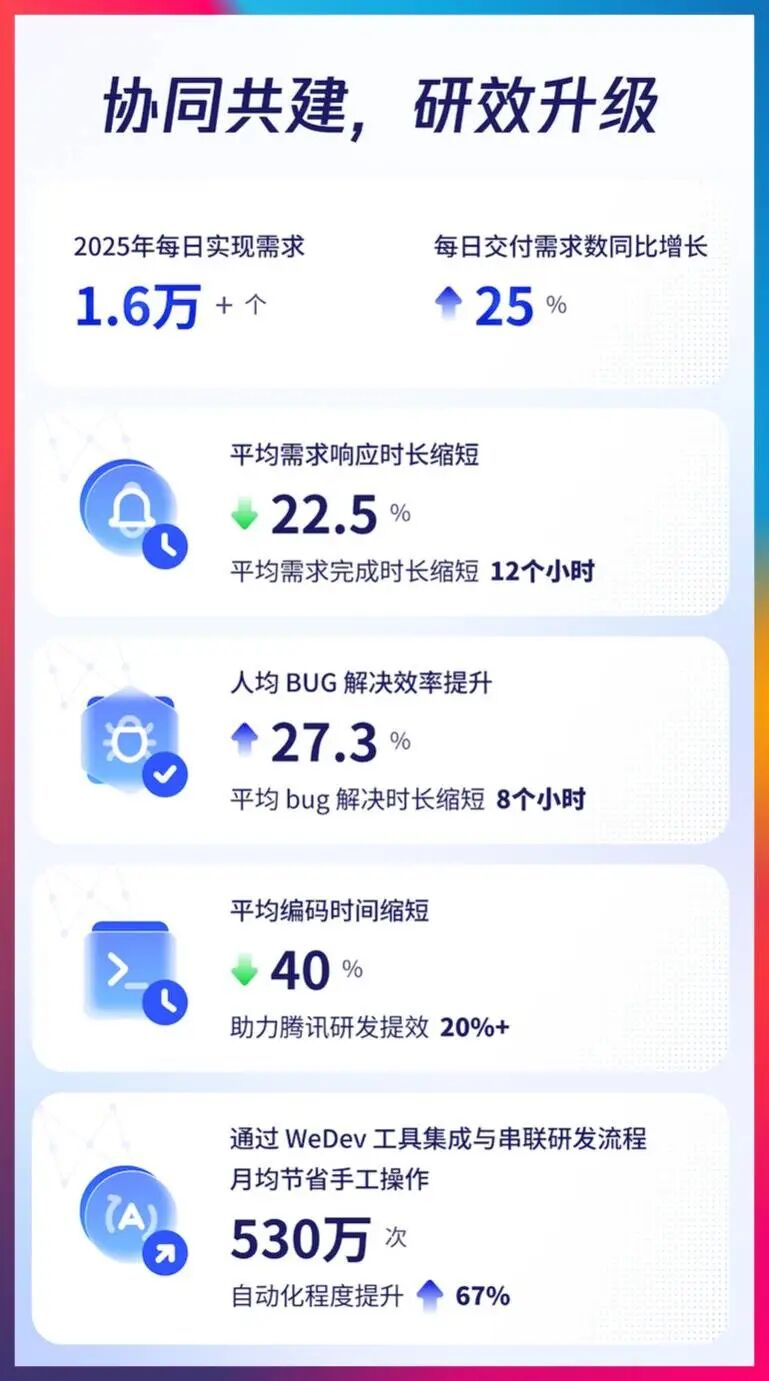
Tencent can steadily secure this more than 20% overall efficiency improvement, not just by letting AI write code, but by synchronously adding flood discharge outlets for the downstream:
• In the code review phase, the AI participation rate directly reaches 94%. That means almost every piece of code submitted goes through the first round of check by the "AI quality inspector" first. 28% of the code defects are directly identified by AI and adopted by engineers. The number of valid problem detections in the whole code review process increased by 44%, which absorbs a large part of the peak pressure for manual reviewers;
• The waiting time for tool chains and environments is reduced to a very low level. By connecting the data of various R&D efficiency tools through the WeDev platform, 5.3 million manual operations are saved every month. The AnyDev cloud R&D platform even reduces the environment configuration time for developers from 1 day to 1 minute;
• The quality defense line is also connected with AI. Static scanning combined with AI has fixed more than 5.4 million bugs and security vulnerabilities throughout the year, and the average time to fix a bug is reduced by 8 hours.
By comparing these three companies, we can see clearly: if a team only buys AI tools, but still follows the old process for downstream review and testing, it will sooner or later be slowed down by the extra code and semi-finished products. Only by setting clear rules in advance, and upgrading the review and testing processes at the same time as Meituan and Tencent did, can the time saved in the upstream be truly turned into earlier version launches.
As a PM, how to specifically modify the process in your hand?
Putting the three cases of DolphinDB, Meituan and Tencent together, the underlying logic can be summed up in one sentence: the previous product R&D process was designed for the era when "code writing was expensive and prototyping was slow", so we used to keep urging the upstream to work faster. Now AI has completely reversed the situation, making "output extremely cheap, but verification and alignment extremely expensive". If the process does not change accordingly, the more products you produce, the longer the team will spend on passing the buck and fixing problems.
Combined with my two years of experience in leading the team to run in, we can start the modification from four aspects:
1. When writing requirements, do not only focus on the background, but first clearly define the "acceptance criteria" and "red lines" at the very beginning
The lesson from DolphinDB is there: most of the AI errors are not caused by AI's inability to write code, but by its lack of knowledge of the implicit rules in the old system. In the past, when we wrote PRDs, we used to write thousands of words of business background first, and leave the edge logic to be confirmed when developers encountered problems. Now it doesn't work. As long as there is an ambiguous description in the requirement, AI can write thousands of lines of code in the wrong direction in five minutes, and it will be a pity to overturn and rewrite them later.
I have set a strict rule with my team now: before core requirements enter the development phase, three things must be placed at the top of the PRD — testable acceptance cases, list of common abnormal boundaries, and red lines of old logic that must never be touched. These three things are not only for developers to read, but also hard rules that developers can directly add to the AI context. Only after all people align on the rules first, will AI not go off track.
2. When splitting requirements, it is better to split them into smaller pieces, and avoid submitting thousands of lines of large chunks of code for testing
With faster code writing speed, it is very easy for developers to package the entire large function into a large submission of thousands of lines of code and throw it into the review and testing process. Senior colleagues can clearly check a change of 100 to 200 lines in ten minutes, but when facing 2000 lines of code output by AI, they will get tired halfway through reading, and most likely click pass directly, leaving hidden dangers that will slip into the online environment.
When product managers arrange schedules and split requirements, they should communicate with the R&D lead in advance: even if AI finishes all five sub-functions in one day, they must split them into five test submissions according to small slices that "can run independently and be tested independently". Splitting more tickets in the upstream seems a bit troublesome, but the downstream review and testing process runs much smoother, and the whole version will be launched earlier in the end.