Is this rally in the US stock market a trap? Wall Street giants have sounded the alarm that the S&P 500 may drop to 5500 points.
The US stock market has just experienced a round of sharp volatility, yet market sentiment quickly shifted from panic to optimism.
But in the view of David Rosenberg, a well-known Wall Street macroeconomist, this round of rebound may be exactly the stage in a bear market that most easily lulls investors into lowering their guard.
He judges that the S&P 500 may have peaked on October 6, and the current rally is more of a reflexive bounce in a typical bear market rather than the start of a new bull market.
Citing market cycles over the past 60 years, Rosenberg points out that bear markets usually go through three stages: the first is the initial decline that lasts about 4 months with a drop of roughly 14%; this is followed by a rebound that lasts around 4 months with an average gain of about 11%, and in about 80% of cases, the market will retest the previous highs; after that, however, the market may experience another roughly 10-month decline with a drop of 27%.
Following this historical path of deduction, he believes the S&P 500 could eventually fall to 5500 points by the end of 2027 or early 2028.
What truly worries him is not just stock market valuations and market sentiment, but the financing pressure behind the AI investment frenzy, the increasingly unbalanced growth structure of the US economy, and the potential wrong policies the Federal Reserve may adopt.
For the first time ever, hyperscale cloud computing enterprises have collectively posted negative free cash flow, and the problems of circular financing and off-balance-sheet debt in the AI industry remain unresolved; at the same time, the Federal Reserve, facing an energy supply shock, may further raise interest rates to suppress demand.
Rosenberg warns that if the policy path continues to deviate, the US unemployment rate may rise above 6%, and the reversal of the stock market wealth effect may further drag down consumption.
The key points sorted out by Wall Street CN are as follows:
The current rebound may only be the halftime break of a bear market. Rosenberg believes the S&P 500 has formed a cyclical top on October 6. Historically, the first drop in a bear market is often followed by a strong rebound, which in 80% of cases will retest the previous highs, but a deeper second drop may come afterward, with the S&P 500 targeting 5500 points.
Market sentiment and cross-asset performance have not confirmed a reversal. The VIX once touched 40, but the Market Vane bullish sentiment indicator still stands at 71, far from the typical historical panic clearing level of 40. Meanwhile, the 10-year US Treasury yield did not rise alongside the stock market rebound, while gold instead went up, indicating obvious divergence in the market.
The AI boom is accumulating financing and capital structure risks. For the first time, hyperscale cloud computing enterprises have collectively posted negative free cash flow, and the problems of circular financing, off-balance-sheet debt and loan guarantees have not disappeared. At the same time, continuous bond issuance and share offerings may change the market environment of net share supply contraction that has prevailed over the past 15 years.
The US economy is not in a full boom, and AI is masking weakness in other sectors. Rosenberg notes that data center construction is growing at a high speed, while other construction activities have declined by roughly 7% overall; real estate sales are at a low level, employment growth is close to zero, and consumption is increasingly dependent on the wealth effect brought by rising stock markets.
The Federal Reserve may create a deeper economic recession to fight against supply shocks. If it insists on pushing overall inflation back to 2%, and energy prices do not fall significantly, the federal funds rate may need to be raised by more than 200 basis points. He deduces that the real GDP trend growth rate may drop from +2% to -2%, and the unemployment rate will rise above 6%.
Rosenberg has not chosen to fully liquidate his positions, but instead reduced risk and shifted to defense. His model portfolio has cut its stock position from 70% a year ago to 40%, with an allocation of 40% equities, 40% bonds, 10% hard assets and 10% cash. Equities are tilted toward healthcare, energy infrastructure and the Japanese market, while bond duration has been increased.
The most dangerous stage of a bear market may be exactly when the rebound takes place
Rosenberg's judgment on this round of US stock market moves first comes from his observation of historical bear market cycles.
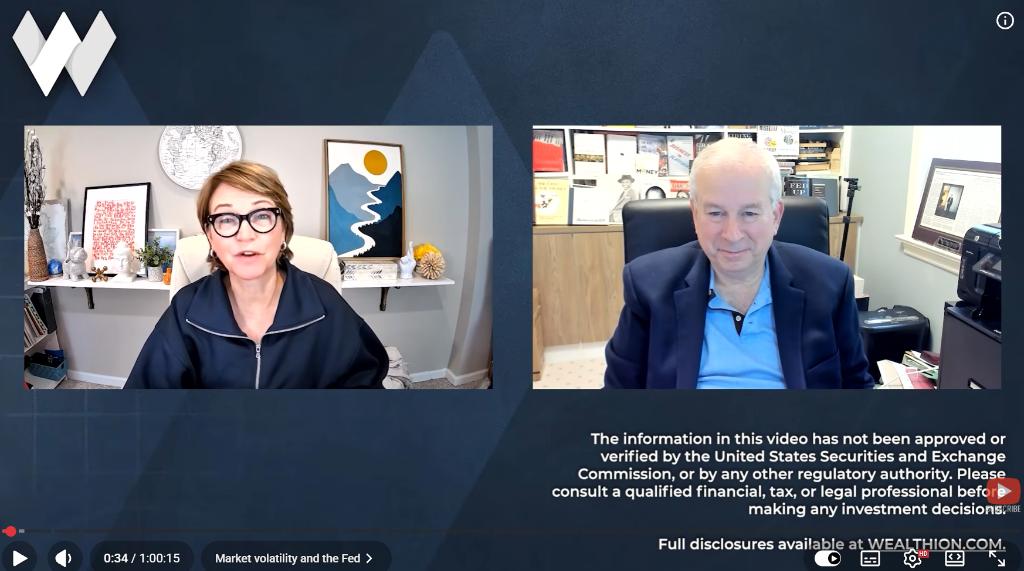
In a conversation with Maggie Lake, host of Wealthion, he explicitly stated that he firmly believes October 6 is the fundamental top of the current cycle for the S&P 500. Based on market experience over the past 60 years, a bear market usually does not fall straight down from the highs, but goes through three phases.
The first phase is the initial decline, which lasts on average about 4 months with a drop of roughly 14%. As of last Friday before the interview recording, the S&P 500 has fallen by more than 12%, with both time frame and magnitude close to this historical characteristic.
The second phase is the bear market rebound. Rosenberg points out that there is usually a rebound in a bear market that lasts around 4 months with an average gain of about 11%. More notably, in about 80% of cases, the market will retest the previous cyclical highs.
This is exactly where the bear market rebound most easily creates illusions.
When the market rises again, investors easily assume the worst is over, and the previous decline was nothing more than a brief correction. But in Rosenberg's view, this rebound does not mean fundamentals have improved. It can be extremely strong, even enough to get investors to re-establish long positions, but it does not necessarily change the direction of the entire economic and earnings cycle.
The third phase is the truly dangerous part.
He expects that after the rebound ends, the market may experience another roughly 10-month decline with a 27% drop. If this historical pattern is applied to the current market, the S&P 500 could fall to 5500 points by the end of 2027 or early 2028.
He also emphasizes that bear markets usually last 12 to 18 months. Historically, during the 2001, 2002, and 2008-2009 bear markets, extremely strong single-day and single-week gains all appeared.
The rebound lacks confirmation from the bond market, and investor sentiment is far from cleared
Apart from historical cycles, Rosenberg also looks for evidence of the reliability of the rebound from cross-asset performance and market sentiment.
Last Friday before the interview recording, the Nasdaq Index fell by about 5%, and obvious panic once emerged in the market. Later, as news related to NVIDIA drove a reversal in sentiment, the stock market rebounded rapidly.
But Rosenberg believes this is more of a market move driven by news and position changes, rather than a return of risk appetite brought by improved fundamentals.
He specifically mentions the performance of the bond market. If the stock market rebound represents investors becoming more optimistic about the economy and corporate earnings, it is usually accompanied by a rise in bond yields, as the market reprices economic growth and future interest rates. But on the day of the recording, the 10-year US Treasury yield barely changed.
Rosenberg says, If this is a truly reliable risk-on trade, the 10-year US Treasury yield should have risen by 5 to 10 basis points.
The performance of gold also took him by surprise.
Over the past year, gold even behaved like a risk appetite asset in some stages, being hit in tandem with AI trades. But in this stock market rebound, gold rose instead, while bond yields did not rise significantly. These signals indicate that no unanimous optimistic judgment has formed in the market.
Investor sentiment has not reached the level typical of a bear market bottom either.
Rosenberg points out that the VIX once hit 40 intraday last Friday, which historically is a notable panic re-entry signal. But the Market Vane bullish sentiment indicator still stands at 71, far from the 40 level he considers representative of true sentiment clearing.
There has also been no obvious shift in Wall Street's sell-side views. He mentions that the most bearish strategists on the street still forecast a 19% rise for the S&P 500 next year, and analysts who assign sell ratings to the stocks they cover only account for 3%. In his view, none of these resemble the sentiment structure that should exist at a typical bear market bottom.
Behind the AI investment frenzy, cash flow and financing risks are accumulating
If the market rebound lacks confirming signals, then the capital expenditure and financing structure of the AI industry itself are Rosenberg's deeper concerns.
He believes this round of market correction is different from several previous brief pullbacks. In the past, market declines could usually wait for the Federal Reserve, the government, or some new technology catalyst to turn the situation around. But this time, the problems come more from the AI industry itself.
The first is corporate cash flow. Rosenberg points out that this summer, hyperscale cloud computing enterprises collectively posted negative free cash flow for the first time. To compete for dominance in the AI space, large tech companies have continuously increased investment in data centers, chips and infrastructure, forming a kind of arms race against each other.
It is very difficult for enterprises to take the initiative to slow down investment, because any company that decelerates first may worry about being overtaken by competitors. But as the scale of investment continues to expand, financing demand rises accordingly. Expansion that originally relied on operating cash flow for support has begun to depend more on debt and external capital.
The second is circular financing. Rosenberg believes there are complex capital and commercial relationships between NVIDIA and the AI startups it invests in. Corporate investment, procurement and financing are intertwined, making the true return on capital of the AI industrial chain increasingly worth examining. Jensen Huang returning to power cannot solve these structural problems.
The third risk comes from off-balance-sheet debt. Apart from bonds that have already been issued, large tech companies and their related projects also have a large number of loan guarantees and other financing commitments. These risks may not directly appear in traditional balance sheets, but once returns on AI investment fall short of expectations, related financing pressure will surface.
He also mentions that large-scale bond issuance this year has pushed credit default swap (CDS) spreads to widen significantly, with some indicators reaching roughly three times previous levels.
What is more notable is share supply. Over the past 15 years, US stock investors have benefited from net supply contraction brought by corporate share buybacks. Companies reduced the number of tradable shares in the market through buybacks, providing continuous support for stock prices.
But Rosenberg believes that as corporate financing demand rises and share offerings increase, the market is entering a brand new phase: net share supply may turn positive for the first time. This means the buyback force that has supported US stocks for a long time in the past may weaken, and new share supply will become a pressure the market has to digest.
The AI boom is masking other problems in the US economy
In Rosenberg's view, the biggest contradiction in the current US economy is the obvious divergence between AI-related investment and other economic sectors.
He mentions that US data center construction maintained rapid growth this year, with an increase close to 90%, while all other types of construction activities fell by roughly 7% overall. This means economic growth is increasingly relying on a small number of tech infrastructure projects, while traditional real estate and other construction activities have not improved in tandem.
He compares this situation to the internet boom in the late 1990s.
Back then, internet investment was a broader economic wave, with technology investment driving the development of a large number of industries, and the contributions of productivity and labor input to economic growth were relatively balanced. But this time, AI investment seems to be siphoning funds and resources away from most other parts of the economy. The market discusses every day how AI will change the world, but easily ignores that a considerable part of the economy is still in a downturn.
Real estate is one example. Rosenberg points out that the US pending home sales index has fallen to a historical low, even lower than levels during the 2008-2009 real estate recession. But compared with AI, the real estate market has received significantly less attention.
The job market also has hidden worries. He believes US year-over-year employment growth is already close to zero. On the surface, the unemployment rate is still around 4%, but changes in immigration policy have affected the labor force participation rate, so the unemployment rate alone cannot be used to judge that the job market remains strong.
At the same time, wage growth has fallen to a nearly five-year low. There is another risk on the consumption side: US residents' consumption is increasingly dependent on the wealth effect brought by rising stock markets.
Rosenberg mentions that the US savings rate has dropped from above 5% to below 4% over the past year, and the wealth effect from rising stock markets has contributed roughly 0.25 to 1.5 percentage points to GDP growth.
If the stock market bull market ends, high-income groups holding large amounts of equity assets may start to cut spending, thus forming a negative feedback loop: falling stock markets weaken the wealth effect, weakening consumption drags down the economy, corporate earnings and employment come under further pressure, which in turn suppresses the stock market.
He believes this situation bears some similarities to the market structure around the 2000 tech stock bubble burst.
The Federal Reserve may push the US economy into recession in order to push down inflation
Throughout the interview, Rosenberg's criticism of Federal Reserve policy is quite direct.
He believes the Federal Reserve is facing an energy supply shock, but is trying to raise interest rates to push down overall inflation. This could be a typical policy mistake.
The current rise in energy prices will be transmitted to broader commodity and service prices through links such as diesel, transportation, aviation, fertilizers and food. But these price increases do not mean there is widespread overheating of demand in the US economy.
Rosenberg argues that the Federal Reserve's interest rate tool mainly affects demand, but cannot directly increase energy supply, nor can it solve the problem of insufficient refining capacity. If the Federal Reserve insists on pushing overall inflation down from roughly 4% to 2%, and energy prices do not fall significantly, it will have to achieve its goal by compressing demand in other areas.
He uses a model to make an arithmetic deduction: under such circumstances, the federal funds rate may need to be raised by more than 200 basis points, reaching a level of roughly 6%.
This will come at a severe economic cost. According to his deduction, the four-quarter trend growth rate of US real GDP may drop from +2% to -2%, and the unemployment rate may rise above 6%.
He believes the current US economic growth trend is only about 2.1%, far lower than the growth level that typically corresponds to when the Federal Reserve historically starts an interest rate hike cycle. The yield curve is also relatively flat, and the labor market is not obviously overheated.
Therefore, he worries that the Federal Reserve is pushing the economy toward a dangerous policy mix: to fight against the energy supply shock, it is actively creating greater demand contraction.
Rosenberg also believes there is currently insufficient evidence to prove that the Federal Reserve has lost its inflation credibility. If the market no longer believes in the Federal Reserve's ability to control inflation, gold, the dollar, inflation expectations and the bond market should have seen more dramatic changes, but he believes these signals have not appeared yet.
He expects the market has priced in the possibility of a 25 basis point rate hike on December 9, but what really deserves attention is not the single rate hike, but the Federal Reserve's statement, press conference and future interest rate path. In his view, if the Federal Reserve further implements consecutive rate hikes next year, it may make a more serious mistake.
Rosenberg did not liquidate his stock holdings: 40% position is bet on healthcare and energy infrastructure
Despite his cautious outlook on the market, Rosenberg did not choose to completely exit the stock market.
He reveals that his model portfolio still had roughly 70% in stocks a year ago, and that share has now dropped to 40%. The overall portfolio allocation is roughly: 40% equities; 40% bonds; 10% hard assets; 10% cash.
He emphasizes that