The situation of Tsingtao Brewery is a shared lesson for all domestic-demand consumer goods.
Since 2026, the share price of Tsingtao Brewery has still not emerged from its trough. Its A-shares hover in the 50-yuan range, nearly 60% lower than the high of 120 yuan in 2023; its H-shares are quoted at around HK$40, with the market value evaporating by more than half from the peak of HK$87 in 2023. Looking at the past three years, it fell by 32% in 2023, rebounded by 9% in 2024, dropped by 23% in 2025, and continued to edge down in 2026. The share price of Tsingtao Brewery has long been rather sluggish.
In sharp contrast to the tepid share price is its 2025 performance: revenue reached 32.47 billion yuan, up 1%, and net profit attributable to shareholders stood at 4.59 billion yuan, up 5.6%, hitting a record high in earnings. In the first half of 2026, revenue was 19.66 billion yuan, down 4.1%, and net profit attributable to shareholders was 3.92 billion yuan, barely rising by 0.4%.
The turning point appeared in the third-quarter report. This summer, Shandong saw more heavy rainfall and lower temperatures than usual, which reduced the scenarios of drinking at gatherings and slowed down the sales of beer at late-night food stalls. In the third quarter, operating revenue decreased by 5.6%, non-recurring profit deducted net profit decreased by 25.3%, and beer sales volume decreased by 9.1%. "The summer is a bit cool" refers not only to the weather, but also to the financial statements.
Let's bring valuation into the picture. Tsingtao Brewery's A-shares have fluctuated in the 50-yuan range for nearly three months, with a price-to-earnings ratio of around 15x, a dividend payout ratio of nearly 70%, and a dividend yield of 4.7%. Its H-shares are discounted by about 33%, with an even higher dividend yield of 5.6%. The valuation level is very attractive.
If the third-quarter performance was only an accidental result of the weather, then buying a stable cash flow at a 5.6% dividend yield means that the current valuation is a considerable opportunity. If there are deeper factors behind the "coolness" — demand is receding and cost dividends are disappearing, then the high dividend is just bait for a trap.
Is it an undervalued opportunity or an overvalued trap? Next, the author will analyze its recent operations, business model and cost structure, identify the key drivers of this year's earnings changes, and judge how far it can go in the future. The answer to whether it is cheap or expensive lies in these steps.
Downward valuation line, flat revenue line, doubled profit line
The history of Tsingtao Brewery dates back to 1903. In that year, British and German businessmen founded "Germania-Brauerei Tsingtau Aktiengesellschaft" in Tsingtao. In 1993, the company was listed on the Shanghai and Hong Kong stock exchanges, making it the first mainland Chinese enterprise to be listed in Hong Kong. It has 56 wholly-owned and controlled beer production enterprises, distributed in 20 provinces, municipalities directly under the central government, and autonomous regions.
Tsingtao Brewery's revenue almost comes from two core markets. In 2025, revenue in Shandong reached 22.32 billion yuan, accounting for 70.1% of total revenue, with sales volume of 5.4 million kiloliters, accounting for 70.6% of total sales. Revenue in North China reached 7.86 billion yuan, accounting for 24.7%, with sales volume of 2.036 million kiloliters, accounting for 26.6%, most of which came from Shaanxi. The two regions together contribute 95% of revenue and 97% of sales volume, among which Shandong alone accounts for more than 70% — the ceiling of this province is almost the ceiling of the whole company.
The State-owned Assets Supervision and Administration Commission of Qingdao holds 32.7% of the company's shares through Tsingtao Brewery Group and is the actual controller. Such an ownership structure determines its operating characteristics: it pursues not only profits, but also employment, tax revenue and the development of local industries, and rarely takes desperate risks. It has nearly 27 billion yuan in cash-like assets on its books, accounting for more than 50% of total assets, but it hardly makes large-scale cross-border or cross-sector mergers and acquisitions to increase returns. It would rather use the money for dividends and bond wealth management (pure bond wealth management, even no enhanced bond funds) than bet on a gamble that may damage its main business and local employment. Steadiness is the background tone given by this ownership structure, and it is also the constraint on the upper limit of its valuation.
In 2025, the company's beer sales volume reached 7.65 million kiloliters, accounting for about 21.6% of the national beer output of enterprises above designated size, firmly ranking second in the industry, while China Resources Beer ranks first. In terms of products, the company follows a "dual-brand" strategy: the core Tsingtao Brewery brand, plus Laoshan Beer as the national second brand. In 2025, the sales volume of the core brand reached 4.49 million kiloliters, up 3.5% year on year, accounting for 58.8% of total sales; the sales volume of other brands led by Laoshan reached 3.15 million kiloliters, accounting for 41.2%.
The price ranges of the two brands exactly divide China's beer market into two segments. Laoshan takes the mass market route: the terminal retail price of its mainstream 500ml product is roughly 3-6 yuan, and even in catering channels it is only 5-8 yuan, which is very popular at construction sites, food stalls and for family stockpiling. The core Tsingtao brand starts from its classic model, with 500ml products retailing at 6-8 yuan, and pure draft beer and white beer in the 10-yuan range. In short, the core Tsingtao Brewery brand is responsible for maintaining price levels, and the Laoshan brand is responsible for maintaining sales volume.
Looking at the valuation (see the figure below), since 2020, it is almost a textbook example of consumer stocks from fanaticism to rationality. In 2020, core assets were clustered by institutional investors and the consumer track was sought after, pushing the P/E ratio of Tsingtao Brewery to 60.4x, with a market value of 135.6 billion yuan. In 2022, its market value once reached 146.7 billion yuan, corresponding to a P/E ratio of 38.5x. That was the pricing of a "growth stock": the market believed that high-end development could push the net sales profit margin from 6% to more than 15%, and profits could maintain double-digit growth for a long time.
After 2022, the boom faded, and the valuation entered a long digestion period. By the end of 2025, the market value was 83.5 billion yuan, with a P/E ratio of 18x. In the third quarter of 2026, the P/E ratio remained at 15x for a long time. From 60.4x to 15x, three quarters of the valuation was cut. This is not because the company has deteriorated — its net profit margin is still hitting new highs, but because the market's answer to "how long can the growth last in the future" has changed.
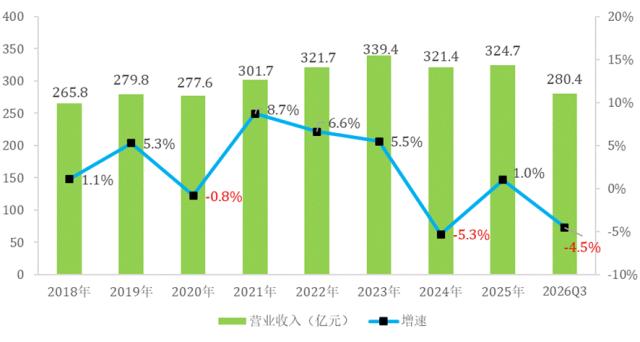
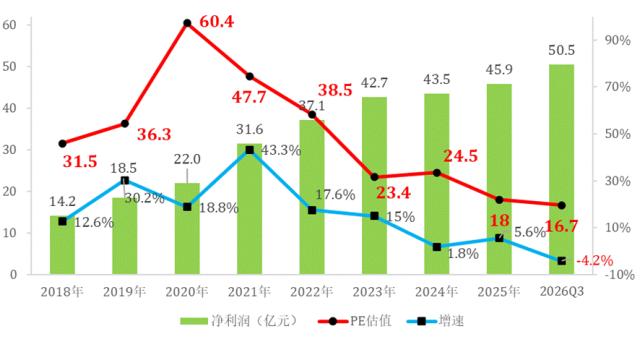
Figure: Comparison of key operating data and valuation of Tsingtao Brewery from 2018 to 2026
From 2018 to 2025, the company's operating revenue rose from 26.58 billion yuan to 32.47 billion yuan, with a cumulative growth of 22.2% and an average annual growth rate of less than 3%, and even dropped by 5.3% in 2024. In the first three quarters of 2026, revenue was 28.04 billion yuan, down 4.5% again.
More notably, the 22% growth was almost fully completed before 2022. In 2022, the revenue was 32.17 billion yuan, and in 2025 it was 32.47 billion yuan, with only 300 million yuan more in three years — since 2022, the revenue curve has been almost a horizontal line.
But the profit curve did not flatten accordingly. Net profit attributable to shareholders rose from 1.42 billion yuan in 2018 to 4.59 billion yuan in 2025, an increase of 2.2 times. Even looking at the three years from 2022 to 2025, it rose from 3.71 billion yuan to 4.59 billion yuan, an increase of 880 million yuan, up 23.6%.
Revenue has not moved for three years, but profits have increased by nearly 900 million yuan — where does this money come from? This is the key to understanding Tsingtao Brewery.
First, the increase in ton price brought by structural upgrading: the revenue per kiloliter of beer increased from 3,309 yuan/kiloliter in 2018 to 4,246 yuan/kiloliter in 2025, up 28.3%; second, the cost dividend: the main raw materials including barley, packaging materials such as glass and corrugated paper fell one after another from 2023 to 2025, directly reducing the direct material cost from 13.32 billion yuan in 2022 to 11.79 billion yuan in 2025, saving 1.53 billion yuan in costs. Revenue stays flat while profits grow rapidly, which essentially means "replacing volume with price and cost".
But why has revenue stayed flat year after year, or even declined? The answer is not in the income statement, but in macro demand (see the table below). In 2018, the population aged 16-59 in China was 897 million, accounting for 64.3% of the total population; in 2025, it was 851 million, accounting for 60.6%, with 45.93 million fewer people in seven years. In the same period, the beer output of enterprises above designated size dropped from 38.12 million kiloliters to 35.36 million kiloliters, down 7.2%. The slopes of the two lines are almost exactly the same.
The working-age population aged 16-59 is the main consumer group of beer, with stable income and real demand. The number of people who drink beer is decreasing year by year, so the total volume of the industry can only be lower year by year. Therefore, the reason for the "flat revenue" is that China's age structure is gradually reducing the number of beer drinkers.
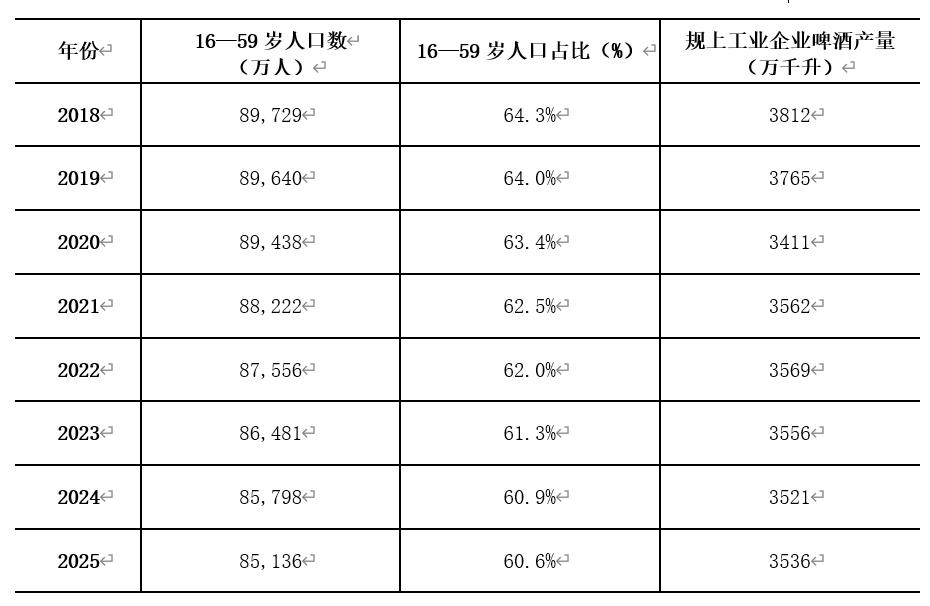
Figure: Data table of population aged 16-59 and beer output of enterprises above designated size from 2018 to 2025; Data source: National Bureau of Statistics "Statistical Communiqué on National Economic and Social Development", output data of main products of industrial enterprises above designated size
This downward demand curve does not only belong to Tsingtao Brewery. Real estate, building materials, baijiu, dairy, condiments, the leading enterprises are all facing the same slope: demand has peaked, how to invest? This is the question left to readers.
The paradigm of the past two decades is "waiting for demand to recover", but on a stepwise downward curve, demand is unlikely to return to the previous level. Tsingtao Brewery's profits are still hitting new highs, but the demand curve under its feet has changed to a new slope. The business model, cost and valuation to be analyzed later must all be viewed on this new slope.
Each guards its own territory and does not cross the boundary: regional segmentation of the beer industry
First, look at an easily overlooked figure. In the first three quarters of 2026, the net profit attributable to shareholders of Tsingtao Brewery was 5.05 billion yuan; the full-year figure in 2025 was 4.59 billion yuan. The profit earned in three quarters is more than that of the whole previous year. The reason is not growth, but season: in the fourth quarter of 2025, the company recorded a single-quarter loss of 690 million yuan.
Arrange the four quarters of 2025, and the shape is clear at a glance: the revenue in the first half of the year was 20.49 billion yuan, with each quarter at around 10 billion yuan; the third quarter was 8.88 billion yuan; the fourth quarter was only 3.11 billion yuan, less than 10% of the whole year. A closer look shows that the gross profit in the fourth quarter was about 770 million yuan, and the gross profit margin was still 24.8%; but the single-quarter sales expense was 1.09 billion yuan, and the administrative expense was 500 million yuan, the two totaling 1.59 billion yuan. The gross profit cannot cover the expenses, resulting in a loss of 690 million yuan. The peak season earns money from sales volume, and the off-season loses money on fixed expenses such as labor and depreciation.
How large are these fixed expenses? Look at the cost structure in 2025. The annual operating cost was 18.55 billion yuan, of which direct materials were 11.79 billion yuan, accounting for 63.5%; direct labor was 1.04 billion yuan, accounting for 5.6%; manufacturing expenses and others were 4.7 billion yuan, accounting for 25.3% — depreciation, energy and maintenance are all included in this item.
Further breakdown, according to the latest annual strategy calculation of GF Securities, in the operating cost structure, malt accounts for about 13.6%, rice 4%, hops 0.9%, and packaging materials about 50.3% (aluminum cans, glass bottles and cartons account for about 23%, 23% and 4% respectively). This is exactly the same as the cost logic of the mineral water industry: the packaging of bottles and cans for beer costs more than the beer liquid itself.
According to the full-caliber statistics, the staff salary in 2025 was 5.47 billion yuan, and depreciation and amortization was 1.29 billion yuan, the two totaling 6.76 billion yuan, equivalent to 36% of the operating cost and 21% of the operating revenue.
This is the business model of the beer industry: about one third of the costs are expenses that have to be paid even if no one is working and the machines are not running. When the sales volume is sufficient, these costs are diluted; when the sales volume is low, these costs remain on the income statement as they are. The fact that the profit earned in three quarters exceeds that of the whole year shows how dependent it is on the summer peak season, rather than how profitable it is.
After clarifying this point, let's look at the competitive landscape.
China's beer industry is a "segmented map". In 2025, the sales volume of China Resources, Tsingtao, Yanjing and Chongqing Brewery was 11.03,