Bank of America 2027 Outlook: AI Investment Becomes the Biggest Uncertainty for the US Economy, and the Federal Reserve Is Expected to Raise Interest Rates Three More Times
Bank of America believes that although the U.S. economy still shows strong resilience at present, the trend of the artificial intelligence (AI) investment wave may determine the trajectory of the U.S. economy and monetary policy in the next two years. If corporate investment continues to grow at a high speed, the Federal Reserve may have to raise the policy rate to 5% or even higher; once AI capital expenditure slows down sharply, the U.S. economy will face a higher risk of recession, and the Federal Reserve may also shift to interest rate cuts.
A research report titled "2027 U.S. Economic Outlook" released by BofA Global Research on November 24 points out that supported by corporate investment and household consumption, the U.S. real GDP is expected to grow by 2.3% and 2.1% respectively in 2027 and 2028, but inflation will still be higher than the Federal Reserve's target. The bank expects the Federal Reserve to raise interest rates by 25 basis points at each of the next three meetings, and the AI capital expenditure cycle is the biggest uncertainty facing the above forecast.
Two Possibilities Behind the Rapid Growth of AI Investment
Bank of America believes that the economies of scale characteristics of the AI industry are prone to "rational overinvestment". In the end, only a few enterprises in this field may win, but every enterprise has to invest on the assumption that it will be the winner. Even if the investment decision of a single enterprise is reasonable, overinvestment may still occur in the whole industry. The most critical issue at present is when this capital expenditure cycle will turn.
According to Bank of America's calculations, since the first quarter of 2025, the real annualized growth rate of AI-related capital expenditure sub-items in the United States, such as software, data centers, computers and peripheral equipment, is about 26%.
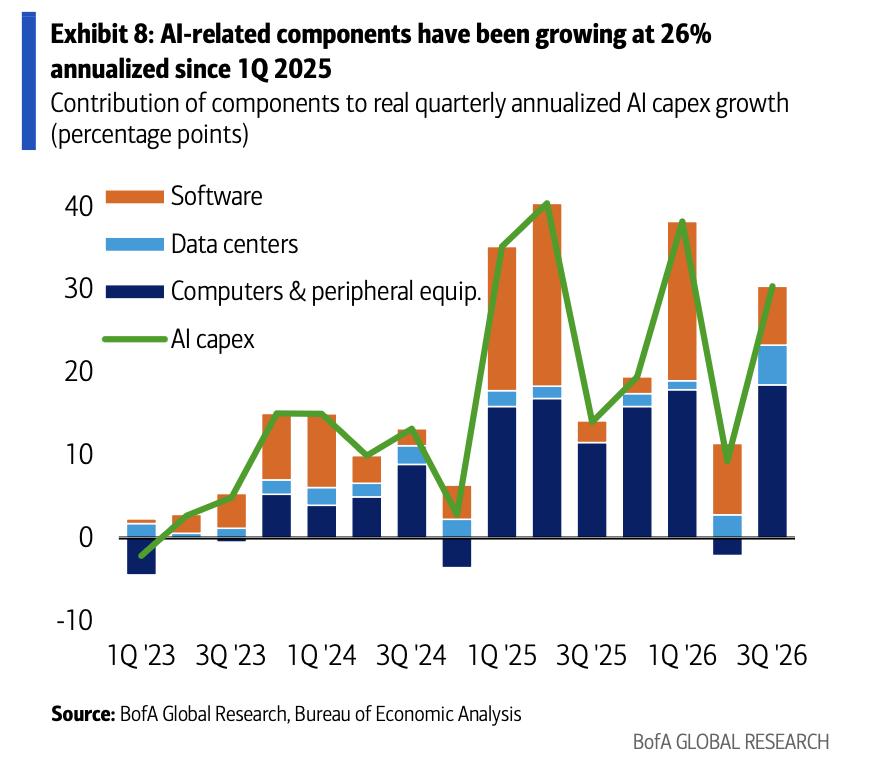
(Since the first quarter of 2025, the real annualized growth rate of U.S. AI-related capital expenditure sub-items is about 26%. The chart shows the contribution of software, data centers, computers and peripheral equipment to investment growth)
There are two completely different interpretations of this high growth rate: first, the overall scale of the AI investment wave exceeds previous expectations; second, a large amount of investment is implemented in advance, which means that future capital expenditure may decline sharply earlier and the decline will be more severe. Bank of America believes that recent economic data is not enough to judge which situation is closer to reality.
Under the baseline scenario, Bank of America expects corporate investment to remain strong at least in the first half of 2027, and then gradually slow down. The growth rate of U.S. real non-residential investment is expected to drop from 7.6% in 2026 to 7.0% in 2027, and further drop to 2.9% in 2028. Calculated at the quarterly annualized rate, the non-residential investment growth rate is expected to drop from 6.3% in the first quarter of 2027 to 2.9% in the fourth quarter, and remain at 2.3% in all quarters of 2028. The bank did not include the scenario of investment shrinkage in the baseline forecast, mainly because it is difficult to judge when it will occur.
Bank of America believes that the results of the U.S. mid-term elections will not significantly change its capital expenditure outlook. Even if some state governments introduce measures to slow down data center construction, the new regulations will take time to affect economic activities, and avoiding excessive advance of investment may instead reduce the risk of future economic recession.
Bank of America also pointed out that due to the time lag between enterprises issuing investment guidelines and related changes being reflected in GDP data, the financial market may price in advance before the actual sharp decline in capital expenditure, but it may also send false signals many times during the period. How to distinguish the real cycle turning point from market noise will be a major challenge for economists and investors.
Household Consumption Remains Resilient, the Gap in Consumption Growth Rate Between High and Low-income Groups Reverses
In addition to corporate investment, household consumption is another major pillar of U.S. economic growth. Bank of America expects U.S. real household consumption to grow by 2.3% and 2.2% respectively in 2027 and 2028.
Although the U.S. economy has encountered energy price shocks this year, fiscal stimulus, the stock wealth effect brought by the AI boom, and improved employment growth have made household consumption show significant resilience.
It is worth noting that internal Bank of America credit and debit card data show that in recent weeks, the year-on-year growth rate of average household bank card consumption excluding gasoline expenditure of low-income families has continuously exceeded that of high-income families, and the previous situation where high-income families led the consumption growth rate has reversed in the bank's sample data.
Looking ahead to 2027, Bank of America believes that the overall inflation decline brought by flat or falling energy prices will become the most important favorable factor for real consumption growth. The cost-of-living adjustment for U.S. social security benefits will also rise from 2.8% in January this year to 3.6% next January.
At the same time, as the Medicaid cuts in the "Big Beautiful Act" are gradually intensified and the tariff refund effect fades, the marginal impact of fiscal policy on economic growth will turn slightly negative.
Bank of America expects that the labor market will continue to remain balanced, with an average of about 64,000 new non-farm jobs added per month in 2027, and the unemployment rate will remain at 4.1% in the next two years.
Deglobalization Makes the 2% Inflation Target Harder to Achieve
Bank of America expects the year-on-year growth rate of the U.S. core personal consumption expenditures (PCE) price index to fall to 2.6% by the end of 2027, 0.1 percentage points higher than the Federal Reserve's September forecast, and further fall to 2.3% by the end of 2028.
In the core inflation forecast, Bank of America estimates that the combined impact of tariffs and the Iran conflict (the latter is mainly transmitted through air fares) on inflation is about 50 basis points, and assumes that these impacts will gradually exit the year-on-year calculation next year. However, given that nominal expenditure growth remains strong, as supply shocks subside, demand-driven inflation may pick up somewhat, partially offsetting the cooling effect of the Federal Reserve's interest rate hikes on inflation.
More notably, Bank of America believes that even if the inflation effect of tariffs fades, the deglobalization trend will continue and continue to put upward pressure on commodity prices.
The bank pointed out that from the entry into force of the North American Free Trade Agreement in 1994 to the outbreak of the COVID-19 pandemic, the annualized growth rate of U.S. core PCE commodity prices was -0.5%. The long-term decline in commodity prices allowed the Federal Reserve to keep core PCE inflation at around 2% even when core services inflation remained at around 2.8%.
However, since February 2020, the annualized growth rate of core commodity prices has risen to 2%. Even if this growth rate slows to around 1% in the future, core services inflation will need to fall by more than 1 percentage point to 2.3% to bring core PCE inflation back to 2%.
Bank of America doubts whether services inflation can achieve such a significant cooling without a sharp slowdown in economic activity.
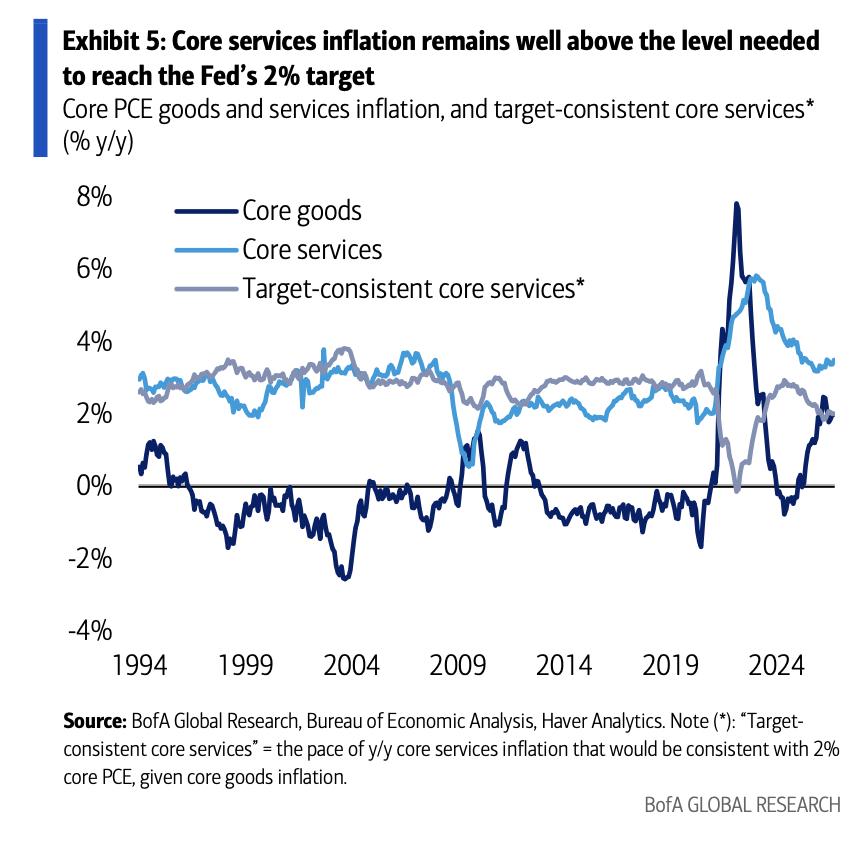
(U.S. core services inflation is still significantly higher than the level required to achieve 2% core PCE inflation at the current core commodity inflation level)
As for overall inflation — based on its oil price forecast from the commodity research team — Bank of America expects overall PCE inflation to fall to 2.5% by the end of 2027. However, as the overall inflation trend is highly dependent on the development of the Iran conflict, the bank has low confidence in this forecast.
The Federal Reserve is Expected to Raise Interest Rates Three Consecutive Times, and the AI Investment Cycle May Change the Interest Rate Path
Bank of America recently added a forecast of an interest rate hike in January 2027, expecting the Federal Reserve to raise interest rates by 25 basis points in December this year, January and March next year respectively, raising the target range of the federal funds rate to 4.50% - 4.75% and maintaining it until the end of 2028.
Bank of America believes that after the release of October CPI data, most members of the Federal Open Market Committee (FOMC) have or will agree on two judgments: first, the pause in interest rate hikes in October was a mistake; second, as monetary policy has fallen behind the situation, the Federal Reserve can no longer advance the tightening at the pace of raising interest rates once a quarter.
Although Fed Governor Christopher Waller left open the possibility of a 50 basis point rate hike in December, in view of the slightly weak October Producer Price Index (PPI) data, falling stock markets and a significant pullback in oil prices, Bank of America believes that consecutive 25 basis point rate hikes are more likely. Market pricing at the time of the report's release showed that the cumulative rate hike at the next two Fed meetings was close to 45 basis points, with a small possibility of a 50 basis point hike in December.
However, the AI investment cycle may make the Fed's actual policy path deviate significantly from the baseline forecast.
If corporate investment continues to grow at a double-digit rate, aggregate demand will be further strengthened, and the upward pressure on wages and prices will also increase. Once wage growth accelerates again and the unemployment rate falls, both the Fed's employment and price stability targets will point to more tightening monetary policy. Sustained strong capital demand may also lead the Fed to believe that the neutral real interest rate is rising, pushing the policy rate to 5% or even higher.
Conversely, if AI capital expenditure slows down sharply, the negative wealth effect brought by falling stock prices and the weakening labor market will jointly suppress household consumption. Even if inflation remains sticky in the short term, the Fed may shift to interest rate cuts based on the judgment that aggregate demand is too weak and the neutral real interest rate is relatively low.
In addition, the inflation data in the first half of 2027 will also become an important factor affecting monetary policy. From December 2025 to May 2026, the annualized growth rate of U.S. core PCE inflation reached 3.9%, and the monthly annualized growth rate was higher than 3% every month. As these high-inflation months gradually exit the year-on-year calculation range, if the year-on-year growth rate of core PCE falls significantly, the Fed may cancel or postpone the interest rate hike in March next year. However, if enterprises make another large annual price adjustment in the first quarter of next year, the Fed may still raise interest rates further, even make a single large rate hike.
AI Applications and Geopolitics Bring Additional Risks
In addition to the capital expenditure cycle, Bank of America also warned that the popularization of AI applications may lead to large-scale job losses in white-collar service industries. The bank expects this risk will not become a reality in 2027, but may gradually become the focus in 2028 and beyond.
Bank of America believes that under this scenario, given the FOMC's dovish bias, the Federal Reserve will still choose to cut interest rates. However, since unemployment caused by technological substitution is structural unemployment rather than cyclical unemployment, the economic policy basis for interest rate cuts is not so clear.
Increasingly frequent cyberattacks may force enterprises to slow down the speed of AI application, which will ease the risk of large-scale layoffs while impacting the revenue of AI enterprises, leading to slowdown in capital expenditure and putting pressure on the stock and credit markets.
The Iran conflict also poses two-way risks. Bank of America points out that the real disposable income of U.S. households has only grown by 1% in the past year. If the energy price shock further intensifies, real consumption will be difficult to maintain the current growth rate of more than 2%. On the contrary, if the conflict is resolved and energy prices fall rapidly, coupled with the wealth effect brought by the possible rise of the stock market, U.S. domestic demand may increase significantly.
Fiscal Deficit and U.S. Treasury Yields May Fall Into a Vicious Cycle
Bank of America points out that the U.S. fiscal problem has not been solved yet. Under the baseline scenario, the bank expects the U.S. federal government's fiscal deficit in fiscal year 2027 and 2028 to reach 2.075 trillion U.S. dollars and 2.25 trillion U.S. dollars respectively, accounting for 6.1% and 6.4% of GDP respectively.
However, more fiscal stimulus measures may even be introduced in the United States next year. The Trump administration wants to increase defense spending, and Democrats may agree to this arrangement in exchange for withdrawing some of the Medicaid cuts in the "Big Beautiful Act". Although such policies are conducive to economic growth, they may further expand the fiscal deficit on the basis of the baseline forecast. Bank of America believes that the bond market may eventually determine whether the U.S. government can implement more fiscal stimulus and the scale of the stimulus measures.
The bank warned that even without new fiscal stimulus, the U.S. bond market may face selling pressure due to investors' concerns about fiscal sustainability. At present, the proportion of net interest expenditure of the U.S. federal government in GDP is at a historically high level, while Washington still lacks the willingness to promote fiscal consolidation.
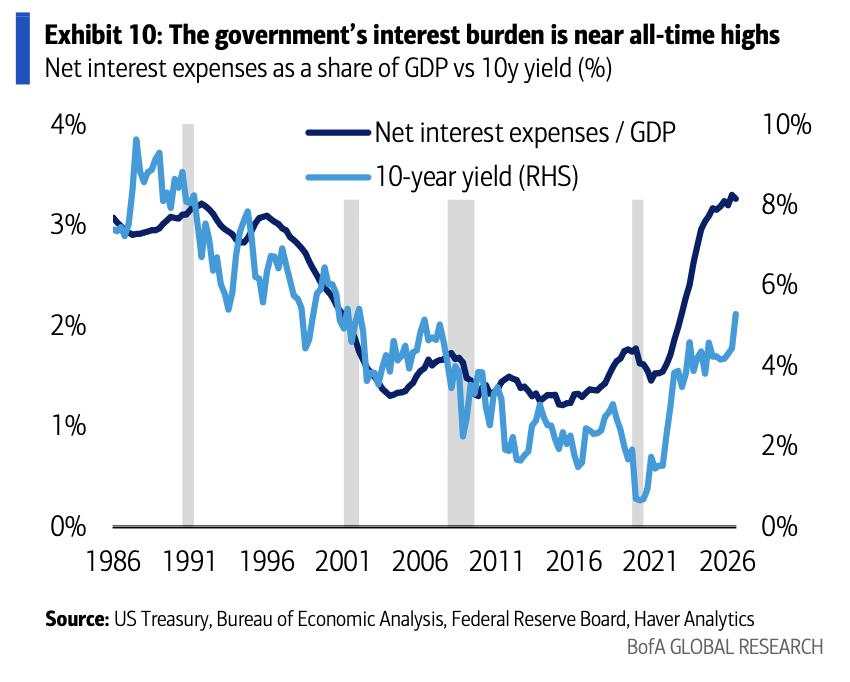
(The proportion of net interest expenditure of the U.S. federal government in GDP is close to the highest level in history, and the 10-year U.S. Treasury yield has also risen significantly in recent years)
Bank of America believes that against the background that the long-term U.S. Treasury yield has risen back above 5%, the United States may fall into a vicious cycle of rising yields, rising interest expenditure, expanding fiscal deficit, and further rising yields, which will eventually impact risk asset prices and economic activities.
Despite the above risks, Bank of America currently still believes that the U.S. economy is in good condition. However, whether the economy can continue to grow steadily in the next two years and whether the Federal Reserve can control inflation while avoiding economic recession will largely depend on the evolution of the AI investment wave.
This article is from the WeChat official account "CLS.cn", author: Xia Junxiong, published with authorization from 36Kr.