Li Auto's Q3 Earnings Report: Deliveries Are Back, Profits Are Yet to Return
On November 25, Li Auto released its financial report for the third quarter of 2026.
This report card is somewhat contradictory: revenue has returned to the growth track, deliveries have increased quarter-on-quarter for three consecutive quarters, gross margin has improved significantly, and operating cash flow and free cash flow have turned positive again. However, on the other hand, Li Auto has still not got rid of losses, with a net loss of 310 million yuan in the third quarter.
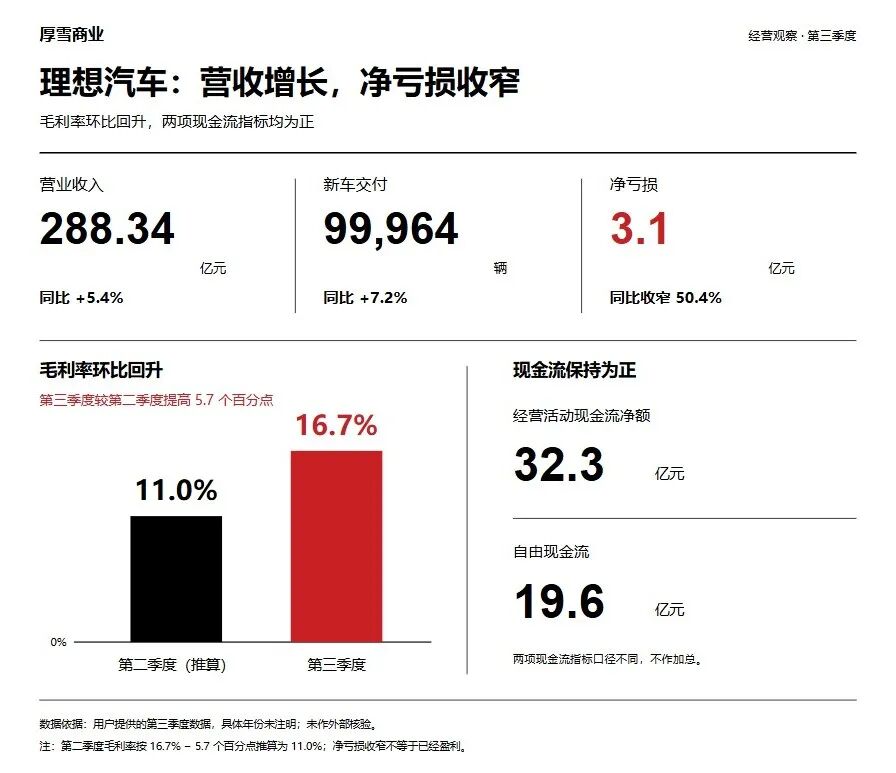
Specifically, Li Auto recorded a revenue of 28.834 billion yuan in the third quarter, a year-on-year increase of 5.4%; 99,964 new vehicles were delivered, a year-on-year increase of 7.2%; the net loss was 310 million yuan, narrowing by 50.4% year-on-year. The gross margin reached 16.7%, up 5.7 percentage points from the second quarter. The net cash flow from operating activities was 3.23 billion yuan, and the free cash flow was 1.96 billion yuan.
If we only look at the quarter-on-quarter change, this is a financial report showing obvious improvement. But if we take a longer time horizon, Li Auto has not returned to the past stage of making sustained profits relying on hit models and high gross margins.
In 2024, Li Auto was still one of the few Chinese new energy vehicle startups that could achieve stable profitability. By 2025, intensified market competition, product rhythm adjustments, and pressure brought by the pure electric transformation made this once top-performing new energy startup go through obvious growing pains.
Now, sales have started to recover, and losses are also narrowing.
But for Li Auto, the real problem is no longer whether it can boost sales, but whether it can re-establish a set of sustainably profitable business models.
Sales have recovered, but Li Auto has not returned to the past
First, let's look at the sales volume.
In the third quarter of 2026, Li Auto delivered 99,964 vehicles, a year-on-year increase of 7.2%, continuing to grow from 98,330 vehicles in the second quarter. Although there is still a gap from the previous peak, it at least shows that Li Auto has gradually walked out of the previous downturn.
The revenue side is also improving.
In the third quarter, Li Auto's total revenue was 28.834 billion yuan, up 5.4% year-on-year and 12.3% quarter-on-quarter. Among them, vehicle sales revenue was 27.094 billion yuan, a year-on-year increase of 4.7%; other sales and service revenue was 1.74 billion yuan, a year-on-year increase of 16.2%.
It is worth noting that revenue growth does not entirely come from sales volume.
The financial report shows that the growth of vehicle sales revenue in the third quarter was mainly driven by the increase in deliveries, but the change in average selling price brought by different product portfolios has offset part of the revenue growth. That means Li Auto is restoring its revenue scale through product structure adjustment, rather than simply raising prices.
What really deserves attention is the gross margin.
In the third quarter, Li Auto's overall gross margin reached 16.7%, and the vehicle gross margin reached 15.3%. Compared with the 11% overall gross margin and 9.4% vehicle gross margin in the second quarter, both have improved significantly.
This means that the gross profit retained by Li Auto for each vehicle sold is increasing.
However, compared with the same period last year, the vehicle gross margin still decreased slightly. More importantly, the improvement of gross margin does not mean that the company has been profitable. Automobile companies also need to cover expenses such as R&D, sales, management and channel costs.
In the third quarter, Li Auto's operating expenses reached 5.516 billion yuan. Although it decreased by 2.3% year-on-year, it was still higher than the gross profit of 4.816 billion yuan in the same period.
This is also one of the direct reasons why Li Auto is still losing money.
In the third quarter, Li Auto recorded an operating loss of 699.6 million yuan and a net loss of 309.7 million yuan. Although it has narrowed significantly compared with the same period last year and the second quarter of this year, there is still a gap from real profitability.
Therefore, the most accurate judgment of this financial report is not that Li Auto has rebounded, but that Li Auto is in the process of recovery.
In the past few quarters, Li Auto needed to solve the problems of declining sales, product competitiveness and organizational efficiency; now these problems are starting to improve, but they have not all been converted into profits.
The real pressure for Li Auto is the transformation from extended-range electric vehicles to pure electric vehicles
Li Auto's most successful business model in the past is the extended-range technology route.
Through extended-range technology, Li Auto has addressed family users' concerns about the range and energy replenishment of pure electric vehicles, and built differentiated competitiveness through large space, intelligent cockpit and family usage scenarios.
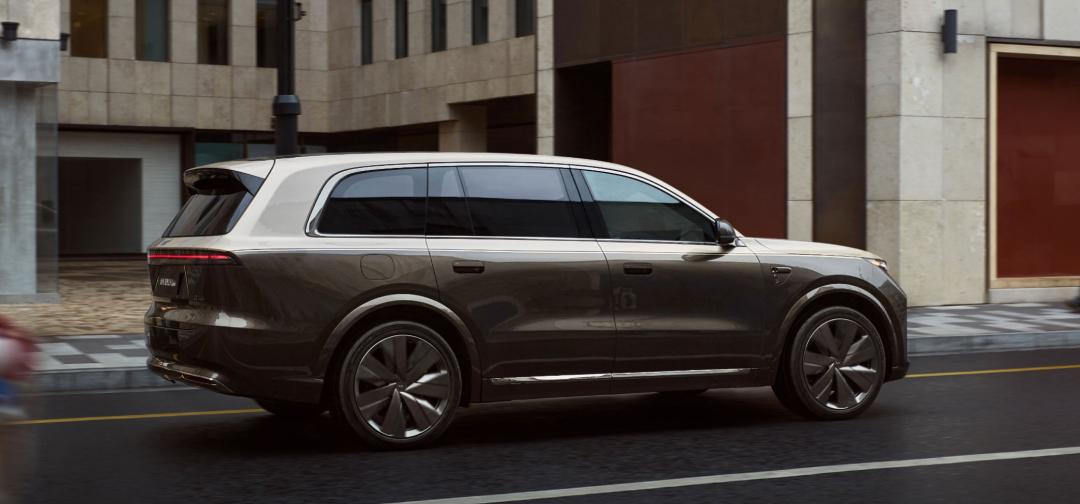
The success of the L-series allowed Li Auto to establish scale and brand advantages in a very short period of time.
But the market environment has changed.
On the one hand, more and more automakers are entering the extended-range electric vehicle market, and the product advantages that originally belonged to Li Auto have been gradually diluted; on the other hand, the range, energy replenishment and intelligent experience of pure electric vehicles continue to improve, and consumers have more and more choices.
Li Auto must answer a question: if the mainstream of the new energy vehicle market gradually shifts to pure electric in the future, can it replicate the success it achieved in the past?
This is also the reason why Li Auto is promoting its pure electric strategy.
But the pure electric market does not leave much room for trial and error for Li Auto. The previous market performance and product rhythm of its pure electric products have made the company pay no small adjustment costs. Compared with extended-range technology, pure electric vehicles not only require new product definitions, but also need to re-establish user awareness, energy replenishment experience and supply chain advantages.
In 2026, Li Auto began to reorganize its product matrix.
In September and October, the company successively launched the new MEGA, i9 and 2026 i6, covering different markets such as flagship MPV, large family SUV and five-seat SUV. The new vehicles are also equipped with self-developed MACH M100 chips, Lianshan batteries and other technologies.
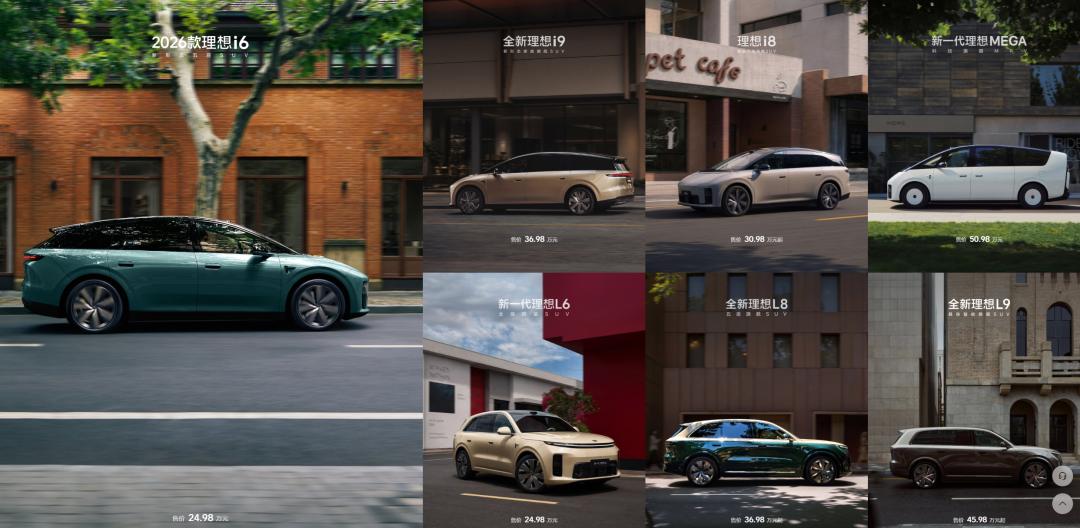
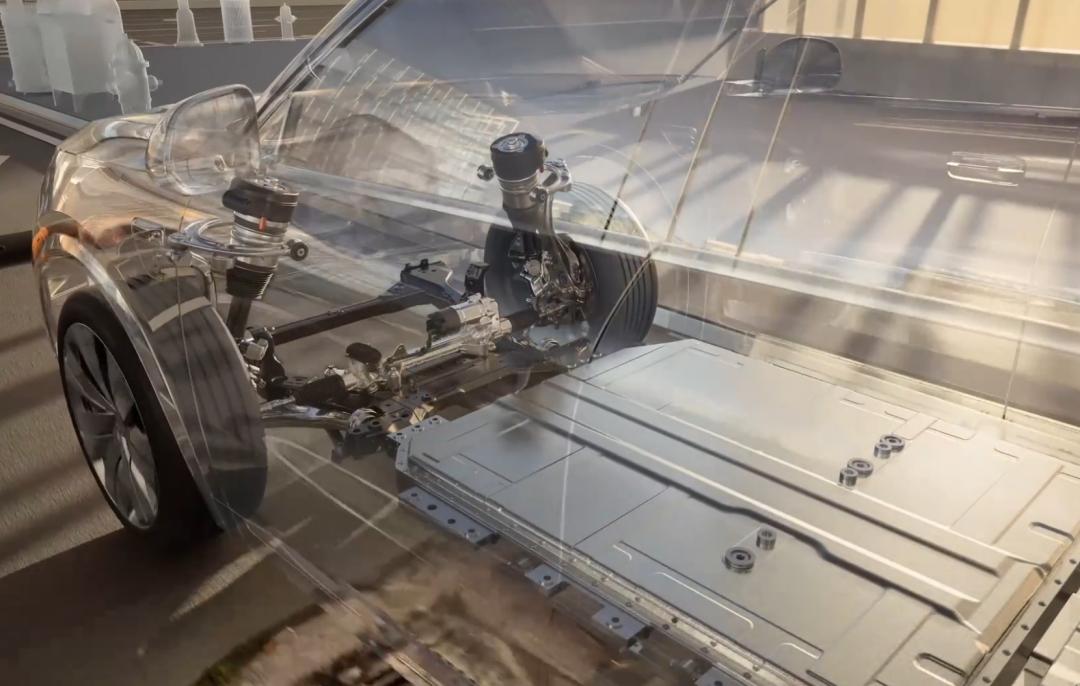
Behind these products is another set of competitiveness that Li Auto hopes to build: no longer relying only on family scenarios and extended-range routes, but building a more complete pure electric product system through chips, batteries, electric drives and intelligent technologies.
This is also why Li Auto keeps emphasizing self-development.
In October, Li Auto announced that Shanghai Mach Core Technology, which focuses on chip and domain controller business, has completed a new round of equity financing. Li Auto invested 1 billion yuan through its wholly-owned subsidiary, and external investors invested 625 million yuan.
At the same time, the company is also promoting the Lianshan battery and self-developed electric drive technology.
These investments will increase R&D pressure in the short term, but in the long run, Li Auto hopes to reduce its dependence on external suppliers and master more core technologies in its own hands.
However, self-development does not naturally equal competitive advantage.
Chips, batteries and electric drive technologies ultimately have to pass the test of the market. Consumers will not necessarily buy a car just because a company has self-developed chips. R&D investment has commercial value only when these technologies are truly converted into advantages in range, energy consumption, intelligent experience and cost.
What Li Auto needs to prove next is whether self-developed technologies can help pure electric products build differentiation, rather than becoming a new cost burden.
The positive cash flow is good news, but not a victory yet
In this financial report, there is another data point more noteworthy than the net loss: cash flow.
In the third quarter, Li Auto's net cash flow from operating activities reached 3.23 billion yuan, and its free cash flow reached 1.96 billion yuan.
Compared with the net outflow of 7.396 billion yuan in operating cash flow and 8.912 billion yuan in free cash flow in the same period last year, this change is quite obvious.
For an automobile company that is still losing money, the importance of cash flow even exceeds the profit of a single quarter.
Because automobile manufacturing is a capital-intensive industry. Developing new cars, building factories, laying sales networks, and purchasing parts all require a large amount of capital. The profit statement can change through depreciation, expense recognition and other accounting items, but cash flow is directly related to whether the enterprise can continue to invest.
The improvement of Li Auto's cash flow is mainly related to factors such as reduced inventory purchase payments and increased customer payments. It shows that the company's operating conditions are recovering, but it cannot be simply interpreted as that profitability has been restored.
As of September 30, 2026, Li Auto's cash reserve was 88.2 billion yuan. Sufficient cash still gives it the ability to continue investing in R&D, products and globalization.
Judging from the latest moves, Li Auto has not stopped expanding due to short-term losses.
The company has launched the new L9 in the United Arab Emirates and made its European debut at the Paris Motor Show; in November, it signed agreements with partners in Hong Kong of China, Thailand, Singapore, the Philippines, Vietnam and other regions to promote the layout of the Asia-Pacific market. According to the company's plan, the European version of Li Auto i6 will start deliveries in the Netherlands and Norway in the first quarter of 2027.
This means that Li Auto's competition is no longer limited to the domestic market.
But going global also requires costs. Channel construction, after-sales service, parts supply and local regulation adaptation are not things that can be completed in the short term. Li Auto needs to restore its domestic business, promote pure electric transformation, and invest in globalization at the same time, so capital use efficiency will become a new test.
The company's guidance for the fourth quarter is to deliver 110,000 to 115,000 vehicles, with revenue of 31.7 billion to 33.1 billion yuan. This target means Li Auto hopes to maintain growth, but whether it can finally be achieved depends on the market performance of new models and supply capacity.
Li Auto now has no shortage of technical reserves, nor is it short of cash.
What it really lacks is a continuously deliverable growth engine.
In the past, Li Auto built its advantages relying on extended-range technology and the family market; now, it needs to prove that pure electric products can also achieve scale, prove that self-developed technologies can bring profit improvement, and prove that overseas markets can become a new source of revenue.
None of these three things is easy.
Li Auto's Q3 financial report has released positive signals: sales are recovering, gross margin is improving, and cash flow has turned positive again. But the net loss still exists, R&D and operating expenses are still high, and the pure electric business still needs time to prove itself.
For Li Auto, the rebound in sales is only the beginning of the recovery. The real turning point is to re-establish a positive cycle among growth, gross margin and cash flow.
Li Auto has proved before that it can define the market with a differentiated product system. Now, it needs to prove that it can do it again amid more fierce competition.
This article is from the WeChat official account "Thick Snow Business", author: Wang Xin, published with authorization from 36Kr.