Why can't the next boom of embodied intelligence gain traction in China?
Over the past two years, nearly all capital in the embodied intelligence sector has been poured into robot bodies, components and large models. However, when a robot is actually deployed in households and factories, people have found that the biggest bottleneck is not just how intelligent it is, but also how much real-world experience it has accumulated — large models can absorb massive volumes of text from the internet, while embodied intelligence systems have to learn how to grasp objects, apply appropriate force, fold clothes and many other skills frame by frame using real-world data.
As a result, human body movements and gestures have suddenly become an untapped "gold mine".
Interestingly, facing the same gold mine, the responses on both sides of the Pacific are completely different: in the United States, data collection has grown into an independently priced segment in the industrial chain, and capital knows exactly where to flow; while in China, even though the embodied intelligence industry is currently cooling down and investment and financing activities are decreasing, another long-standing problem restricting the development of the sector remains — data collection can rarely become an independent financing story, and it is mostly embedded as a supporting chapter in projects related to robot bodies, models, bases and local industrial initiatives. On one side, players "know exactly how to invest", while on the other side, players "know data collection is needed but cannot figure out how to turn it into a viable business".
This is the two most authentic starting scenarios of the "robot data gold rush".
The same gold mine, two sets of mining logics in China and the US
To understand this misalignment, we can first look at how capital forms a closed loop in the US market.
The current data collection boom in the US is most easily misinterpreted as "capital has found a new hot track again". But the real change does not lie in the market hype, but in the path. In the past, investors focused on robot bodies, models and dexterous hands when evaluating robotics projects — data was only a negligible cost item in the R&D process. Now, a clear industrial chain has been fully validated: model companies demand data, data collection companies expand production capacity, and capital makes investments following the logic of "supplier positioning".
The capital flow on this track is well documented. From September to November 2026, three representative financing deals were disclosed in the US data collection track: Midcentury, which focuses on first-person perspective data and simulation, secured a $15 million seed round; Maxinsights, which deploys first-person perspective data, tactile and force perception collection, secured a $30 million seed round; Mecka, which focuses on human demonstration, multi-modal collection and closed-loop robot deployment, secured a $60 million Series B round. At the same time, Humyn Labs, an Indian startup that specializes in collecting real human motion data in work and daily life scenarios, recently disclosed a $47 million financing, with the US as its major customer market. This also proves that the US embodied intelligence industrial chain has already formed a globalized division of labor for data production.
What better illustrates the "clear path" than the financing amount is who is making the investments. For example, Mecka's this round was led by HSG, and the investor list also includes Nvidia, M12 (the investment arm of Microsoft), Qualcomm Ventures and Samsung. When giants in the chip, cloud computing and consumer electronics sectors all appear on the shareholder list of a data collection company, they are not buying tens of thousands of hours of videos, but a key position — to occupy the data segment in advance in the physical AI supply chain.
An unnamed industry insider in the data collection sector added an easily overlooked detail: the period from September every year to Thanksgiving is traditionally the peak financing season in the US. This year, after OpenAI released GPT-6 Astra, the model capabilities have been verified again and again, and "investors' confidence has kept rising". In other words, it is not that capital suddenly concentrated its bets on this track, but that technological progress has provided a feasible direction for investment, so capital dares to flow into this sector.
One of the best samples to prove how big a business this path can generate is Maxinsights. In a public podcast interview, Yuan Yuguang, founder of the company, disclosed that the company's annual recurring revenue (ARR) has reached about $250 million, compared with only about $1 million last year — a 250x year-on-year growth. This company recruits ordinary people to wear cameras to record their daily activities including cooking, folding clothes and cleaning, and then converts the videos into training data that robots can use. It holds 2 million hours of first-person perspective data, and its operation network covers 8 countries with more than 4,000 data collectors.
Yuan Yuguang's judgment on this round of growth is very straightforward: the Data Scaling Law has been realized in physical AI. A supporting evidence comes from Dyna Robotics: it announced in August that it had discovered the scaling law in the robotics field, and Maxinsights is the largest supplier behind the 1 million hours of pre-training data of Dyna-2.

Source: Dyna Robotics X post
Wang Zhen, COO of Cervo Technologies, a physical AI/embodied intelligence data infrastructure company, described the US data collection business he observed: it has already become an independent segment in the industrial chain, capable of independent financing and independent valuation. "As long as we (data collection companies) can stably supply products to large tech firms and get into their supplier lists, there will be basically no obstacles for this company to go public or be acquired."
Turning back to the Chinese market, the surface situation does not look that "cold". In the same period, multiple data collection companies disclosed financing deals: Jianzhi Robotics secured a $100 million Series A+ round, Kexing Space secured nearly 100 million yuan, Yitai Embodied Intelligence secured tens of millions of yuan in an angel round, and Noitom Robotics completed an undisclosed Pre-A+++ round.
Capital has entered the market, but the logic is different: in the US, VCs and tech giants are competing for "positioning" to price an independent track; in China, the main players in investment and financing are industrial capital and local platforms, which are more focused on providing supporting services for robot bodies, models and local industrial projects. When the whole industry cools down, supporting businesses are the first to feel the chill.
The actions of local governments are the most intuitive indicator of this trend.
Yang Mingquan, partner and head of business at Zhiyue Infinite, a domestic provider of full-process data services and base operation solutions, told "Xiaguang AI Lab" that in the first half of this year, local governments approached them almost every week, hoping that they would set up local companies and co-build data collection bases. But by August, the pace slowed down significantly, and the questions from local governments became much more demanding — how do you conduct business verification? How long will it take to recoup the investment? Has similar project been carried out in other regions, and what is your differentiation?
An industry insider also cited an example: Zhiyuan has internally incubated Mifeng Technology, an embodied intelligence data company. "Logically, Zhiyuan can directly outsource data collection services, but almost all model companies of a certain scale in China tend to build in-house teams or incubate data collection businesses internally." He attributed this to a cultural difference between China and the US — overseas food delivery platforms only focus on food delivery services, while domestic food delivery apps add functions including consumer credit, movie ticket booking and mini-games, "trying to cover everything". As a result, leading robot body manufacturers and model companies almost all add the "data collection" chapter to their own business stories, making it difficult for third-party data collection companies to build their own independent business narratives.
Talking about the current domestic data collection business, he used four words to describe it: "basically unviable" — the competition is extremely fierce, and the exit channels are very limited. Data collection companies can hardly go public independently in China, and most of them can only survive by being acquired. "Only one or two companies can finally grow into market leaders and successfully go public."
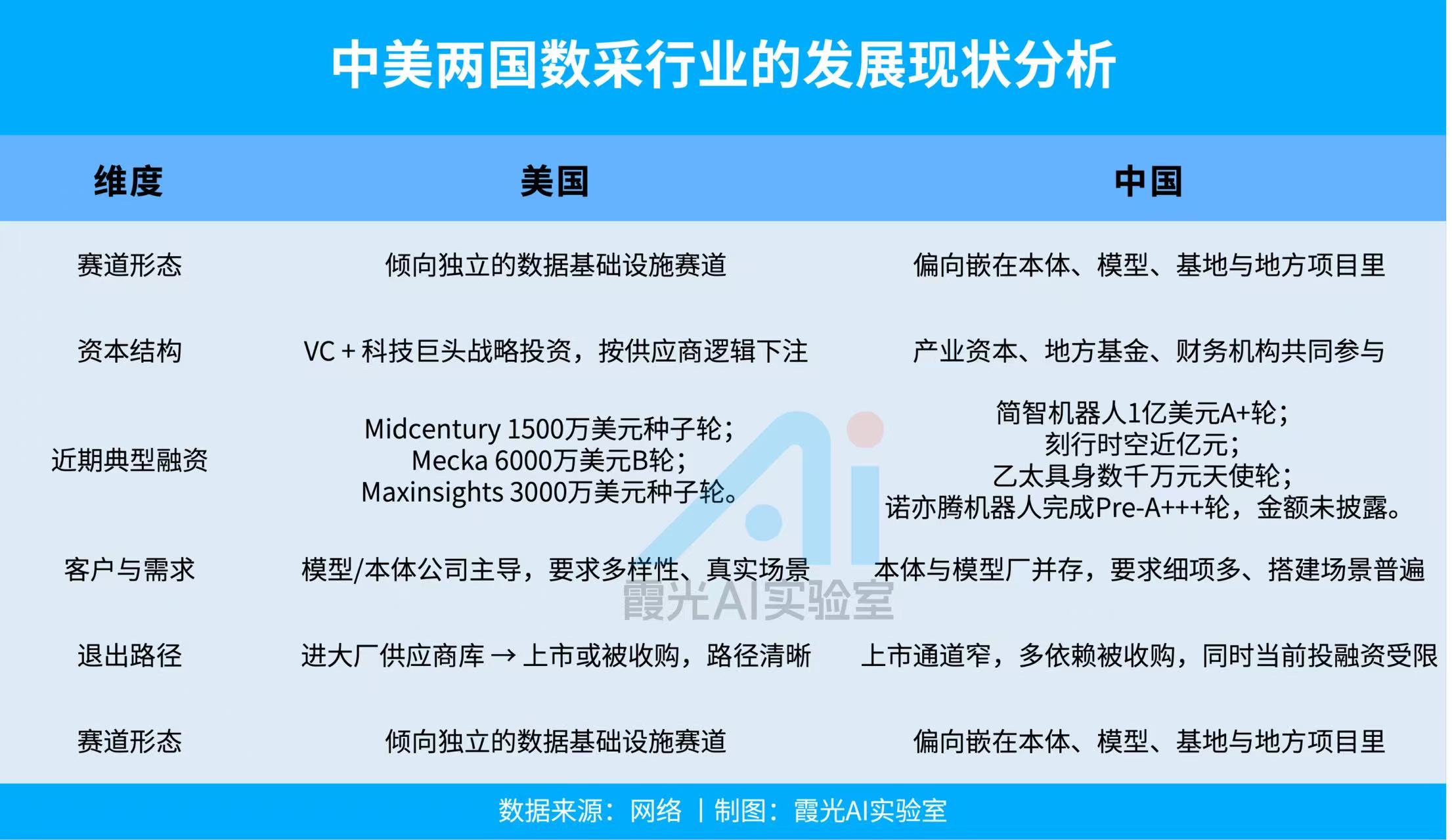
Note: The financing cases listed in this article are counted based on companies whose main business is data collection/data services; enterprises that also operate world model and other businesses are not included, to ensure comparability between Chinese and US samples.
The first-hand experience of frontline practitioners may be closer to the truth: The "cooling down" of China's data collection industry is not necessarily reflected in the order volume. According to Yang Mingquan, their overall business remains stable, existing orders have not been suspended, but the number of new clients has dropped from "new clients every day" to "three or four new clients every two weeks". The real cooling down lies in two aspects: first, after the regulatory requirements became stricter, the payment collection period has been extended, which directly brings challenges to the cash flow of data collection companies; second, on the financing side, in addition to the tightened listing channels, local governments have also shifted from "competing to invest" to "requiring business verification". What has cooled down is not the demand, but the ability to convert demand into cash and viable business stories.
The gap between Chinese and US data collection sectors does not lie in technology, but in cash flow
Since data collection can become an independent business in the US but cannot form a viable business narrative in China, the problem is inevitably related to a keyword — moat. Interestingly, when this question is raised to practitioners in China and the US, they get almost opposite answers.
Yuan Yuguang's answer is very definite: there are moats. But the moat he refers to is not a certain batch of data assets. What data companies sell is high-quality data, and the real difficulty lies in the "process of producing high-quality data" — this process relies on a set of self-developed models of Maxinsights, and the training source of the models is the ground truth data accumulated by the company itself. "This part is our real proprietary data that no one else has. So most companies that want to enter this track now are already late, and there is a gap of two to three years." He emphasized, "This is a physical process that cannot be generated synthetically."
Yuan Yuguang summarized this production capability as "vertically integrated": the entire chain from hardware development, operation, data pipeline to final output must be connected. No single segment can be missing — world model companies have neither operation capabilities nor self-developed hardware, and pure data collection companies do not have data production lines or proprietary data. "Only companies that integrate the whole chain can output data with the highest quality, largest volume and highest diversity."
The details in the industrial chain are accumulated over time through long-term practice. The data pipeline has been iterated for six or seven times; the annotation models are self-trained, because self-developed models can not only reduce costs but also improve quality... These details together form the "uncatchable moat" that Yuan Yuguang believes no competitors can catch up with.
When the same question is raised to domestic practitioners, the answers are almost completely opposite.
"Currently, all (data) companies have no competitive advantages," Yang Mingquan said directly. His definition of "advantage" is either monopoly or exclusive resources that no one else has. "But I don't think any data collection supplier in China can claim that they have such exclusive advantages. What you have, others actually also have."
He specifically denied one capability that is often regarded as a barrier — operation. At its peak, Zhiyue Infinite coordinated more than 1,200 people across the country, and now the number is slightly reduced to about 700 to 800 people, with 5 data bases deployed nationwide. But he said large-scale personnel management "is a core capability, not a core competitive advantage", and it is only a "prerequisite for entering this industry".
More interestingly, he does not believe that US data collection companies have stronger operation capabilities: "Domestic clients have relatively higher requirements, which forces us to be more competitive than overseas players — no matter in terms of large-scale personnel management, labor efficiency or cost control."
Wang Zhen's answer is more straightforward. When asked why domestic data collection companies cannot secure financing while companies focusing on models or robot bodies can easily get funding, his answer is: "I think it is because there are no moats, there are too many players in China that can do this business."
But the really thought-provoking part is his subsequent supplement about the US market — "Overseas markets do not have such moats either. Overseas markets only have sufficient order volume, which can support high cash flow, and data collection companies can easily enter the supplier lists of large tech firms."
This statement redefines the meaning of "moat": in the US, what makes capital willing to invest is not deep technological barriers, but stable orders, cash flow and the access ticket to the supplier lists of large tech giants. What China lacks exactly is these elements — narrow listing channels, long payment collection periods, and clients often go back on their words even after acceptance. Before companies have time to build their moats, their cash flow has already broken.
After Astra: Will data demand increase or decrease?
The debate over moats has not been settled, and GPT-6 Astra has pushed another variable onto the stage: as models become more powerful, will the data collection business become easier or more difficult to operate?
Let's first look at the exciting side of the industry. Dyna Robotics announced that it found the Scaling Law for robots using 1 million hours of first-person perspective data. When the rule that "the more high-quality data you have, the better the model performance will be" is verified, data collection is no longer a cost item, but a business with calculable return on investment. After GPT-6 Astra was released, Wang Zhen's feeling is that "many companies dare to bet on first-person perspective data now, while they were still testing the water before".
But on the other side of optimism, Yang Mingquan raised a thought-provoking question: if models can "absorb" data demand on their own, will the foundation of data collection become thicker or thinner?
He said that after Astra was released, the domestic data collection business did not see obvious growth, which is completely different from his previous prediction. He analyzed that as data quality improves and models keep iterating, "in the future, we may not need 10 million hours of data, and 5 million hours may be sufficient. Even later, 100,000 hours of data may be enough to achieve the same model performance".
The smarter the model is, the less data it may need. In this round of gold rush, even the demand for high-quality data may be determined by the speed of model iteration.
What kind of data is the market still lacking?
Although it is still uncertain how much data models will need in the future, the demand for data diversity, generalization capability and high quality has reached a broad consensus. As models iterate faster, the core problem of data collection has shifted from "whether we need to collect data" to "what kind of data to collect and for whom". The debate over "whether the same set of data can be sold to multiple companies" exactly exposes the real structure of market demand.
Yuan Yuguang's answer is yes. At Maxinsights, datasets are delivered in the form of licenses, and the scale is expanding every day. His judgment is: "Once a dataset is verified by one client, it can easily generate the same or even higher value for other clients." The difference does not lie in the data itself, but in the client's recipe — different model architectures and different post-training methods.
Yang Mingquan's answer is no, and he directly calls this a "false proposition". In May and June this year, they also noticed similar market trends, and collected 5,000 hours of ready-made datasets for trial, but only sold 2,000 hours in the end, "the whole project was loss-making".
He listed three major reasons for this situation: First, there is no unified standard. "The high quality you define may not be recognized by other companies"; Second, the validity period of data is very short — "one set of data can only circulate in the market for about 3 months"; Third, the specifications will "drift" — the mainstream data collected in May was binocular data, but now quadocular data has become the mainstream, "the original data no longer meets the new requirements". What is more troublesome is that different clients focus on different dimensions: some focus on posture trajectories, some on motion labels, and some on depth information. "Data itself is a highly customized product," Yang Mingquan concluded