Who would pay 68 yuan for the small adzuki beans?
The likely scenario is that capabilities will not disappear, but only shift to new positions. Standalone Personal Agents cannot make the "full-scenario to-do delegation" logic work, but the task-execution capabilities themselves will be disassembled and internalized into more appropriate places — embedded into super apps, and built into system-level assistants.
The personal agent war among tech giants has kicked off again
ByteDance's Xiaodou has finally entered public beta testing.
This Muse-aligned product was rumored to be "rushed out in 6 days and launched before September 30" before the National Day holiday, but it was delayed until the end of November to finally make its official debut. Joining it at the table are Alibaba's Qwen Go, Ant Group's Lingguang, Tencent's Xiaowei, and many others.
The backdrop of this battle is markedly different from that of the last round. The last round was ignited by Meta's Muse — its mobile DAU exceeded 10 million just over two months after launch, Instinct's valuation soared from $2.5 billion to $30 billion, OpenAI, Anthropic, xAI, and Google all rolled out their own Personal Agents, and domestic tech giants showed signs of following suit.
Beneath the hype, the "war" at the product level is real, but the "main battlefield" at the resource level is not in personal agents. The competitive focus of ByteDance, Alibaba and Tencent has shifted to office agents, a scenario with more certain revenue potential.

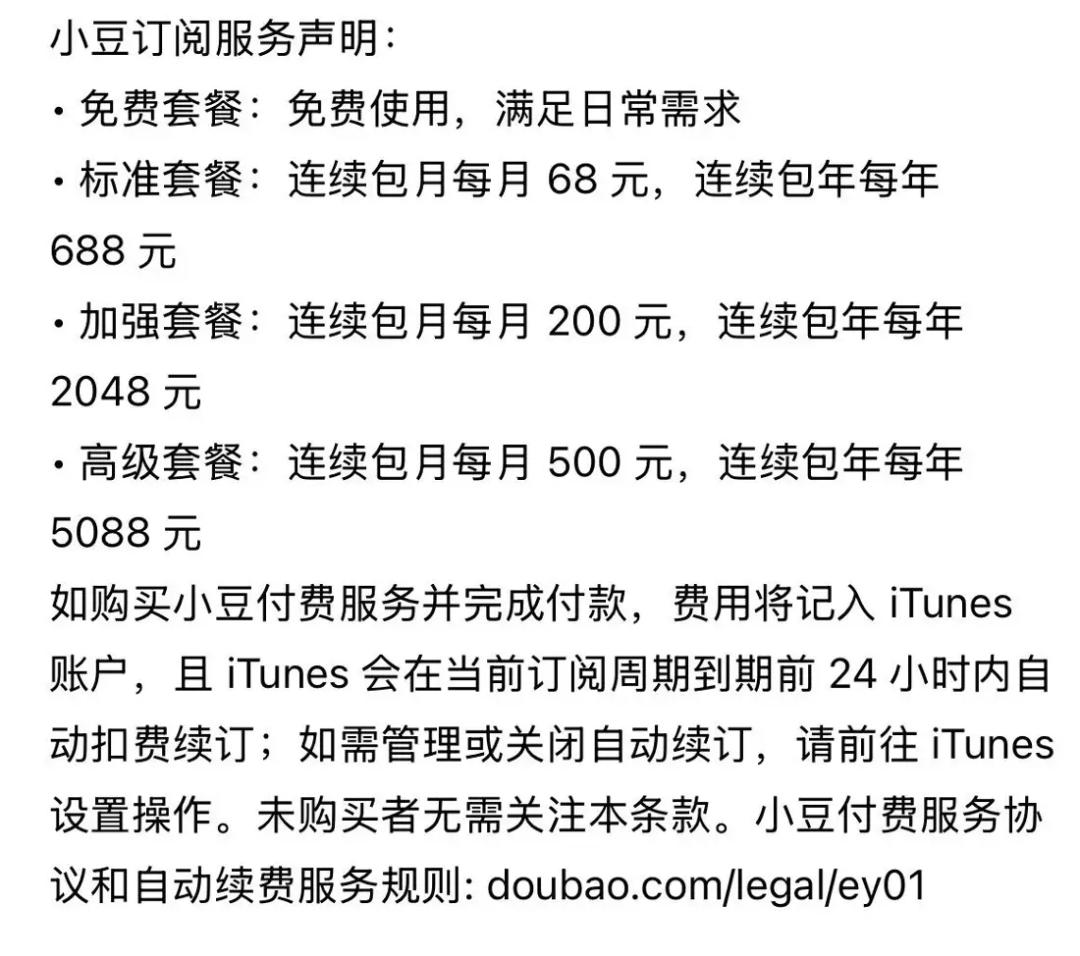
Xiaodou was not rolled out to all users on a grand scale, but started with an invitation-only public beta, and at the same time released a complete price list: free tier, standard tier at 68 yuan per month, enhanced tier at 200 yuan per month, premium tier at 500 yuan per month, with a maximum annual payment of 5088 yuan.
The invitation-only approach, coupled with this high starting charging standard, itself declares that Xiaodou is not a product that will be pushed to the C-end market with unlimited resources. It is launched with careful cost control, not an all-in bet.
When domestic tech giants compete in personal agent development, the end result is nothing more than reorganizing their respective ecosystems, and it will be an extra bonus if they can further open up more transaction links.
Who will pay 68 yuan for Xiaodou?
Xiaodou has taken the most direct, most risky and most straightforward path: charging C-end users directly.
The C-end business in the AI era is not like the previous internet businesses where marginal costs tend to zero and losses are diluted by scale. Burning tokens is a fixed cost that can never be eliminated no matter what. When the agent's workflow is running, the cost is even higher than that of a chatbot.
The fact that one user corresponds to one cloud virtual machine determines that this is first and foremost a subscription business, not a traffic business. The deeper the user uses it, the more linearly the reasoning and computing power costs accumulate.
The 68 yuan/month standard tier of Xiaodou is already at a high level among domestic AI subscriptions. The memberships of Doubao and Wenxin are both in the range of dozens of yuan, ChatGPT Plus is equivalent to about 140 yuan in RMB, and Xiaodou's standard tier is directly positioned at the level of "significantly more expensive than domestic chatbots, half cheaper than the top international configurations".
The 200 yuan/month enhanced tier has reached the mid-range of professional tools. The top 500 yuan tier with annual payment of 5088 yuan is targeted at productivity tools for design and development, not mass consumer goods.
Although there is a free quota, it can be predicted from the fact that more and more Doubao users are hitting the free quota wall that Xiaodou has strictly limited free tokens from the very beginning. It does not intend to pursue large-scale user growth for free, but actively chooses a narrow path: using high ARPU to cover the cost of tokens and cloud virtual machines, and continue to screen out the group of users with sufficiently high willingness and ability to pay.
CICC once estimated that the average monthly hardware cost for moderate personal agent users is about 23 US dollars, "some package subscription fees may be difficult to cover hardware costs, and more revenue space comes from commission sharing and advertising". It also estimated that by 2030, the transaction commission revenue of China's PA market will reach 391.8 billion yuan, far exceeding the 83.8 billion yuan of subscription revenue.
That is why the other two paths (diluting costs through the ecosystem, and supplementing subscriptions with transaction commissions) have become more mainstream solutions.
Martin Lau, President of Tencent, mentioned Xiaowei's business strategy at the Q3 earnings meeting: the goal is to cover WeChat users, use small models to control costs, and even after full opening, "the cost will not be very high, which will be lower than the quarterly cost of Yuanbao at the beginning of the year".
Tencent also does not expect Xiaowei to charge separately. Instead, it will play a multiplier role within the WeChat system. "Increasing WeChat's revenue by 10% to 20% will be a very considerable number".
Xiaowei shifts the charging target from C-end users to the incremental transactions and advertising within the ecosystem. Following this logic, Xiaowei gives up being an all-encompassing agent, and instead penetrates into fine-grained scenarios, embedding the multiplier effect into WeChat's existing business cycle.
As for Meta, Zuckerberg admitted that Muse still consumes a lot of computing power, and the solution is to "improve cost efficiency by more than 10 times in the next year". The monetization focus also falls on transaction commissions: more than a quarter of Muse's weekly active users use the shopping function, with the average purchase amount exceeding 200 US dollars. Meta plans to "charge enterprises by facilitating transactions"; at the same time, it provides paid subscriptions for users who need advanced models and extra quotas.
These three paths: diluting costs through ecosystem thickness (Xiaowei), covering costs with high ARPU (Xiaodou), and supplementing subscriptions with transaction commissions (Muse). It is not ruled out that Xiaodou will be integrated into the Douyin ecosystem in the future, but for now, this middle subscription path, which has no ecosystem multiplier and cannot cover unit costs, has become the most risky zone in business.
For this narrow path to work, the premise is that its task-execution capabilities have reached an "irreplaceable" level, and users are willing to pay a separate budget for professional software for it, instead of treating it as an optional novelty tool.
Barriers to cross
Does China's internet ecosystem really support Personal Agents?
There is not enough factual support at present.
Domestic personal agents have uneven capabilities. The evaluation of "MiuLifeBench", the standard specially built for Personal Agents mentioned by "Zang AI", shows that there is a grade gap between domestic models and top global models, with poor stability and the tendency to work silently without asking users for feedback; DeepSeek V4.1 Flash is the only domestic model that "crosses levels to challenge top models"; Qwen4 Max is too prone to send messages to external parties across user permissions; the customized Seed used by Xiaodou is too old in version to be evaluated fairly.
But the more pre-positive barrier than capability is Chinese users' naturally low willingness to "pay for efficiency tools".
This is a conceptual issue as well as an ecosystem issue. After ten years of polishing by the mobile internet, every scenario including utility bill payment, taxi hailing, food delivery, hospital registration, online shopping and even tax filing in China has achieved extremely smooth experience.
Zhu Xiaohu, Managing Partner of GSR Ventures, said in a public conversation, "Do you have a secretary? Most people don't, and they don't need one." In his view, a large number of high-frequency life services in China have long been covered by super apps and mini-programs, while some typical scenarios of Muse in the US — travel planning, bill negotiation, refund chasing, service reservation — may not form strong enough demand in China.
There are underlying differences between Chinese and American internet ecosystems. Things that US users find convenient with Muse usually already have existing entry points in China, and users can complete them with a few clicks. The space for AI agents is compressed into an extremely narrow gap.
For example, holding a real-time queuing system but insisting on letting AI make a call that may not be answered is somewhat retro. A self-media test of Qwen Go showed that in order to make it call to reserve a restaurant table, the tester spent ten minutes on dialogue and confirmation, but finally failed to complete the reservation, "It's really better for me to call directly to ask".

Moreover, China's fragmented super app ecosystem has created another layer of "authorization" barrier.
Users' consumption, social interaction, payment and content browsing are scattered on different platforms. To complete a task, an agent not only needs to understand the user's intention, but also needs to obtain data and operation authorization, and establish a stable connection with the service provider. In reality, the capability boundary of Qwen Go is limited to Alibaba's own ecosystem; Xiaowei cannot communicate with external servers, and cannot execute tasks once it leaves WeChat; the authorization of the previous Doubao mobile phone was also limited to ByteDance's system and some third-party apps.
Therefore, whether competing ecosystems are willing to open up and to what extent they open up is enough to form a strong constraint on the capabilities of domestic personal agents. In the US, Muse can get context from emails, execute tasks with a cloud browser, and settle through Stripe. The four pieces of the puzzle are independent but can be combined together.
Beneath this ecosystem factor, there is another deeper contradiction hidden in the tech giants themselves. As an efficiency tool, the underlying logic of personal agents is to save time for users. However, the core business model of tech giants is still monetization based on user duration.
In order to increase revenue, tech giants even need to add frictions to the simple and efficient process, adding information feeds that grab users' attention. This makes promoting personal agents sometimes more like a performance art to prove that they have entered the AI-native era.
What comes next?
Of course, the story of Personal Agents will not end here.
The more likely scenario is that capabilities will not disappear, but only shift to new positions. Standalone Personal Agents cannot make the "full-scenario to-do delegation" logic work, but the task-execution capabilities themselves will be disassembled and internalized into more appropriate places — embedded into super apps, and built into system-level assistants.
For example, Xiaowei gives up being all-encompassing and instead penetrates into the fine-grained scenarios of WeChat, or mobile phone manufacturers and model manufacturers move from pre-installed applications to system-level agents.
For users, this experience is even smoother. There is no need to open a standalone agent app, no need to repeatedly explain the background, and the capability quietly works in the existing entry points and at the system level.
Therefore, the essential value of Xiaodou's 68 yuan in the future may not be the delegation capability, but the judgment to pick out the noteworthy things before users do, in a super ecosystem where service handling has been done to the extreme, amid information overload and choice fatigue.
If it only turns things that users could finish in three clicks into three rounds of dialogue, and the authorization and entry points required for those three rounds of dialogue are still in the hands of others, it will be very difficult for anyone to pay for this 68-yuan service.
This article is from the WeChat Official Account "20 She" (ID: quancaijing_20she), authored by bad_sheep, and published with authorization from 36Kr.