AI actors on Hongguo have become "Idol Trainees" in batches.
Wang Yao, who is in her early 20s, has more than a decade of experience as a star chaser. She has followed several generations of popular entertainers in the showbiz, always commenting on them in a fair, objective and rational way. With the rise of the Hongguo era, she eventually threw herself wholeheartedly into a character in an AI short drama.
To be precise, the actor she is obsessed with is a character in the AI short drama universe.
Ever since she watched the short drama "Peerless Martial Arts: From Temporary Worker to Martial Arts Master Who Shakes the Whole World", Wang Yao fell head over heels for the protagonist Chen Haoyu, and immediately checked the details on his Hongguo filmmaker page.
It turned out that this AI character named Chen Haoyu, unlike many characters in other AI short dramas that only appear in one series of works, has far more appearances.
As an AI artist under Huajing, Chen Haoyu not only has his own set age and public persona, but also has starred in multiple AI short dramas including "The Awakening of the False God" and "Dao Seal Enters the Body", and has set a goal of appearing in 100 AI short dramas.
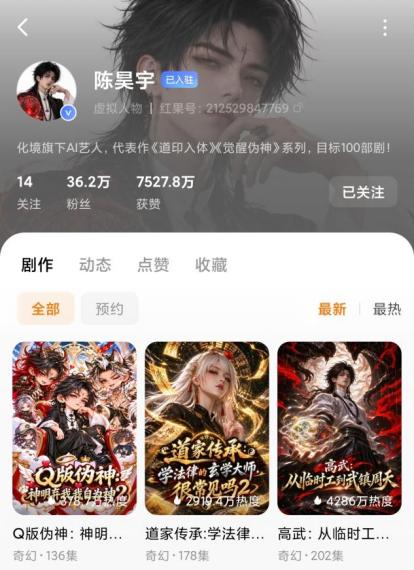
The form that AI actors play AI roles in short dramas makes Wang Yao feel quite mind-blowing. Based on her previous experience, different from real human actors who can star in dozens of works, characters in AI short dramas are often one-time appearances: they can only be known by audiences in one single IP, and cannot sustain public attention.
But now, the AI short drama industry is learning from the real world and launching exclusive AI actors. Meanwhile, these AI actors seem to be not satisfied with just acting, and have plans to debut as public celebrities.
AI Actors Also Shoot Vlogs?
For Chen Haoyu, the character Wang Yao adores, if he only appears in one short drama, where can Wang Yao see him again after she finishes watching the whole series?
After all, there will be new characters, new 3D models and new personas in the next AI short drama. When Wang Yao gets hooked on another new drama, she will probably shift her affection to the new character.
To prevent their hard-won fans from leaving, some production teams have begun to let AI characters step out of their original storylines and continue to appear in other short dramas.
After the Hongguo short drama "The Lucky Girl: The Pond Master Arrives" became a hit, many audiences remembered the lead character Xiyu. Recently, Xiyu has appeared in another drama "One Sentence From Xiyu: Wipe Out the AI Telecom Fraud Park".
Xiyu is in a new drama, but she is still the same Xiyu. Some production teams, just like Huajing, even set up independent identities for AI actors, allowing them to play different roles in different dramas just like real human actors.
In the short drama "The Beloved Wife of the Butcher", the female lead Xu Nan is played by AI actor Liu Shutong; on the other hand, AI short drama actor Feng Zeyu plays the male lead Nangong Yunxuan in the time-travel drama "Gold Medal Empress".

With their own names, AI actors have also started to open personal accounts outside the Hongguo platform. They can continuously release content unrelated to their original storylines.
Recently when scrolling through short videos, I found that an AI actor named Pu Xia shares his daily vlogs on Douyin, including clips of him working as an extra on the AI filming set, and daily moments of having breakfast and doing makeup.
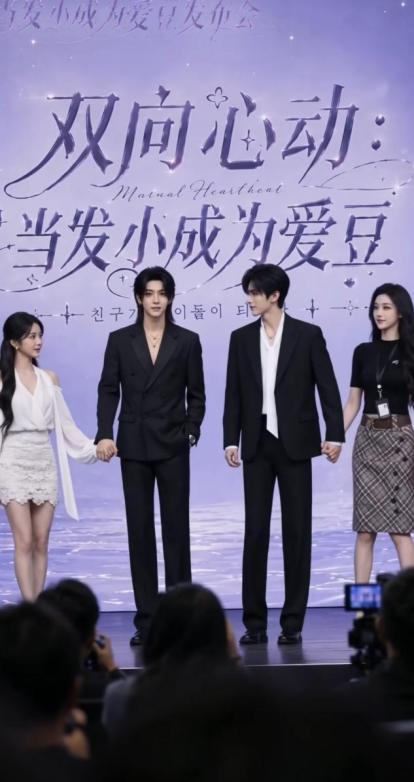
At the same time, some AI short dramas also hold AI press conferences, where the attending AI actors interact with each other just like real human actors.
When the AI short drama "It's a Crush: When Your Childhood Friend Becomes an Idol" was released, the production team held an AI-generated press conference for it; at the event, the AI characters in the drama including Jin Daoyu and Han Shuya made appearances one by one, and vlogs of them waiting backstage at the conference were also leaked.
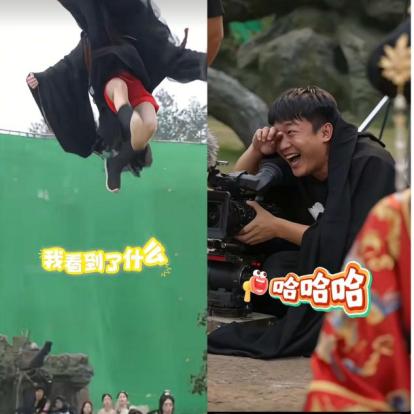
Not only that, in another short video Wang Yao scrolled through, the actual filming site of AI short dramas even appeared: real-life shooting elements such as green screens, cameras and red shorts might make people with poor eyesight mistake it for behind-the-scenes footage of a real human drama.
AI actors work so hard on social platforms not only to accumulate fans, but also to pave the way for business opportunities outside the dramas.
After the Hongguo short drama "NOVA: Rising Star" became widely popular, the four members of the singing group Four One in the drama not only opened personal accounts on Douyin, but also settled on platforms including Qishui Music, QQ Music and NetEase Cloud Music, releasing their original songs on these platforms.
On the other hand, Jiang Yuyue, the female lead of the short drama "The Legend of Ten Thousand Demons", collaborated with Lin Xiaosheng to shoot an AI short video to promote Lin Xiaosheng's oyster sauce products.
But when AI characters start to talk about their experience of using products, the controversy they arouse is unprecedented. The AI character Fang Taozi from "The Laid-off Girl" endorsed Nut Power contact lenses. She put on the contact lenses in the AI video and said: "My contact lenses are very comfortable even after wearing them for a whole day." How can a virtual person wear contact lenses? This endorsement quickly drew a lot of doubts from consumers. The regulatory authority ruled that the advertisement was false, and the AI production team behind Fang Taozi was fined 68,000 yuan.
Infringement or Accidental Lookalike?
AI actors learn from real people to shoot vlogs and hold press conferences, and sometimes their looks are even identical to real human actors.
As a big fan of Hongguo short dramas, Wang Yao has seen AI characters that look like celebrities including Xiao Zhan, Zhang Ruoyun, Huang Xiaoming, Zhang Zifeng, Ju Jingyi and many more in the short dramas she watched. Sometimes after finishing a short drama, she feels all the characters in it are familiar faces.
After all, the process of generating human faces with AI is essentially a probability game.
Since AI modeling requires massive data input, the huge amount of human face information on the Internet has become the object for AI to imitate and learn from. Meanwhile, since celebrities have relatively higher exposure online, AI has more materials to learn celebrity faces, making it easier to generate similar appearances.
Some AI characters accidentally end up looking similar to real celebrities, but some AI short drama production teams deliberately generate faces identical to real human actors to grab the audience's attention.
Recently, actress Zhao Liying filed a lawsuit against the Hongguo platform. Some short dramas on the platform are suspected of using AI face-swapping and face-blending technology to synthesize her facial features onto the characters in the dramas without permission. At present, this dispute has not yet been ruled.
Actors are not only worried that AI characters will affect their own careers. After a familiar face is borrowed, it may also be put into plots that the original actor has never agreed to star in.
An AI short drama adapted from *A Dream of Red Mansions* has spoof scenes where Lin Daiyu slaps Xue Baochai, and Grandmother Jia kneels down to Lin Daiyu. Different from the well-received Sheng-Dai CP, many people cannot accept such plots.
The characters from *A Dream of Red Mansions* appearing in this AI short drama are almost one-to-one replicas of the actors from the 1987 edition of *A Dream of Red Mansions*. In response, Zhang Li, the actress who played Xue Baochai, stated that she did not authorize the short drama to use her portrait, and will pursue the AI production team's liability for infringement.
Is it possible to block the imitation of real people at the video generation stage? As a post-90s tech enthusiast who is obsessed with AI, Xu Yang tried two popular AI video generation software respectively.
First, Xu Yang tried to use an AI video app to generate a video where a man who looks like Huang Xiaoming stands on the stage and gives a speech. The app quickly finished creating the video, and the protagonist does look somewhat similar to Huang Xiaoming.
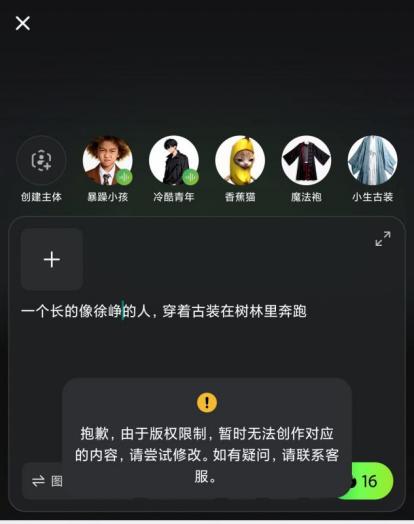
Later on the Keling App, Xu Yang made two consecutive requests to generate people who look like Xu Zheng and Shen Teng, letting them run in a forest wearing ancient costumes. Both requests were rejected due to copyright issues.
The third time, Xu Yang requested to generate a man who looks like Logger Vick. This time Keling approved the request and generated a funny video.
In addition to setting restrictions on the software, some AI short drama production teams have come up with their own methods to avoid infringement: they use the faces of themselves or people around them for modeling.
An AI short drama producer said: "Since using other people's faces is infringement, and AI-generated faces are too similar to real ones, we will use our colleagues' faces to make cameo appearances for some roles, and we will take the chance to spoof our colleagues or leaders."
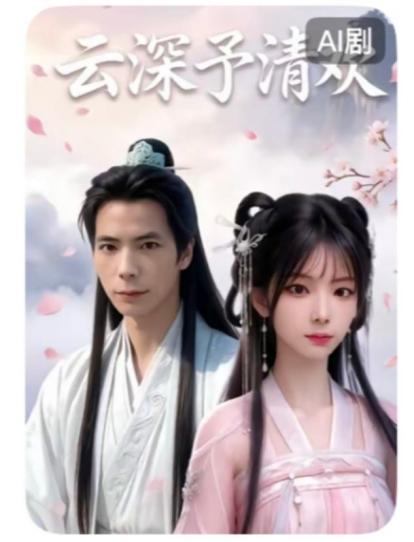
Xu Yang did find out on Hongguo short dramas that some characters in AI works are not good-looking at all, but look very much like ordinary passers-by. Maybe it is some short drama producer's acquaintance who was used for a prank.
Can AI Short Dramas Rely on High-Quality Works to Win Audiences?
It is obvious that how to model AI characters has become a highly controversial issue. How to define whether a human face constitutes infringement is still under discussion.
Where a face comes from is just the first question. In front of the camera, the performance of AI characters also needs to stand up to the audience's scrutiny.
On closer inspection, the most obvious flaw lies in their facial expressions.
Different from real human actors, AI characters lack real emotions, so no matter they are happy or sad, their eyes are often hollow. Long-time viewers of short dramas are likely to experience the uncanny valley effect.
At the same time, when AI characters make related expressions, tiny details such as the movement of facial muscles, the undulation of the throat, and the angle of the corners of the mouth are prone to imperfect flaws that do not conform to the laws of human body movement.
When encountering scenes that require exaggerated expressions, their performances tend to be over the top.
Under the current AI technology conditions, although AI characters can handle most expressions, they tend to act very exaggeratedly when it comes to scenes like blushing, eyes sparkling, or drooling, which are more suitable for cartoon and comic styles.
For example, Wang Yao found when watching short dramas that when AI characters make expressions like happiness or shock, their eyes often turn into a laser-like state to show sparkling eyes; when they need to drool, the saliva will flow as much as a waterfall.
These performance issues still exist, but with the maturity of technology, AI characters are becoming more and more delicate. For the short drama industry, scenes that were unaffordable, impossible to shoot, or hard to shoot well in the past can now be realized with the help of AI, and many excellent works have begun to emerge.
Data from the National Radio and Television Administration shows that in the first 8 months of 2026, 430,000 micro short dramas were launched nationwide, 13 times the total number of 2025; among them, AI dramas account for more than 90%.
Hongguo has become another national-level App. Data from Quest Mobile shows that in September 2026, Hongguo had about 430 million monthly active users, a year-on-year increase of 81.8%; its daily active users exceeded 200 million, surpassing the sum of the daily active users of iQiyi, Tencent Video, Youku and Mango TV.
In the third quarter of 2026, the per capita daily usage duration of Hongguo App's monthly active users reached about 151 minutes, ranking first among national-level Apps including WeChat, Douyin and Xiaohongshu.
The rapid growth of AI short dramas has brought opportunities to practitioners. But when new dramas come out one after another, sometimes the same story is repeatedly presented to the audience.
Xu Yang has repeatedly seen the same plot on Hongguo — "The overbearing president husband goes bankrupt, and the vase wife is actually a super capable career woman". This exact story alone has been made into more than a dozen AI short dramas.
Including "My Husband Goes Bankrupt, The Vase Wife's Identity Can No Longer Be Hidden", "Miss Jiang Stops Pretending", "Mr Gu, Don't Sign, Your Wife Is The Behind-the-Scenes Queen", "The Day My Ex-Husband Went Bankrupt, I Took Back The Gu Group", "The Vase I Have Supported For Three Years Is The World's Top Talent"...
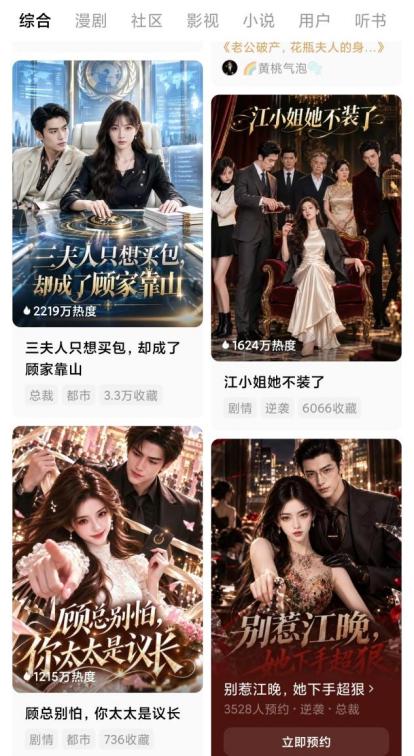
The plots and personas of these dramas are very similar, and the surnames of the characters are mostly the common surnames in the short drama circle such as Gu, Lu, Su and Jiang.
The more short dramas there are, the easier it is for similar stories and faces to get mixed up. Those AI actors who debut through short dramas may be able to grab the audience's attention with interesting gimmicks. Whether fans will continue to follow them ultimately depends on whether they can produce high-quality works