Doubao is also set to be served on the dining table.
Recently, a personnel change has taken place in Douyin Local Life Services. According to 36Kr, Pu Yanzi no longer serves as the President of Douyin Local Life Services, and has been transferred to the position of company consultant to participate in public welfare-related work afterwards. Her relevant post will be succeeded by Mo Shaojun, the former head of Hongguo Short Drama.
Mo Shaojun is a post-90s generation. After joining ByteDance, he has successively taken charge of the businesses of Fanqie Tingting and Hongguo Short Drama, which are recognized as the sectors that first benefited from the AI dividend within the ByteDance ecosystem.
And AI is absolutely the most outstanding star of ByteDance this year. Hongguo and Doubao have become new hit traffic products, with monthly active users exceeding 400 million respectively, taking an absolute leading position in the short drama and AI fields. As is known to all, the performance of short drama has also been greatly boosted by AI.
Therefore, while other major tech giants are still exploring the AI monetization path, ByteDance has actually already achieved tangible commercial performance brought by AI.
At present, with the appointment of the young and promising manager Mo Shaojun, Douyin Local Life Services has also begun to pursue performance growth driven by AI.
In addition to the early pilot in the travel and hotel business, Doubao has recently launched the "Find Store" function, which displays stores that meet users' needs in a map visualization way.
More than that, *FunTalk* has found that Doubao has quietly appeared in Douyin's food ordering QR code, becoming an AI service assistant for offline catering stores.
The war of local life services has returned to the dining table once again.
01
Li Xing is the head of a Douyin local life service provider, whose main business is to promote Douyin food ordering QR codes and tap-to-order services.
But different from other service providers on the market, Li Xing's team has developed the Doubao food ordering function based on Douyin's existing food ordering system.
According to the Doubao food ordering steps he demonstrated, consumers need to scan the code or use the tap-to-order function to enter the Douyin food ordering page. Different from the traditional food ordering menu, there is a "Doubao helps you order" button at the bottom right corner of this page.
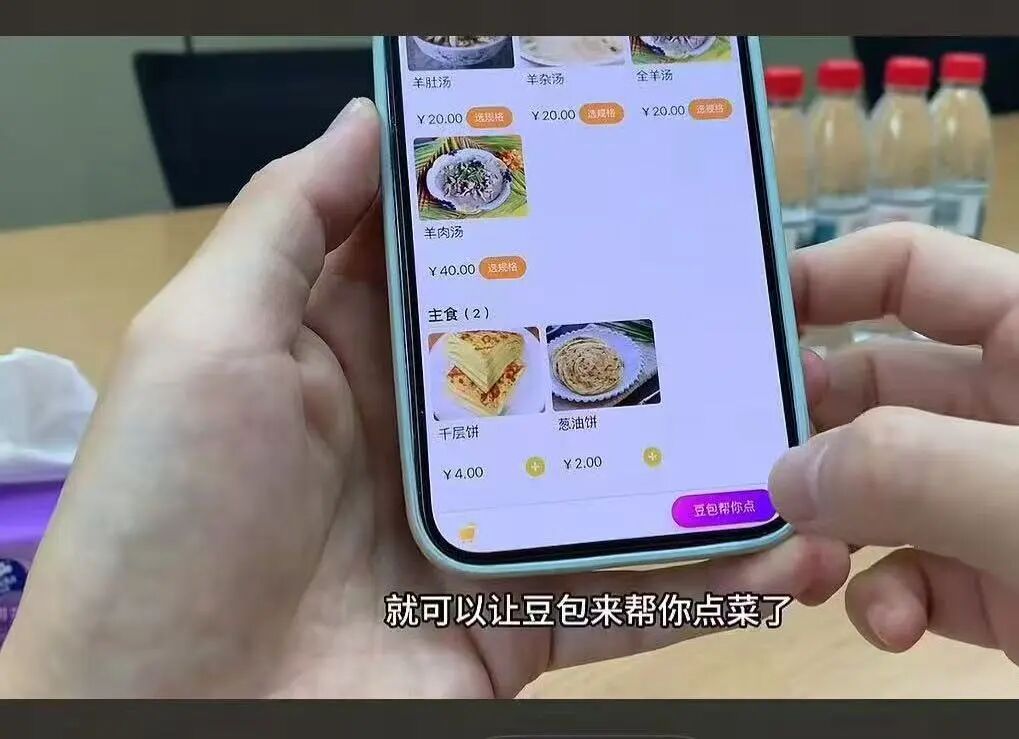
After consumers click this button, Doubao will recommend a set of dishes according to the number of diners, budget, dining scenario and special needs selected by consumers, and consumers can add all the dishes to the shopping cart with one click.
According to Li Xing's introduction, the Doubao food ordering service is more suitable for large restaurants, such as merchants with hundreds of dishes on the menu.
For some first-time customers, ordering food in such restaurants is quite difficult, which may take 5 to 10 minutes to finish ordering a full table of dishes, greatly affecting the table turnover rate of the restaurant. Using the Doubao food ordering function can greatly improve the ordering efficiency.
If consumers are not satisfied with the dishes recommended by Doubao, they can also directly adjust the dishes by talking to Doubao. For example, they can tell Doubao their preferred taste, and Doubao will re-filter and recommend dishes that match their taste from the menu.
This is actually equivalent to introducing an AI employee in charge of ordering, who is a service assistant that can respond without any waiting even during peak hours.
However, according to the information we learned from a number of Douyin service providers, apart from Li Xing, no other service provider has confirmed that they are carrying out the Doubao food ordering business for the time being.
But Lin Zhou, who is also a service provider, said this is not surprising. The platform provides interfaces that service providers can develop on, so some service providers embed the Doubao function into Douyin's food ordering products. At this stage, the Doubao food ordering function is more like a gimmick or a sales pitch when service providers promote their businesses.
But Lin Zhou also mentioned that there are indeed precedents in the industry where new businesses are opened to a small number of service providers for testing before official launch. This means that if the implementation effect is good, it is not ruled out that the official Doubao team will promote this business themselves.
It is worth mentioning that the AI food ordering function is not originally created by Li Xing's team. Meituan's food ordering system has also added the intelligent food ordering function. After merchants activate Meituan's intelligent ordering service, the system will be equipped with an intelligent service assistant.
Meituan's intelligent service assistant is very similar to the Doubao food ordering function. It will also personally recommend dishes and matching plans according to consumers' taste preferences, number of diners, budget and other information, so as to reduce the difficulty of ordering for consumers.
02
Although the Doubao food ordering function can indeed bring additional value to merchants, it is not easy to get merchants to accept it.
There is an essential difference between AI and traditional Internet products: every time AI answers a question, it consumes real computing and reasoning resources in the background.
This also means that in the food ordering scenario, every time Doubao recommends dishes to consumers, corresponding costs will be generated.
Li Xing said that currently, recommending a full set of dishes through Doubao food ordering consumes 0.5 computing power unit, which is equivalent to 0.5 yuan. When activating the service, merchants can get some free computing power as a gift, but after the free quota is used up, merchants need to purchase additional computing power themselves.
In fact, acting as a computing power purchasing agent is also one of the main sources of income for Li Xing's team. The Doubao food ordering function is developed based on Doubao. Service providers need to purchase computing power from Doubao first, and then resell it to merchants, earning the price difference in between.
In addition to the computing power cost, merchants also need to pay the activation fee for the Doubao food ordering service.
Li Xing told us that currently, their team is the only service provider that has launched the Doubao food ordering function across the country, which means that if merchants want to use the Douyin food ordering service with this function, they have to accept the pricing set by Li Xing's team.
According to the materials provided by Li Xing, the current activation fee for Doubao food ordering ranges from 980 yuan to 1980 yuan. It is understood that this fee mainly covers the food ordering system, payment speaker and 100 marketing videos.
In reality, many small and medium-sized catering merchants actually have demands for content operation. However, considering that content planning, shooting and editing have certain professional thresholds, requiring additional costs to produce, and subsequent distribution and promotion work is also needed, they can only give up this demand for the time being.
Li Xing's team precisely discovered this pain point, so they also added a "share video for discount" function to Douyin's food ordering system.
In short, merchants can offer some free side dishes or drinks to guide consumers to share the merchant's marketing video to their own Douyin account with one click after finishing ordering.
And the 100 marketing videos are prepared to match this function.
Moreover, after merchants use Douyin's food ordering products, they can also get some traffic incentives. For every 10,000 yuan of transaction completed, merchants need to pay a service fee of 60 yuan, but at the same time they can get 15,000 exposures, including exposures of videos and live stream content. Under ideal conditions, it can also bring additional online sales.
But Lin Zhou commented that this is actually a disguised form of bundled sales. Because the service fee ratio of 0.6% is the top standard in the industry, while the production cost of this kind of marketing video made by AI is very low, only a few yuan or even a few mao per video.
03
There is only one month left in 2026, and all major business sectors have entered the settlement period one after another.
In recent years, Douyin has maintained a strong offensive in the local life service market. Even if it cannot win the MVP title, it is an indisputable fact that it has become a trillion-yuan scale player.
Lin Zhou observed that in some regions covered by his company's services, the Gross Transaction Value (GTV) of Douyin Local Life Services has been in the first tier, but if Douyin's local life service business wants to reach a higher level, it must supplement stable and deterministic traffic.
Relying on its algorithm mechanism, Douyin has forced a breakthrough in the red ocean of local life services. However, consumption generated by interest is difficult to be converted into deterministic actions, which makes Douyin trapped in the dilemma of low verification rate and low repurchase rate at the same time.
Statistics show that the verification rate of Douyin group buying is only 50% to 60%.
In fact, Douyin has been trying to build deeper connections with local life service merchants. Several years ago, Douyin already tried to place food ordering QR codes on dining tables, but the promotion effect was not ideal.
As Lin Zhou knows, currently, WeChat's scan-to-order service has the highest usage rate, followed by Alipay's NFC (tap-to-order) service, and Meituan's food ordering service ranks the third. Consumers have formed inertial usage habits on these platforms, so it is not easy for Douyin to replace them.
Even though some service providers have added the Doubao food ordering function to Douyin's food ordering system, Lin Zhou still believes that food ordering is a process that requires a sense of participation, and the dishes matched by Doubao cannot meet the personalized taste needs of all consumers.
However, this does not prevent Doubao from becoming an opportunity for Douyin to overtake in corners in the local life service track.
With the rapid rise of Doubao, users' usage habits have been cultivated. In the daily interaction of "ask Doubao when you have problems, play with Doubao when you are free", Doubao has become a trusted life assistant for users.
The existence of Doubao has effectively broken the inherent shortcoming of insufficient internal traffic conversion in the ByteDance ecosystem.
Different from Douyin, Doubao's traffic logic is closer to the "user actively searches for goods" logic of Meituan. Users will initiate conversations with Doubao to find answers only when they have clear demands.
At the same time, the generative content delivery method undoubtedly shortens the "exposure-conversion" funnel, making monetization more direct.
Lin Zhou revealed that Douyin official has actually released signals of diverting traffic from Doubao, but it is still in the testing stage and has not been officially promoted.
He highly recognizes the traffic value of Doubao, and admitted that if Doubao opens the traffic entrance, his company will also divert traffic from Doubao.
But for Doubao, it is critical to grasp the proper degree of commercialization.
ByteDance is best at the traffic business, but the original commercialization idea cannot be directly copied to Doubao. For Doubao, the real difficulty is not opening the traffic entrance, but how to open it properly.
Generative AI recommendation and traditional search engine advertising are two completely different forms. In traditional search engines, advertisements are a kind of "reference results", which are not only marked as ads, but also coexist with other non-advertising results. Users can judge whether to adopt them according to their own experience.
But the content recommended by generative AI is often unique, which has a direct impact on users' decision-making.
For example, if users use Doubao to order food, they must trust that Doubao will provide the most beneficial answers for themselves, such as signature dishes, discounted dishes, or dishes that best match their own taste.
However, in the investment promotion materials provided by Li Xing, Doubao can "help merchants recommend high-profit dishes, increase merchants' profits, and make it easier for customers to order signature dishes."

So who on earth is the AI that users trust serving? This logic of "the wool comes from the dog" probably needs to be rethought in the generative AI era.
Behind Doubao's 400 million monthly active users, there are not only tool-type users with clear professional demands, but also a large number of ordinary users who mainly use it for daily Q&A and life consultation. These ordinary users have a high degree of trust in Doubao, but their ability to screen the answers provided by Doubao varies from person to person.
Maintaining the balance between commercial interests and user trust is probably a skill that every AI to C business needs to master.
Therefore, for ByteDance, playing the Doubao card in the local life service business is not only an opportunity for Douyin to supplement deterministic traffic, but also a social experiment on the boundary of AI commercialization.
(At the request of the interviewees, Li Xing and Lin Zhou are aliases)
This article is from the WeChat official account "FunTalk" (ID: iFuntalker), written by the FunTalk team, and authorized for release by 36Kr.