With NVIDIA placing its bet on it and 60 million US dollars already raised, can this AI lab make virtual teachers teach students effectively?
In the spring of 2025, three Chinese engineers who had conducted years of doctoral research at Apple decided to leave and founded a company called Nuance Labs. Their office is located in Seattle, the United States, and the team is small, with only more than 20 people by the autumn of 2026. This small team has received a total of 60 million US dollars in financing in less than two years since its establishment.
This September, Nuance Labs secured 50 million US dollars in Series A funding, led by existing shareholder Lightspeed Venture Partners, with other investors including NVIDIA, Accel, South Park Commons, and Define Ventures.
On November 9, Nuance Labs officially released its first full-duplex audio-visual foundation model Nuplex 1.0, along with two AI characters Emma and Nora based on this model, while opening the Beta version API.
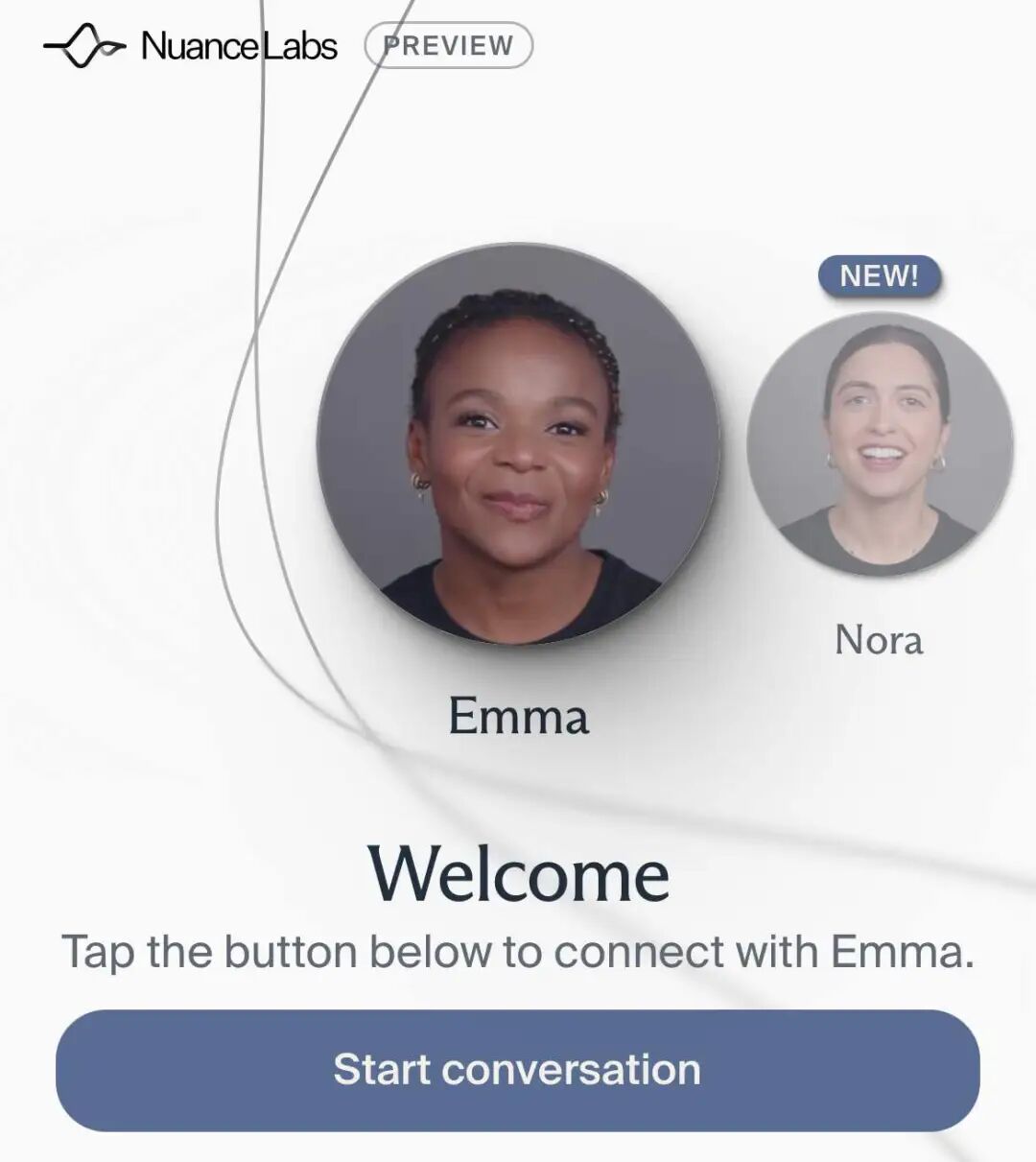
Nuplex 1.0 is positioned to build a set of underlying capabilities for AI that are closer to the way humans communicate. It does not pursue the "fastest response", but tries to make the response timing close to the rhythm of real human conversations. For example, when the AI is talking to you, it is truly "looking" at you.
Emma and Nora are two successively released characters, whose images and voices have been authorized by real people, and currently only support English. It is understood that the number of signed characters is still continuously expanding.
According to Nuance Labs, after opening the preview of Emma and Nora, over 100,000 hours of face-to-face conversations and more than 1 million conversations have been generated within two weeks, which "far exceeded expectations".
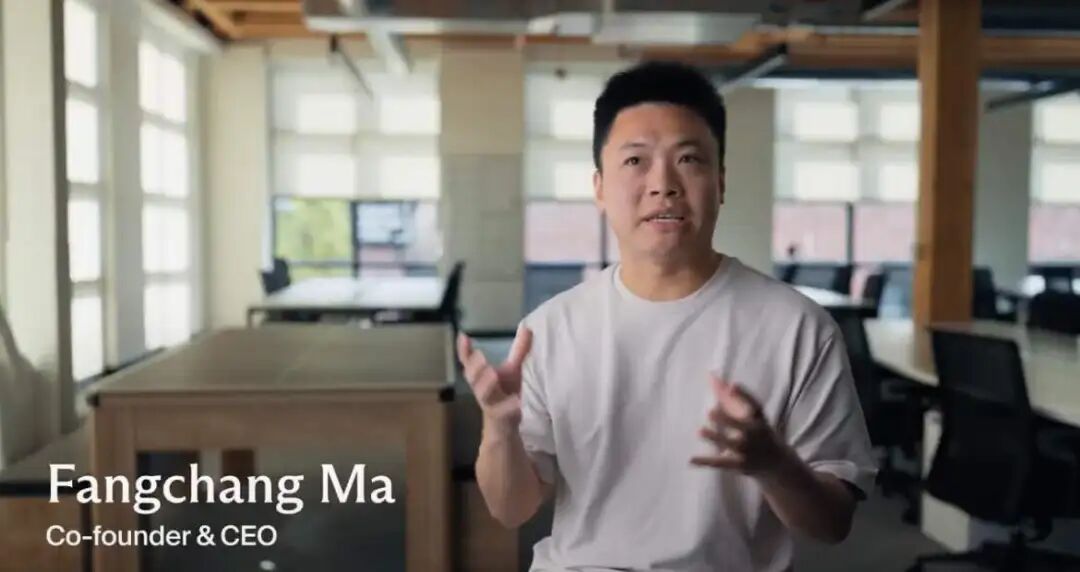
The use cases listed by Fangchang Ma, CEO of Nuance Labs, during the Series A financing include sales and customer service, coaching, vocational training, and education.
In the education scenario, it is expected to partially restore the scarcest capability of real human teachers: sustained attention, which can perceive students' confusion or distraction by capturing their micro-expressions and tones, so as to dynamically adjust the teaching rhythm.
01 Three former Apple researchers, targeting the "human touch" in AI communication
All three co-founders of Nuance Labs have doctoral research backgrounds and once worked at Apple on research in machine perception, graphics, audio-visual generation and other fields.
Fangchang Ma, Co-founder and CEO, holds a doctorate in robotics and machine learning from the Massachusetts Institute of Technology. He once served as an engineering manager at Apple, participating in research related to neural rendering, 3D reconstruction and generative AI.
Edward Zhang, Co-founder and CTO, holds a doctorate in computer graphics from the University of Washington. He used to be a senior research scientist at Apple, with research directions including computer vision, graphics and digital human technology.
Karren Yang, Co-founder and Chief Scientist, holds a doctorate from the Massachusetts Institute of Technology, focusing on audio-visual synthesis, and once engaged in related research at Apple.
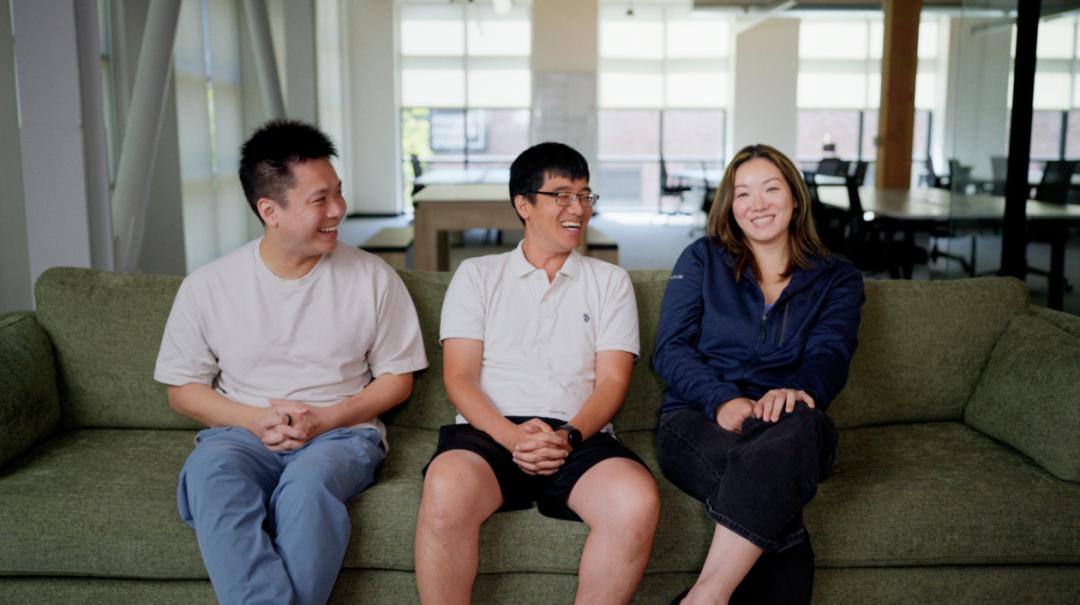
The three met at Apple. Previously, they participated in research work related to Apple Vision Pro, including technical directions such as the digital human Persona.
This experience also influenced the entrepreneurial direction of Nuance Labs.
The Persona feature of Apple Vision Pro attempts to reconstruct the user's facial image through cameras and related algorithms, so that the other party in remote communication can see a digital image close to a real person. However, a realistic digital image does not mean natural communication. The character can have real facial features, skin and facial details, but still have problems such as stiff expressions, slow reactions, and unnatural eye contact.
This is exactly what Nuance Labs wants to further solve.
In the view of the founding team, existing AI digital human products generally adopt the technical route of module splicing: first convert the user's speech into text, then hand it over to the large language model to generate a response, then output the sound through speech synthesis, and finally drive the virtual human to complete the lip sync and expression animation.
This process can realize basic question and answer, but each link needs to process and transmit information, which is prone to delay. More importantly, when people communicate with each other, a large amount of information is not contained in the text.
The tone, eye contact, pauses, and expressions of a person when speaking, as well as the nods and responses when hearing the other party speak, will all affect the communication effect. Nuance Labs hopes to integrate these capabilities into the same model.
02 Let AI listen, understand and respond at the same time
According to the introduction, the core technical direction of Nuance Labs is the Full-Duplex audio-visual interaction model.
When a user asks a question to an AI virtual human, the system usually needs to go through multiple steps such as speech recognition, language understanding, content generation, speech synthesis and character animation.
The problem with this architecture is that AI often needs to wait for the user to finish speaking before starting to organize a response. Even if the speech is generated, it may not be able to complete natural facial expressions and physical reactions synchronously.
Nuance Labs hopes to change this interaction method.
Through a unified audio-visual model, Nuance Labs completes perception, reasoning and expression at the same time. The company calls it the Human Foundation Model for human communication and expression.
According to the company's technical introduction, the model will learn the behavior patterns of humans in real communication, and generate continuous interactive feedback by predicting subsequent audio and visual information. It hopes to combine natural dialogue rhythm, expressions and voices to reduce the delay and incoordination caused by splicing multiple models.
The company's official website regards 500 milliseconds as an important goal for real-time dialogue delay, and lists active listening, expression naturalness and interaction fluency as core technical directions.
The significance of this technical idea is that the interaction method of AI may evolve from the past text and voice-oriented mode to a multi-modal interaction that is closer to real human face-to-face communication.
03 Is the AI teacher really coming?
Among the potential application scenarios announced by Nuance Labs, education is one of them.
From the perspective of technical capabilities, this company does have some integration points with the education industry, especially scenarios requiring continuous interaction such as language learning, oral practice, interview coaching, speech practice and personalized tutoring.
The first is language learning.
If Nuance Labs' model can achieve real-time audio-visual interaction, language learning products will have the opportunity to be closer to real human communication.
Duozhi experienced the English dialogue with Nuance Labs' character Emma, and the intuitive feeling is that it is more suitable for learners with strong language skills. Users can have a video call or a voice call with Emma, and Emma can respond in time according to the user's expression rhythm. When the user pauses, hesitates, or repeatedly uses the same sentence pattern, the AI can ask follow-up questions, give prompts or adjust the difficulty of the dialogue at the right time.
During the video call, Emma will nod, smile, and make actions such as looking confused and surprised.
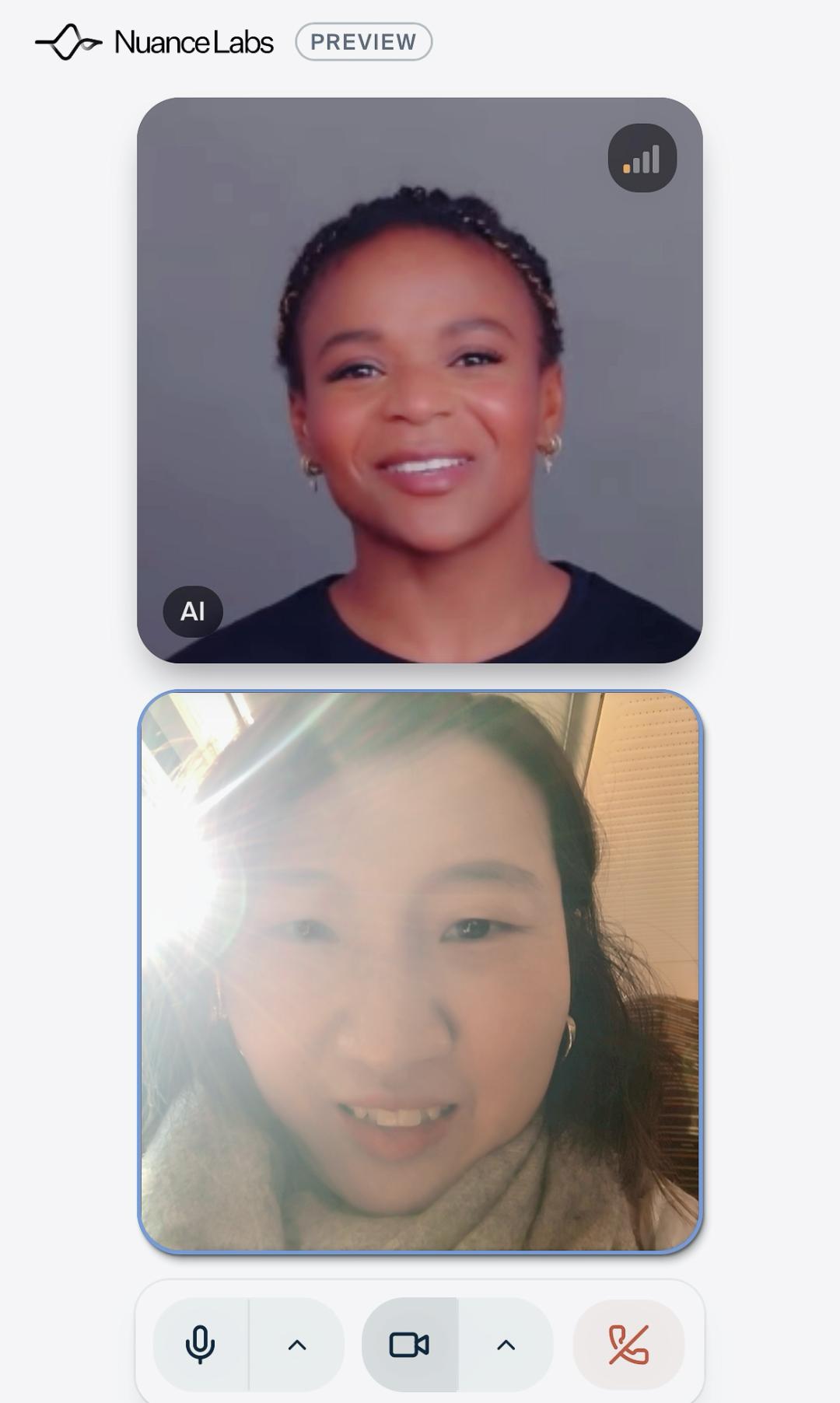
After the conversation ends, a short video can also be generated to help users review the content of the conversation.
The second is speech and expression training.
For users, the cultivation of speaking ability can hardly be completed only by text feedback.
Based on the audio-visual interaction capability, AI can act as an interviewer, speech audience or classroom questioner to allow students to conduct simulation training. When students answer questions, AI can react in real time, and provide feedback combining voice and video information after the training.
Such applications can also be extended to vocational education and teacher training. For example, normal university students can simulate classroom teaching through AI to practice how to ask questions, respond to students and organize classroom interactions; new workplace employees can use AI to conduct interview and presentation training.
What is more noteworthy is the AI teacher.
At present, there is no clear definition of AI teachers, and there are many such products. Many products have the image of a teacher or a cartoon character, but the interactive experience varies greatly.
One of the core capabilities of a good teacher is to continuously read the status of students during class — who has understood, who is distracted, and who has doubts but dare not speak up. Large-class teaching cannot achieve this, and the reason why one-on-one tutoring is expensive is largely due to this sustained attention.
If Nuance Labs' model can continue to approach the level of real people in real-time performance, it can theoretically take on part of the role of an "observer". During the process of knowledge explanation by the AI teacher, AI can maintain the communication rhythm through voice or expression feedback; when the student's expression is unclear, it can also guide the student to reorganize the language.
It is understood that Nuance Labs currently has about 27 team members. The funds from the Series A financing will be mainly used for model R&D, expanding the research and engineering team, and advancing public research previews.
Currently, Nuance Labs can be used without registration, but each conversation lasts up to 15 minutes, and the number of free uses is limited.
Nuance Labs is still in the early stage of product commercialization. The company plans to open its capabilities to external developers through models and APIs, so that other enterprises can integrate real-time audio-visual interaction technology into their own products.
This means that its future competitors may not only be traditional digital human companies, but also large technology companies that are deploying voice interaction, AI Agent and multi-modal models.
If Nuance Labs can further solve the problems of real-time perception, natural expression and continuous interaction, industries that require high-frequency interpersonal communication such as education, training and customer service may all become its potential markets.
But for the education industry, when AI has expression capabilities that are increasingly close to real people, can it really help students learn better? The answer remains unresolved.
Official Website:
https://home.nuancelabs.ai/
This article is from the WeChat Official Account "Duozhiwang" (ID: duozhiwang), written by Wang Shang, published with authorization from 36Kr.