The top-performing concept stock has nearly doubled in price this week...
In the morning, the share price of SUNMI Technology hit HK$195.40, marking the highest point since its listing seven months ago.
Only three days have passed this week, and the stock has almost doubled, with its market value rising from HK$40.2 billion to HK$77.8 billion.
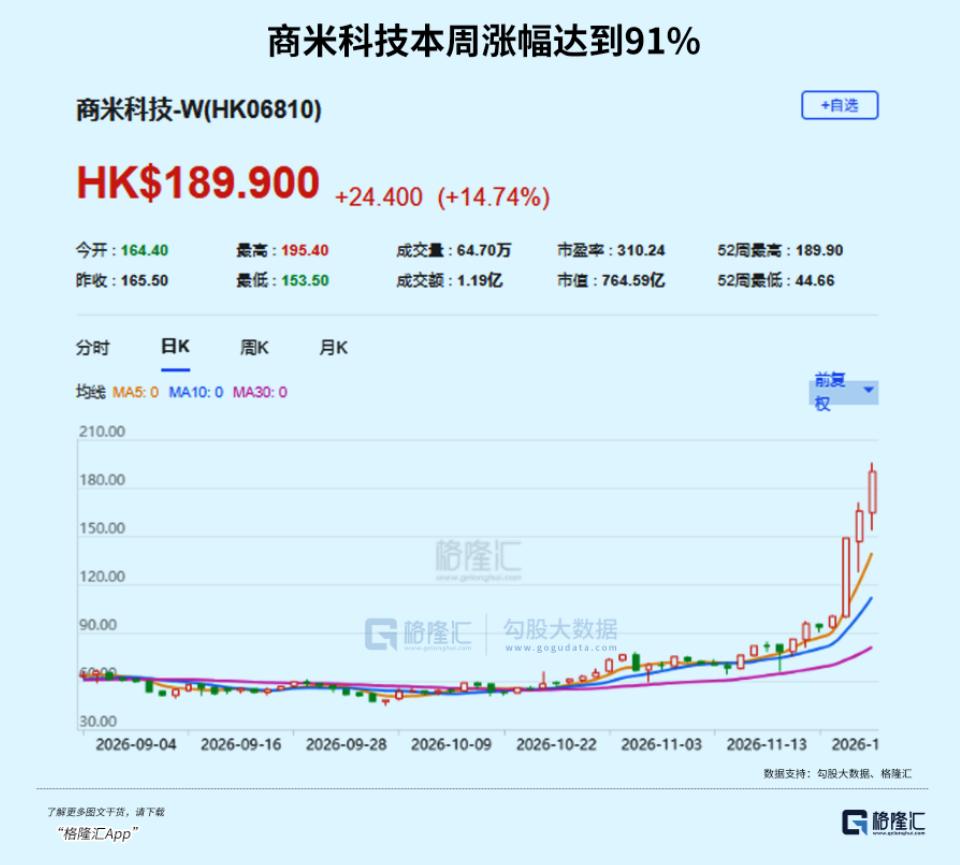
If we extend the timeline further, the company's market value was less than HK$18 billion in early October, but it has surged 3.3 times in two months.
What on earth happened?
Ingenious Packaging
Going back to last Sunday night, SUNMI Technology released its development strategic positioning, mission and vision for the next 10 years, formally positioning itself as a practitioner of "Business Physical AI", and announced the full layout of "BIoT + End-Edge-Cloud Integrated Distributed AI Computing Architecture + Agent Service System".
Right after the market opened on Monday, the share price skyrocketed by 48.65% in a single day, kicking off the near-doubling trend this week.
The market has pushed SUNMI to become the most-watched Physical AI target on the Hong Kong stock market. Media outlets rushed to report on that very day, with the first sentence of the coverage reading "Another Physical AI concept stock has exploded".
However, those who followed the trend to buy in may not be aware that this "Business Physical AI" is very different from the "Physical AI" in the public's general perception.
SUNMI's core main business is commercial IoT smart devices, namely the cash registers in offline stores, the most common of which are POS machines.
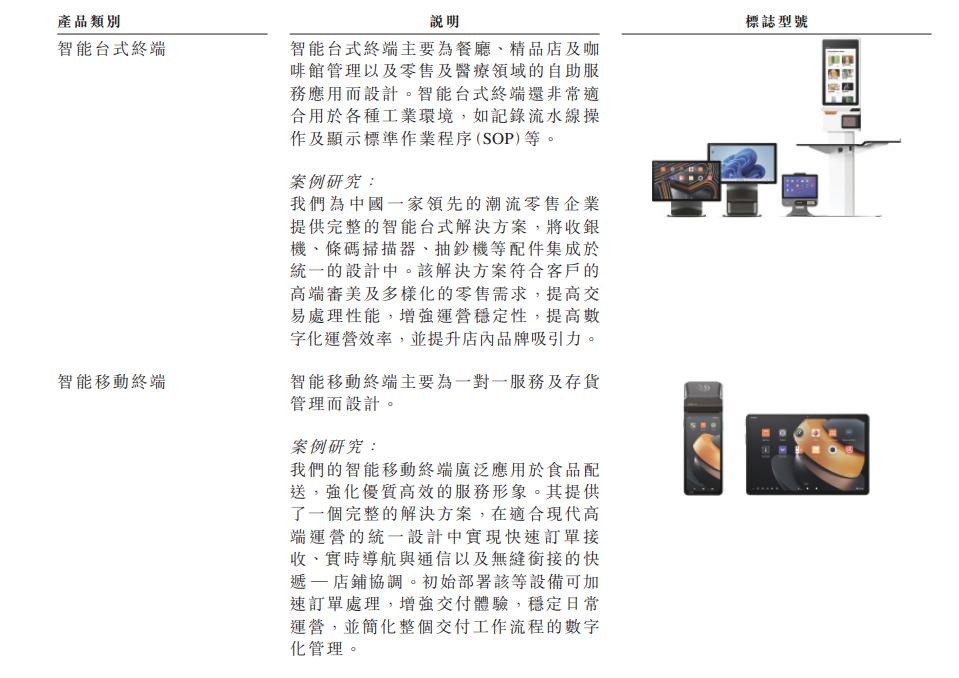
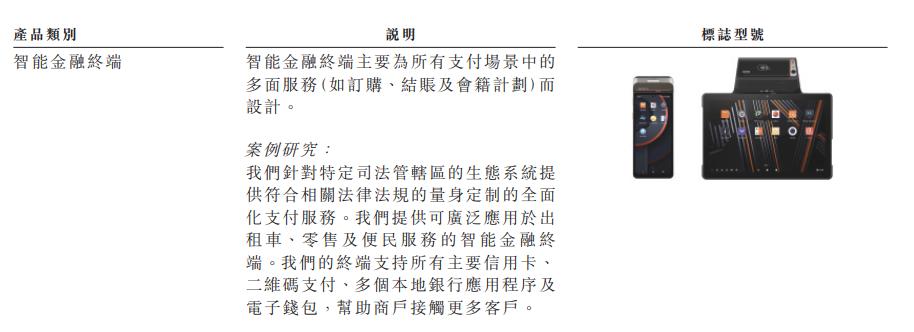
Common products and services; from the prospectus
According to the data disclosed in the prospectus, as of the end of 2025, the monthly active number of SUNMI devices has reached about 6 million units.
These devices are deployed in 231 countries and regions around the world, with more than 39,000 commercial applications launched in its app store, and the cumulative download volume has exceeded 260 million times.
According to the data from CIC in the prospectus, SUNMI's coverage among the top 100 catering enterprises in China exceeds 70%, and its coverage among the top 100 chain stores also exceeds 60%.
In addition, the newly launched Windows commercial models hit the most sensitive pain point of migration cost for large chain brands, allowing merchants with complex legacy software systems to directly replace hardware without discarding and clearing their original software.
Supported by a huge base of existing terminal devices, it seems quite reasonable for SUNMI to extend its services with the help of AI.
However, on second thought, this only belongs to "AI running in physical space", not the Physical AI in the field of embodied intelligence.
In the industrial sector, Physical AI (which enables machines to see, judge on their own, and then turn judgments into actions) actually only recognizes one thing: whether the final output of the system is a physical action, and the entire control closed-loop must be controlled at the millisecond level.
According to the official definition given by NVIDIA, Physical AI refers to enabling autonomous systems such as cameras, robots, and autonomous driving vehicles to perceive, understand, reason, and actually execute or orchestrate complex actions in the physical world.
If a large language model only describes "how to grasp a cup" in text on the screen, it does not count as Physical AI. Because its output stays on the screen pixels, the closed loop is not truly established until a set of underlying control systems converts the instructions into electrical signals and torque of the robotic arm.
That is to say, the key to Physical AI lies in whether the output form is a physical action, not in whether there is AI, whether there are sensors, or whether it looks like a human.
How does SUNMI define Business Physical AI?
"AI perceives the physical world through smart terminals, and feeds business decisions back to stores after analysis by large models."
In the actual operation of offline commerce, the actual closed loop is often calculated on a "daily" basis.
The business data collected by store cash registers and sensors is first uploaded to the headquarters background, and after the system generates analysis reports, it is uniformly distributed to all stores. The whole cycle is often delayed by two or three days, which is far from the millisecond-level control required by the physical world.
Cleverly, in order to package this kind of business of "helping store managers make business decisions" into a more tech-savvy narrative, SUNMI simply borrowed the classification coordinate system of autonomous driving to rebrand itself.
Thus, it has delineated a five-level AI-enabled operation capability system for commercial entities from L1 to L5:
L1 refers to manual operation and digitalization, L2 refers to local assistance, L3 refers to global collaboration, L4 refers to high autonomy, and L5 refers to full autonomy.
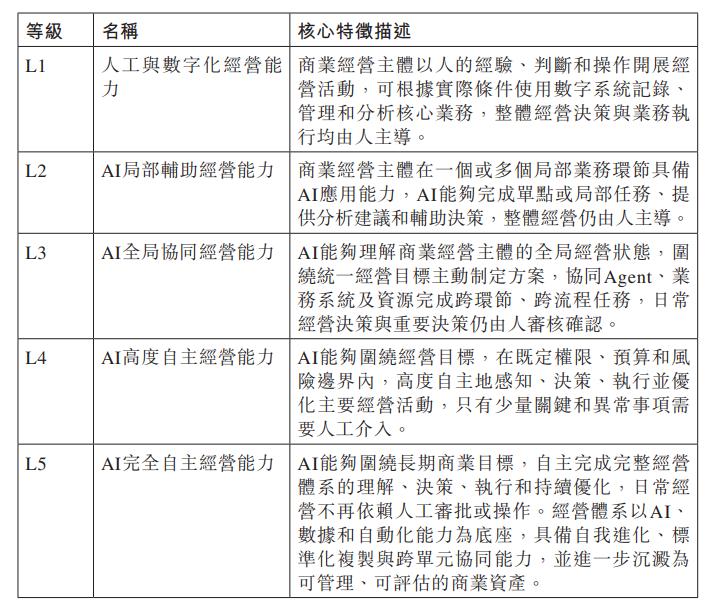
AI-enabled operation capability and application grading system for commercial entities; company announcement
For example, taking L3 as an example, it is defined that AI can understand the global business status, actively formulate plans, and coordinate multiple agents to complete cross-link tasks, but the final business decision still needs to be reviewed and approved by humans.
Because autonomous driving itself is one of the flagship cases of Physical AI, in the Physical AI list listed by NVIDIA, Robotaxi is listed at the top alongside warehouse robots, industrial robotic arms, and surgical robots.
Around this set of "Business Physical AI" narrative, SUNMI also launched several specific product and architecture actions at the press conference, but the focus still remains on the store operation software and terminal experience.
On the end side, Hi Sunmi, a native agent embedded in SUNMI OS and starting up with the device, is launched. It supports voice wake-up and has four capabilities: voice interaction, business self-diagnosis, passenger flow analysis, and intelligent marketing. Store clerks can directly use voice to complete three operations that used to span three systems: querying the daily passenger flow peak, setting up member full-reduction activities, and troubleshooting paper jams in receipt printers.
On the cloud side, it launched "SUNMI Super Store Manager" for merchants, and the Magic AI platform for developers that covers the whole process from requirement sorting to application release. It even planned the edge computing power box AI BOX and the edge large model that can be deployed locally.
The edge computing power is still on the planning drawings at present, and what SUNMI has actually implemented are still end-side agents and cloud tools centered on store operation.
But since it is essentially just a store operation upgrade, how was this round of share price revaluation market pulled up?
How Was the Market Rally Ignited?
Reviewing the market trend, we can find that it is actually spliced together by two completely different market segments, and before the opinion-bombarding announcement released on November 22, the first doubling market had already been completed without the official concept setting.
Specifically, starting from the intraday low of HK$44.66 on October 2, to the close of HK$99.90 on November 20, SUNMI's share price has quietly accumulated an increase of 123.7% in nearly seven weeks.
Subsequently, catalyzed by the announcement, the share price soared from HK$99.90 on November 20 to around HK$193.30 in the intraday trading on November 25, rising another 93.5% in just a few trading days.
By disassembling several key nodes of the first market segment, the preheating of market funds actually has traces to follow long ago.
On October 5, SUNMI's share price suddenly surged by nearly 15% during intraday trading. Then on October 22, the company held the SDC Developer Conference with the theme of "HelloAI", and on October 28, the share price rose by another 12.2% in a single day.
Aligning the timelines can reveal the real source of the narrative. As early as in its research report in July, Deutsche Bank had already defined SUNMI as "the core target of offline merchant digitalization and AI entry", which was a full month and a half earlier than the official announcement on November 22.
Therefore, the official announcement was only the fuse that ignited the final main rising wave, not the whole reason for the entire round of market rally.
Putting these two market segments into the coordinate system of the entire capital market for horizontal comparison, the difference will be more obvious. With the time interval strictly limited from the close of October 29 to the intraday trading on November 25 (pre-adjusted caliber), the A-share Physical AI sector index has fallen by 10.81% cumulatively, and the Hang Seng Tech Index has fallen by 8.53%.
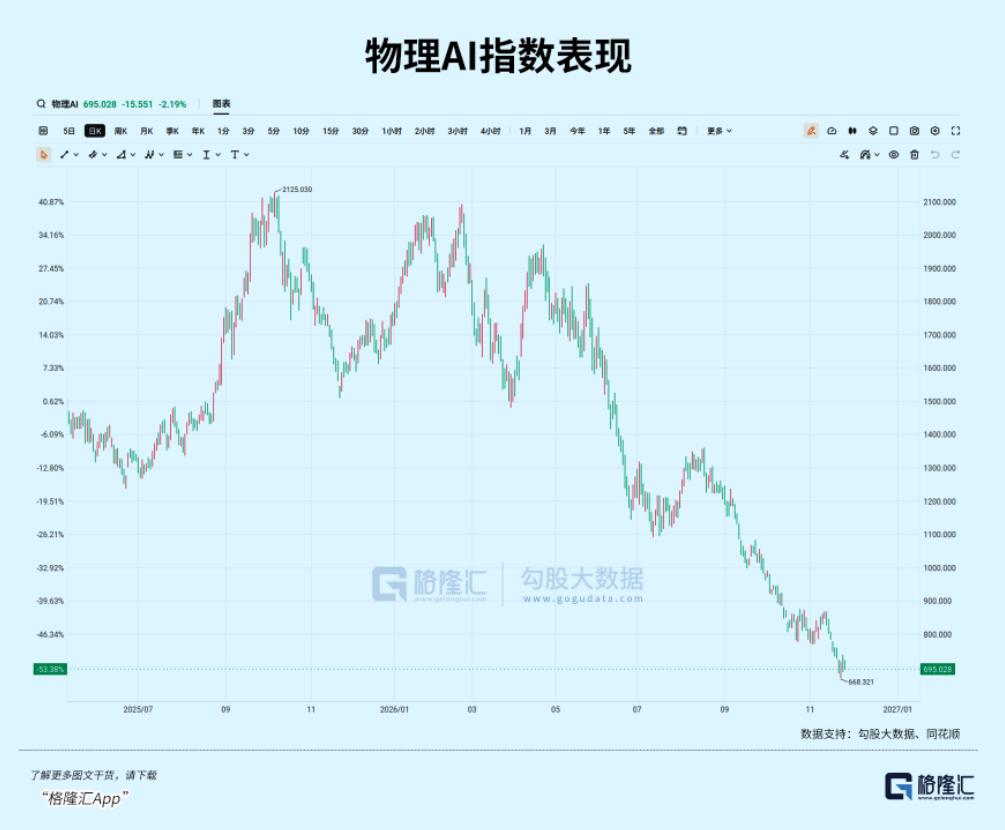
In the same period, the peer targets in the Hong Kong stock market that are actually involved in spatial intelligence and robots also performed sluggishly, and only SUNMI surged against the trend.
As for the one-day collective pulse of the entire sector on November 23, the real industrial catalyst actually came from the breakthrough of embodied intelligence large models.
The Ember-0 benchmark test released by XDOF on that day showed that the comprehensive task success rate of the dual-arm robot driven by GPT-6.2Astra increased significantly from 19.6% to 41.2%. Among them, the success rate of "clamping bread with a clip" jumped from 10% to 90%, and even the highly difficult "knotting" and "unfolding a T-shirt" also broke through from 0% to 3% and 19% respectively.
On the same day, CITIC Construction Securities also took the opportunity to release a research report, proposing that "Physical AI is the next wave of artificial intelligence, and robots are one of the best physical carriers of AI".
Catalyzed by the news, SUNMI skyrocketed by 48.65% on that day, followed by Koo Tech up 23.40%, 51Vistar up 10.66%, Laifu Harmonic up 9.48%, and Syrius Robotics up 8.28%.
It can be seen that what made the whole sector more excited that day was the progress of the embodied brain, and SUNMI only became the most flexible carrier in the eyes of funds because of its plate characteristics.
The company has no southbound capital participation, no mainstream index inclusion, only one institutional coverage, superimposed with a tradable share capital of only 304 million shares, a turnover rate of only 0.11%, and the lock-up period of cornerstone investors extended to March 28, 2027.
This means that before the 11.5208 million shares (accounting for 27.03% of the global offering shares) are lifted on March 29 next year, there is almost no large-scale institutional selling pressure in the market.
Extremely thin liquidity plus highly locked chips allow a buy order of tens of millions of Hong Kong dollars to easily push a single-day amplitude of more than 20%.
Apart from the extreme chip game, the company's financial fundamentals actually only play the role of "providing a safety lower limit", which is not enough to explain the explosive power of the share price doubling.
According to the financial report for the first half of 2026, SUNMI achieved an operating revenue of 1.762 billion yuan, a year-on-year increase of 25.8%, and the overall gross profit margin remained at 32.1%, which was basically the same as the same period of last year.
Although the book recorded a net loss of 69.996 million yuan, the breakdown is mainly due to the one-time listing expenses of 49.85 million yuan and the share-based payment of 8.295 million yuan.
The adjusted net loss disclosed by the company is 11.854 million yuan (excluding listing expenses and share-based payment); if the net exchange loss of 85.97 million yuan is further restored on this basis, the profit is about 74.12 million yuan.
This less-than-satisfactory report card, even if it cannot explain the explosive power support of short-term doubling, will not lead to a complete collapse of the share price.
Therefore, this extreme share price elasticity does not come from a sudden explosion of fundamentals, but is jointly triggered by the unique capital and index structure of the Hong Kong stock market, the lack of institutional pricing anchors, and highly locked chips.
The B-end Is a Big Cake, and Big Tech Companies Are Also Eyeing It
The AI narrative is ultimately to extend space for the main business, and it is hard to say whether it can be done well in the future. However, looking at the first half-year report after its listing, although SUNMI's revenue is growing, hardware still supports the overall market, and software and services have not yet gained momentum.
In the first half of 2026, smart hardware devices still contributed 99.2% of SUNMI's operating revenue, while the PaaS platform (that is, software and service fees collected monthly in addition to hardware sales) and customized services, which truly represent the monetization potential of software and AI, only accounted for 0.8% of the total revenue in half a year.
On the R&D side, SUNMI's investment intensity is also slowing down. In the first half of the year, the company's R&D expenditure was 216.2 million yuan, a year-on-year slight increase of only 3.5%, far lower than the revenue growth rate of 25.8% in the same period.
Looking at the annual sequence of the past three years, SUNMI's R&D investment from 2023 to 2025 was 354 million yuan, 394 million yuan and 423 million yuan respectively, which was originally increasing year by year. Therefore, the 3.5% growth rate in the first half of 2026 actually hit the lowest level in the past three years, and the R&D expense ratio also dropped to about 12.3% accordingly.
What is more worthy of vigilance is that SUNMI's customer base is also shrinking, and it is highly dependent on a single core major customer.
Prospectus data shows that the number of paying customers of SUNMI has dropped all the way from 2,506 in 2022 to 2,337 in 2023, 2,