The mysterious model suddenly topped the trending searches, and HungerG became an overnight viral hit. Who on earth is it?
Who on earth is HungerG?
Last night, this mysterious code name unexpectedly landed on X's trending list without any warning.

The cause of the incident is very simple.
The two leading AI coding platforms Qoder and OpenCode suddenly dropped a "surprise perk" by launching a fully anonymous stealth model.
The official introduction released several key details:
Ultra-long 1 million token context window.
Native multi-modal input support.
A formal commitment that user data will never be used for model training.
What is more attractive to developers is that this anonymous model also comes with a limited-time free benefit: Qoder users can experience it for free, and OpenCode Go subscribers can also make free calls this week.
In just a few hours, real test posts spread all over the internet.
Some people watched it build a 3D fusion reactor completely on its own; some stared at the screen as it wrote scripts to take over the browser and find bugs; other developers added it to their own model evaluation leaderboards.
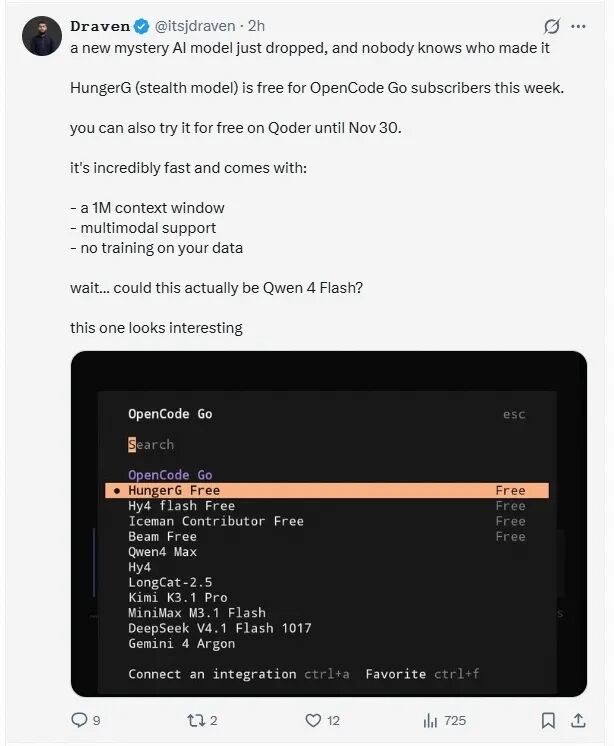
HungerG, whose name even looks like it was typed randomly on a keyboard, has overnight become the biggest unsolved mystery in the AI industry.
At present, on OpenCode, this model has climbed to the 3rd place on the daily overall ranking list.
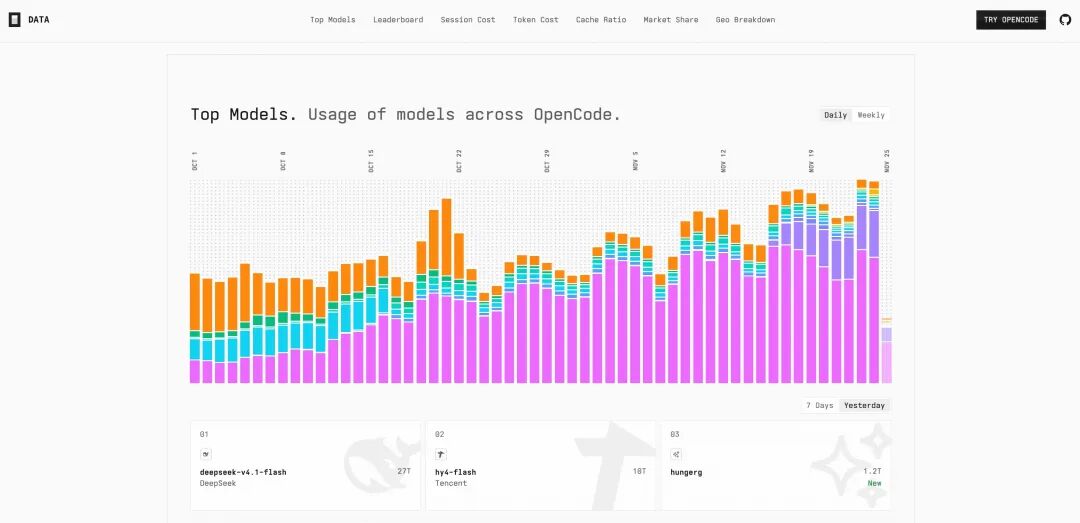
Dark Horse Model, Limited-Time Free Access
Today, GPT-6.2 and Claude 5.5 are in fierce competition. Although the price of tokens has dropped repeatedly, it is still a considerable expense for heavy-use developers.
A new model that supports million-token context, native multi-modal input, and offers free trial naturally attracts a large number of developers to come and try it out.
186 Calls, 37 Minutes: The Monster That Learned to "Borrow Eyes"
Well-known overseas developer @loktar00 gave HungerG an instruction: "Build a ship with code."
HungerG quickly finished writing the code for 3D modeling, and tried to check the actual rendering effect to verify whether the generated content meets the requirements.
However, the built-in browser of the current application does not support WebGL technology at all, so the picture cannot be rendered and shows a full black screen. For the model, it is equivalent to being "blind".
If it were an ordinary model, it would probably give up at this point, but HungerG did not.
It started scanning the system paths, found another full-featured browser installed on the computer. Right after that, it wrote a piece of script, forcibly took over that browser, and successfully rendered the 3D scene.

To see the details clearly, it controlled the browser to continuously rotate the perspective, and took 31 consecutive screenshots of the screen from different angles.
Then it sent these 31 screenshots back to the multi-modal visual analysis module, and suddenly came to a conclusion: "The hull on the left looks like it has been cropped, and there is a missing texture."
After that, it directly modified the source code, and perfectly fixed the texture and model defects.
Throughout the whole process, no human intervened.
A single task took 37 minutes, triggering 186 consecutive tool calls. It wrote code by itself, found tools by itself, checked the effect by itself, found bugs by itself, and finally fixed them by itself.
Head-to-Head Competition: Wheat Fields, Harvesters and Nuclear Fusion
On the other side, developers also began to conduct comparative tests between different models.
Netizen @LatentOperatorX directly put HungerG and DeepSeek V4.1 Flash on the same competition arena:
Use the Three.js engine to assemble a working harvester in the wheat field.
The result is very interesting.
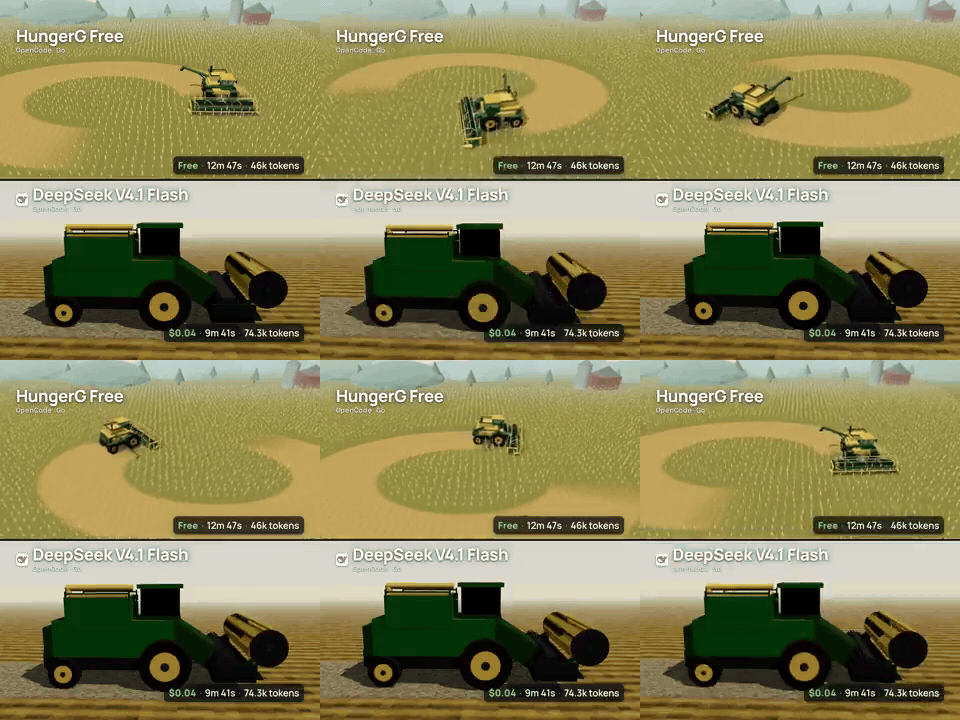
From the physical collision of the wheat field to the modeling of the harvester, the mechanical structure generated by HungerG is not only more complete, but even the light and shadow details and the logic of gear operation are steadily better than its competitor.
But this is not its limit.
Another netizen only spent 15 minutes using it to build an interactive 3D nuclear fusion reactor completely from scratch.
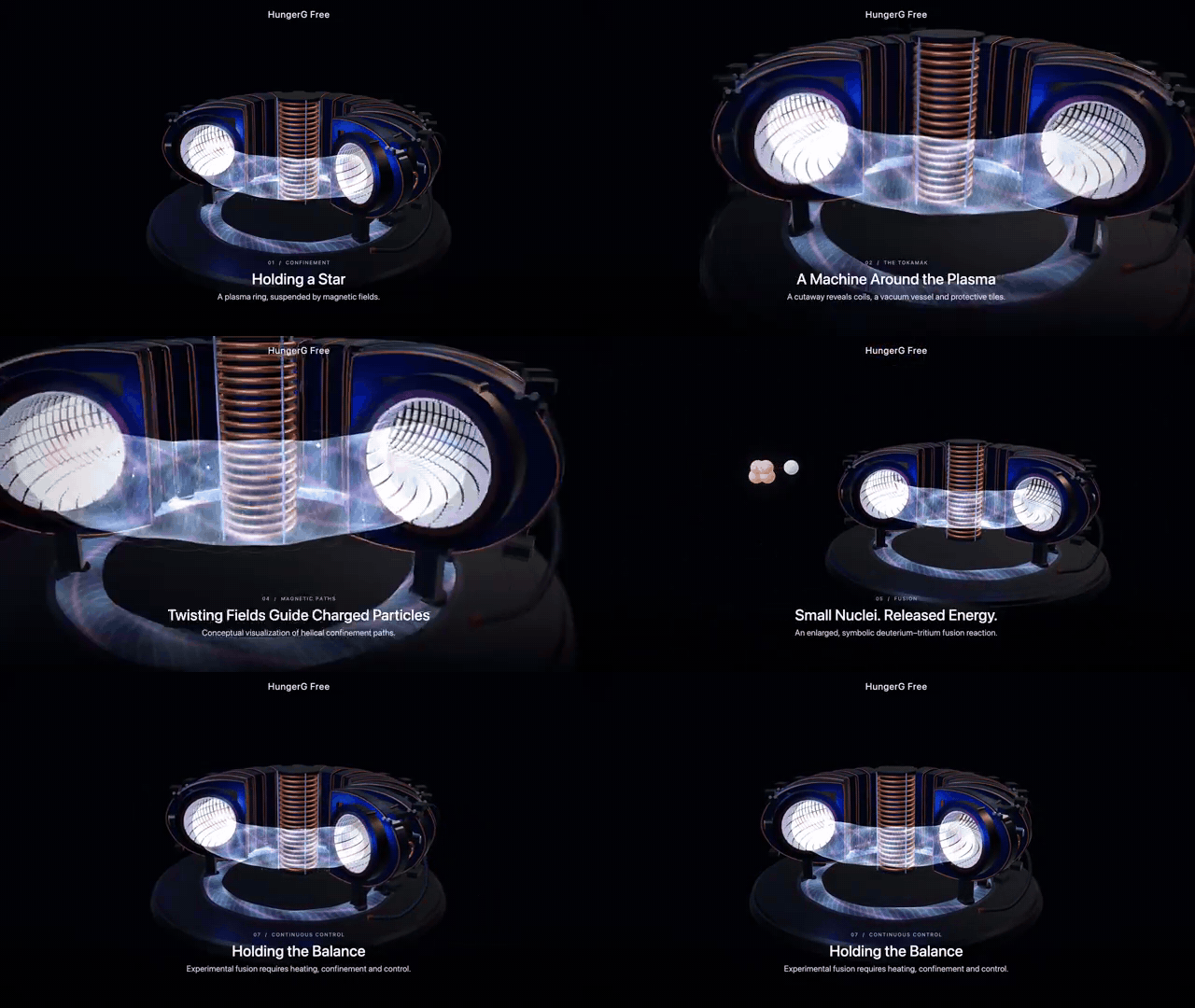
From the particle effects of magnetic field confinement to the metallic texture of the reactor shell, everything was completed independently by AI.
This developer marveled in his tweet:
It is fast, with high output quality, and extremely strong multi-modal closed-loop capability. The most outrageous part is that it can even run multiple Agents on parallel tasks at the same time, without any drop in speed.
He wrote at the end of the post: "No matter who the team behind HungerG is, you guys have done an amazing job this time!"

Third-Party Evaluation: How Does It Perform in Complex Reasoning Capabilities?
If daily tests rely on stunning performance, then professional Benchmark is the mirror that reveals the true level.
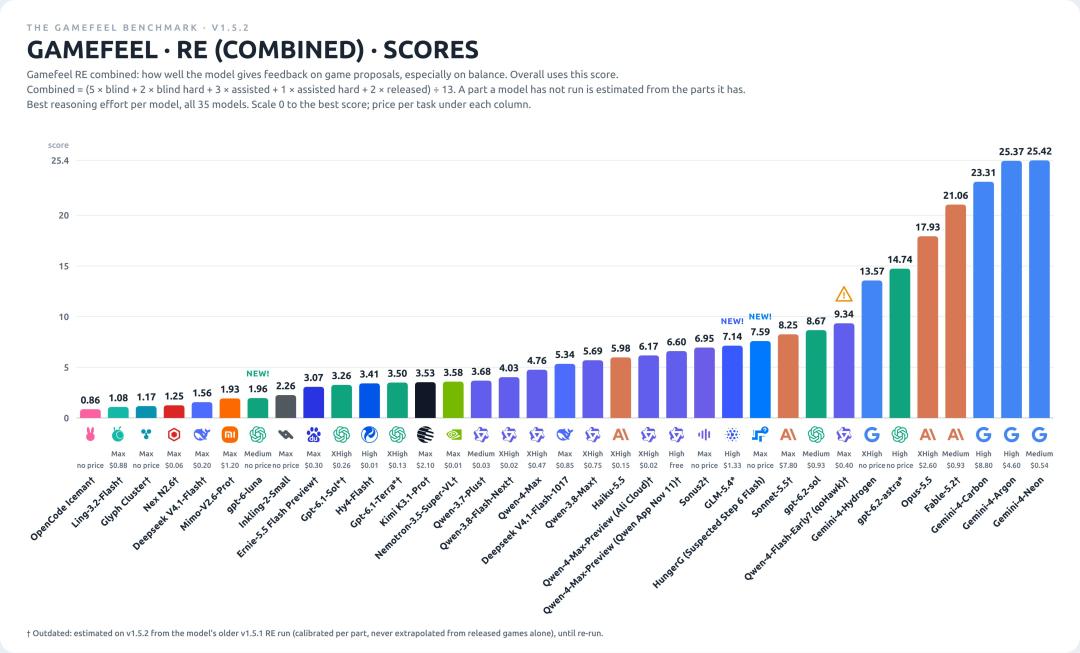
Developer @follistatindev disclosed the latest scores of the authoritative Gamefeel Benchmark v1.5.2.
Gamefeel Benchmark tests "game design document evaluation and numerical balance feedback".
In other words, it feeds complex card mechanics and the numerical system of unreleased games to AI. Even human game planners would get dizzy calculating these contents, to see if the AI can spot numerical collapse and find balance loopholes at a glance. This extremely tests the model's long text logical reasoning ability, as well as its ability to deconstruct complex systems.
In this leaderboard, HungerG's performance is noteworthy
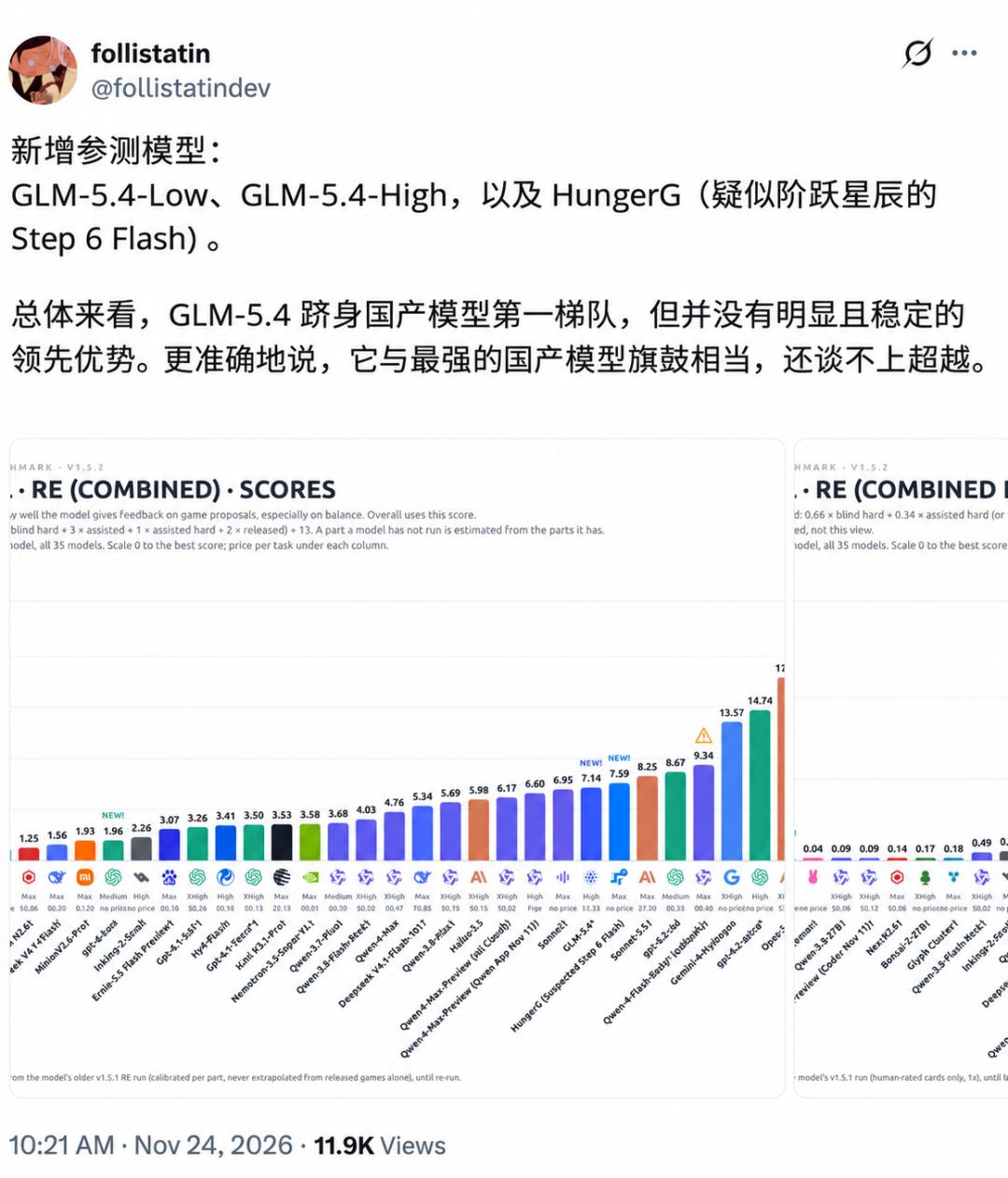
In the comprehensive ranking (RE Combined), HungerG (Max tier) scored 7.59 points, and GLM-5.4 (High tier) scored 7.14 points.
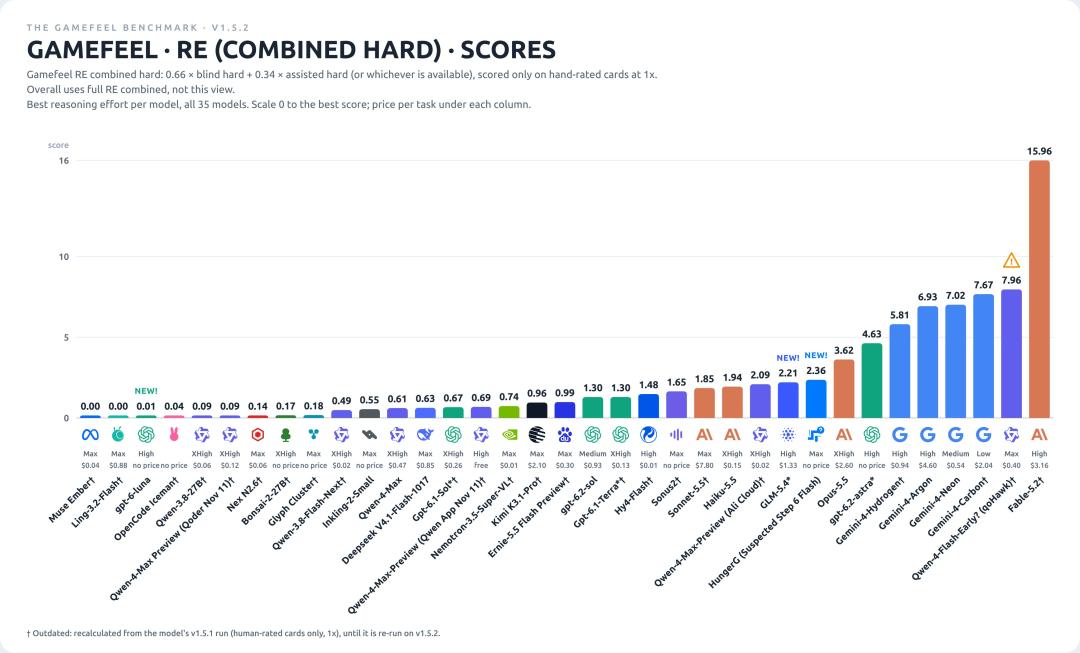
In the hell-level extreme pressure test "Combined Hard", HungerG ranked 9th with 2.36 points, higher than Claude Sonnet 5.5 (1.85 points) and Claude Haiku 5.5 (1.94 points) in the same list.
The most brutal test is the Blind Hard pure blind test.
There is a dashed line in the figure, which represents "the average level of human players with an IQ of 120 and no experience in this game (about 2 points)".
In this cruel competition field, 27 out of 35 top models failed to reach the human baseline.
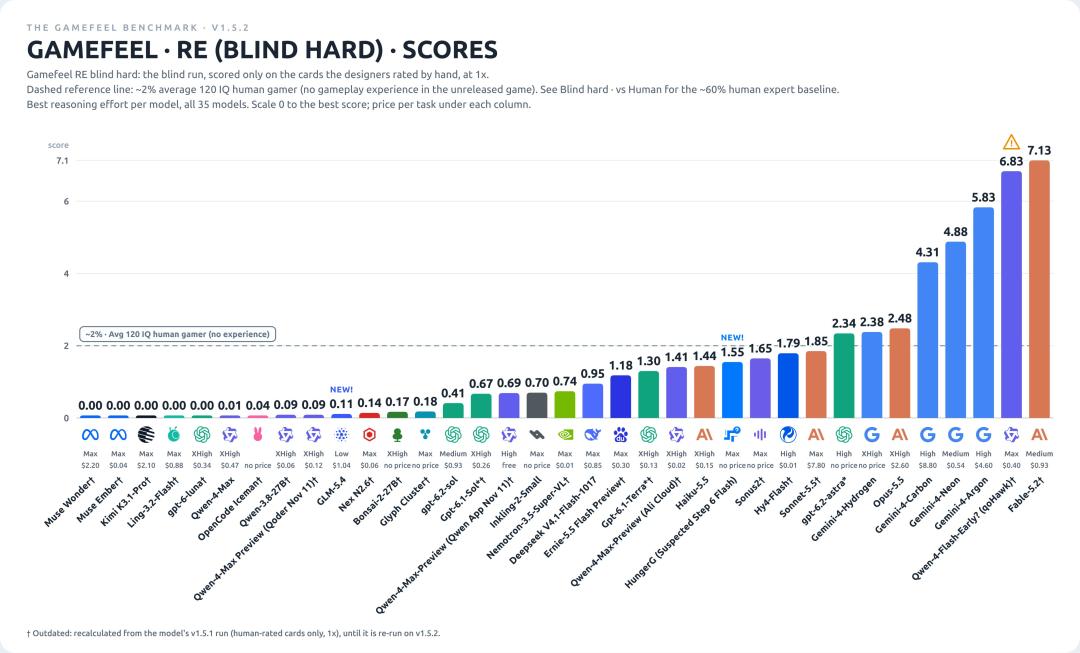
HungerG scored 1.55 points. Although it failed to cross the human baseline of 120 IQ, this result already ranks at the very top of domestic models.
Real-World Test: It Can Actually Get Work Done
After reviewing the tests from overseas developers and third-party leaderboards, we also tried several different types of tasks to test HungerG's actual performance.
This 3D Small Factory Can Actually Operate Properly
The small factory generated by HungerG is made in great detail: the robotic arm has a metallic texture, and the tape and labels on the cartons are all present. The actions of grasping, moving over, and putting down are connected one by one, the robotic arms will avoid each other, and the parcels are queued with proper spacing, which looks very realistic.

The whole task ran for 40 to 50 minutes, and the final finished product is complete enough: it can sort automatically, switch perspectives following the parcels, and the robotic arm can resume working after shutdown and recovery.
With a large number of items and long steps, it can connect all these functions together and finish the task properly, which fully demonstrates HungerG's solid capability in handling long-duration tasks.
86 Parts That Make a Mechanical Firefly Come Alive
The most interesting feature of this mechanical firefly generated by HungerG is that you can disassemble it little by little. Drag the slider, the head, thorax, wings and abdomen separate layer by layer, the gears inside are still rotating, and the wick is also lit, just like you are admiring a precision mechanical collection up close.
With soft shadows and glowing effects, the whole model looks very delicate. When the camera moves to the side and back, you can continue to observe the joints and internal structures, and the details in the 3D space can withstand viewing from different angles.

The capability for long tasks is also hidden in these small movements: to spread its wings, it must first open the elytra, retract its mechanical feet before taking off, and assemble the parts back in order when restoring.
All 86 parts have their own positions, and they also need to respond to pause, drag, click and reset operations. A slight oversight will easily cause chaos. The finished product record shows that after three consecutive resets from the completely disassembled state, all parts returned to their original assembly positions.
It can take care of the action sequence, part relationships, and the state after repeated operations, which reflects HungerG's ability to continuously deliver solid details in complex tasks.
In one sentence, it created a playable Chinese chess game that you can play against.
We only put forward one requirement: make a Chinese chess game that people can play against.
HungerG returned a web page that you can open and play immediately.
The rules of Chinese chess are actually quite complicated: the horse will be blocked if there is a piece in front of its moving direction, the cannon can only capture a piece by jumping over exactly one intermediate piece, and the two generals cannot face each other directly. It didn't make a single mistake on any of these rules.
The computer opponent does not move randomly, it will calculate several moves ahead, and plays the game very decently. The chessboard has a wood grain texture, the chess pieces are rounded, the color matching is calm, it looks like a properly developed formal product, and it can also be played on mobile phones.

What is even more rare is the way it works.
This is no small task, it worked on it alone for a long time, checked documents, ran programs, opened browsers, and operated more than a hundred times in total.
After finishing writing the