41 Billion US Dollars: The Trend Indicator of the Largest M&A Deal in the Pharmaceutical Industry Over the Past Three Years
On November 24, Sanofi announced that it will acquire U.S. biopharmaceutical company Insmed for an all-cash consideration of $175 per share, with a total consideration of $41 billion (approximately 37.6 billion euros). This is the largest merger and acquisition deal in the global pharmaceutical industry since Pfizer acquired Seagen for $43 billion in December 2023.
The market was not caught off guard by this news. After the acquisition rumors spread, Insmed's stock price had already been pushed up for one round; on the day the news was officially confirmed, Insmed's pre-market trading price rose by about 14% further, and Sanofi's stock price increased by nearly 6%. The shareholders of both the buyer and the seller voted in favor of the deal at the same time, which is not common in large-scale M&A transactions.
When we put the transaction terms, asset list and Sanofi's own financial data together, the full picture of this M&A deal gradually becomes clear.
Three Core Assets
The assets Sanofi obtained from the acquisition are roughly divided into three parts:
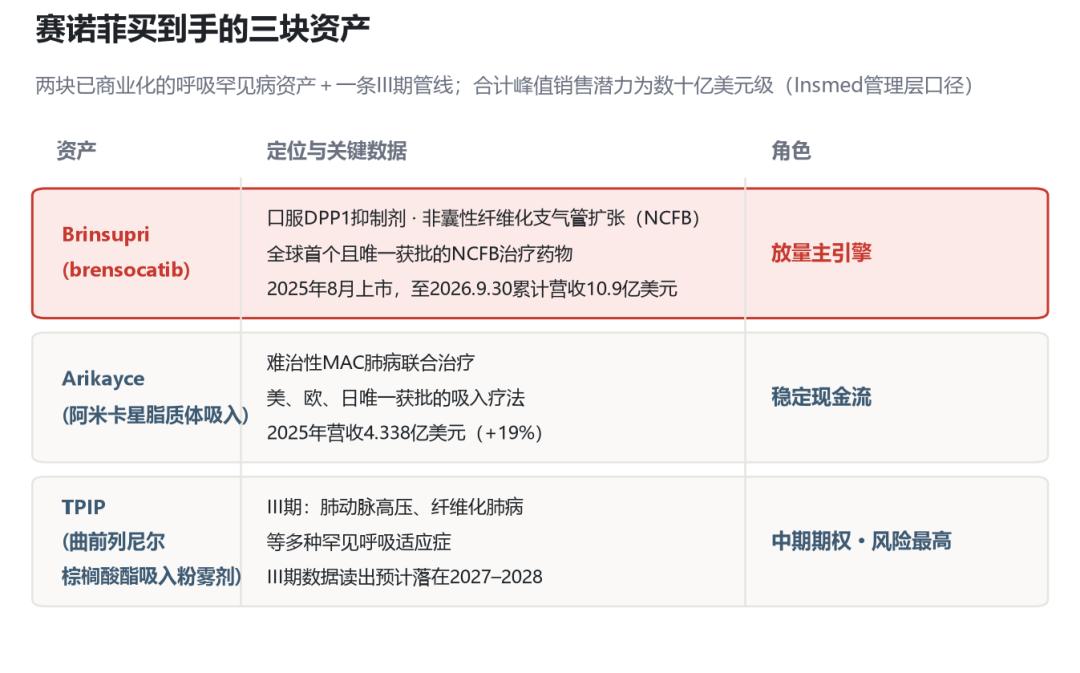
Figure: Three assets Sanofi acquired from Insmed. Source: Sanofi press release, Insmed
The first asset is Brinsupri (brensocatib).
It is an oral once-daily DPP1 inhibitor, which was launched in the United States in August 2025 for non-cystic fibrosis bronchiectasis (NCFB). It has now been approved in the United States, the European Union, the United Kingdom and Japan. It is the world's first approved DPP1 inhibitor, and also the first and only approved therapeutic drug for NCFB, with no competitors in this indication.
From its launch in August 2025 to September 30, 2026, its cumulative revenue reached 1.09 billion U.S. dollars, crossing the blockbuster drug threshold just over one year after launch. According to Will Lewis, CEO of Insmed, Brinsupri has become the standard treatment for NCFB patients in just over a year since its launch.
The second asset is Arikayce.
It is amikacin liposome inhalation suspension, used in combination with multi-drug regimens to treat refractory Mycobacterium avium complex (MAC) lung disease, and it is the only approved inhalation therapy for refractory patient groups in the United States, Europe and Japan.
Its full-year revenue in 2025 was 433.8 million U.S. dollars, up 19% year on year; in September this year, the FDA accepted its new indication application under priority review. This drug is positioned as a small-scale asset for chronic disease management: it has a steady growth rate, a limited revenue ceiling, but highly predictable cash flow.
The third asset is the phase III pipeline TPIP.
It is treprostinil palmitil inhalation powder, a once-daily inhaled prostaglandin investigational drug targeting multiple rare respiratory indications such as pulmonary arterial hypertension and fibrotic lung disease. This is the part with the highest risk in the transaction, and also one of the reasons why Sanofi is willing to pay consideration for "mid-term growth".
In terms of transaction structure, the $41 billion all-cash deal is funded by Sanofi's own capital plus debt financing, with JPMorgan Chase and BNP Paribas providing a $35 billion bridge loan.
Where Does the Premium Come From
Calculated based on the stock price before the news broke, Sanofi paid a premium of about 46% (the premium compared to the closing price of the previous trading day was about 17.4%, and the front-running during the rumor phase pushed up the base price).
Rare respiratory disease is a special track. Both NCFB and refractory MAC lung disease are chronic and progressive diseases. Once patients start treatment, their medication cycle is calculated in years, with very little space for drug discontinuation or switching, leading to extremely high patient stickiness. As the world's only approved drug for this indication, Brinsupri has no direct competitors in the foreseeable window.
This combination of "orphan drug plus chronic disease" exactly matches the attribute that the capital market is most willing to price: high cash flow visibility. Arikayce's consecutive 19% growth rate and Brinsupri's billion-dollar revenue ramp-up curve in one year are both footnotes to this visibility.
It should be noted that this type of asset also means a ceiling for the patient pool. The size of the NCFB patient population is limited, and Brinsupri's growth relies on penetration rate increase and regional expansion, rather than expansion of the patient pool. According to the caliber given by Insmed's management, the combined commercialized products and phase III pipeline have "peak sales potential of several billion dollars".
The Pressure of Patent Cliff
The reason why Sanofi made the move at this moment can be found in the financial statements of Dupixent.
In the third quarter of 2026, Dupixent recorded single-quarter sales of 5.7 billion euros, accounting for nearly 40% of the company's net sales in the quarter; for the whole year of 2025, the sales of this drug exceeded 15 billion euros. One single drug supports nearly half of the revenue of Europe's largest pharmaceutical company, and such concentration is almost unheard of among large multinational pharmaceutical companies. Its U.S. patent is expected to expire around 2031.
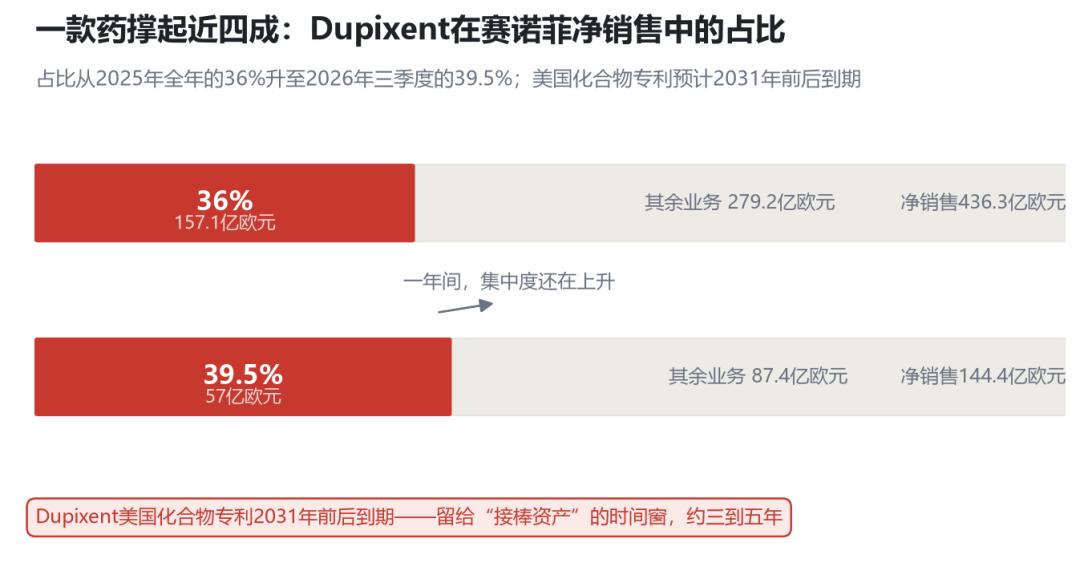
Figure: The proportion of Dupixent in Sanofi's net sales. Source: Sanofi 2026 Q3 financial report
The industry has repeatedly demonstrated what patent expiration means: generic drugs enter the market, the price system collapses, and most of the revenue slips away within two or three years. The time window left for Sanofi is from now to before 2031, about three to five years. It takes about ten years for a drug to go from clinical trials to launch, and it is too late to rely on internal R&D alone. M&A is the only way to lock in "succession assets" into the schedule in advance.
Such basic facts determine the design logic of the transaction. Brinsupri is already ramping up sales, and Arikayce provides stable cash flow, both assets can be incorporated into the income statement right now; the phase III data readout of TPIP is expected to fall in 2027-2028, which will follow right after the deal closes.
If everything goes well, when Dupixent generics enter the market in 2031, Sanofi will already have a portfolio of respiratory assets generating tens of billions of dollars in annual sales in operation.
Trend: The Cycle of Supplementing Pipelines through M&A
Looking at the bigger picture, the trend revealed by this transaction is more noteworthy than the deal itself.
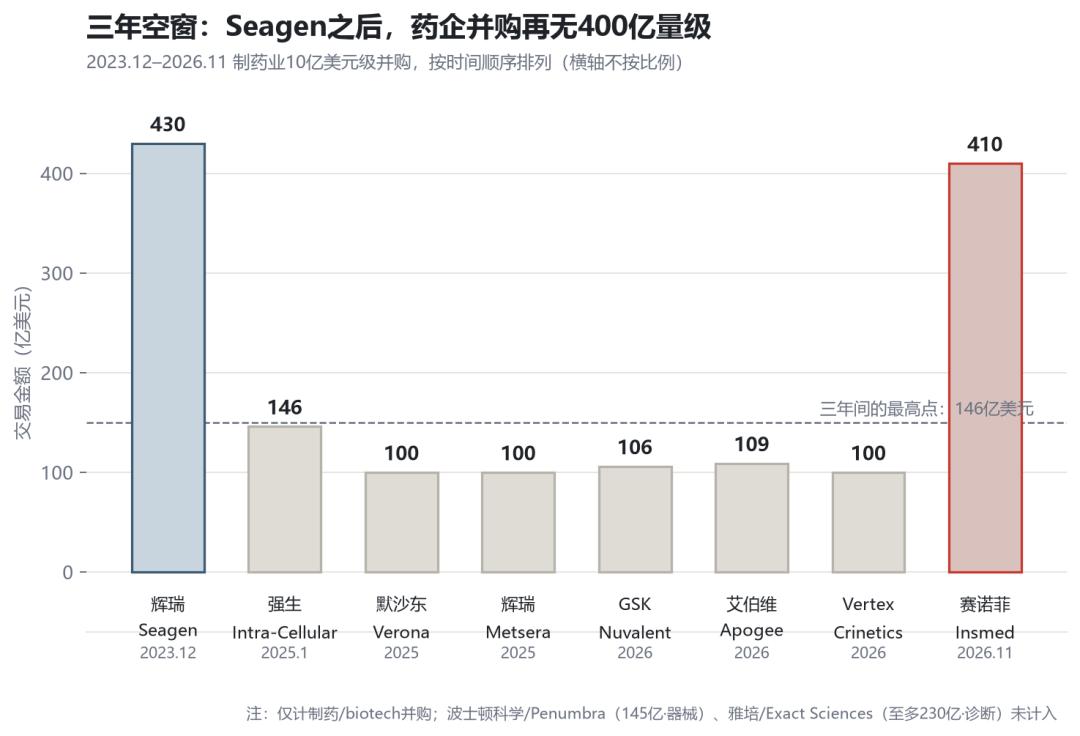
Figure: Sequence of large-scale M&A deals in the pharmaceutical industry since 2023. Source: Reuters, company announcements
After Pfizer/Seagen ($43 billion, December 2023), there has been no M&A deal of the same magnitude in the industry for three full years. In these three years, the strategic focus of multinational pharmaceutical companies has been placed on weight-loss drug competition, internal pipeline restructuring, and small-scale early-stage BD transactions successively.
The Sanofi/Insmed deal breaks the silence, and the way it breaks it carries clear signal significance: The buyer has adjusted its priority, no longer clinging to high-growth stories, but focusing more on acquiring certainty — already launched drugs, proven sales curves, and approved indications.
The "control group" of this choice is internal R&D. A new drug takes an average of about ten years from project initiation to launch, with a clinical trial failure rate of over 90%; by purchasing an already commercialized asset portfolio with a 40%-50% premium, both the failure risk and cycle risk can be transferred at the same time.
In an environment where patent cliffs are coming in concentrated batches and investors are increasingly pressing the question of "whether there is still growth after patent expiration", the willingness of multinational pharmaceutical companies to exchange premiums for certainty has risen systematically. Sanofi's $35 billion bridge loan also shows that the financing environment gives them room to do so, with loose interest rate conditions and the capital market remaining open to large-scale M&A financing for high-rated pharmaceutical companies.
It is worth noting the transmission path of this trend. When multinational pharmaceutical companies start paying $41 billion for "commercialized rare respiratory disease assets", it also sets a valuation benchmark for similar assets across the whole market: The valuation anchor points of segment-leading assets with high patient stickiness, clean competitive landscape and visible cash flow have been raised.
This pricing signal will spread in two directions: it will lead the primary and secondary markets to re-evaluate the respiratory and rare disease tracks, and also spread to biotech companies that are looking for exit and realization paths.
For R&D-oriented enterprises, this means an M&A window is opening; for investors, this means the asset screening criteria are shifting from "pipeline imagination" to "cash flow certainty".
This article is from the WeChat official account "Yi Yao", author: Li Jingyi, published with authorization from 36Kr.