Dong Peng falls into the "illusion of Jinjiu's prosperity"
In 2025, owners of some tobacco and liquor stores found that the small-bottle Jinjiu they had been selling for decades suddenly could not meet market demand. The next year, stockouts became increasingly widespread, and many large liquor wholesalers at Zhengzhou Bairong even ran out of stock for two to three months.
Against the backdrop of the Baijiu industry struggling with excess inventory, Jinjiu has emerged as a rare dark horse for growth. In the first half of 2025, sales of 125ml red-label Jinjiu reached nearly 5 billion yuan, a year-on-year increase of about 50%; the overall revenue growth rate of JING Group exceeded 20% for the whole year.
After Jinjiu became a smash hit, both liquor enterprises and pharmaceutical enterprises lined up to enter the health tonic liquor track. Now, even Dongpeng, a beverage manufacturer, has joined the competition.
The new product "Haolihai" compound liquor launched by Dongpeng this time is a 33% ABV 150ml small-sized liquor with a retail price of 16 yuan. Customers can pay an additional 4 yuan to redeem another bottle if they win the prize under the cap. From packaging and pricing to raw materials and formula, it is benchmarking against the unrivaled leader of the track, Jinjiu.
With larger capacity and lower price, the product has completed distribution in Henan, Hainan, Guangdong, Shandong, Jiangxi, Anhui and other regions in less than half a month.
Dongpeng's entry into the liquor market seems to be driven by the urge to ease its own operational pressure.
According to the recently released third-quarter financial report, Dongpeng's energy beverage recorded its first negative growth since its listing, while its high-growth electrolyte beverage only saw a slight year-on-year revenue increase of 0.49% in the single quarter. The company's performance has slowed down significantly for the first time since its listing in 2021.
Dongpeng entered the market with a liquor product that looks very similar to Jinjiu, but it has not chosen the right path for its development.
Who emptied the shelves of Jinjiu?
Before Jinjiu re-emerged as a growth dark horse, it had stayed at the threshold of 10 billion yuan in annual sales for six or seven years. The early days of Jinjiu looked just like what many new entrants are experiencing now: a small-sized liquor placed in restaurants, sold to middle-aged and elderly male consumers.
China JING Liquor, the core SKU of JING Group, was launched in 1989. In the era when health tonic liquor was regarded as a gift, the advertising slogan "Jinjiu is good, but don't overindulge" from Jiang Kun on CCTV in 1993 spread rapidly, which quickly helped Jinjiu complete national consumer education, and transformed traditional medicinal liquor from a product "only to be consumed when sick" to a choice for "daily nourishment".
In 1997, Jinjiu launched the 125ml small bottle with a price of more than ten yuan. The product was distributed to food stalls, fast food restaurants and small restaurants, expanding the consumption scenario from home nourishment to on-site drinking at dining places.
This strategy was simple and effective. From 2005 to 2017, JING Group's sales revenue grew from 920 million yuan to 10.49 billion yuan, entering the 10-billion-yuan club of the liquor industry together with Moutai, Wuliangye and Yanghe.
The success of Jinjiu has also shaped the established path of the health tonic liquor industry: targeting male consumers, building nourishment-related brand perception, launching low-priced small-bottle products, and distributing through dining channels. Jinjiu followed this path for more than 20 years, until it hit a bottleneck in 2017.
In 2018, JING Group's sales revenue dropped to 10.2 billion yuan, and then hovered around the 10-billion-yuan mark. Wu Shao Xun, Chairman of JING Group, later publicly recalled, "It means that we have been stagnant for all these years."
During this period, Jinjiu also tried to connect with new consumers. In 2018, it successively cooperated with JD.com and Alibaba Retail Access; in 2020, it piloted cloud stores in Wuhan, Hangzhou and Guangzhou, but none of these attempts made notable waves.
Yedao Luguijiu, which was once called the two leading players of the track together with Jinjiu, was listed on the A-share market as the "first stock of health tonic liquor" in 2000. Its revenue once exceeded 1 billion yuan in 2003, and the gross profit margin of its core Luguijiu SKU was nearly 70%. Later, its main business continued to lose money, resulting in consecutive annual losses. It was marked as ST from 2018 and fell into repeated struggles to maintain its listing status.
Wu Shao Xun, Chairman of Jinjiu, attributed the industry bottleneck to two points: aging category perception, and incompatibility with social drinking scenarios. Later, Jinjiu achieved its second boom by tapping into the female consumer market.
In 2022, Wang Nan Bo, President of JING Group, took the lead in setting up a content marketing team of about 50 people, which focused on operating Douyin and Xiaohongshu to create content for Generation Z and female consumers. The product side was also adjusted in advance to reduce the medicinal taste and make it suitable for mixed drinks.
In October of the same year, Jinjiu launched cooperation with Starcom Media. It first signed a contract with its subsidiary Maifeng E-commerce to develop live-streaming e-commerce business. Later, Starcom took charge of KOL content seeding for Jinjiu on Xiaohongshu, Douyin and WeChat Channels, as well as product placement in Tencent's popular TV series and variety shows.
In early 2023, Jinjiu began to appear on Xiaohongshu with the label of "cheap and cost-effective domestic whiskey", and derived the first generation of mixed drink recipes such as "Jinjiu + Water Soluble C100" and "Jinjiu + Red Bull". At the end of the year, a female user shared her experience of relieving dysmenorrhea by drinking Jinjiu on Xiaohongshu, giving Jinjiu the nickname "magic water for menstruation".
In the following two years of 2024 and 2025, Jinjiu was tied to labels such as "liquor for independent women" and "Jinjiu girls". The number of related posts on Xiaohongshu exceeded 100,000, with nearly 200,000 discussions under the corresponding entry.
Memes such as "Drink Jinjiu, no more worries about menstruation" and "Drink China Jinjiu, have fun with relatives and friends" continued to go viral and became trending topics on Weibo.
At the end of 2025, the claim of "relieving dysmenorrhea" spread more and more widely, exposing Jinjiu to public opinion risks of misleading functional promotion. The company immediately made a clear statement that it had never promoted such curative effects.
In addition, as Xiaohongshu began to tighten the functional promotion of health food and strictly crack down on the mass marketing of ordinary user posts in the "Zhengzhou Gang" style, Jinjiu shifted its promotion resources to Douyin, focusing on the decompression and light intoxication scenarios of young people after work.
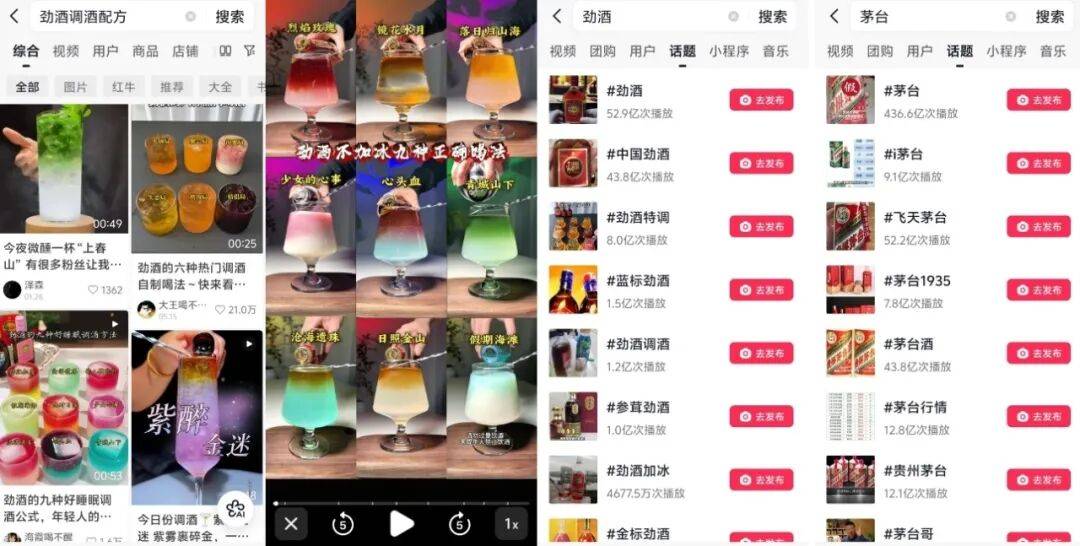
Leveraging the visual impact of videos, a large number of seeding videos about romantic light intoxication and fancy mixed drinks were released. Various trends emerged one after another, such as "savior for low mood", "health-focused version of Long Island Iced Tea", "9 Jinjiu mixed drink recipes for better sleep", and "9 ways to drink Jinjiu without ice". Hundreds of special mixed drink formulas using Jinjiu as the base liquor gradually accumulated across the entire internet.
On Douyin, the topic popularity of Jinjiu even exceeded that of Feitian Moutai, with 5.29 billion views. Other related topics such as China JING Liquor and Fancy Special Mixed Drinks also recorded 4.38 billion and 800 million views respectively.
In the first half of 2025, sales of 125ml red-label Jinjiu reached nearly 5 billion yuan, a year-on-year increase of about 50%; in the second half of the year, periodic stockouts gradually occurred at some terminals in Henan and Guangdong.
In October of that year, Wang Nan Bo disclosed that Jinjiu had added about 9 million new young users aged 18 to 30 in the past two years, of which about 4 million were female.
Can no second player stand out from the 80 billion yuan market bubble?
At this year's Spring Sugar and Alcohol Fair and Autumn Sugar and Alcohol Fair, Jinjiu's booth was one of the most lively exhibition areas. The unbranded and custom-developed liquors that used to fill the exhibition halls decreased significantly, and hundreds of new health tonic liquor products became the highlight of the events.
More and more players, including liquor enterprises and pharmaceutical enterprises, are pouring into the track.
In the liquor enterprise camp, Gujing Gongjiu launched Shenli Liquor, Moutai Health Liquor Industry launched Weishu, and well-known liquor enterprises such as Wuliangye, Fenjiu and Gu Yue Long Shan all launched new liqueur products.
Pharmaceutical enterprises are also unwilling to lag behind. Beijing Tongrentang has Huoli Liquor, Dong-E E-Jiao has E-Jiao Liquor and Zhuangben · Qiwei Cistanche Liquor, Guang Yu Yuan launched the Guilingji small-sized series, Yiling Pharmaceutical cooperated with Luzhou Laojiao to develop Lu Can Liquor, and Kuihua Pharmaceutical and Buchang Group also launched their own corresponding products.
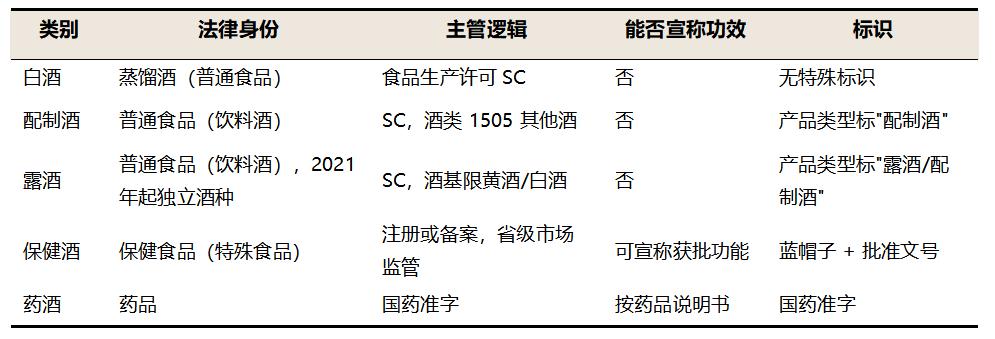
However, the medicinal liquor, health tonic liquor, liqueur and compound liquor mentioned by exhibitors are not the same category.
Song Tao, chief taster and deputy director of the fermentation department at China National Food and Fermentation Research Institute, introduced to "City Insight": "Medicinal liquor is classified as medicine rather than liquor. It must be approved with the national medicine approval number and can only be sold in pharmacies. Health tonic liquor belongs to health food, which requires the national health food approval number / provincial health food approval number and the "blue hat" logo. The approval of new health tonic liquor licenses has very strict requirements, making it extremely difficult to obtain. For example, Jinjiu's blue hat certification was approved as early as 1997."
He further explained that both liqueur and compound liquor belong to ordinary food, which can be produced with a food production license, but it is legally prohibited to explicitly or implicitly imply any health care effects. Compared with liqueur, compound liquor has fewer restrictions: it can use edible alcohol as base liquor, and can also use food additives in accordance with relevant regulations.
If sorted by access threshold and regulatory stringency, the order is roughly: medicinal liquor > blue hat certified health tonic liquor > liqueur > compound liquor.
With low access threshold, the formulas of compound liquor are often superficial, with longer and longer ingredient lists, but vague production techniques and formula logic. A national first-class liquor designer with in-depth knowledge of traditional Chinese medicine theory told "City Insight": "The formulas of many products are like prescriptions from an incompetent doctor, which cannot grasp the core effect and only pile up ingredients blindly."
Apart from the formula, these new product SKUs have no obvious differences: their alcohol content is between 33% and 35%, specifications are concentrated in 105ml to 150ml, prices are set at 16 to 20 yuan, and all scenarios point to drinking with meals. Placed on the same shelf with the trademark removed, it is almost impossible to tell them apart.
Although some new products target the female market, there are no obvious differences in liquor body, consumption scenarios and content narratives, except for lower alcohol content, smaller bottles, and adjustments in naming and packaging to cater to female consumers.
Weishu from Moutai Health Liquor Industry is one of the new products with relatively high popularity. Its sales exceeded 10 million yuan within three months after launch, and it has been distributed to more than 300 local stores in Renhuai. In contrast, the red-label Jinjiu SKU alone achieved nearly 5 billion yuan in sales in the first half of 2025. Even with different statistical cycles, the two sets of data still show the huge gap in scale between new products and leading SKUs.
More new products are stuck in the distribution channels. A marketing manager of the liqueur department of a well-known pharmaceutical enterprise told "City Insight": "Most new health tonic liquor products from liquor and pharmaceutical enterprises achieve peak performance right after launch. After pushing the first batch of inventory through their existing channels, the stocks cannot flow further, and the terminal sales rate is at most 30%."
Take Hainan Yedao, which does OEM production for Dongpeng, as an example. As of the end of January this year, the annual audit institution visited 16 distributors, and the terminal sales proportion of the high-quality Luguijiu series was about 20%. By the end of February, the terminal sales rate of 18 million-level distributors was only 40%.
A central China liquor dealer once revealed: "There is a huge amount of overstock in channels, and the product visibility at terminals is acceptable, but the sales rate is not ideal. There is almost no sales after the Spring Festival." In the Zhengzhou Bairong market, the price of a 125ml product from Yedao has dropped from 16-18 yuan to 13-14 yuan.
However, the sluggish performance in channels has not stopped the allure of the market breaking through 80 billion yuan in scale.
The widely spread claim that "the liqueur market size exceeded 80 billion yuan in 2025" is not a statistical result with a clear caliber and public calculation method. The original statement in Huachuang Securities' research report that "the industry scale is expected to exceed 80 billion yuan in 2025" includes health tonic liquor and medicinal liquor. After multiple rounds of re-telling, the vague statistical caliber was misrepresented as the market growth rate.
Other publicly circulated estimates of 20 billion yuan, 30-40 billion yuan, etc. either count the ex-factory income of enterprises above designated size, or include blue hat certified health tonic liquor, compound liquor, terminal retail sales and even channel inventory into the same statistical scope. The figures vary several times, but they are often used to corroborate each other.
Famous liquor enterprises need a second growth curve, production regions need new development stories, and investment promotion fairs need new selling points. As a result, the popularity of Jinjiu alone is over-interpreted as the prosperity of the entire health tonic liquor market.
The market size figure is getting higher and higher, but no second player has emerged behind Jinjiu. The gap that Dongpeng has set its sights on may be exactly this empty market space.
Dongpeng, which has lost its cost advantage, cannot become the beloved choice of target consumers
Judging from its starting point alone, Dongpeng is indeed a very promising entrant in the eyes of the public.
Dongpeng has always opened up the market through its distribution network and low-price strategy, and its new product this time also follows this strategy. The 33% ABV, 150ml, 16-yuan SKU has a larger capacity than Jinjiu's 35% ABV 125ml bottle, but the price is at the same level, which essentially cuts into Jinjiu's market by leveraging cost-effectiveness.
By the end of the third quarter, Dongpeng had 3,787 distributors and more than 4.6 million active terminals, covering almost all prefecture-level cities. More than half a month after the launch of the new product, Dongpeng had already distributed the goods to Henan, Hainan, Guangdong, Shandong, Jiangxi, Anhui and other regions. Using the same vehicles and the same group of sales staff, the marginal cost of new product distribution is close to zero, which is a moat that other brands