AI film and television stocks have collectively hit the daily down limit, and the "story premium" of the AI concept has expired.
The story of AI film and television has been hard to tell recently.
On November 17, the A-share film and media sector suffered a collective correction. Multiple stocks including Beijing Culture, Hengdian Film and Television, Wen Tou Holdings hit the down limit. Huace Film & Television fell 13.34% in a single trading day, and Zhewen Pictures dropped 10.08%. The capital that was still reveling on the daily limit board a moment ago began to scramble to exit the market in the blink of an eye.
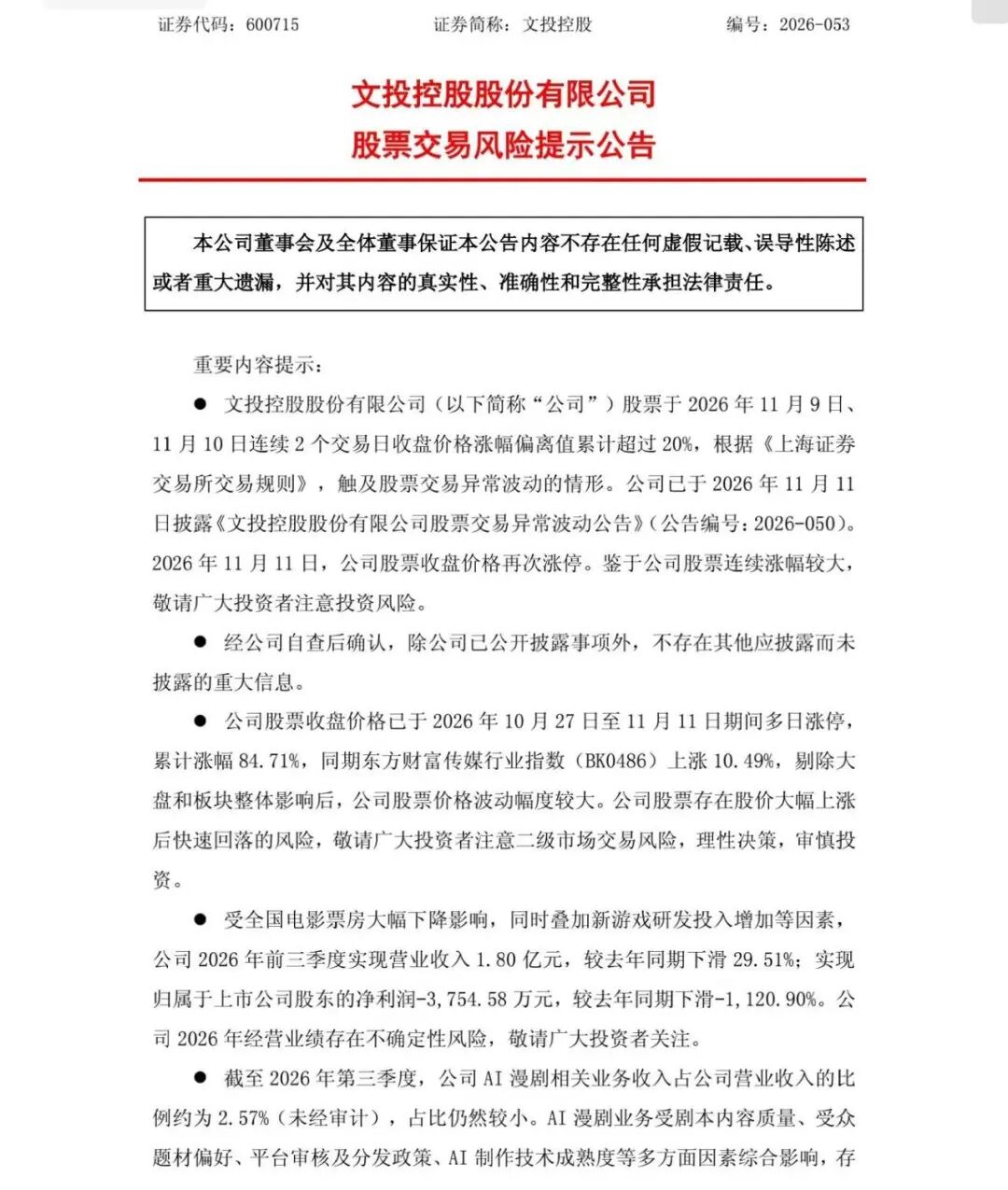
This decline did not come without warning. The night before, Wen Tou Holdings, which had recorded consecutive daily limit gains for multiple days, issued a stock trading risk warning announcement: as of the third quarter of 2026, the revenue generated by the company's AI manhua drama related business accounted for about 2.57% of its operating revenue. Meanwhile, the company's operating revenue in the first three quarters decreased by 29.51% year-on-year, the attributable net profit to shareholders recorded a loss of 37.5458 million yuan, and it also faced the risk of being imposed delisting risk warning if its full-year performance failed to meet the standards.
This announcement acted like a basin of cold water poured on the overheating rally of AI film and television concept stocks. Looking back at the market performance since November, the concepts of short dramas and AI manhua dramas once became popular targets chased by capital, with the cumulative increase of the sector exceeding 24% at one point. Wen Tou Holdings even recorded 10 daily limit gains within 15 trading days. At that time, the market was discussing who could take the lead in seizing the AI content production entrance, and who could open up new growth space with the help of technology.
However, this round of stock price changes suddenly altered the valuation logic of AI film and television concept stocks. The actual revenue of AI business has become an important basis for testing the authenticity of the concept, and the market has begun to doubt those fancy capital stories. It is one thing for a company to access AI tools, and quite another for the technology to enter the production process and form a stable business. Whether it can finally bring revenue and profit is the question that listed companies must answer.
Piercing the valuation bubble of concept stocks
The share price of Wen Tou Holdings rose by 120% cumulatively from October 27 to November 16, while the media industry index only increased by 5.54% in the same period. On November 12 and November 16, the company's turnover rate reached 37.66% and 37.82% respectively, and the single-day trading volume reached 3.553 billion yuan and 3.957 billion yuan respectively.
In just more than ten trading days, the stock price has completed a fairly sufficient emotional pricing. But the problem is that the company's operating fundamentals have not changed by such a large margin synchronously.
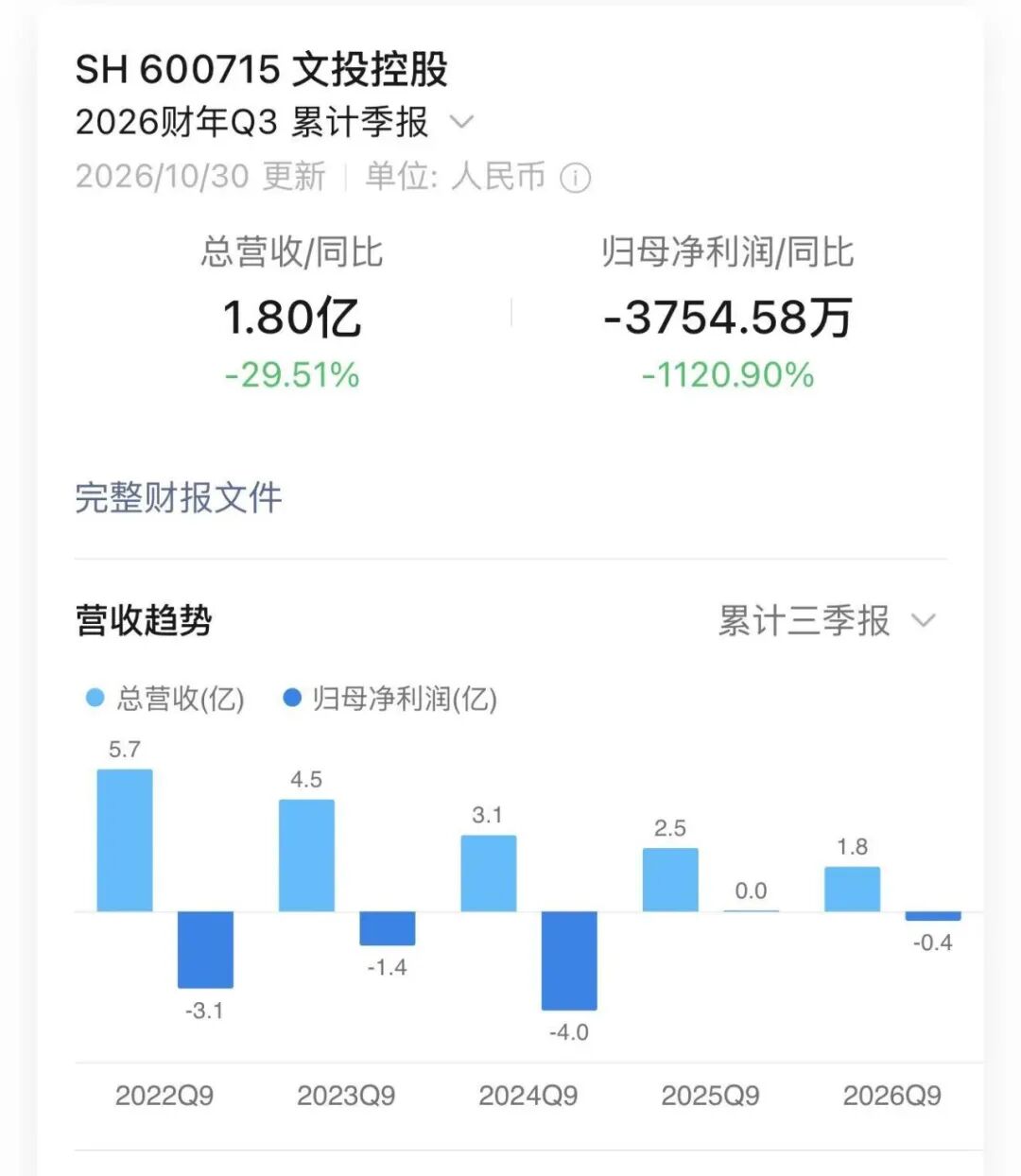
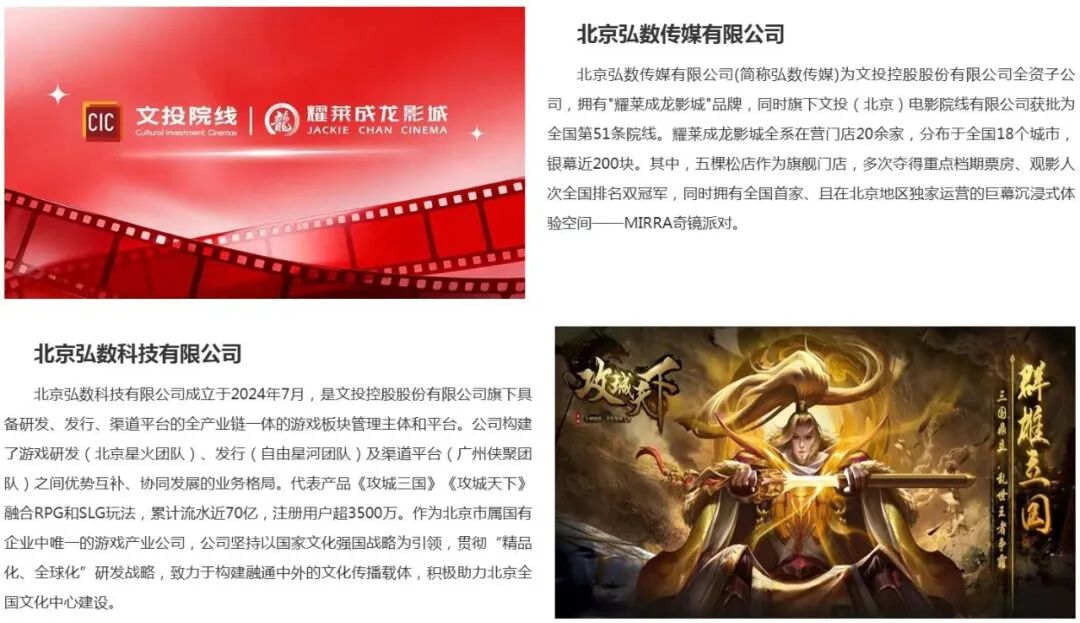
The original business portfolio of Wen Tou Holdings mainly involves cinema and theater chain operation, games and other businesses. In the first three quarters of 2026, the company achieved an operating revenue of 180 million yuan, down 29.51% year-on-year; the attributable net profit to shareholders recorded a loss of 37.5458 million yuan. The announcement also warned that if the audited relevant profit indicators for the full year are negative, and the operating revenue after deducting relevant income is less than 300 million yuan, the company's stock will face the risk of being imposed delisting risk warning.
Under such operating background, AI manhua drama has naturally become an important direction for the market to look for new growth stories. And the company is indeed carrying out this business.
According to relevant reports, Wen Tou Holdings cooperates with content and technology companies to develop and produce manhua dramas using AIGC tools. In the first three quarters, the company has launched a total of 225 AIGC-assisted production episodes, 109 of which have been released online, and some works have gained certain popularity on the platforms. In addition, the company also participated in the development of projects such as *Journey to the West: Just Became the Great Emperor, Let Me Catch Sun Wukong?*.
From the perspective of content production, these actions are not completely worthless. After all, whether a production system can be established and stable project supply can be formed are all problems that AI manhua drama companies need to solve. But from a financial perspective, there is still a threshold between the number of projects and commercial value.
225 projects put into production and 109 projects released online sound quite large in scale, but in the end, the revenue they bring only accounts for 2.57% of the company's operating revenue. This means that the growth of content output has not yet been converted into revenue contribution enough to change the company's operating structure.
It is particularly worth noting that the number of released manhua dramas and their broadcast popularity are not the same thing as the company's recognized revenue. After a work is released, it may generate revenue through platform revenue sharing, copyright licensing, co-production and other methods, or it may only get limited commercial returns. High popularity of a work does not mean that the producer can definitely get the income matching its popularity. A large number of projects does not mean that every one of them can make a profit.
In the past, the industry talked about AI manhua dramas, focusing more on how much it can reduce the production cost, how much it can shorten the production cycle, and whether it can allow a small team to complete the work that used to require dozens or even hundreds of people to finish. Now, as more and more companies enter the track, simply proving that they can produce AI content is no longer enough.
What is more interesting is that Wen Tou Holdings is not the only company that needs to face such inquiries. Since November, some listed companies have successively issued risk warning announcements during the period of abnormal stock price fluctuations, and the AI concept labels that the market used to take for granted have also been dismantled one by one by the companies' own business descriptions.
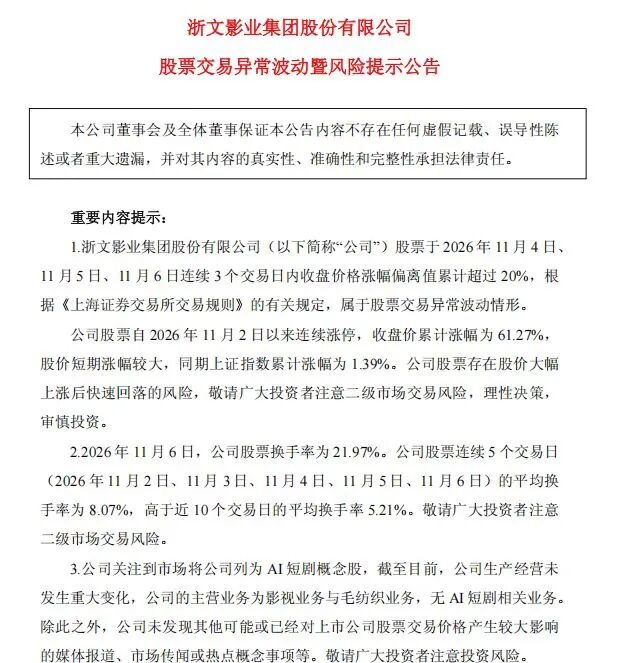
Take Zhewen Pictures for example. At the beginning of November, the share price of Zhewen Pictures recorded consecutive daily limit gains, and the market classified it as an AI short drama concept stock. On November 6, the company issued a risk warning announcement, clearly stating that its main businesses are film and television business and wool textile business, and it has no AI short drama related business for the time being. The announcement also specially reminded that the company's stock price has increased significantly in the short term, and investors need to pay attention to transaction risks.
This is a bit embarrassing. Investors thought they had bought a new player in the AI film and television industry chain, but the company came out to say that it had not carried out the corresponding business. There is not even the most basic correspondence between the identity of the concept stock and the actual operation of the company.
A similar situation also occurred to Longban Media. According to public disclosure information, the company once mentioned the actual revenue of AI video business in its risk warning: the relevant business generated about 80 yuan of operating revenue in June 2026, and about 75,000 yuan in July, accounting for less than 0.01% of the operating revenue in 2025. Nanwei Software once put forward business expectations such as producing 300 AI short dramas per year, and later clarified the relevant forecast, saying that the completed AI short dramas have not yet generated revenue.
Three companies, three different business statuses. Wen Tou Holdings has carried out AI manhua drama production and released works online, but the revenue proportion is still limited; Zhewen Pictures was classified into the AI short drama concept by the market, but clearly stated that it has no relevant business; Longban Media has taken actual business actions, but its early revenue is almost negligible; Nanwei Software has experienced the gap between business expectation and actual implementation.
These situations cannot be confused, but they all illustrate one problem: the concept classification of the capital market cannot replace the operating facts of listed companies.
A real AI film and television company cannot only rely on a single technology card
The financial reports of listed companies usually disclose revenue according to the original business segments. AI technology may have been applied to film and television production, advertising marketing, copyright operation and other links, but it is not split separately. Therefore, we cannot directly conclude that an enterprise has no AI content just because the AI revenue is not listed separately. Conversely, having AI business does not mean that it already has a mature business model.
In other words, some companies have already integrated AI into their production processes, but it still takes time for them to form an independent profit growth point. Hengdian Film and Television is a relatively representative one among them.
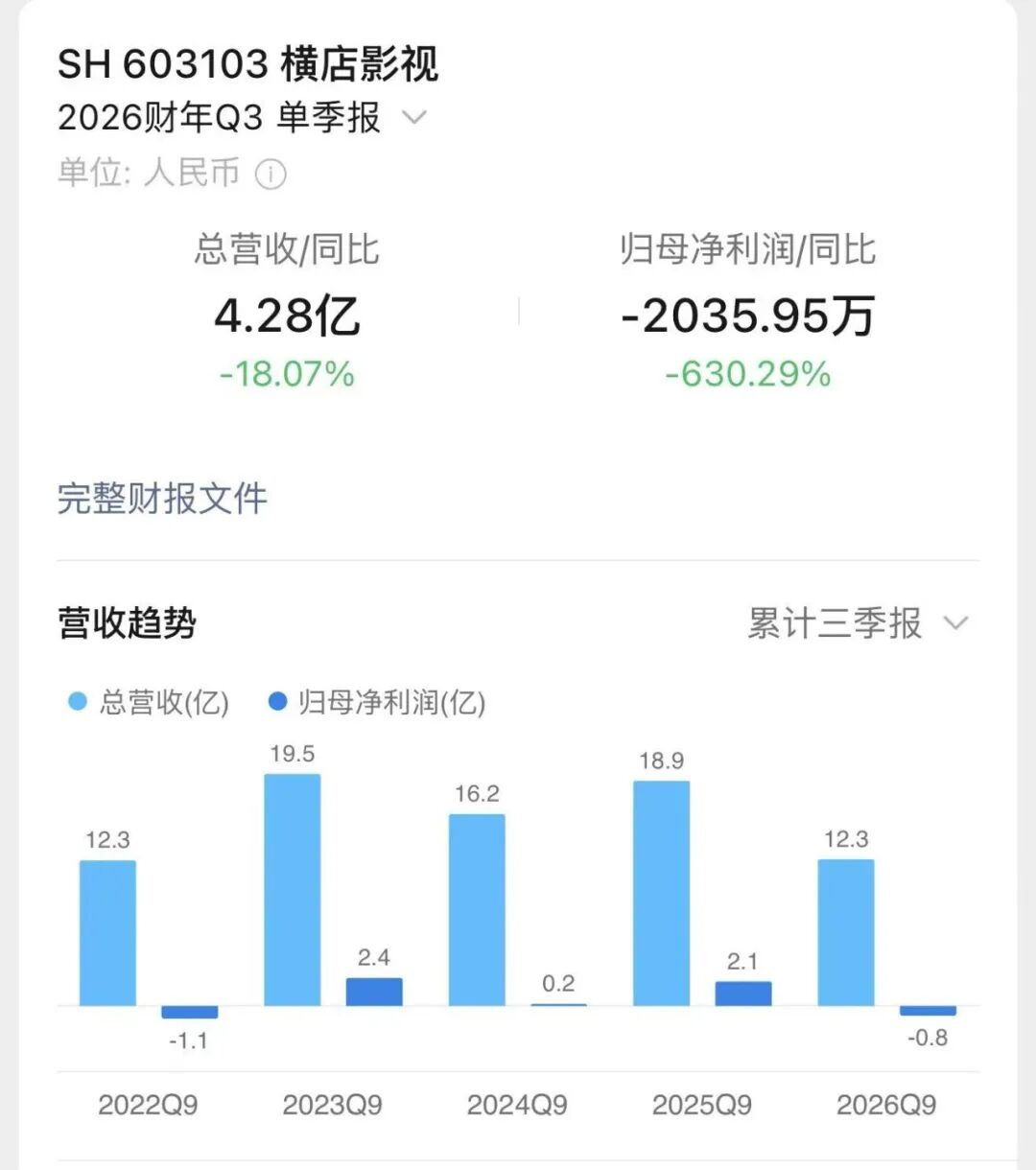
As a company in the traditional film and television industry chain, Hengdian Film and Television's core business in the past mainly focused on theater chain operation, film investment and distribution. In the first three quarters of 2026, the national film market was under overall pressure, and Hengdian Film and Television also faced the problem of limited growth space for its traditional business. Therefore, at present, according to the company's 2026 three-quarter report, Hengdian Film and Television is taking AI deeply empowering the full-link operation of IP as the main line, promoting IP content incubation, derivative development and commercial implementation.
On the content side, the company relies on AI to assist the pre-planning of original animated films, anime series and TV dramas; on the derivative side, it has promoted the full-process implementation of key IP cultural and creative products from R&D and design to sales; on the production capacity side, its subsidiary film and television production company has completed the construction of AI drama production system, has launched multiple AI short dramas, and reached an annual framework cooperation with leading platforms. AI is no longer just an independent content production project, but has begun to connect with the company's existing resources.
For example, a film and television company with mature IP reserves can produce animated short films, extra content and character stories through AI to extend the content life cycle of IP. In the past, some IP derivative content was difficult to launch due to factors such as production cost and cycle. Now AI has lowered part of the production threshold, which can theoretically give more small-volume content the opportunity to be developed. For traditional film and television companies, this is indeed a direction worth trying.
However, Hengdian Film and Television's financial report does not separately disclose the revenue scale of AI short dramas, nor does it give the profit contribution of this part of the business. We can confirm that it has established relevant production capacity, but we cannot directly draw the conclusion that AI business has become a new performance pillar of the company.
Take Gravity Media for another example. Different from Hengdian Film and Television which cuts in from IP assets and film and television production, Gravity Media's advantages come more from marketing, traffic operation and content distribution. The company's 2026 semi-annual report disclosed that it has formed a team covering AI creation tool R&D, short drama platform R&D, AI screenwriting, video content production, traffic delivery operation and content distribution, and initially formed the production and operation capability from script creation to omni-channel distribution.
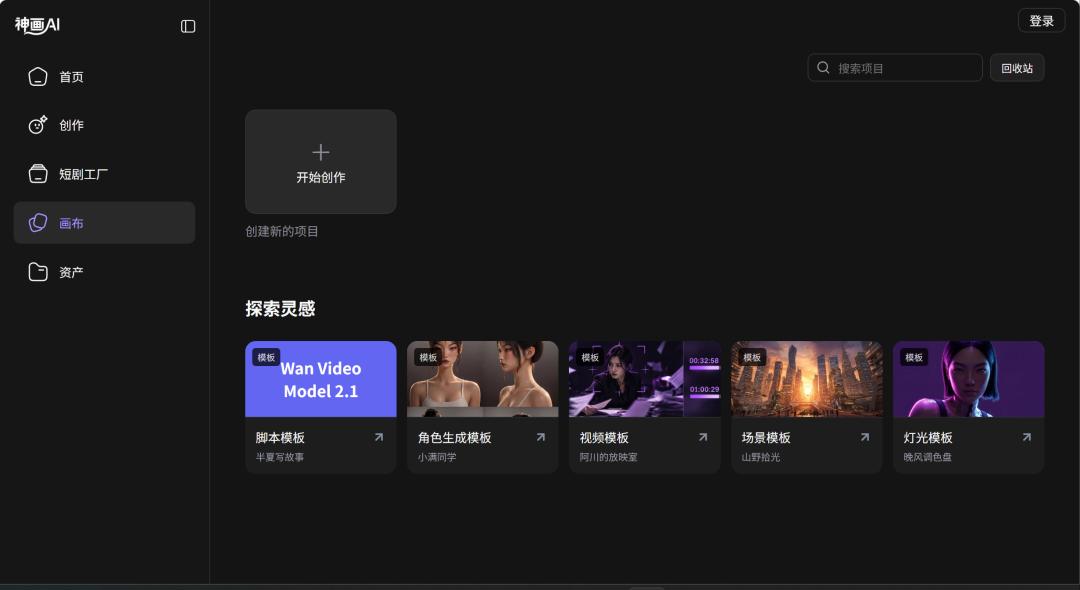
Among them, the self-developed AI short drama creation tool "Shenhua AI" was officially launched in the first half of 2026, which can realize functions such as script disassembly, material extraction, dubbing, image and video generation, finished film synthesis and export, and connect with many third-party text, image, video and audio large models. This leaves more business imagination space than simply purchasing AI tools and cooperating with external teams.
Correspondingly, the situation of Huace Film & Television is more special. As a leading content company in China's film and television industry, Huace Film & Television has a relatively mature film and television production system, copyright resources and content development capabilities. For such a company, the potential value of AI is not only the reduction of production cost, but more importantly, whether it can change the development method of content assets.
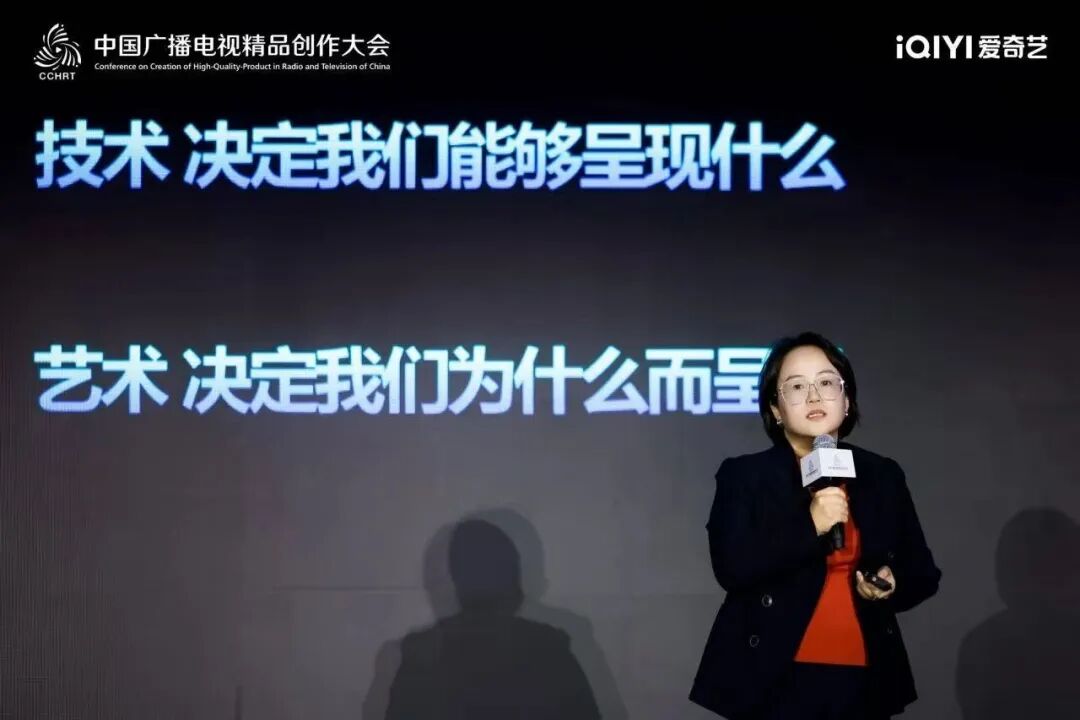
It should be noted that Huace Film & Television's 13.34% drop on November 17 does not mean that its AI business is in the same operating state as Wen Tou Holdings. The company has film and television content production capabilities, as well as technology application and business layout, but the market still needs more revenue and profit data that can directly correspond to the AI business.
The differences between these companies actually point to different positions in the AI film and television industry chain. Hengdian Film and Television has theater chains, IP and production resources, Gravity Media has marketing and distribution capabilities, Huace Film & Television has content development and copyright accumulation, and Wen Tou Holdings has carried out AI manhua drama production. Their paths to enter the AI track are different, and whether they can finally realize value cannot only depend on who has released more projects and whose technical terms are more fashionable.
This also explains why for the same AI film and television concept stock, the company's valuation logic should be different. For companies with mature production systems, we can see whether AI has improved the project turnover efficiency; for companies with IP reserves, we can see whether AI has brought new content development and licensing revenue; for companies with marketing channels, we can see whether AI content can be converted into new customers and delivery demands. For companies that have released works online, we need to further inquire about the production cost, copyright revenue, revenue sharing payment and gross profit margin of each single work.
AI film and television is not an industry where you can make money naturally as long as you have technology. Only when high-quality content, technical efficiency and commercial returns are truly connected, can AI change from a new term in the financial report to a new increment for the enterprise.
Story premium recedes, AI film and television begins to accept financial inspection
In the short drama market, the performance of the A-share market is not completely consistent with that of the overseas market. On November 17, US stock short