Jensen Huang is facing a class-action lawsuit, and the representing law firm states that hundreds of investors have already contacted it.
On the evening of November 23, the board of directors of NVIDIA (NASDAQ: NVDA) announced via official notice that Jensen Huang's positions as President, Chief Executive Officer and Director are restored with immediate effect, only 11 days after he resigned from all these posts on November 12.
After the news was released, NVIDIA's US stock once rose by more than 27% in pre-market trading, then opened higher, with the maximum intraday increase reaching 36.5%, and finally closed at $165.05, up 31.5%. Its intraday market value once reclaimed the $4 trillion mark.
While billions of internet users are indulging in the "feel-good narrative" of Jensen Huang returning to NVIDIA, a shareholder class-action lawsuit is also placed in front of them. On November 8, NVIDIA's board of directors announced the launch of an independent investigation targeting Jensen Huang; after the US stock market closed on November 9, NVIDIA and Jensen Huang were sued by shareholders in a class action alleging that they had defrauded shareholders.
The plaintiff's law firm Rosen Law Firm (hereinafter referred to as Rosen Law Firm) exclusively responded to Time Finance that "hundreds of investors" have contacted the firm or signed representation agreements regarding this case, and more than one investor intends to file a motion for lead plaintiff. Rosen Law Firm also stated that the next step is to submit the motion for lead plaintiff before January 8, 2027.
Time Finance consulted Gao Sirui, a lawyer focusing on international financial law research, and Xiang Yuanfang, a lawyer at YK Law (Yingke US) in New York, on this case, and received relatively consistent judgments: the case will most likely be dismissed.
"Resignation and reinstatement do not equal his indirect admission of the securities fraud allegations; but it at least shows that this controversy has gone beyond the scope of personal life and has substantially affected NVIDIA's corporate governance and the stability of its top management," Gao Sirui said. "What really determines the outcome of this lawsuit is still whether the company made material misstatements before, whether the management had intentional fraud, and whether the investors' losses were caused by these acts."
What is the class action about? NVIDIA's four public responses are suspected of being misleading
Back to November 9. Five minutes after the US stock market closed, the above class action complaint was submitted to the U.S. District Court for the Northern District of California, with case number 5:26-cv-13448. The plaintiff is led by shareholder Mark Kistenmacher, and the class action period is from October 9, 2025 to November 8, 2026.
In the exclusive response to Time Finance from the above plaintiff's law firm, Rosen Law Firm stated that the complaint is based on two parts of materials: one is the U.S. Department of Commerce's investigation into Megaspeed, and the other is foreign media reports on chip transshipment. The plaintiff claims on this basis that NVIDIA was aware of the relevant risks when making relevant public statements.
Time Finance read the full text of the complaint published by Rosen Law Firm and found that its focus is not on Jensen Huang's personal affair itself, but on the four public responses from Jensen Huang and NVIDIA. Rosen Law Firm's response specified that the statements suspected of being misleading are concentrated in paragraphs 18, 19, 26, and 28 of the complaint, a total of four public responses.
The complaint points out that the first "misleading information" is in a statement by NVIDIA spokesperson John Rizzo: there is no evidence that the chips were "transshipped"; after verification by the compliance team, it was determined that Megaspeed is "wholly owned and operated by a company with its registered address and headquarters located outside China, with no Chinese shareholders"; after employees visited for inspection, "no evidence of transshipment was found".
The second and third pieces of "misleading information" also came from Rizzo. He explained Jensen Huang's appearance at a bar in Taipei as "the operation team receiving clients, and Jensen will come to introduce the market situation when he is free".
The fourth "misleading information" appeared in Jensen Huang's exclusive interview on October 30, 2026. In the interview, Jensen Huang said that NVIDIA's dealings with Megaspeed are normal and there is no abnormal relationship. "We have studied all their deployments of GPUs, counted every single one, and I think the U.S. government has done the same."
The plaintiff in the complaint believes that these four statements are inconsistent with the facts. The so-called "factual details" are also written in detail in paragraph 20 of the complaint.
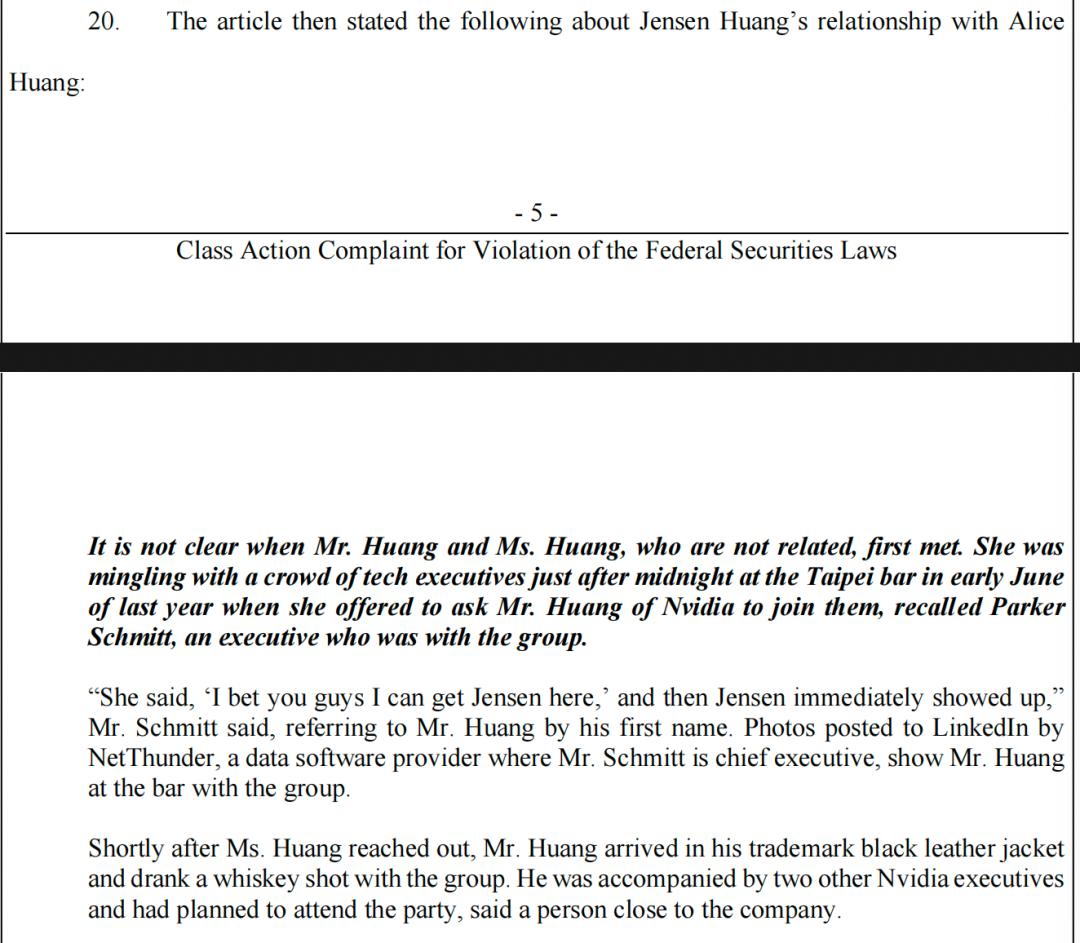
The unsigned original complaint published by Rosen Law Firm Source: Screenshot from Time Finance
Lawyers: Personal affair does not constitute disclosure obligation, lack of evidence of benefit transfer
Although the facts alleged in the complaint cite many public materials and information provided by insiders, in the eyes of the two interviewed lawyers, it is very difficult for this case to meet the requirements of actionable statement and materiality.
According to the U.S. Securities Exchange Act of 1934, the plaintiff needs to prove that the defendant made material misstatements or omitted material facts, and further meet the elements such as intent to defraud, investor reliance, and loss causation.
"At present, there is only a romantic relationship and no evidence of benefit transfer, so the probability of the case being dismissed is higher, and it is difficult to meet the subjective fraud and materiality thresholds of the PSLRA," lawyer Xiang Yuanfang told Time Finance.
"A pure personal relationship usually does not constitute securities fraud. What really brings this case into the scope of securities law review is the intersection between the professional identity of the woman involved and NVIDIA's business relations, and whether the relevant matters involve conflicts of interest, export control and national security risks," lawyer Gao Sirui reminded.
NVIDIA's GPUs are subject to U.S. export control and national security policies. If there are chip transshipment or export control risks in relevant transactions, it may affect investors' judgment on the company's future operations. According to Gao Sirui, what this case really needs to review is: whether NVIDIA's previous public statements on Megaspeed's business relations, chip transshipment and related compliance reviews are substantially inconsistent with the actual situation the company mastered at that time, thus misleading investors.
The announcement of Jensen Huang's reinstatement on November 23 specifically states that the board of directors "listened to the opinions of senior U.S. government officials" in the decision-making process, and is thus convinced that Jensen Huang's reinstatement "does not pose a national security risk".
"Materiality" is another threshold. The standard of the U.S. Supreme Court is: a piece of information is considered material only if there is a substantial likelihood that a reasonable investor would consider it significantly alter the total mix of information available to them. For this case, Gao Sirui believes that the plaintiff needs to prove that there is a correlation between the executive's personal behavior and the company's operational risks, and this relationship may lead to conflicts of interest, information leakage or affect the company's relationship with the U.S. government; it also needs to prove that the change in market price is indeed related to it.
"Although NVIDIA's stock price fell and Jensen Huang resigned as CEO after the incident, the plaintiff still needs to prove that there is a causal relationship between the stock price drop and the corrective disclosure, and exclude the impact of overall market fluctuations and other factors," Gao Sirui added.
NVIDIA has had a precedent of class action before, which has lasted for 8 years and is still under trial
"The plaintiff will obtain materials such as cooperation orders, emails, executive communications, and conflict of interest declarations. NVIDIA is facing the cost of responding to the lawsuit and the pressure of governance rectification," Xiang Yuanfang believes. "For Jensen Huang, civil litigation generally will not lead to the board of directors removing him directly. If there is no intentional fraud, the liability will be covered by insurance, and it is difficult to recover compensation from his personal property."
In fact, NVIDIA has had a precedent for this kind of case. Xiang Yuanfang told Time Finance that around 2018, NVIDIA also faced a class action lawsuit from investors, who alleged that NVIDIA counted a large number of GPU sales flowing to miners as "gaming business" revenue, and failed to fully disclose the risk of cryptocurrency demand fluctuation. This case was dismissed by the U.S. District Court for the Northern District of California in 2021, and the U.S. Court of Appeals for the Ninth Circuit overturned the dismissal ruling in 2023; on March 25, 2026, the court ruled to grant class action certification, and the case is still under trial, which has lasted for 8 years so far.
It is worth mentioning that this incident also forced NVIDIA to reach an administrative settlement with the U.S. Securities and Exchange Commission (SEC). The SEC found that NVIDIA failed to fully disclose the contribution of cryptocurrency mining to its gaming business revenue in its financial reports. In May 2022, the two parties reached a settlement, and NVIDIA paid $5.5 million.
Xiang Yuanfang also cited another case of an extramarital relationship between a CEO and a supplier's executive as an example, where the court directly dismissed the case on the grounds of "no transaction distortion". He said that in court rulings, personal affairs themselves do not constitute a disclosure obligation, but if it is confirmed that the public statements are inconsistent with the facts, the case may still go a long way.
This article is from the WeChat Official Account "Time Finance APP" (ID: tf-app), written by Zhao Shuchan and Bai Jinlei, edited by Bai Jinlei, and published by 36Kr with authorization.