The share of inference computing power has surpassed 70%, and the center of gravity of computing power demand is shifting from peak scenarios to long-tail scenarios.
In 2023, computing power demand was almost entirely oriented toward model training: the larger the model parameters and the more cards a cluster has, the more likely it is to take the lead in the capability competition, and the way to measure demand was to count how many ten-thousand-card clusters leading manufacturers planned to build. By 2026, this same approach no longer works. On one hand, some thousand-card-level intelligent computing centers in western China have a server deployment rate of less than 50%, and the actual utilization rate of deployed equipment is less than 30%, with annual operating costs exceeding 30 million yuan [12]; on the other hand, market estimates show that the daily average Token consumption of China's large models has risen from the 100-billion level in early 2024 to the 500-trillion level in June 2026, an increase of more than 5000 times in over two years [2]. Low-latency inference clusters in eastern cities are described as "Token factories" that require queuing for delivery [3]. Both are called computing power demand, but why is there idle capacity on one side and tight supply on the other? The difference does not lie in the total volume, but in the form of demand: training is a one-time, concentrated, clearly countable peak, while inference is scattered, continuous, and a long-tail demand that keeps repurchasing as call volume grows.
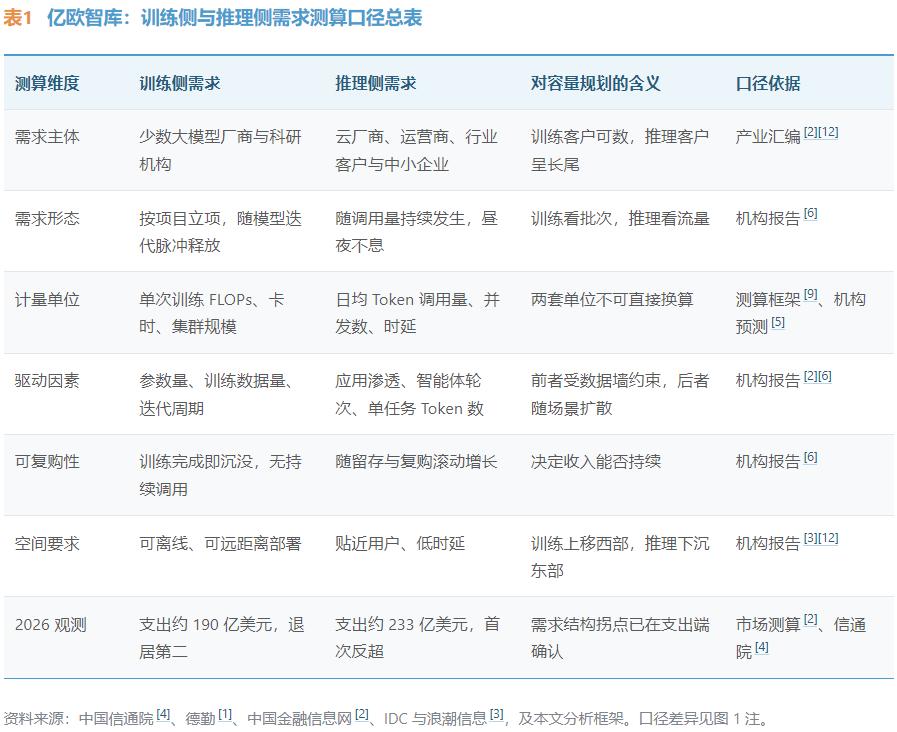
The dominance of AI computing power demand has shifted from the training side to the inference side. Training demand is measured by the one-time investment of clusters and is released in pulses as models iterate, while inference demand is measured by Token call volume and grows continuously as applications penetrate. Continuing to use the method of estimating demand based on the scale of training clusters will cause mismatches in three directions at the same time: regional layout, load form and capacity planning. Splitting demand into two categories: peak and long-tail, is the premise of re-measurement.
The two types of demand are not two consecutive segments on the same curve, but two types of quantities with different measurement methods. Training demand corresponds to fixed asset investment that can be calculated at one time, while inference demand corresponds to operating costs that roll over with business volume. The former determines the specification and power capacity of the cluster, and the latter determines the density and utilization rate of nodes. Using the ruler of the former to measure the latter is the root cause of measurement that leads to many intelligent computing centers being idle immediately after completion.
I. The structure of AI computing power demand has reversed, and the proportion of inference has exceeded training for the first time
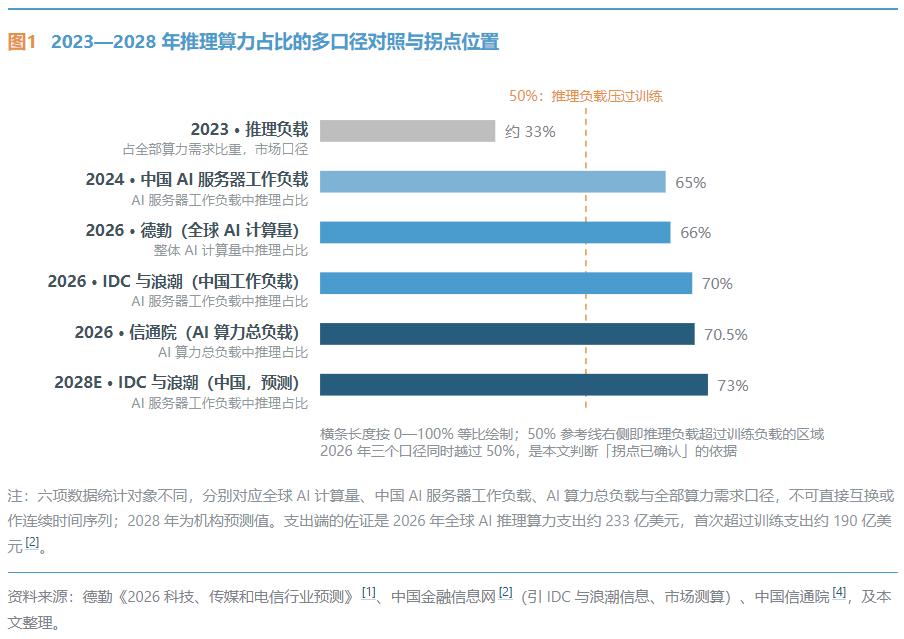
2026 has been confirmed as the inflection point of demand structure by multiple statistical calibers. Deloitte's *2026 Technology, Media and Telecommunications Industry Forecast* judges that the proportion of inference computing power in the overall AI computing has reached 66%, exceeding training for the first time [1]; IDC and Inspur's calculation of China's AI server workload shows that the proportion of inference has risen from 65% in 2024 to 70% in 2026, and will further rise to 73% in 2028 [2]; the *Token Economy Development Research Report* released by the China Academy of Information and Communications Technology (CAICT) shows that the proportion of inference computing power in the total AI computing load in 2026 is 70.5% [4]. The statistical objects of the three calibers are different, but they all point to the same direction: inference load has exceeded training load.
The change on the expenditure side is more direct. In 2026, global AI inference computing power expenditure is expected to be about 23.3 billion US dollars, exceeding large model training expenditure of about 19 billion US dollars for the first time [2]; the inference hardware market size reaches 2 to 3 times that of training hardware, and more than 40% of NVIDIA's revenue already comes from inference [2]. Statistics from TrendForce on the top five cloud computing manufacturers in North America show that the increase of AI inference computing power in 2026 is about 122%, and the growth rate is more than twice that of training computing power [7]. The shift of demand from "teaching models" to "using models" does not mean that model capabilities are no longer important, but that the investment in capability competition has shifted from one-time pre-training to post-training, test-time computing and large-scale service [9].
Putting 2023 and 2026 together makes the structural change clearer: in 2023, AI inference load only accounted for about one third of all computing power demand, and it rose to about two thirds in 2026 [2]. Experts from CAICT summarize this change as "training moving up, inference sinking", that is, training is concentrated in a few large clusters, and inference sinks to cities and edge nodes. Research institutions judge that the ratio of inference demand to training demand may reach 3:1 [6]. For infrastructure operators, the object of capacity planning has changed accordingly: in the past, the question to answer was "how many ten-thousand-card clusters to build", but now the question to answer is "how much continuous call volume to support".
II. Training computing power is bought out at one time by a few manufacturers, and the load returns to zero after iteration is completed
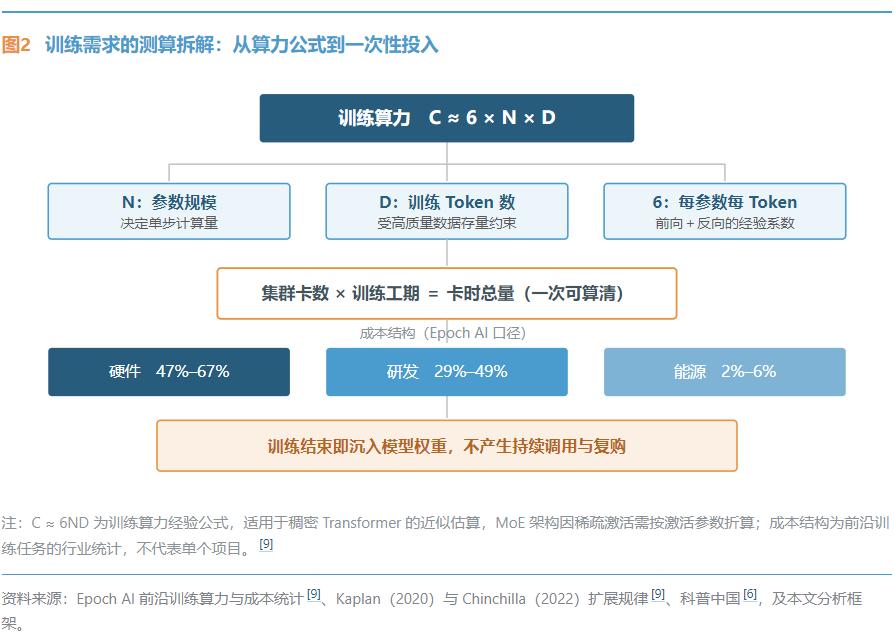
The measurement object of training demand is a single task, not continuous traffic. The classic measurement framework writes training computing power as C ≈ 6 × N × D, that is, each parameter and each training Token requires about 6 floating-point operations [9]; accordingly, the total computing power required for a cutting-edge training is jointly determined by the parameter scale N and the training data volume D, which translates to the number of cluster cards multiplied by the training period on the procurement side [9]. This is completely different from the measurement method of rolling by call volume on the inference side: the total volume can be calculated when the training task is initiated, and after the training is completed, the consumed computing power is integrated into the model weights and no longer generates subsequent calls [6].
DeepSeek V3 is one of the few cases that has disclosed complete training parameters: MoE architecture with 671 billion total parameters and 37 billion activated parameters, trained on 2048 H800 cards for 55 days, and the disclosed single training computing power cost is about 5.6 million US dollars [10]. This figure needs to be understood according to the statistical caliber, it does not include pre-research, ablation experiments and total hardware expenditure, and the hardware investment disclosed in the same period exceeds 500 million US dollars [10]. Statistics from Epoch AI show that cutting-edge training computing power has maintained an annual growth of about 4.1 times since 2010, with a doubling cycle of about five months, training costs have an annual growth of about 2.4 times, and single cutting-edge training expenditure is expected to cross 1 billion US dollars around 2027 [9]; in the cost structure, hardware accounts for 47%–67%, R&D personnel account for 29%–49%, and energy only accounts for 2%–6% [9].
Therefore, training demand presents two measurable characteristics. Concentration is reflected in the customer structure: the number of manufacturers and institutions that can afford cutting-edge training investment is limited, and individual demands can be listed one by one; pulse is reflected in the time distribution: demand is released in batches with the model iteration cycle, and there is almost no new load during the iteration gap. Planning capacity based on training demand requires separating "single peak value" and "annual total volume" — the peak value determines the cluster specification and power capacity, and the iteration rhythm determines the annual average utilization rate, the two cannot be replaced by one number.
III. Piling up computing power cannot bring proportional improvement, the data wall and capability convergence suppress training demand
The reason why the growth rate of training demand peaks is not insufficient investment, but the decline in marginal output of investment. A series of scaling law studies proposed in 2026 point out that the growth rate of high-quality text supply is lower than the growth rate of computing power input, the value of derivative Tokens generated by repetition and rewriting decreases, and continuing to increase pre-training computing power cannot buy proportional capability improvement [9]. Epoch AI estimates that the global stock of high-quality texts is about 300 trillion Tokens, and the boundary of available data falls between 2026 and 2032 according to different training intensities [9]. Data has become a non-expandable input, while parameters and computing power can still be expanded through capital. The gap between the two is the source of the ceiling of training demand.
Another signal is the convergence of model capabilities. In 2026, the score gap of multiple cutting-edge models on benchmarks such as SWE-bench Verified has narrowed to less than 1 point, and the results obtained by different architectures and different training budgets are close [9]; the empirical ratio of about 20 Tokens per parameter in the Chinchilla era has been greatly broken through, the average Token/parameter ratio of open-source models has risen from about 10 in 2022 to about 300 in 2025, and some small models have reached a ratio of tens of thousands to one through over-training. The industry has shifted its budget from "making models larger" to "making models cheaper to serve" [9]. IDC judges that the pre-training scenario is gradually converging, industry users will focus on post-training and inference scenarios, and the improvement of algorithm efficiency is also accelerating the transfer of computing power investment from the training side to the inference side [2].
Training demand will not disappear, but its growth pattern has changed. Cutting-edge training is still a high-unit-price investment for a few entities, and the scale of single projects continues to rise; what supports the total growth of computing power is no longer "more and larger-scale pre-training", but post-training, reinforcement learning, test-time computing and multi-modal expansion [9][2]. The implication for demand measurement is that the training side should be modeled according to "a few high-value peak tasks", not according to linearly extrapolated scale growth, otherwise the peak value will be misread as a trend, and the annual average load will be overestimated.
IV. Call volume has increased by more than 5000 times in two years, inference demand is changing from pulse to continuous load
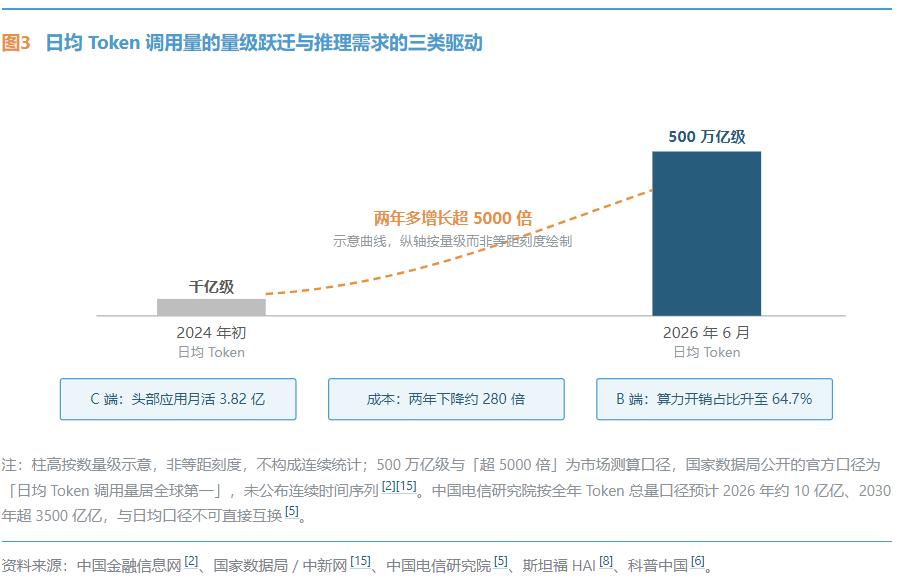
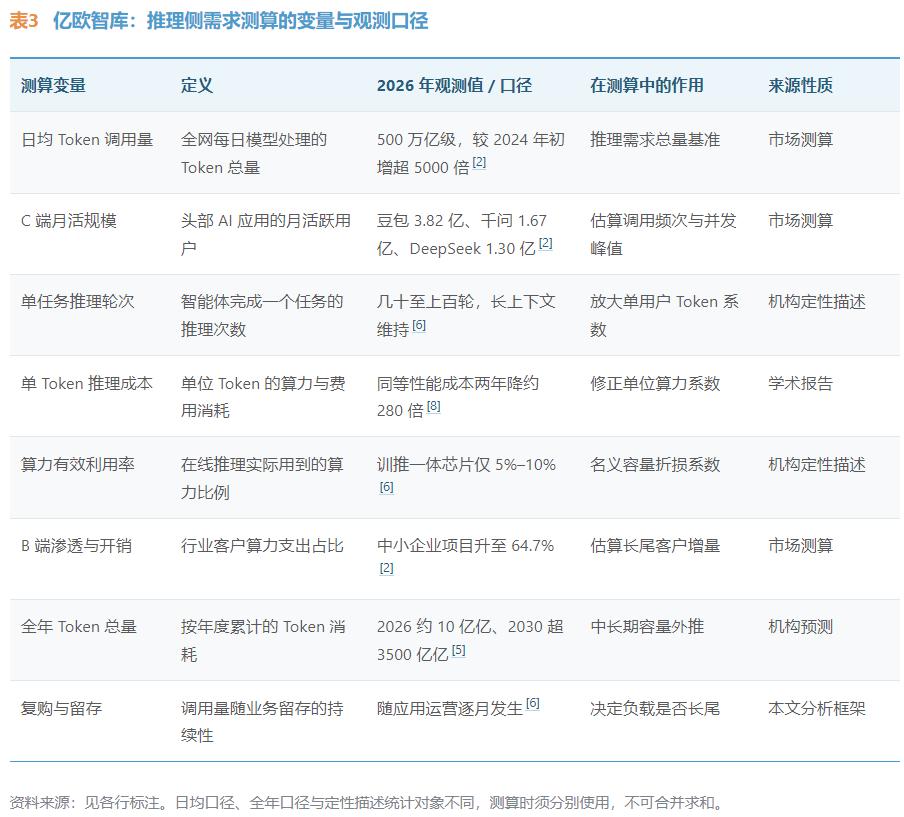
The starting point for measuring inference demand is call volume. Market estimates show that the daily average Token consumption of China's large models has risen from the 100-billion level in early 2024 to the 500-trillion level in June 2026, an increase of more than 5000 times in more than two years [2]; according to the caliber of the National Data Administration, the daily average Token call volume ranks first in the world [15]. The scale on the application side can explain this growth rate: in June 2026, the monthly active users of Doubao App are about 382 million, Qwen is about 167 million, and DeepSeek is about 130 million [2]. Different from training demand, these calls will not end with the acceptance of a certain project. As long as the application is in operation, the load will continue day and night [2][6].
Agents have amplified the Token consumption of a single task by another order of magnitude. The single consumption of traditional one-question-one-answer is limited, while agents need to plan independently, call tools repeatedly, and maintain long-context memory. One task may go through dozens or hundreds of rounds of inference [6]. The *AI Infrastructure Development Research Report in the Agent Era (2026)* from China Telecom Research Institute predicts that China's Token consumption will rise from the 10-quadrillion level in 2026 to over 3500 quadrillion in 2030, with a compound annual growth rate of nearly 12 times, and the computing power demand will grow by nearly 10 times on average every year in the next two to three years [5]; the same caliber also predicts that the inference computing power market will account for 80% in 2029 [7]. It should be noted that the above forecast adopts the annual total Token caliber, which cannot be directly converted with the daily average call volume caliber of market estimates, and the two are only used for mutual verification of trends [5][2].
The decline in cost is the other half reason for the surge in demand. Stanford's *2025 Artificial Intelligence Index Report* shows that the inference cost to achieve the same performance as GPT-3.5 has decreased by about 280 times in two years [8]; the decline in unit cost makes scenarios that were not feasible before become payable, and the penetration of the B-end accelerates accordingly. The proportion of computing power expenditure in small and medium-sized enterprises' AI projects has risen from 38% in 2024 to 64.7% in 2026 [2]. This also brings a new measurement difficulty: the growth of call volume and the decline of unit cost occur at the same time. Capacity planning cannot only look at the number of Tokens, but also the computing power consumption per Token, concurrent peak and latency constraints. At present, many online inferences still use training-inference integrated chips. These chips use expensive packaging and high-bandwidth memory to take into account high-precision computing and massive data throughput required for training, and the computing power utilization rate is often only 5%–10% in online inference with low latency, high concurrency and small batches [6]. There is obvious loss between the nominal computing power and the actual bearable call volume.
The long tail of inference demand has two meanings. One is the long tail of customers: demand spreads from leading internet companies to finance, manufacturing, government affairs, medical care and small and medium-sized enterprises [2][3]; the other is the long tail of time: revenue and use are repurchased month by month with retention, rather than released at one time with project initiation. The superposition of the two layers determines that inference side capacity pays more attention to node density and latency certainty, rather than single-point cluster scale [3][12].
V. Training and inference are diverted to different regions, and their locations are determined by latency requirements and industry distribution
The shift of demand structure has directly rewritten the regional division of labor. By the end of July 2026, the completed intelligent computing scale of the eight major hubs and three computing-power-electricity coordinated development zones has accounted for more than 85% of the national total, and 1.45 million PFLOPS of intelligent computing power has been incorporated into the national-level monitoring and scheduling platform [12]; the regional division of labor has taken shape, eastern hubs focus on low-latency inference and industry applications, while western hubs undertake large-scale training, data storage and offline analysis [3][12]. Ulanqab, Inner Mongolia, has signed 89 data center projects with a total agreed investment of over 500 billion yuan by June 2026, which is a typical sample of western hubs undertaking training demand [12].
The physical constraint of the division of labor is latency. Training tasks can be deployed offline and remotely, are not sensitive to network latency, and are suitable for layout in western regions with lower energy and land costs; online inference is close to users, and scenarios such as financial risk control,