After burning through 50 billion yuan, JD is still no match for Meituan and Alibaba.
Its spending efficiency lags far behind that of Meituan and Taobao Flash Delivery, which is the fundamental reason why JD is unable to compete against the other two players.
It is said that inside JD now, anyone who mentions the food delivery business in front of Richard Liu will be berated by him.
It is hard to verify whether the rumor is accurate, but at least two facts are confirmed.
One is that Guo Qing, the core operator of JD Food Delivery and head of JD's local life business, has confirmed his departure from the company.
The other is that the daily average order volume of JD Food Delivery now stays stable at 6.3 to 6.4 million, accounting for only 5% of the total order share of the three platforms (Meituan takes 73 million orders, Taobao Flash Delivery takes 48 million orders), which has fallen back to the level before the food delivery war broke out in early April last year.
A war that burned tens of billions of cash ended up with such a result, no one would feel good about it.
In this issue, we will talk about why Richard Liu launched this wrong war back then, and how JD withdrew from the food delivery war.
01
At the beginning of the story, let's pull our perspective back to the year before the food delivery war.
In August 2024, the national subsidy program was launched. The categories selected for the first-phase trade-in subsidy policy, commonly known as the "8+N" category, are mainly concentrated in home appliances and digital 3C fields such as refrigerators, washing machines, TVs and computers.
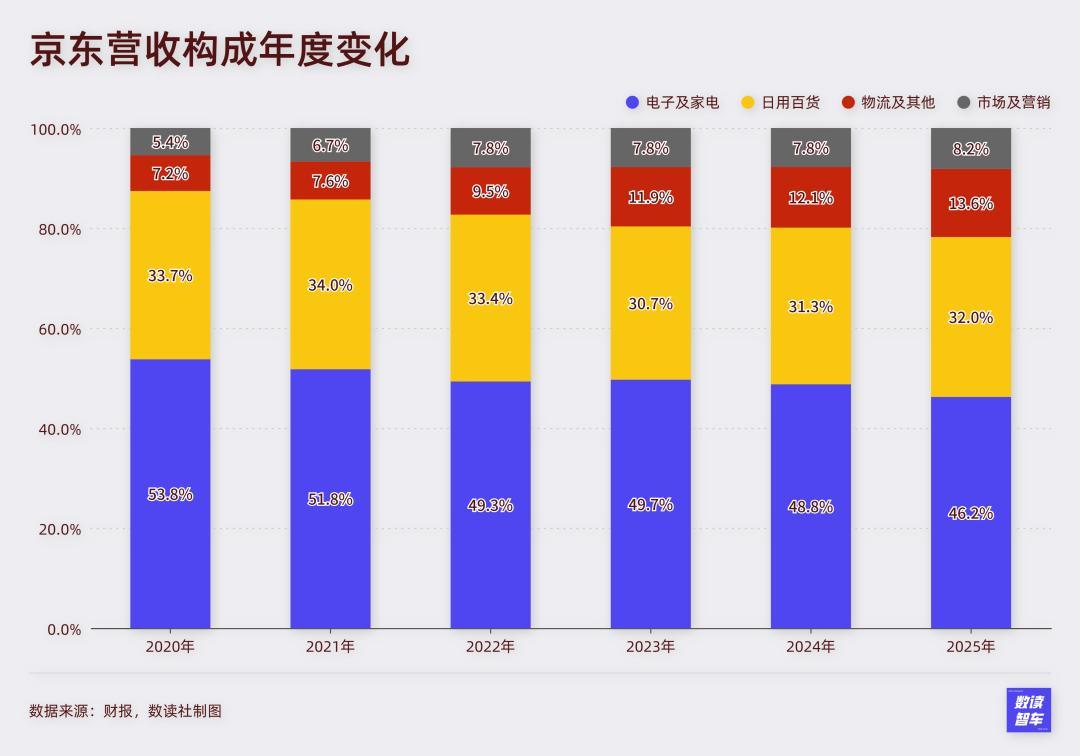
Home appliances and digital products are exactly JD's core business areas. Even though JD has been diversifying its revenue streams over the past few years, home appliances and electronics still account for more than 40% of the company's total revenue.
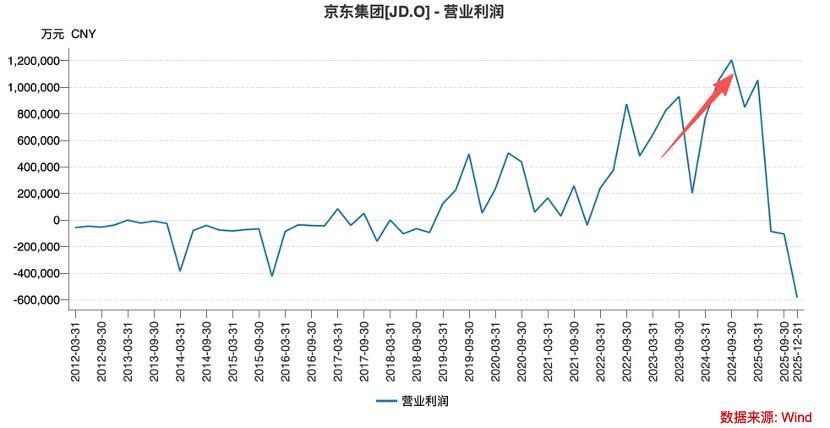
As a result, in 2024, JD hit an all-time high in both operating profit and revenue, especially with a sharp surge in profit in the second half of the year. The main reason is that the national subsidy launched in the second half of the year exactly matched Richard Liu's core business advantage.
Richard Liu is a very smart man. He knows that the best time for a company to pursue transformation is when its business is booming and revenue is growing rapidly. It will be too late to look for a second growth curve when the company is already running out of resources.
And food delivery is the second growth curve Richard Liu planned for JD.
As for why he chose food delivery instead of other categories? Because although JD does not lack capital, it lacks sufficient human resources.
The unit price of home appliances and digital products is very high, which supports considerable transaction volume and profit.
But JD is not a "highly popular" platform, and users will not think about opening it every day.
Looking at the financial report, the active user growth rate of JD was 30% in 2020, dropped to 20% in 2021, and fell to single digits in the first three quarters of 2022, which can be said to have fallen into stagnation. Since the fourth quarter of 2022, JD has no longer published this data indicator in its financial reports.
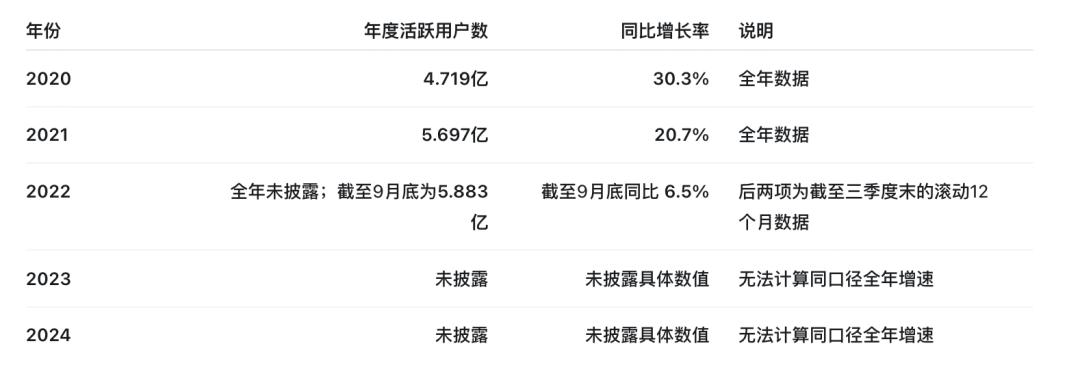
Just imagine, if this figure is decent and considerable, will a listed company choose to hide it?
So we can infer that by the fourth quarter of 2022, JD's user count may have stopped growing, or even turned negative.
Therefore, it is very necessary to increase user activity and expand the user base.
What kind of business can be used to achieve this goal? High-frequency businesses like food delivery are very suitable. Besides, JD already has Dada, which provides instant delivery services, whose business model is similar to food delivery, and its capabilities can be migrated to the new business.
Therefore, in February 2025, JD Food Delivery was officially launched as an independent entry, quickly rolled out in 39 cities, and fired the first shot of the food delivery war.
02
In the food delivery sector, many companies have tried to challenge Meituan, including Didi and Douyin, but all ended in failure. Meituan did not even take them seriously.
Because they attacked Meituan starting from the business itself. Meituan has deep roots, and those latecomer challengers could not pose a threat to it at all.
But Richard Liu was very clever. He started from public sentiment. Since the public has long been dissatisfied with Meituan, if he can mobilize public sentiment, he may be able to form an "anti-Meituan alliance".
Therefore, the first thing JD Food Delivery did after launch was not to offer subsidies, but to introduce three policies.
For merchants, it launched the "zero commission for the whole year" policy.
For riders, it promised to pay social insurance and housing fund for full-time riders.
For the market, it targeted to promote high-quality dine-in merchants.
The three policies correspond to three major pain points in the industry.
Is Meituan's commission too high? Should riders in flexible employment also be provided with social security? Is the food safety of Meituan guaranteed?
The answers to these questions cannot be covered in a single article. We only need to know that these disputes about public sentiment, labor relations and business legitimacy are the things that can really hurt Meituan.
As we all know, Richard Liu is always very energetic when talking about employee benefits, moral principles and social responsibilities. Public opinion warfare has always been his comfort zone.
Soon, a large-scale discussion about social security, rider rights and platform commissions was set off across the entire Internet. From February to April last year, JD obviously took the upper hand in public opinion. JD Food Delivery also gained far more public attention than its actual market size, and seemed to have become the third giant in China's food delivery market after Meituan and Ele.me (which had not changed its name at that time).
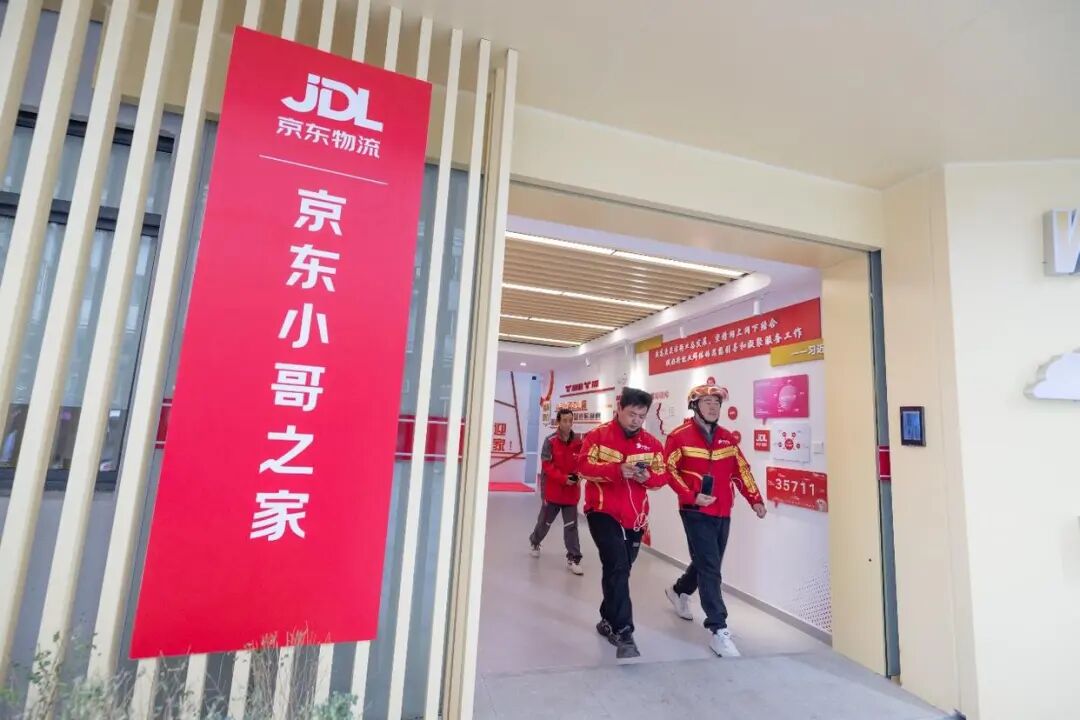
It should be noted that in fact, at this stage, JD's daily order volume was only around 1 million, and its total market order share was just over 1%, which was too small to even be a supporting role for the other two competitors.
In the first round of public opinion warfare, Richard Liu won.
03
After the initial victory, JD quickly launched the next round of actions.
In April 2025, JD officially announced tens of billions of subsidies for food delivery, with an estimated annual investment of 10 billion yuan.
Very soon, Cotti Coffee priced at 3.9 yuan, Guming priced at 4.8 yuan, Shuyi Herbal Jelly priced at 3.8 yuan, and Mixue Bingcheng with a final price of 1 yuan, these incredible low prices appeared on JD one after another.
With the support of subsidy red envelopes, the order volume of JD Food Delivery began to soar. After the 10 billion yuan subsidy was officially announced on April 10, by April 22, the daily order volume of JD Food Delivery skyrocketed from more than 1 million to 10 million. In just over a week, its total market order share increased from 1% to more than 10%.
This was absolutely the most glorious moment for JD Food Delivery. In those days, people in my WeChat Moments posted screenshots every day showing that they had bought cheap milk tea on JD, which almost became a national carnival. JD also moved forward triumphantly, expanding its covered cities from the initial 39 to 166 in one go.
At this time, the major players in the industry finally could not sit still.
It should be noted that before this round of food delivery war, the pattern of the entire food delivery industry had basically stabilized. Meituan occupied about 70% of the market share, and Ele.me under Alibaba took more than 20%.
As the core business of local life services, Ele.me has a high strategic status within Alibaba.
The sudden rise and rapid expansion of JD directly triggered Alibaba's sense of crisis, and the entire company quickly entered a combat state.
Alibaba took out its trump card as soon as it made a move, directly setting up a food delivery entry on the homepage of Taobao APP called Taobao Flash Delivery, which was synchronized with Ele.me. It also issued tens of billions of subsidies to fight head-to-head with JD. Then Taobao joined hands with Ele.me, distributing 100 million cups of milk tea and coffee to consumers almost "for free" by providing 18-yuan coupons.
With the super APP Taobao as the traffic entry and the support of Alibaba's strong capital strength, Taobao Flash Delivery only took 3 days to reach 10 million daily orders from zero, which was a quarter of the time JD took. Then after about 20 more days, the daily order volume of Taobao Flash Delivery rushed to 40 million, which was close to Meituan's daily order volume before the food delivery war.
Seeing that Taobao Flash Delivery achieved explosive growth in just one month, Meituan also could not sit still. Wang Xing directly announced that "all necessary measures will be taken to win the competition", declaring that Meituan joined the war, and the food delivery war broke out in full scale.
By June, Taobao Flash Delivery announced a 50 billion yuan subsidy plan for the next year. In July, Taobao Flash Delivery successively launched "Saturday Peak Day" campaigns, using concentrated large subsidies to increase order volume, and hit a record high of 80 million orders in a single day. Meituan followed up and fought back at the same time, hitting an astonishing daily volume of 150 million food delivery orders.
At this stage of the commercial war, JD was already struggling to cope.
On June 1, the daily order volume of JD Food Delivery exceeded 25 million. After that, no higher figures appeared in JD's public relations reports or various third-party surveys.
25 million orders, less than 15% of the order share, that was JD's limit.
In April and May, JD's public statements were still full of pride, with a tone of wanting to rectify China's food delivery market. But by June, such tone disappeared. Instead, Richard Liu began to explain to the outside world that the essence of JD's food delivery business is to develop its supply chain capability.
Later, JD began to weaken the catering food delivery business, shifted its focus to 7Fresh and JD Supermarket, and no longer participated in large-scale subsidies for a wide range of categories. In July and August, when Alibaba and Meituan were fighting the most fiercely, JD had already left the game.
Guo Qing, the food delivery operator we mentioned at the beginning, could only soften his attitude to the media, saying that JD's food delivery business should be measured in cycles of at least 5 or 10 years, and it would not fight for short-term gains, nor use subsidies to boost order volume to create market bubbles, and would not fall into the "order volume trap".
In short, JD had no more chips left.
What is more ironic is that when the food delivery war was at its hottest, Wang Puzhong, the operator of Meituan Food Delivery, also accepted an interview with the media. The reporter asked: Do you pay attention to JD now? Wang Puzhong directly replied: No.
04
So where did JD lose? Is it just because it could not compete in subsidies?
That is only one of the reasons. The bigger reason is that JD thought it was fully prepared for the food delivery war, but in fact, it was not prepared at all.
Food delivery is a three-party chain, consisting of merchants, riders and users, none of which can be missing.
User order volume can be quickly boosted by subsidies, but the supply of merchants and the rider team cannot be built in a short period of time.
Before the war, JD thought that with Dada's riders, it could smoothly transition to the food delivery business.
But after the war started, it found that Dada's transportation capacity was not enough. Dada's average daily delivery volume was only more than 3 million orders. When the order volume surged to 10 million or even 20 million, JD's transportation capacity could not keep up. It could only pay a high price, 5 to 10 yuan more per order, to attract riders who originally worked for Meituan and Ele.me.
Similarly, the merchant side was also a part that JD could not handle well.
Although before the war, JD Food Delivery had accumulated a number of "high-quality dine-in food delivery" merchants, mainly large chain brands, those small individual merchants could only be negotiated and settled one by one. In order to attract more food delivery merchants to settle in, JD could only offer more favorable policies.
For example, for a certain red envelope subsidy, other platforms usually pay half of the subsidy and the merchants pay the other half, but for the same red envelope on JD, the platform has to pay 80% of the subsidy, and the merchants only need to pay 20%.
In one sentence, other players can get the effect of 80 billion yuan by spending 50 billion yuan, but JD can only get the effect of 8 billion yuan by spending 10 billion yuan.
Its spending efficiency lags far behind that of Meituan and Taobao Flash Delivery, which is the fundamental reason why JD is unable to compete against the other two players.
Meituan and Taobao Flash Delivery have been operating for many years, and their operation capabilities are very mature. They know exactly how to set subsidy amounts for merchants in different time periods, different cities, different regions and different categories to maximize order volume and sales, and how to allocate riders, distribute incentives and do a good job in management.
These capabilities cannot be obtained simply by burning money, but they determine the success or failure of the war.
05
In my opinion, Richard Liu is undoubtedly a very charismatic manager and an excellent entrepreneur.