Short dramas have become the "life-saving straw" for major tech giants amid the decline in their Q3 financial performance.
In the third quarter of 2026, if you conduct a word frequency statistics on the performance meeting speeches of major tech giants, "short drama" will most likely rank in the top three.
Ding Lei of NetEase stated at the performance meeting that the "explosive development" of short dramas has diverted users' attention from games; Tencent's management called the short drama entry on WeChat a "breakthrough success", noting that it has "started to contribute significantly to advertising revenue"; for Kuaishou, short dramas are not only "one of the rare bright spots" in its financial report, but also a "cost item" that drags down gross profit margin.
On the night of the earnings call, NetEase's US stocks closed down by more than 11%. The next day, its Hong Kong stocks plunged by more than 19% at one point during intraday trading, and closed down sharply by 17.6%. Bilibili was the most inconsistent with this narrative. When Chen Rui was asked about the erosion caused by short dramas, he simply answered that there was no such impact, and its Hong Kong stocks directly opened more than 14% higher the next day.
The same word plays completely opposite roles in the narratives of different companies.
If short dramas are really so profitable, those companies engaged in short drama business should have made a fortune, right?
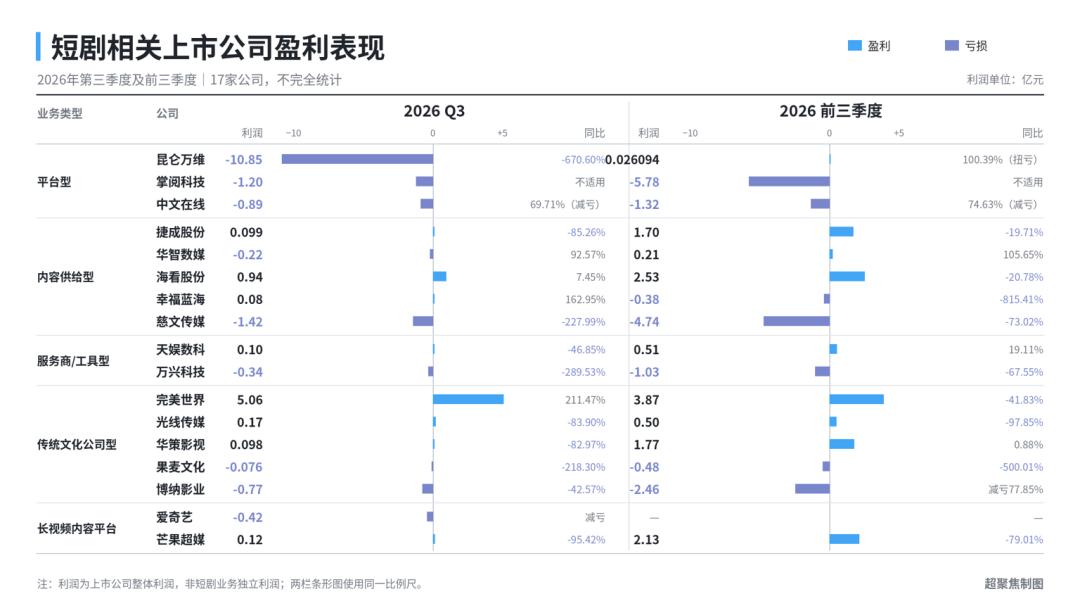
According to incomplete statistics from Super Focus on the profitability of listed companies with short drama business in the first three quarters, in this quarter, almost all companies barely broke even, except for Perfect World which made huge profits and Kunlun Tech which suffered huge losses.
According to statistics from DataEye Drama Check, the overall short drama market size in 2026 is expected to exceed 120 billion yuan, 98.7% of the projects cannot recover their costs within half a year. Taking 50 million views as the reference line for cost recovery, the hit rate of popular works is less than 0.1%, and the ROI of small and medium teams is generally lower than 0.8. Among domestic short drama traffic investment enterprises, ByteDance's Douyin Marketing Platform accounts for about 73% of the market share, Tencent Advertising accounts for 17%, and Kuaishou accounts for 8%. Short drama companies are fiercely competing, and the traffic investment budgets they have finally squeezed out eventually flow to the platforms that own the traffic pools.
Tencent's "Green Bubble Short Drama" has indeed driven incremental advertising revenue, but a UBS report also points out that the profit margin of this part of incremental advertising has been diluted by short-term traffic acquisition costs and ecological investment. Short dramas bring advertising revenue to platforms, but platforms also have to continuously pay traffic costs in order to keep users staying in the short drama scenario. They do make money, but it is not that easy.
Games and long videos have been robbed of user time, advertising platforms have eaten up the budget for short drama traffic investment, and they themselves have entered the short drama business personally, actively keeping users in their own closed traffic loop. The relationship between major tech giants and short dramas is far more complicated than "having their time taken away by short dramas". They are victims, beneficiaries and suppliers of short dramas at the same time.
In this sense, short drama is actually a walled city: people inside want to get out, and people outside want to get in.
Short drama has become the "universal scapegoat" in the financial reports of major tech giants
Recently, due to its extremely high discussion volume, Hongguo Short Drama launched a self-enabled "time lock" function. Users can set the daily usage duration, which is equivalent to setting a "parent mode" for children or an "anti-addiction mode" for their parents. Now there is no need to worry that the whole family will stay up late to binge-watch short dramas.
It is logically reasonable for Ding Lei to shift the blame to short dramas: users only have a limited amount of fragmented time, and if they spend time on Hongguo Short Drama, they will play one less round of *Justice Online*.
Financial reports show that NetEase's net revenue in the third quarter was 27.9 billion yuan, down 1.8% year-on-year, and game revenue was 22.9 billion yuan, down 1.7% year-on-year, which was the first negative growth since the third quarter of 2024.
However, NetEase's own financial report also shows that deferred revenue was lower than expected, the performance of its main products in the summer vacation was mediocre, and its next core new product *Infinity* will not be launched until January 2027. The diversion effect of short dramas is an external variable, while the product pipeline gap is an internal rhythm issue. When these two things happen at the same time, only picking one to talk about is more or less "picking soft persimmons to pinch".
The situation on Tencent's side is mixed. Short dramas on WeChat are indeed contributing to incremental advertising revenue. Without them, the advertising growth rate would be even slower in the context of weak consumption. However, UBS's research report reveals the other side: the profit margin of incremental advertising brought by short dramas has been "diluted by short-term traffic acquisition costs and ecological investment".
Short drama advertising revenue has come in, but in order to nurture the short drama ecosystem, Tencent has to give benefits to content providers, which makes its gross profit margin thinner. The gross profit margin of marketing services has dropped from 57% to 52%. Short dramas are not only an incremental source of advertising revenue, but also a deduction item for gross profit margin. When a business appears in both the "growth bright spot" and "profit drag" sections, it is no longer a pure business, but has become a narrative tool.
Kuaishou's situation provides an observation window. In the third quarter, Kuaishou's DAU hit a record high of 417.3 million, and MAU reached 818.5 million, also a new high. However, in the same financial report, the average daily usage time per user decreased year-on-year, and the average online marketing revenue per DAU dropped from 48.3 yuan to 42.8 yuan. This is the first time that the three indicators of rising monthly active users, declining usage duration, and declining advertising revenue per user have shown such a deviating trend.
Kuaishou itself also admitted at the performance meeting that a considerable part of the audience attracted by short drama content are "low-frequency viewers" who "can come in but are difficult to retain". At the same time, the revenue sharing cost of short drama advertising is eating into the gross profit margin, and Daiwa Securities estimates that its operating profit margin fell by 17 percentage points year-on-year to -2.0%. Short dramas bring in traffic, but the traffic they bring in is not very valuable, and the cost to acquire it is not low.
iQiyi's membership service revenue in the third quarter was 3.97 billion yuan, down 6% year-on-year, returning to the level around the fourth quarter of 2020; Mango Excellent Media's attributable net profit in the third quarter was 11.55 million yuan, down by more than 95% year-on-year. Although the DAU of the short drama channel has doubled, the advertising revenue of AI short dramas is only a tiny part of the overall market.
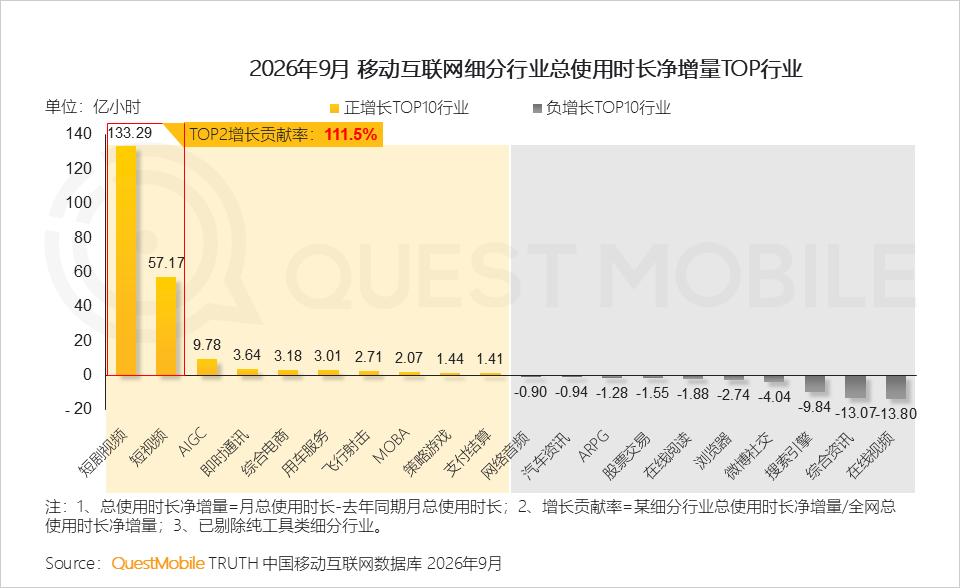
Data from QuestMobile clearly shows the structural change: in September 2026, the total usage duration of short drama videos increased by 13.329 billion hours, while the total duration of online videos decreased by 1.38 billion hours in the same period. Users' attention is indeed shifting from traditional long videos to short dramas.
Attributing the weakness of long videos to "short dramas taking away users' time" is very smooth in narrative, because it simplifies the competition about content supply efficiency into a war about content duration. But the problems of long videos did not start from the day when short dramas appeared.
Users' habit of watching dramas at double speed, the loss of patience caused by bloated drama plots, and the passivation of payment willingness caused by shrinking membership rights, these structural problems have been brewing long before the rise of short dramas.
Short dramas only provide a cheaper, faster and more straightforward alternative, giving those marginal users who were already on the verge of leaving a reason to quit. Attributing the decline to short dramas is equivalent to rewriting a long-accumulated content efficiency problem as an external category impact.
Rather than saying that short dramas are "snatching" the jobs of long video platforms, it is better to say that they are redefining the "table for making a living". If you don't join the short drama camp now, you won't be given spicy sticks and potato chips later, no one will leave you instant noodle soup, no one will wake you up for early classes, and you will have to go to the toilet alone after class.
The danger of the "short drama diversion" explanation is that it easily covers up what major tech giants are reluctant to elaborate: NetEase's product pipeline gap, the squeeze on profits caused by Tencent's AI capital expenditure and ecological subsidies, Kuaishou's pressure on its core e-commerce advertising business, and so on.
It is true that short drama is a real variable in the ecosystem of major tech giants, but it is also being used as a convenient "unified caliber" to shirk responsibilities.
Bring in DAU, drive down ARPU
So what exactly do short dramas bring to major tech giants? If we only look at the level of "diverting duration", the conclusion seems that all giants are suffering losses, but these views obviously only stay at the level of "who is taking whose time".
The significance of short dramas for large internet companies needs to be viewed from three roles, and there is a hard-to-reconcile contradiction between these three roles.
The first role is a traffic black hole. Short dramas, especially the free IAA mode represented by Hongguo Short Drama, are essentially machines that devour users' fragmented time at extremely low cost.
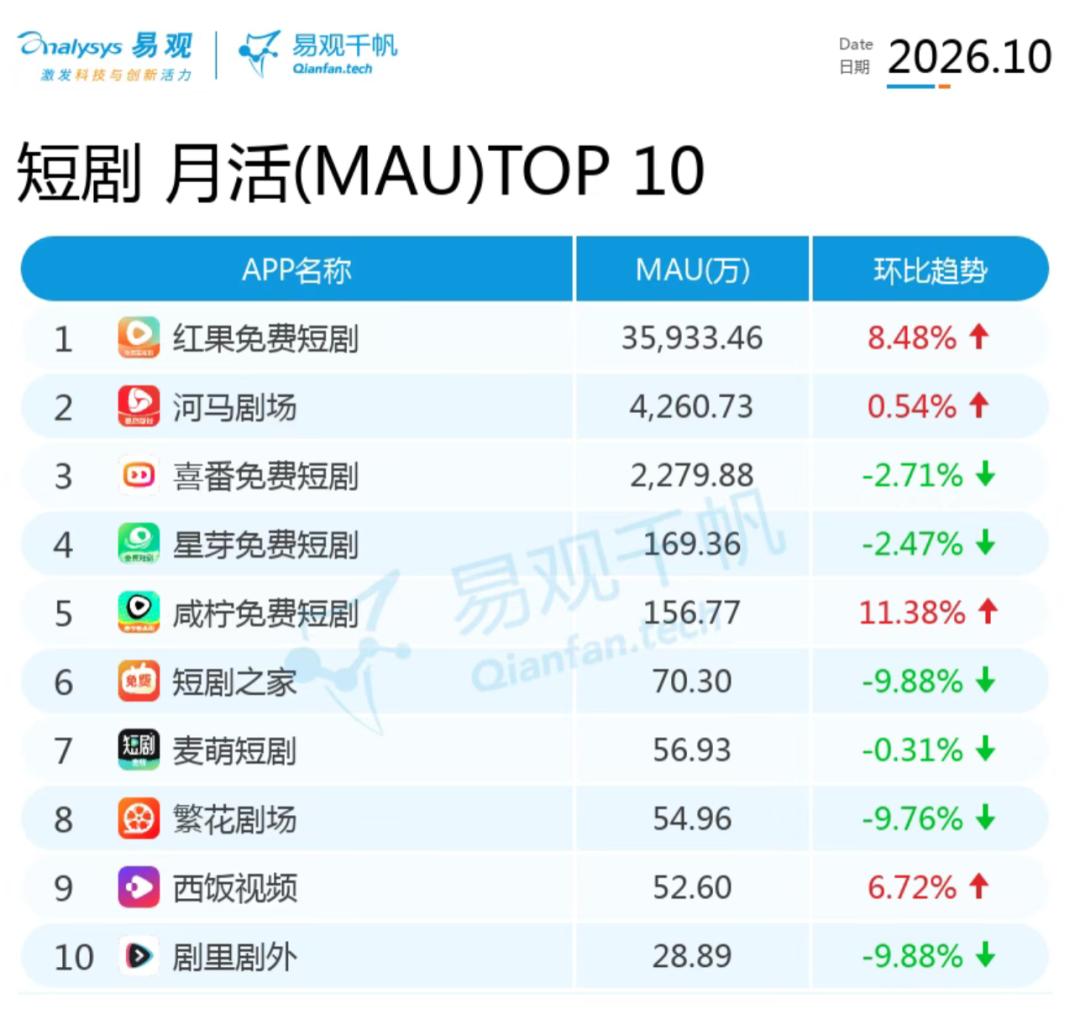
Data from Analysys Qianfan shows that in October 2026, the average daily usage duration per capita of independent short drama apps reached 113.04 minutes, with 4.96 launches per capita per day. The market structure is highly concentrated: Hongguo Short Drama had nearly 360 million monthly active users in October, Hippo Theater had 42.6 million, Xifan had about 22.8 million, and the remaining 43 apps all had less than 1 million monthly active users.
For any internet company that relies on user duration to realize monetization, the financial consequences of this level of attention shift are immeasurable. The pressure on NetEase's game revenue, the dilution of Kuaishou's main app usage duration, and the dual contraction of long video membership and advertising revenue are all downstream manifestations of this black hole effect.
It does not only devour the stock duration of major tech giants, but also creates new advertising inventory and new consumption scenarios. The question is who gets the pricing power of these new inventories.
The second role is a cost item rather than a profit item, which is the layer most easily covered by expressions like "short dramas contribute incremental revenue" in the Q3 financial reports.
Tencent's short drama advertising revenue is rising, but UBS clearly points out that the profit margin is diluted by traffic acquisition costs and ecological investment. The rising revenue sharing cost of Kuaishou's short drama advertising has directly dragged its operating profit margin into the negative range.
According to Daiwa Securities' research, "for every additional 1 yuan of short drama advertising revenue Kuaishou earns, it generates 1 yuan of sharing cost at the same time". This means that for the platform, the marginal profit margin of incremental short drama advertising revenue is far lower than that of traditional e-commerce advertising or brand advertising.
Hongguo's own actions in 2026 also confirm the same logic: it canceled the large-scale guaranteed revenue sharing for producers, and tightened the guaranteed amount for AI scripts. The core motivation is to "turn profits positive" and "the stage of subsidizing for scale is over". Even the biggest beneficiary in the short drama track is shifting from "burning money for DAU" to "calculating profits", and other major tech giants that use short dramas as an incremental growth story will hardly avoid this account.
The third role is a diluent of monetization efficiency, which is the most structural layer that is most easily skimmed over in earnings calls.
Kuaishou's data provides an observation window: MAU rose by 12%, DAU had almost zero growth, and advertising revenue per DAU dropped by more than 11%. The short dramas bring in "low-frequency viewers", who contribute to the monthly active user number, but do not contribute matching usage depth and advertising value.
Tencent's social network revenue decreased by 1% year-on-year, and the number of paid value-added service subscribers decreased by 5% year-on-year, indicating that the incremental advertising revenue brought by short dramas did not stop the contraction of the long video subscription base. In other words, short dramas are an antidote at the "quantity" level, but may be another kind of pressure at the "quality" level.
When users' time on the platform shifts from a 20-minute game and a 45-minute TV episode to a 90-second short drama, the advertising density and payment willingness that can be carried per unit time are most likely to decline. Short dramas create more "view counts", but the commercial value of each view is lower. When this shift reaches a certain scale, it will change from an "incremental growth story" to a "structural headwind".
Superimposing these three roles together, we can find that short drama is not a fictional "scapegoat". Its diversion effect is real, quantifiable, and has left clear traces in the financial reports of many companies.
However, when major tech giants choose to emphasize the "diversion" or "contribution" of short dramas at performance meetings, they are often choosing the most favorable narrative framework for themselves: it is easier for NetEase to attribute the decline of game revenue to external attention competition than to explain its product pipeline gap; it is more pleasant for Tencent to define short dramas as a "breakthrough success" of advertising than to elaborate on the dilution of gross profit margin caused by ecological subsidies; it is more decent for Kuaishou to put short dramas in both the "bright spot" and "cost" drawers than to admit that the main app usage duration is diluted and advertising revenue per DAU is declining.
Short drama is a real variable, but when the real variable is used as a shield, what it often obscures are those things that are more difficult to explain clearly in a 45-minute earnings call: product cycle, the return rhythm of capital expenditure, and a more simple question — when the user's entertainment unit is fragmented from "hours" to "seconds", how big an account does the internet business model that makes a living by user duration need to recalculate.
Short drama does not take the blame for this account, but it cannot escape from it either.
This article is from the WeChat official account "Super Focus foci", written by Fang Wensan, and published with authorization from 36Kr.