Guangzhou, which is said to have "fallen behind", still firmly maintains its position as a global first-tier city.
Over the years, whenever the ranking of China's first-tier cities is mentioned, Guangzhou is inevitably brought up for discussion.
Some people argue that Guangzhou's economic growth is slowing down, its emerging industries are less well-known than those of Shenzhen and Hangzhou, and the status of this veteran first-tier city seems to be increasingly awkward.
However, a newly released global city ranking shows a different side of Guangzhou to the public.
Recently, the Globalization and World Cities Research Network (GaWC) released its 2026 ranking of the world urban system. Among the 785 participating cities worldwide, Guangzhou ranks 24th, at the Alpha level, which is commonly known as the world first-tier city.
Other international metropolises at the same Alpha level as Guangzhou include Chicago, Amsterdam, Los Angeles, etc. A total of 6 cities in China are included in the Alpha series, namely Hong Kong, Beijing, Shanghai, Guangzhou, Taipei and Shenzhen.
If we extend the timeline, this achievement becomes even more remarkable.
In 2000, Guangzhou only ranked 109th on this list; it rose to 73rd in 2008, and entered the Alpha level for the first time in 2016. Today, Guangzhou has maintained its status as a world first-tier city for ten consecutive years, with its ranking rising by a total of 85 places compared with 2000.
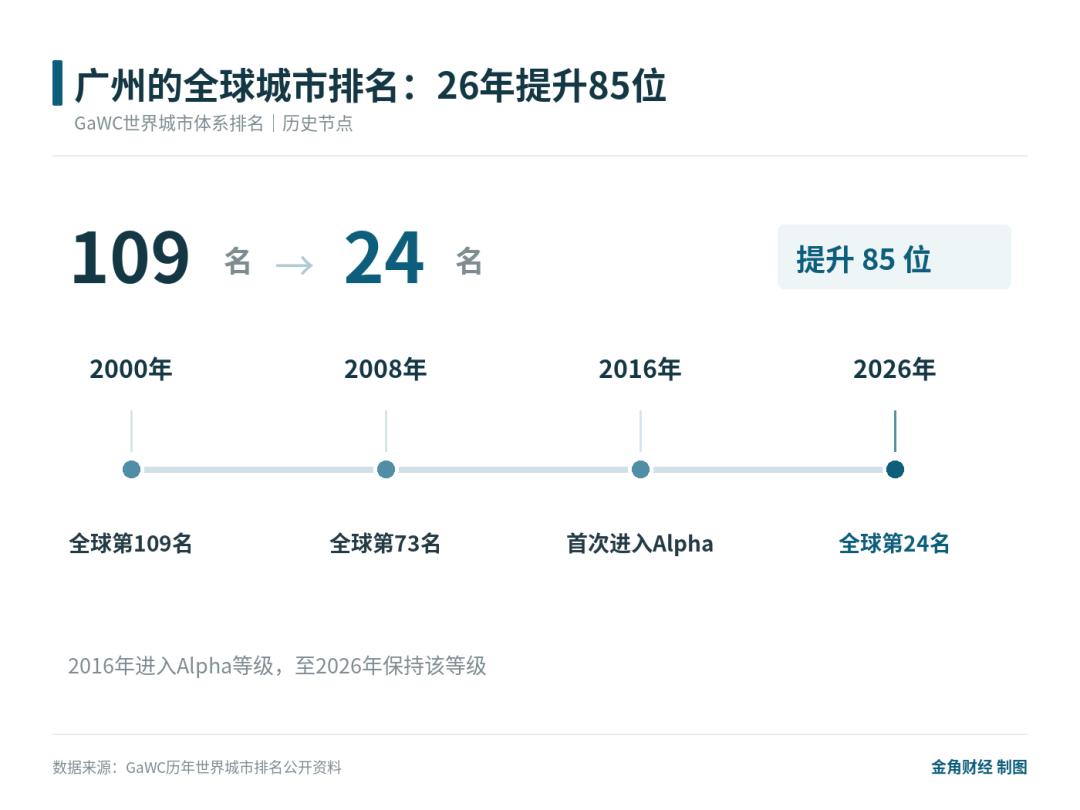
On one hand, the "Guangzhou falling behind" theory has emerged from time to time over the years, on the other hand, Guangzhou has long maintained its first-tier status in global city rankings.
How does this time-honored commercial city gain a firm foothold in global competition?
Behind this ranking lies an answer that is often overlooked.
Being a world first-tier city is not just about GDP
When talking about world first-tier cities, many people first think of GDP, skyscrapers, international airports, or the number of Fortune Global 500 headquarters located in the city.
But the GaWC ranking is not calculated in this way. Founded in 1998, this research institution mainly studies the position of cities in the global economic network.
The 2026 assessment covers 785 cities worldwide and 175 leading high-end producer service enterprises, involving industries such as finance, law, accounting, advertising, and management consulting.
Why these industries?
Imagine a Chinese enterprise preparing to do business in Europe: it needs banks to provide cross-border financial services, lawyers to handle local legal issues, and accountants and consulting firms to help cope with the commercial rules of different countries.
These professional service institutions often set up branches in major global cities, thus forming a huge commercial network connecting all cities.
What GaWC studies is the position of a city in this network and how closely it is connected with other cities.
Therefore, this is neither a GDP ranking nor a livable city ranking. The international finance, legal, accounting and consulting services that are not easily noticed by ordinary people are the focus of the assessment.
Guangzhou has decades of accumulation in this regard.
From the foreign trade port in history, to the Canton Fair and specialized wholesale markets after the reform and opening up, and then to the trade network formed by relying on the manufacturing industry in the Pearl River Delta, Guangzhou has always been an important gateway for China's foreign business.
Enterprises come here to find orders and negotiate cooperation, which naturally generates huge demand for cross-border finance, foreign-related legal affairs, audit consulting and international logistics. These industries are not as conspicuous as automobile factories and skyscrapers, but they are essential supporting facilities for cross-border business.
In 2025, the added value of producer services in Guangzhou accounted for 59% of the tertiary industry, 5.9 percentage points higher than that at the end of the 13th Five-Year Plan period.
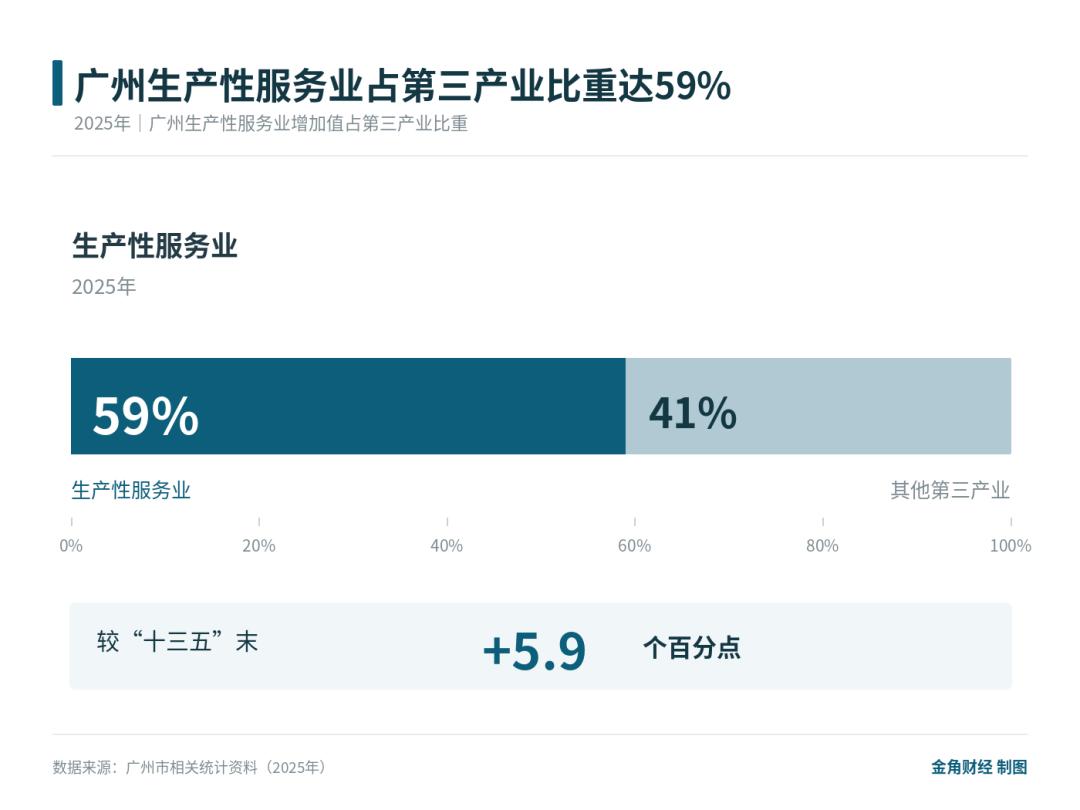
Although the scope of producer services is broader than the high-end services investigated by GaWC, this set of data still shows that Guangzhou's service industry is not only limited to the familiar catering, shopping and tourism sectors.
Providing services for enterprise production and operation itself is a huge business in Guangzhou.
Why do 350,000 global business people still come to Guangzhou?
Nowadays, cross-border e-commerce is so developed that overseas purchasers can contact Chinese factories, check products and complete orders while sitting in their offices.
However, every year during the Canton Fair, a large number of foreign business people still travel to Guangzhou specially.
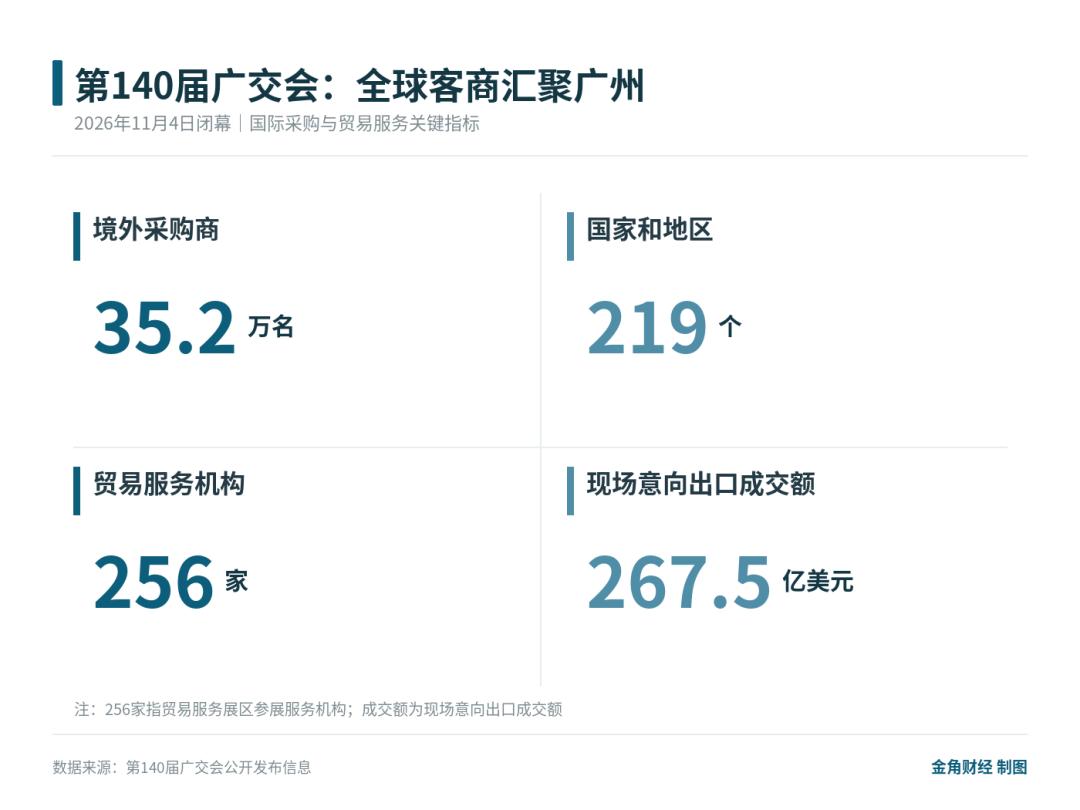
On November 4 this year, the 140th Canton Fair closed, with 352,000 overseas purchasers from 219 countries and regions attending the event, up 12.2% from the previous session, hitting a record high in the number of participants.
It should be noted that at the first Canton Fair in 1957, there were only more than 1,200 overseas purchasers, and the exhibition area was no more than 9,600 square meters.
Today, the exhibition area has expanded to 1.55 million square meters, with more than 32,000 participating enterprises. The on-site intended export turnover reached 26.75 billion US dollars.
Nearly 70 years have passed, why are purchasers from all over the world still willing to travel thousands of miles for this trip?
Because cross-border business is far more complicated than just checking products, comparing prices and placing orders online.
When purchasing mechanical equipment, you need to inspect the production capacity and after-sales service; when importing new energy vehicles, you need to understand local certification, parts supply and sales channels; when the order amount is large, a series of issues such as financing, settlement and contract performance will also be involved.
Especially for the first cooperation, purchasers often hope to see the products with their own eyes, negotiate terms face to face, and if possible, visit the factories in person.
The reason why Guangzhou can attract so many business people lies in the brand of the Canton Fair, as well as the huge manufacturing industry in the Pearl River Delta and the trade services accumulated over many years.
A new change at this year's Canton Fair is very representative.
For the first time, the trade service exhibition area covered all ten categories of producer services, with 256 resident service institutions, an increase of about 20% over the previous session.
From logistics warehousing, industrial design to cross-border investment and financing, overseas comprehensive services, and even foreign-related law firms providing contract and intellectual property consulting, all gathered here, attracting more than 130,000 visits.
Why are these professional institutions also willing to participate in the Canton Fair?
The more complex cross-border transactions are, the more service demands generated around the transactions.
When a piece of equipment is sold overseas, it may also require installation and commissioning, operation training and after-sales maintenance; when a batch of goods enters a new market, enterprises may need to redesign packaging, apply for certification, and arrange warehousing and logistics.
At this year's Canton Fair, 36.5% of participating enterprises have provided "product + service" solutions, extending their profit scope from simply selling goods to back-end delivery and maintenance. This not only broadens the profit space of manufacturing enterprises, but also opens up an incremental market for financial, legal, logistics and consulting institutions.
An exhibition not only matches commodity orders, but also realizes precise docking of professional services.
Guangzhou's advantages go far beyond the exhibition hall.
The Pearl River Delta has a developed manufacturing industry, so business people can continue to inspect surrounding factories after visiting the exhibition; Baiyun International Airport connects cities at home and abroad, and Guangzhou Port undertakes a large amount of international cargo transportation.
In the first three quarters of 2026, the passenger throughput of Baiyun International Airport reached 67.09 million person-times, a year-on-year increase of 9.8%; in the same period, the container throughput of Guangzhou Port reached 21.5669 million TEUs, a year-on-year increase of 4%.
When purchasers come to Guangzhou, they can find corresponding services for the whole process from finding suppliers, visiting factories, negotiating cooperation, to subsequent financing, settlement and transportation in Guangzhou and its surrounding areas.
Of course, the number of Canton Fair business people is not a direct evaluation indicator of the GaWC ranking, but the continuously active international trade continuously nourishes the growth of local financial, legal, accounting and consulting institutions, firmly anchoring Guangzhou in the global commercial network.
The exhibition is only held twice a year, but business does not end when the exhibition hall closes. Some business people come to Guangzhou once a year, some enterprises set up purchasing institutions here, and more orders, cooperation and service demands extend beyond the exhibition.
This is the real foundation that Guangzhou has accumulated over decades of international trade.
Guangzhou's next global business
However, today's global urban competition is no longer just about competing for commodities and orders.
From Dubai, Riyadh to Shenzhen, more and more cities are striving to compete for multinational enterprise headquarters, R&D centers, international capital and scientific and technological talents. If Guangzhou wants to continue to gain a firm foothold in this new competition, it must launch more products and technologies with core competitiveness.
In the first three quarters of 2026, Guangzhou's GDP reached 2.4851 trillion yuan, up 5.7% year on year. Among them, the output of new energy vehicles increased by 54.6%, the added value of the integrated circuit manufacturing industry increased by 64.8%, and the investment in high-tech manufacturing increased by 31.5%.
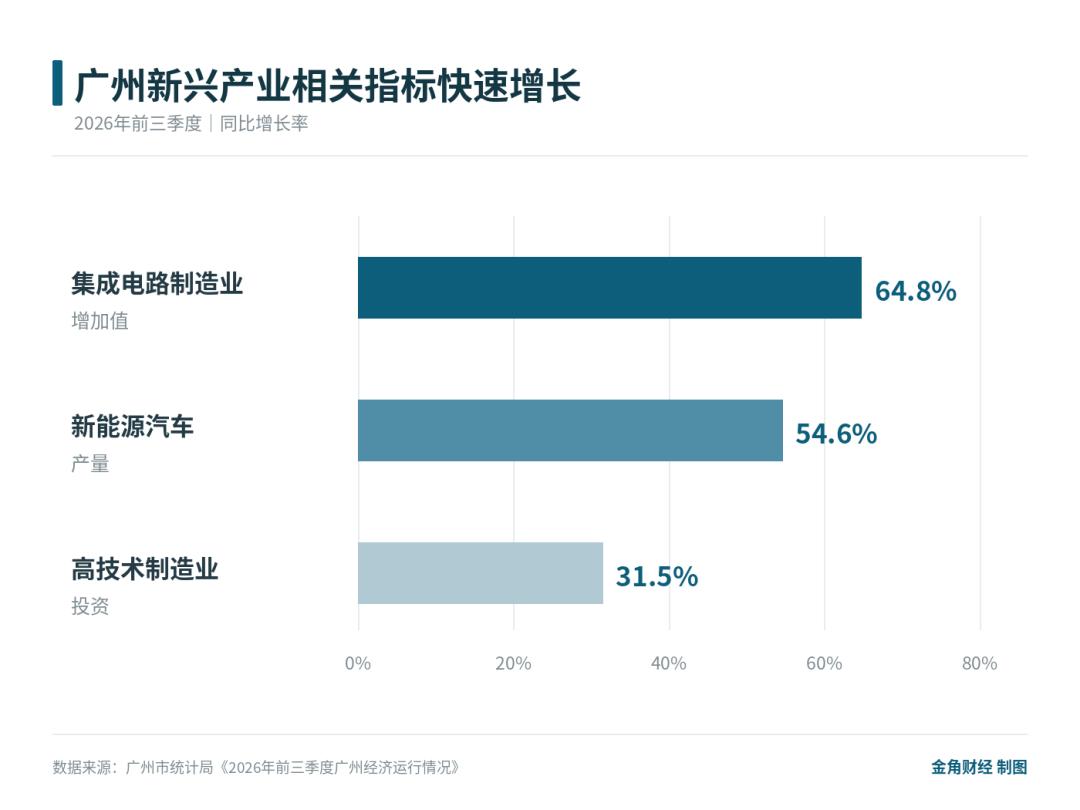
New industries are gaining momentum at an accelerated pace. For these enterprises, in addition to tackling key problems in R&D and expanding production capacity, there is an unavoidable hurdle: how to open up the global market?
At this year's Canton Fair, a very interesting case emerged.
The technology enterprise Galaxy Waterdrop introduced its gait recognition technology that the team has been developing for 16 years into the security scenario of the Canton Fair exhibition hall. Piloted in Area A of the exhibition hall, this system can identify people through their walking postures.
For Galaxy Waterdrop, the Canton Fair is not only a high-intensity actual combat scenario, but also a rare international window: purchasers from all over the world can witness the real implementation of this technology with their own eyes.
Similar opportunities are also attractive to Guangzhou's developing industries such as intelligent equipment and auto parts.
For a technology to get out of the laboratory, enterprises not only need to solve R&D problems, but also find customers who are willing to pay for it. The international trade channels that Guangzhou has accumulated for many years can just come in handy.
At the same time, new service demands are growing simultaneously around the overseas expansion of new technologies and new products. When a technology enterprise prepares to enter the overseas market, in addition to R&D and production, it also needs services such as product certification, intellectual property protection, overseas marketing, and cross-border settlement.
From January to August this year, the operating revenue of enterprises above designated size in Guangzhou's leasing and business services industry increased by 25.7% year on year, and that of the scientific research and technology services industry increased by 8.6%. As more and more local enterprises go global, relevant professional service institutions will also have the opportunity to get more customers.
For Guangzhou, this is a clear development account.
If it only helps enterprises complete commodity transactions, the profits it earns mainly come from the trade and logistics links; if it can retain R&D and design, brand operation, international marketing and high-end professional services by virtue of this advantage, Guangzhou can capture more generous value from the same cross-border business.
This is also the area where Guangzhou needs to make efforts in the next stage: to enable more new technologies and new products to go to the world via Guangzhou, and at the same time retain high value-added industrial links locally.
The grand industrial evolution will eventually be transformed into development opportunities for ordinary people. When more and more enterprise R&D centers, brand departments and professional service institutions take root in Guangzhou, the city will be able to release more diverse and high-quality jobs.
Guangzhou already has decades of experience in doing international business. From being an important gateway for global trade to the continuous emergence of new technologies and new industries, this city is still looking for new growth space.
In the new round of global industrial competition, whether Guangzhou can transform its decades-old commercial advantages into more high value-added industries and business opportunities is perhaps more worthy of attention than its ranking on the world city list.
References:
1. GaWC Official Website: World Cities 2026
2. Guangzhou Daily: GaWC 2026 Global City Ranking Released, Guangzhou Steadily Ranks as a World First-tier City
3. China Service Trade Guide Network of the Ministry of Commerce: Special Report on Trade Services of the 140th Canton Fair
4. Guangzhou Municipal Bureau of Statistics: Report on Guangzhou's Economic Operation in the First Three Quarters of 2026
5. Nanfang Daily: 70 Years of the Canton Fair, Witnessing the Struggle and Courage of Two Generations