After missing out on Unitree, foreign investors from Japan, South Korea and other countries are scrambling to invest in Chinese embodied intelligence companies.
Over the past two years, Unitree Robotics' robots have not only gained huge popularity in China, but also swept across the globe, going viral overseas on multiple occasions.
Wang Xingxing was not only invited as an honored guest to NVIDIA's annual conference dinner, but Unitree was also appraised by Elon Musk as "extraordinarily strong, and a top-tier formidable competitor".
However, after checking all the historical financing records of Unitree Robotics, we find that its shareholder list is entirely composed of Chinese capital, with no foreign large-scale enterprises involved at all.
This contrast exactly leads to three questions that arouse my interest: among the first echelon of Chinese humanoid robot ontology companies, which ones have received capital from foreign large manufacturers? When did these foreign enterprises start investing in China's embodied intelligence sector? Besides ontology manufacturers, are there any industrial chain companies among the invested parties?
20 Chinese sample embodied intelligence companies have received investments from large foreign manufacturers
Based on the data from IT Juzi, I pulled all the domestic embodied intelligence/robot investment events in the past five years (from January 1, 2022 to November 17, 2026) through MCP, totaling 1407 entries. Then I identified each entry one by one to check if there are well-known foreign enterprises and multinational companies among the investors, and finally screened out 33 valid entries.
The latest entry is the $500 million Series F financing announced by Agile Robots on November 12, 2026, with a post-investment valuation of $8.5 billion. SoftBank led the investment, and the follow-on investor list includes NVIDIA, Hitachi Group and T.Capital. All investors in this round are large foreign manufacturers.
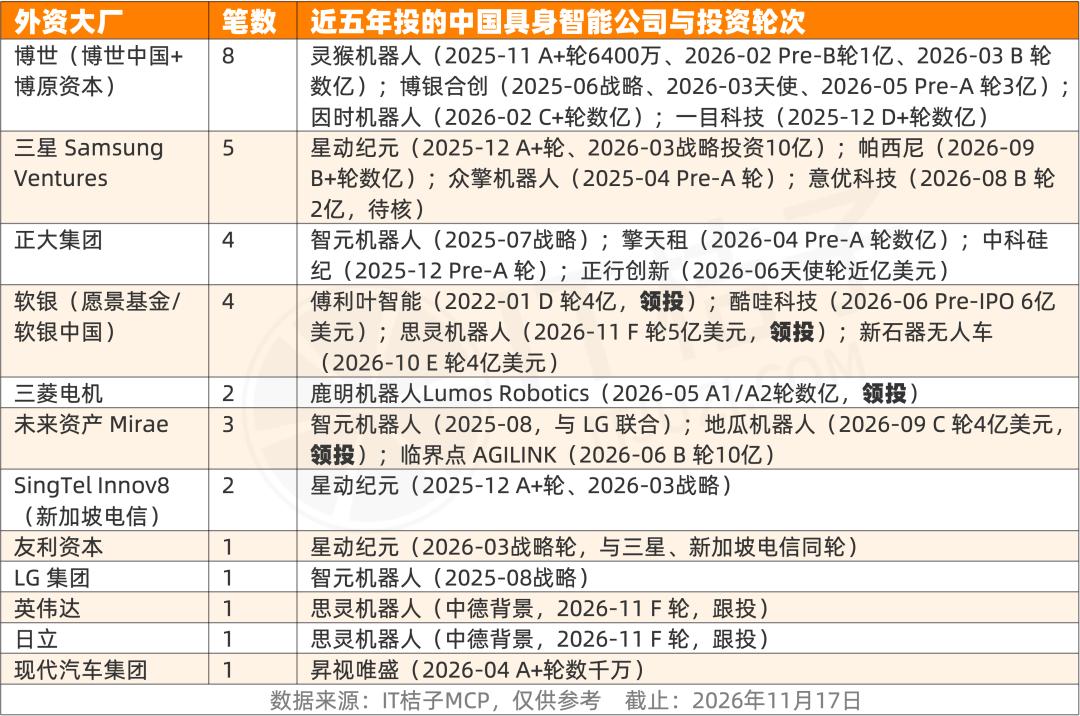
This table includes a total of 33 investments, covering 20 robot companies, with 12 large foreign manufacturers from South Korea, Southeast Asia, Japan and Europe as investors.
Among the 20 invested companies, only three players from the first echelon of humanoid robot ontology have received investments from large foreign manufacturers: Agibot (three foreign investors including LG, CP Group and Mirae Asset), Starbot (three investors including Samsung, Singtel and Woori Capital), and Zhen Robotics (Samsung).
From its establishment in 2016 to its IPO on the Sci-Tech Innovation Board in 2026, Unitree Robotics' investor list for nearly a decade is entirely composed of Chinese capital and industrial parties, with no foreign capital involved.
The vast majority of the remaining invested companies are located in the industrial chain.
The upstream links cover components and chips: Pacini that develops tactile sensors, Linghu Robotics, InTimes Robotics, Yimu Technology and E-You Technology that produce robot joints and core components, Zhongke Siji that develops dexterous hands, and DigiRobot that develops robot computing chips. The downstream links cover implementation scenarios: Neolix in the unmanned delivery sector, Cowarobot in the environmental sanitation sector, Fourier Intelligence in the rehabilitation sector, as well as Luming Robotics and Boyin Hechuang that carry out delivery in industrial scenarios.
That is to say, foreign capital is more invested in components, chips and scenarios, rather than humanoid robot ontology.
The entry time point of foreign capital: mostly after 2025
Among all these investments, only 1 deal took place in 2022, which was the Series D financing of Fourier Intelligence, led by SoftBank Vision Fund Phase 2 with an amount of 400 million yuan. In the two years of 2023 and 2024, the 12 large foreign manufacturers made zero investments in Chinese robot companies.
But at that time, China's embodied intelligence financing had already shown signs of an explosive period. One supporting evidence is that the financing amount of China's embodied intelligence track multiplied in 2023 and exceeded 10 billion yuan for the first time. In addition, Agibot and Starbot were both founded in 2023, and their high-value core financing took place exactly in the two years after their establishment, and later they developed into the first echelon of humanoid robot enterprises.
After 2025, especially in the more than one year since the second half of 2025, these large foreign manufacturers began to make intensive investments, and nearly 90% of the investment events were concentrated in this period. This is also the stage when Unitree Robotics' financing channel in the primary market is about to close and it is moving towards IPO listing.
After missing Unitree, large foreign manufacturers set their sights on other leading humanoid robot unicorns. For example, in July and August 2025, CP Group and LG Group successively made strategic investments in Agibot, and Samsung Ventures joined the shareholder list of Starbot in December 2025.
Putting the two timelines together, we can see that the entry time of foreign capital generally falls in the growth investment stage from Series A+ to Pre-IPO, and they rarely get involved in early-stage projects, entering the market after local capital completes the valuation.
Therefore, rather than saying that foreign capital came late, it is better to say that they were completely absent in the two critical years and failed to foresee the arrival of China's embodied intelligence wave in advance.
Geopolitical background of foreign capital: US-based players are collectively silent, while South Korean players make systematic layout
When classifying these 12 large foreign manufacturers by country, the result shows an extremely uneven distribution: large Asian foreign manufacturers are in the dominant position, while European and American large foreign manufacturers can be said to have disappeared collectively.
South Korean manufacturers are the only foreign camp that systematically increases their positions in China's embodied intelligence sector, with layouts in four links: humanoid ontology, tactile sensors, robot joints and industrial automation.
Samsung Ventures has made 5 investments, covering humanoid ontology (Starbot, Zhen Robotics), tactile sensors (Pacini) and robot joints (E-You Technology). LG has made one investment in Agibot.
Mirae Asset has 3 investments, among which it led the $400 million Series C financing of DigiRobot. Hyundai Motor Group invested in Shengshi Weisheng through its affiliated robot entity.
There is also Woori Capital under South Korea's Woori Financial Group, which joined Starbot in the same round as Samsung and Singtel. Woori Financial is one of the five largest financial holding groups in South Korea, with main businesses covering banking, securities and insurance. Its investment shows that South Korean capital has made systematic asset allocation for Chinese robot ontology, rather than scattered trial investments.
Southeast Asia and Japan are the second echelon: Singtel invested in Starbot, the Thailand-based CP Group has continuously invested in four companies in China, and Mitsubishi Electric invested in Luming Robotics.
So far, only one European manufacturer, Germany's Bosch Group, has been tracked, but its investment entities are Bosch China and Boyuan Capital, which are already relatively localized investment institutions. It made the earliest layout: as early as 2019, Bosch China led the Series A+ financing of Megvii Robotics, and has continuously increased its investment in Linghu Robotics in the past five years.
Finally, looking at US-based large manufacturers, NVIDIA, Qualcomm, Microsoft, Google, Amazon, Intel and other companies have zero records of investing in Chinese robot companies since 2022. The only related deal is the investment in Agile Robots, which was made directly by its German headquarters.
But this does not mean that they do not invest in embodied intelligence. In fact, they invest heavily in robot projects, but all the capital flows to their home country the US and Europe.
NVIDIA has invested in Figure AI, Skild AI, as well as Field AI and Dyna Robotics. Amazon has invested in Skild AI and Germany's Neura Robotics. Intel has invested in Figure AI and Field AI. Microsoft has invested in Bright Machines. Google Ventures has invested in Apptronik, and most of these targets have already reached the unicorn level.
Two investment paths: acting as both customer and shareholder, or pure financial investment
By analyzing the investments of these large foreign manufacturers in China's embodied intelligence sector based on the source of capital, we can find structural differences.
The first category is industrial capital, including 7 players: Bosch, Mitsubishi Electric, CP Group, Hitachi, Hyundai Motor Group, LG and NVIDIA, who have made a total of 19 investments.
They share a common investment logic: first act as a customer and carry out business cooperation, then become a shareholder, and use equity to strengthen the binding cooperative relationship.
In July 2025, Mitsubishi Electric and Luming Robotics signed a strategic cooperation agreement. Mitsubishi Electric opened up four industrial scenarios of quality inspection, assembly, sorting and material handling to Luming Robotics, and built joint laboratories in Suzhou and Shanghai. After the products were verified on Mitsubishi Electric's production lines, Mitsubishi Electric led the Series A1/A2 financing of Luming Robotics in May 2026. This is a very typical path of providing scenarios first and then taking equity.
The case of Hyundai Motor Group investing in Shengshi Weisheng is also very typical.
Shengshi Weisheng first entered the Hyundai system as a channel partner, and received orders worth tens of millions of yuan from Hyundai Motor Group's shipbuilding business, with the scheduling extending to 2029. In April 2026, Hyundai Motor Group invested tens of millions of yuan in the Series A+ round of Shengshi Weisheng, and promised to help it expand overseas with Hyundai Motor's global network after the investment.
Hitachi and NVIDIA's investment in Agile Robots is also similar, but the pace is much faster.
On September 29, 2026, Hitachi and Agile Robots announced strategic co-creation. At the Berlin GTC in October 2026, NVIDIA and Agile Robots jointly released the humanoid robot Agile ONE SN, and in the same period, the two parties also implemented a sorting project in the Audi factory. Less than two months later, Hitachi and NVIDIA both followed up and participated in the Series F financing of Agile Robots in November.
As for Bosch, it has gone deeper in China: it directly set up a joint venture to take control of the implementation direction of embodied intelligence in the manufacturing industry.
Boyuan Capital, a market-oriented investment platform under Bosch, and Galaxy General Robotics jointly established Boyin Hechuang, focusing on implementing embodied intelligence in the industrialization scenarios of the manufacturing industry. Bosch has increased its investment in every round since its establishment: the strategic round in June 2025, the angel round in March 2026, and the Pre-A round in May, none of which was missed.
In addition, Bosch China has also invested in Linghu Robotics, InTimes Robotics and Yimu Technology. There is limited public information about these three deals, which are more like pre-positioning around Bosch's own supply chain.
The logic of CP Group is slightly different.
In July 2025, CP Group took equity in Agibot through strategic investment, with the investment intention of exchanging scenarios for equity: the implementation scenarios of CP Group in retail, agriculture and animal husbandry, and logistics are exactly what Agibot needs. After that, CP Group successively invested in Qingtian Zu, Zhongke Siji and Zhengxing Chuangxin, covering different business types from humanoid ontology to robot leasing and dexterous hands, behind which is the logic of procurement plus distribution.
The industrial capital under this path buys the verified delivery capability, and the equity is only used to fix the procurement relationship.
LG Electronics may be the only exception. In August 2025, it jointly led the Series A+ financing of Agibot with Mirae Asset, which is LG's first bet on a Chinese robot company. This investment is more like a trial investment.
The other category is financial funds, including 5 players: SoftBank Vision, Mirae Asset, Samsung Ventures, Singtel Innov8 and Woori Capital, who have made a total of 15 investments, focusing mainly on investment returns.
Most of the lead investors in large-scale financing rounds are financial funds. For example, SoftBank Vision led the Series D financing of Fourier Intelligence and the Series F financing of Agile Robots, and Mirae Asset led the Series C financing of DigiRobot.
For Chinese robot companies, the industrial synergy from large foreign manufacturers is a late and restrained check, and the real early-stage valuation right and confidence come from local venture capital and CVC of domestic large manufacturers.
This article is from the WeChat official account "IT Juzi" (ID: itjuzi521), written by Wu Meimei, and published with authorization from 36Kr.