2026 AI-Native Overseas Expansion Report
From exporting commodities and labor to exporting AI capabilities, Chinese enterprises are undergoing fundamental changes in the form of value output.
Co-released by Xiaguang Society & Xiaguang Think Tank and Singtel, the 2026 report *AI-Native Global Expansion: When "Chinese Intelligence" Becomes a New Export* focuses on six major AI-native industries and five key overseas markets, conducting systematic deconstruction and in-depth analysis on the stage evolution, institutional window, regional selection, track opportunities and delivery bottlenecks of AI-native overseas business.
AI Going Global: From Efficiency Tools to Native Commodities
In 2026, leading AI enterprises expanding overseas usually operate on three parallel tracks.
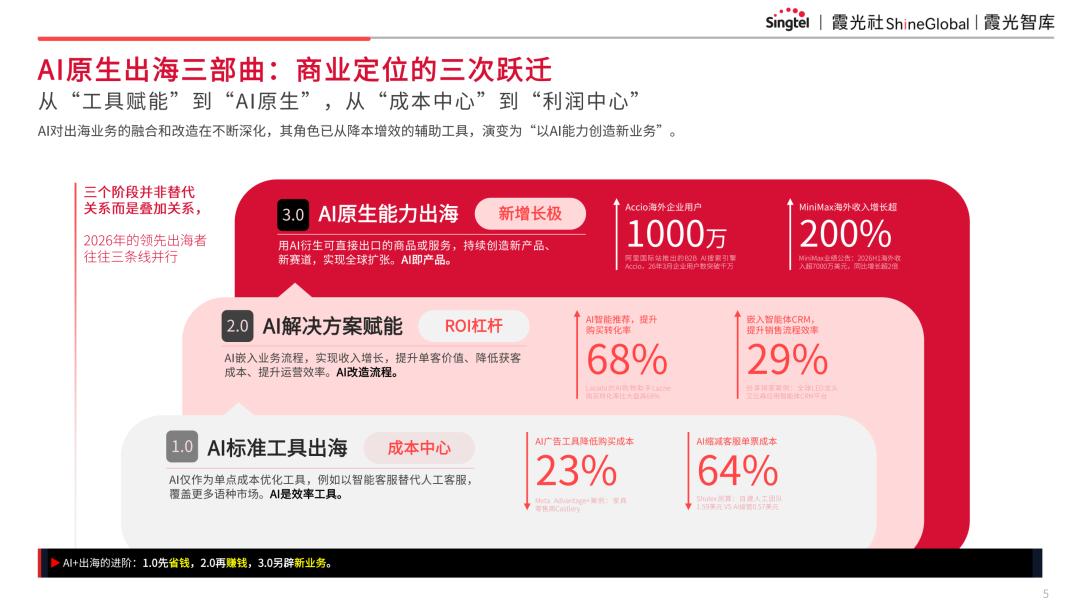
AI Going Global 1.0 – Standard Tool Export: The value of AI lies in cost reduction.
At this stage, AI is mainly used for intelligent customer service replacement and advertising delivery optimization. According to Shulex's calculation, the per-ticket cost of building a self-operated manual customer service team is USD 1.59, while AI reception can reduce this cost by 64%.
AI Going Global 2.0 – Solution Empowerment: AI becomes an ROI leverage.
At this stage, AI is embedded in business processes, acting on operational indicators such as conversion rate and sales efficiency. For example, Lazada boosted its purchase conversion rate by 68% above the overall market level through the AI shopping assistant Lazee; Absen, the global leading LED enterprise, improved its sales efficiency by 29% with the help of Fenxiaxiaoke's intelligent agent CRM platform.
AI Going Global 3.0 – Native Capability Export: AI becomes an export product.
At this stage, AI capabilities have become directly exportable commodities or services. In March 2026, the number of enterprise users of Accio, the B2B AI search engine on Alibaba International Station, exceeded 10 million; in the first half of 2026, MiniMax's overseas revenue exceeded USD 70 million.
Short drama going global is a typical epitome of AI going global.
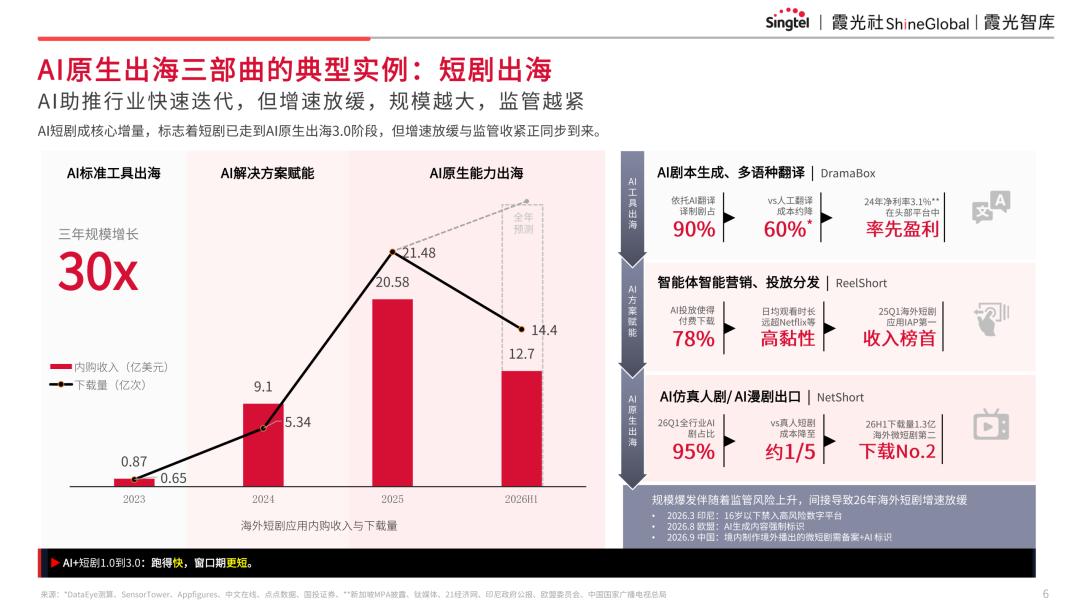
1.0 Stage, AI-translated dramas account for 90% of DramaBox's content, cutting 60% of costs compared with manual translation. It recorded a net profit margin of 3.1% in 2024, taking the lead in achieving profitability among head platforms;
2.0 Stage, ReelShort reached a paid download rate of 78% through intelligent agent marketing delivery, and topped the IAP revenue list of overseas short drama applications in Q1 2025;
3.0 Stage, AI-generated hyper-real human dramas and comic dramas account for 95% of NetShort's total content, with the cost being about 1/5 of that of live-action short dramas. It gained 130 million downloads in H1 2026, ranking the second among overseas short drama platforms.
However, the explosive growth of the short drama market is also accompanied by rising regulatory risks. Since March 2026, Indonesia has banned users under 16 from accessing high-risk digital platforms, leading to a slowdown in the growth rate of overseas short drama market in 2026.
2026-2027 is the Critical Period Before the Tightening of AI Global Expansion Rules
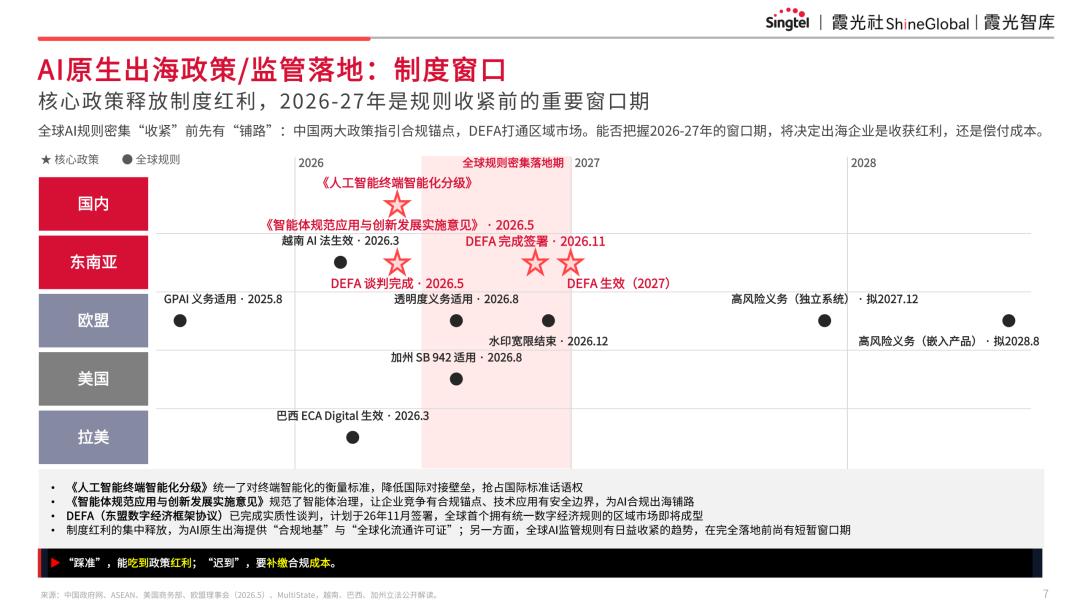
Global AI regulatory rules are generally tightening, but there is a short window before the rules are fully implemented. Whether enterprises can seize this window will determine whether they can enjoy institutional dividends or bear compliance costs.
From the perspective of domestic policies, the *Intelligent Classification of Artificial Intelligence Terminals* unifies the measurement standards for terminal intelligence, reducing the difficulty for enterprises to align with international standards; the *Implementation Opinions on the Standardized Application and Innovative Development of Intelligent Agents* draws a clear safety boundary for the development and application of intelligent agents, so that enterprises can follow clear rules.
At the overseas level, ASEAN DEFA (ASEAN Digital Economy Framework Agreement) was signed in November 2026, making it the world's first regional market with unified digital economy rules.
Regulatory rules of other major economies are also taking effect at an accelerated pace: in the EU, the General AI Model (GPAI) rules have been applicable since August 2025, and transparency obligations will take effect in August 2026; California's SB 942 Act in the US requires disclosure of the source of AI-generated content; Brazil's ECA Digital (Digital Protection Rules for Children and Adolescents) came into force in March 2026. These rules vary in rhythm and intensity, directly affecting the market access threshold and compliance cost of each regional market.
AI-Native Overseas Enterprises Should Select Suitable Markets According to Their Own Capability Characteristics
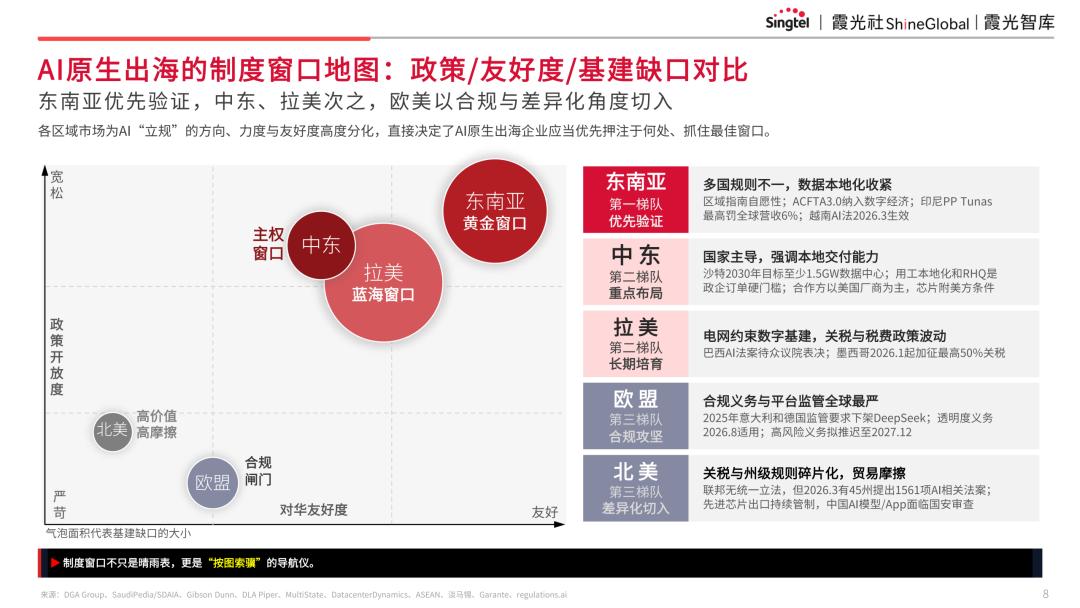
There is no one-size-fits-all optimal market solution for AI-native global expansion, and enterprises need to choose appropriate markets based on their own capability characteristics.
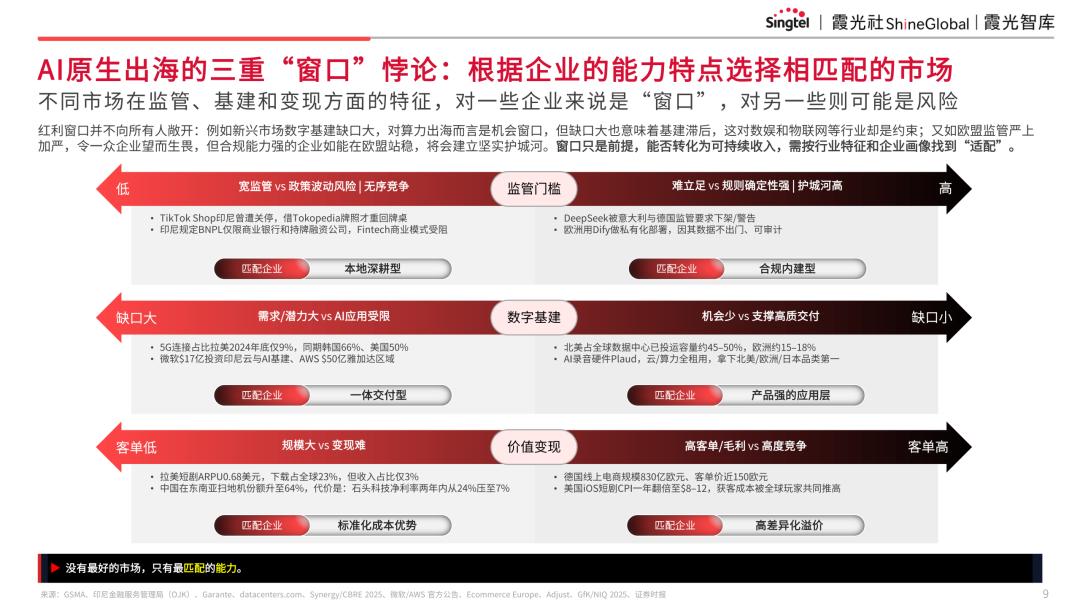
Regulatory Threshold: Markets with loose supervision face large policy fluctuations and disorderly competition. TikTokShop Indonesia was once shut down and only returned to operation by obtaining the Tokopedia license, and Fintech business models are restricted by BNPL licenses, which are more suitable for local enterprises; markets with strict supervision have strong certainty but high entry cost. DeepSeek was required to add warning prompts or even be removed from shelves in Italy and Germany, and European enterprises can use Dify for private deployment to keep data locally, which is more applicable for enterprises with built-in compliance capabilities.
Digital Infrastructure: Markets with large infrastructure gaps have huge demand and potential, but the application of AI is restricted. At the end of 2024, 5G connections only accounted for 9% of total connections in Latin America, while the proportion was 66% in South Korea and 50% in the US in the same period, so Latin America is more suitable for integrated delivery enterprises; markets with small infrastructure gaps have fewer opportunities but can support high-quality delivery. North America accounts for nearly 50% of the global operational data center capacity, and Europe accounts for about 15%-18%, so Europe and the United States are more suitable for application layer enterprises with strong product capabilities.
Value Monetization: Markets with low unit customer price have large user scale but difficult monetization. Short drama downloads in Latin America account for 23% of the global total, while the revenue proportion is only 3%, which is suitable for enterprises with cost advantages; markets with high unit customer price have high gross profit but fierce competition. The unit customer price of e-commerce in Germany is nearly 150 Euros, which is more suitable for premium enterprises with high differentiation.
Six Major Tracks & Five Key Markets: Full View of Opportunities and Breakthrough of Dilemmas
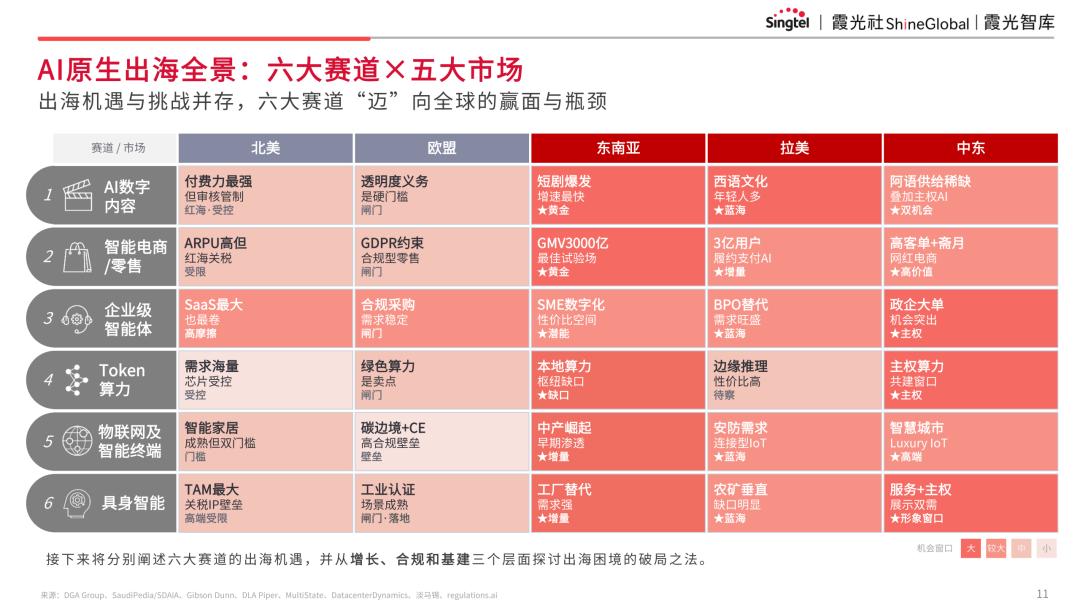
AI digital content, intelligent e-commerce/retail, enterprise-level intelligent agents, Token computing power, IoT and intelligent terminals, embodied intelligence — the opportunity combinations and bottlenecks of the six AI-native tracks show obvious differences.
(1) AI Digital Content Going Global
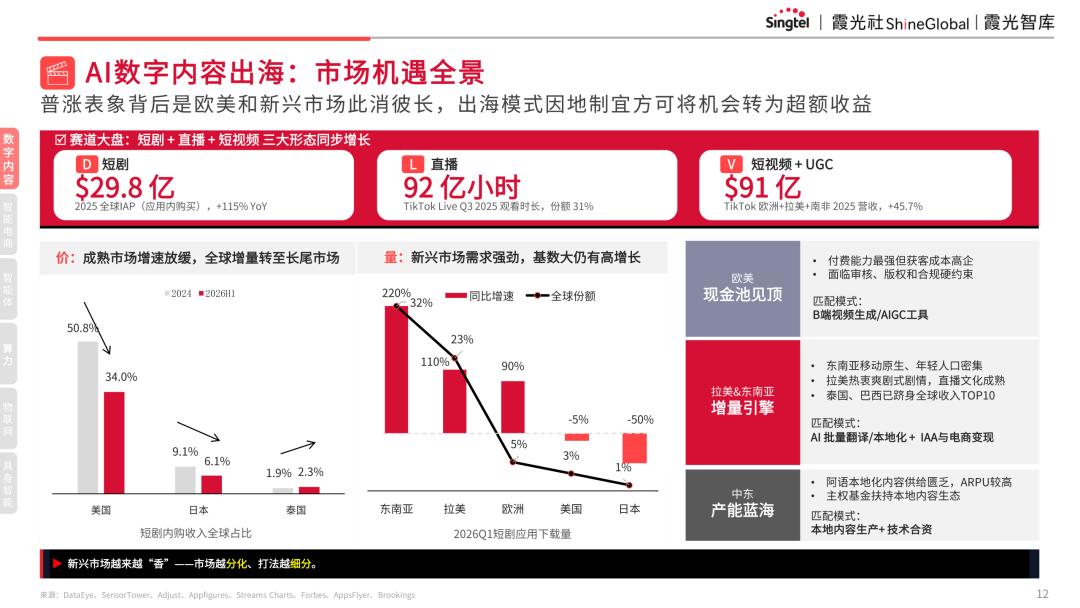
The European and American markets have the strongest payment capacity, but with high customer acquisition cost and strict copyright review, so they are more suitable for B-end video generation and AIGC tools, winning by tool efficiency rather than content scale; Latin America and Southeast Asia are dominated by mobile-native users with dense young population, who prefer fast-paced plot content. Thailand and Brazil have entered the top 10 of the global short drama revenue list, which is more suitable for using AI batch translation to reduce costs, and realize monetization through IAA and e-commerce; the Middle East market has scarce Arabic content supply, high ARPU, and sovereign funds supporting local content ecology, so it is more suitable for local content production and technology joint ventures.
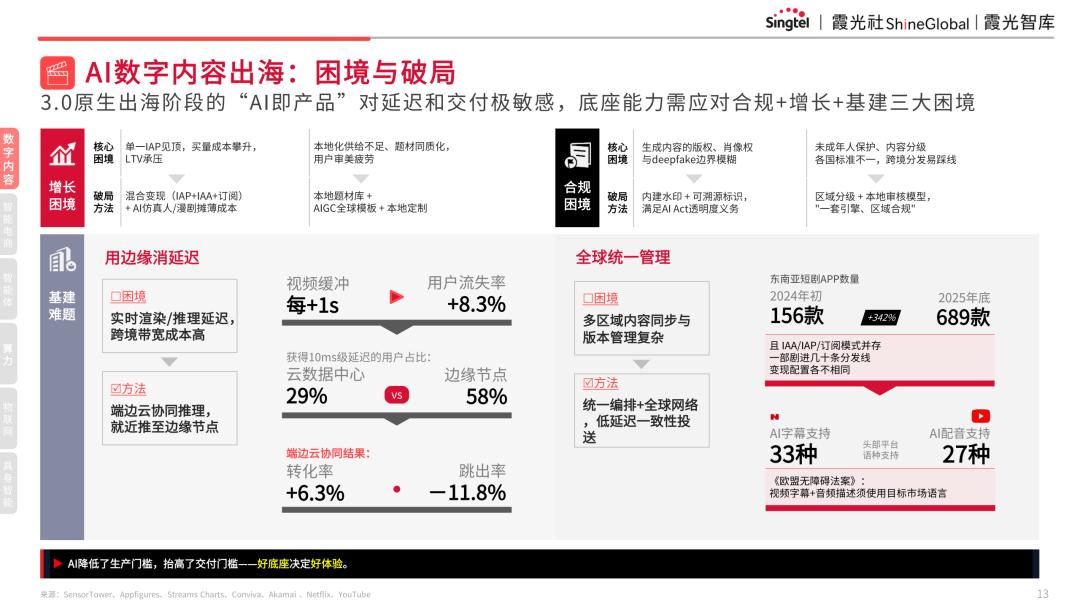
The dilemmas of AI digital content going global are mainly divided into three categories: growth, compliance and infrastructure. In terms of growth, under the single IAP model, the user acquisition cost keeps rising and LTV is under pressure, insufficient localized supply and homogenized themes lead to user fatigue, and the breakthrough lies in mixed monetization (IAP+IAA+subscription) and AI hyper-real human/comic dramas to dilute costs; in terms of compliance, the boundary of copyright and portrait right is ambiguous, and the standards for minor protection and content classification are inconsistent, so it is necessary to build built-in watermarks and traceable marks to meet transparency obligations, and establish a regional classification plus local review model; in terms of infrastructure, delay directly erodes user experience — every 1 second increase in video buffering will lead to an 8.3% rise in user churn rate.
(2) Intelligent E-commerce/Retail Going Global
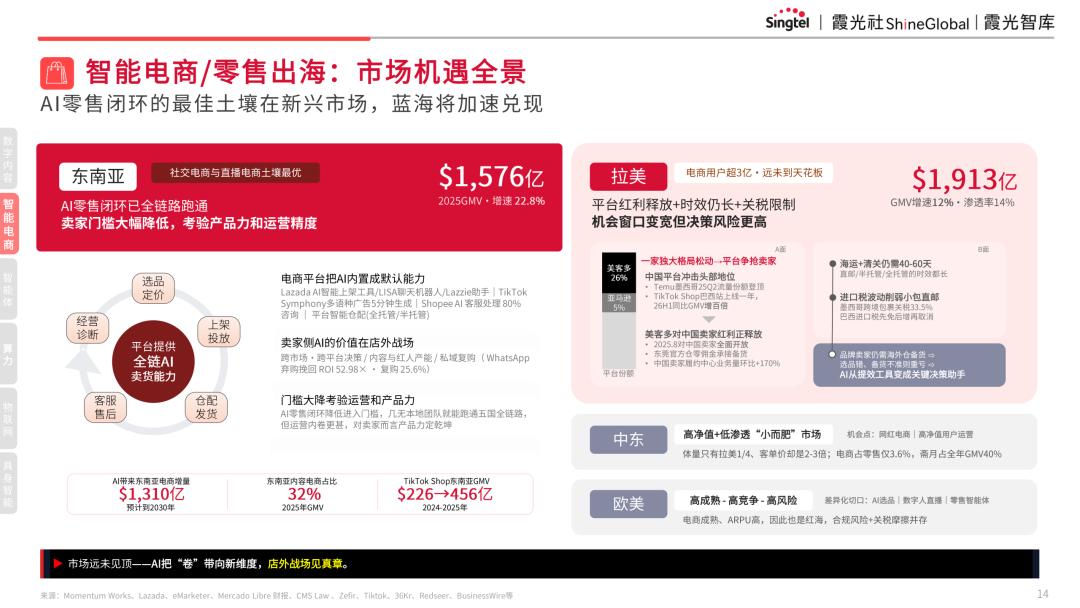
The best soil for the closed loop of AI retail lies in emerging markets. In 2025, the GMV of social e-commerce and live streaming e-commerce in Southeast Asia reached USD 157.6 billion, with a year-on-year growth of 22.8%. Platforms have embedded AI into the whole chain of product selection and pricing, listing and delivery, warehousing and customer service, greatly reducing the operation threshold for sellers while putting forward higher requirements for precision. The value of AI outside the platforms (cross-market product selection, WhatsApp private domain repurchase) is also remarkable. It is expected that by 2030, AI will bring USD 131 billion increment to Southeast Asian e-commerce, of which content e-commerce accounts for 32%; Latin America has more than 300 million e-commerce users, far from reaching the ceiling, its 2025 GMV reached USD 191.3 billion with a 12% year-on-year growth, and the role of AI is shifting from "efficiency improvement tool" to "decision assistance"; the Middle East is a "small but beautiful" high unit customer price market, with opportunities concentrated in influencer e-commerce and high net worth user operation. Europe and the US are markets with high competition and high risk, where compliance risks coexist with tariff frictions, and the differentiated entry points lie in AI product selection, digital human live streaming and retail intelligent agents.
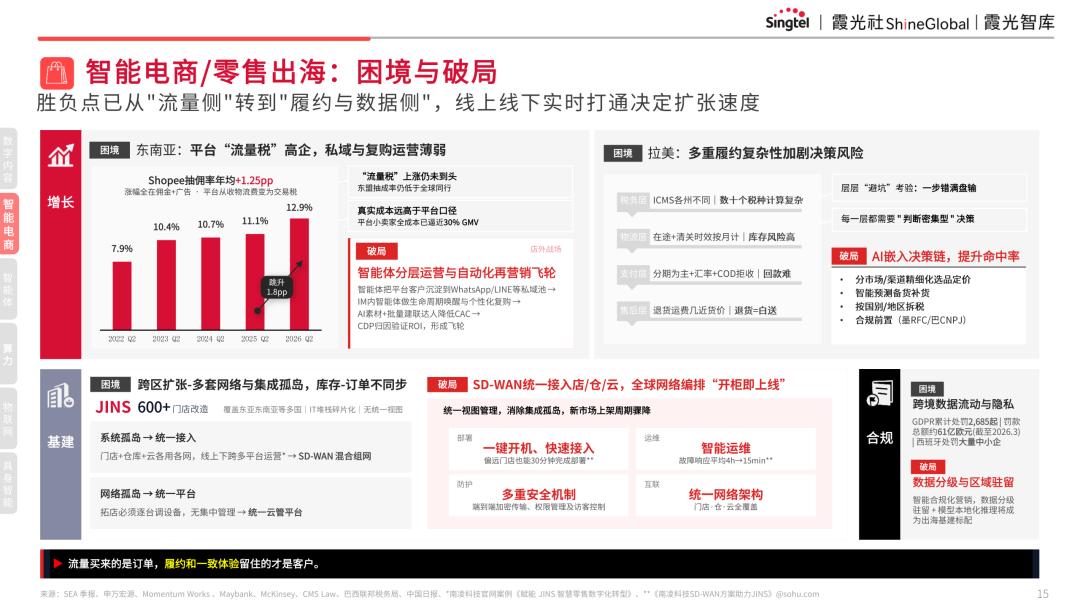
The dilemmas of intelligent e-commerce/retail going global also involve growth, compliance and infrastructure. At the growth level, the competition focus has shifted from the "traffic side" to the "performance and data side". The "traffic tax" of Southeast Asian platforms keeps rising (in Q2 2026, Shopee's commission rate reached 12.9%), coupled with weak private domain operation, the platform cost of small sellers is close to 30% of GMV. The key to breakthrough lies in hierarchical operation of intelligent agents and automated remarketing, precipitating customers into private domains such as WhatsApp/LINE, reducing CAC through AI materials and batch contact, and forming a repurchase flywheel; at the infrastructure level, cross-border expansion faces the problem of multiple sets of networks and integration silos, making it difficult to synchronize inventory and orders. JINS was restricted by fragmented IT stack in its cross-national operation of more than 600 stores, and the breakthrough relies on SD-WAN to uniformly access stores, warehouses and clouds, realizing global network orchestration and "one-click startup and fast access"; at the compliance level, cross-border data flow and privacy requirements are becoming stricter, the cumulative fines of GDPR have exceeded 6.8 billion Euros, and Spain has issued large fines for violations, the breakthrough point lies in data classification and regional residency.
The Bottleneck Does Not Lie in the Model, But in the Delivery
To realize AI-native opportunities in the six overseas tracks, three thresholds need to be crossed: growth is restricted by customer acquisition cost and monetization model, compliance is restricted by cross-border data transmission and content classification, and infrastructure is restricted by delivery bottlenecks — unable to enter the market, unable to transmit data across borders, and intelligent agents go offline.
