After being exposed by Chinese netizens for "data theft", the founder of the 77k-star open-source AI programming tool broke down on the spot: I will close the source tonight.
The most proud moat of open-source software is "code transparency", but when it is disassembled line by line by developers, what is exposed is a data collection channel that has been running secretly for eight months.
At the end of November 2026, T3 Code, the star AI programming console with 77,500 stars on GitHub, suffered the worst reputational backlash since its launch: it not only claimed "zero telemetry" on its official website while sending back usage data by default, but was also pointed out to read local Claude and Codex authentication files across directories, and even had high-risk overstepping behaviors such as "fake deletion" to retain records and scanning plaintext parameters of processes across the entire device in the background.
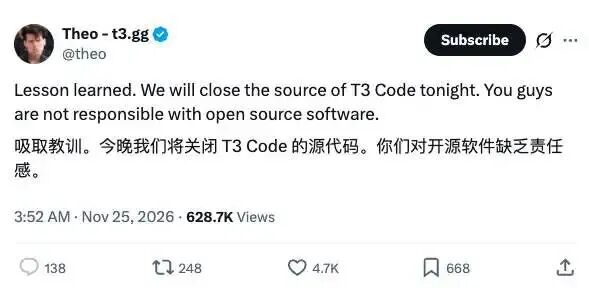
Faced with community doubts, founder Theo once lost emotional control on social platform X, threatening to "close the source of T3 Code tonight". Although he later publicly denied the closed-source plan, this storm has brought the gray area of AI programming tools in privacy collection and permission overstepping to the table.
Source-level Disassembly: A Chain Reaction Triggered by a Single Tweet
In the overseas developer community, Theo Browne (online alias t3dotgg) is a quite influential figure. With 585,000 subscribers accumulated on his YouTube channel and his long-term image of advocating the open-source ecosystem, his AI programming tool T3 Code quickly gained 77,500 Stars on GitHub, and many developers therefore safely connected their local code bases and development permissions to it.
However, multiple doubts raised by hardcore developer @realchendahuang through comparing the source code and public Issues have plunged this tool into controversy. As the code details are sorted out one by one, the actual practices of T3 Code in underlying data collection and local permissions have gradually come to light.
The first point is the direct contradiction between official website claims and code implementation. T3 Code emphasizes privacy-friendliness in its promotion, but the source code shows that the software silently integrates PostHog and Sentry analysis services on both desktop and web ends, sending user behaviors and error stacks to external parties. It will even automatically report events in the background when users start local services through the command line (t3 serve). It was not until the update in November 2026 that the team added a switch to turn off telemetry on the settings page, and it remains enabled by default.
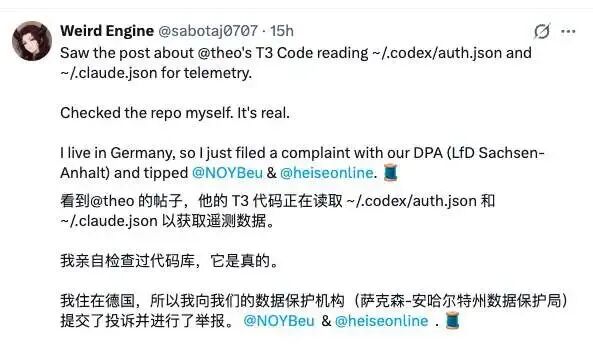
The more concerned cross-directory reading logic appears in the Identify.ts file. When T3 Code generates a unique device identifier, the code will directly read the local authentication files of Claude (~/.claude.json) and Codex (~/.codex/auth.json) on the user's local machine, extract the email and account ID in them for hash concatenation. This means that even if the user has never registered a T3 account, it can associate usage behaviors with the same real identity by using the local credentials of other AI tools.
As developers continued to troubleshoot along the repository Issues, more local data and process permission issues were verified one by one.
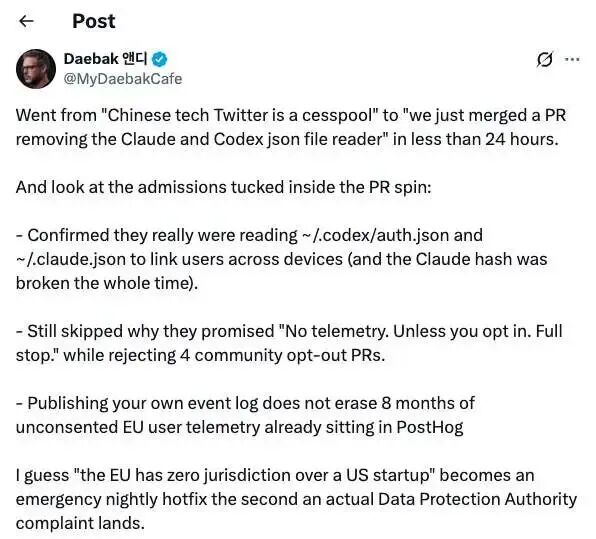
The built-in process monitoring component t3-resource-monitor still enumerates and scans all processes of the entire computer in the background every 5 seconds even after the user closes the diagnostic panel, including irrelevant third-party software. It was not until public opinion fermented on November 24 that the repository merged the patch (PR #41889), which indirectly confirmed that the full command line parameters at process startup had been recorded into telemetry and historical snapshots before — and command line parameters often contain plaintext API Keys and database passwords.
At the same time, when the interface pops up a prompt of "permanently delete" when deleting conversations, no line is deleted in the local SQLite database, resulting in more than 40GB of hard disk space being occupied for some users within a few weeks (Issue #17845). When the company intranet address appears in the conversation, the front end will also request the favicon interface of Google, exposing the internal host name in external requests (PR #32657).
In addition, even if you configure the environment variable according to the tutorial to turn off telemetry, the server will still forcibly connect to http://raw.githubusercontent.com to pull the list every time it starts, and no setting item or enterprise policy can block this behavior.

This long Chinese technical analysis post posted on X (Twitter) quickly detonated the developer circles at home and abroad, and was soon translated and reposted to overseas forums such as Reddit.
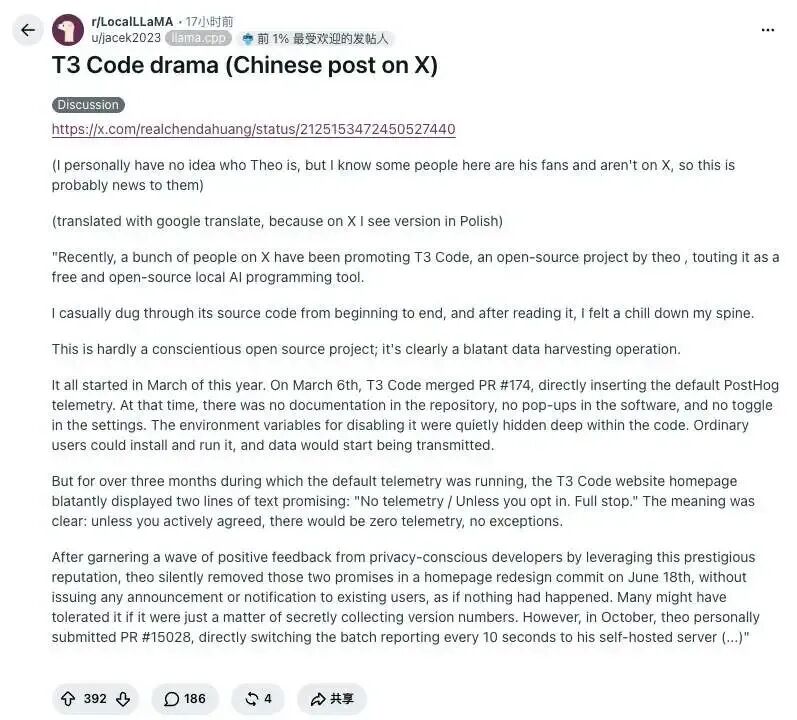
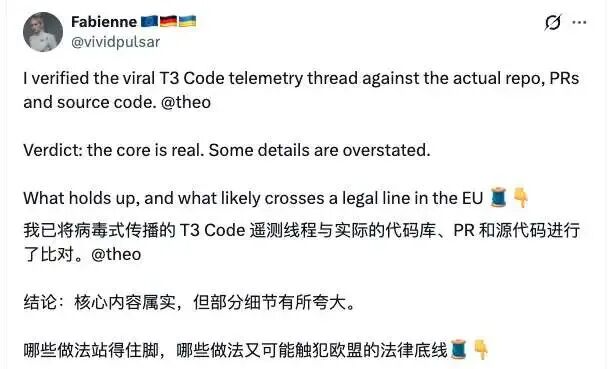
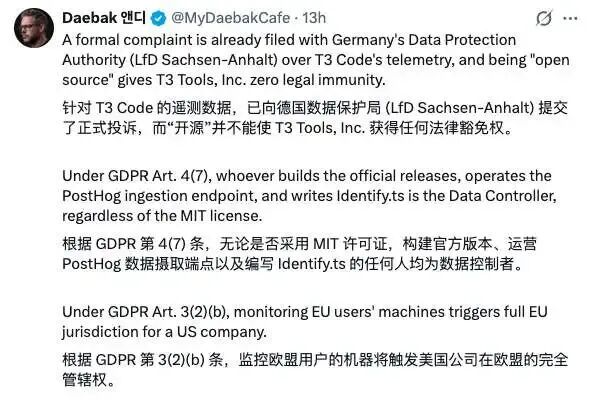
Many developers who just followed the trend to install this tool said they uninstalled it overnight, and many developers pointed out that its practice of enabling telemetry by default without clearly notifying users during installation may touch the compliance red line of the EU GDPR.
Breakdown and Arrogance: Theo's Response and His Views on Chinese Developers
If the hidden operations in the code can still be defended as "technical oversight", then Theo's subsequent series of tweet confrontations on social platform X further expanded the controversy.
As the tweet at the beginning of the article that sparked nationwide discussions shows, in the face of the source code audit first initiated by Chinese developers, Theo's first reaction was not to verify the code or apologize, but to respond to community doubts with "closing the source tonight".
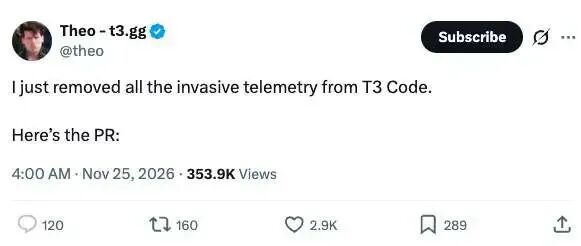
However, shortly after this tough statement sparked widespread discussion, Theo posted successive tweets to urgently "put out the fire": on the one hand, he showed the PR to announce that "I just removed all the invasive telemetry from T3 Code", on the other hand, he published a long post to publicly defend himself. He admitted that he did read the local authentication files of Claude and Codex to generate hashes in order to deduplicate multi-device users and prevent user indicators from being falsely high, but insisted that "no user files or sensitive data have ever been uploaded", and even released his own complete 95,789 usage event logs of more than 100MB to brand himself as "the most transparent open-source CEO in history".
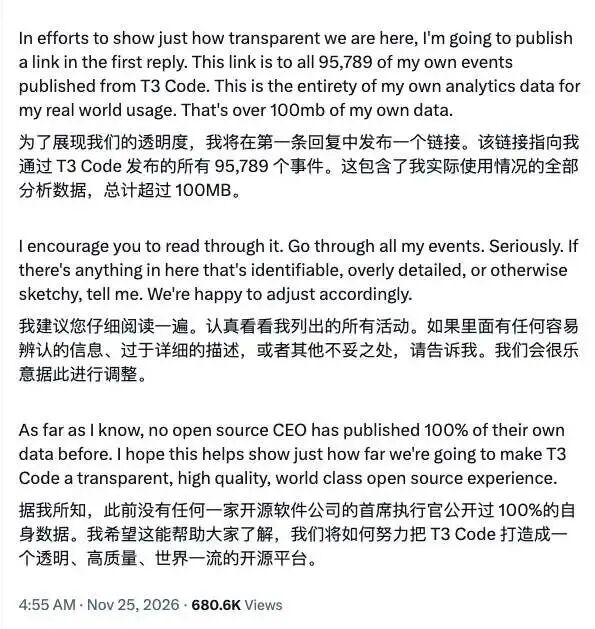
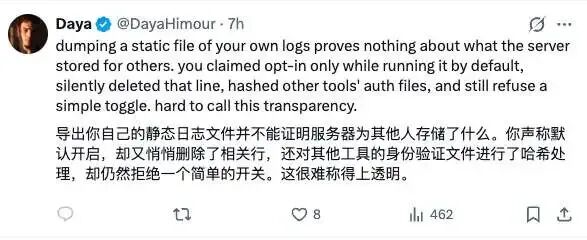
However, this public relations operation of "exposing his own logs" did not calm the public anger, but instead attracted more refutations. Some developers pointed out the logical loopholes in it: "Exporting a static log file of your own cannot prove what the server stores for other people. On the one hand, you claim that collection is opt-in only when users choose to join, on the other hand, you enable it by default and quietly delete that line of commitment in the document, and hash the authentication files of other tools, and still refuse to provide a simple interface switch. This can hardly be called transparent."
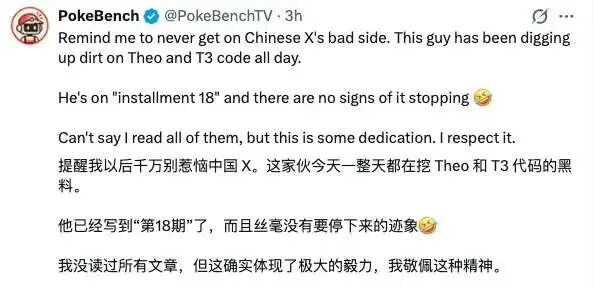
At the same time, in the multiple rounds of tweet confrontations around this incident, Theo's way of responding to Chinese developers has also caused a lot of controversy.
In fact, if we push the timeline forward, the cause of this huge uproar is quite dramatic. At first, there was only friction between the overseas community and Chinese developers around the compliance issue of "Chinese developers making modified versions based on T3 Code but using similar names". Theo then spoke publicly on social platforms to accuse Chinese teams of plagiarism and violation of regulations.
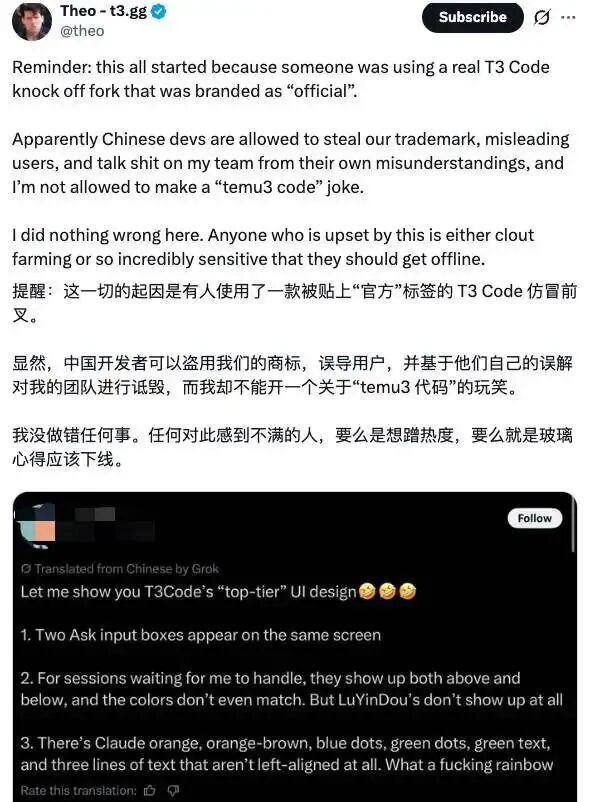
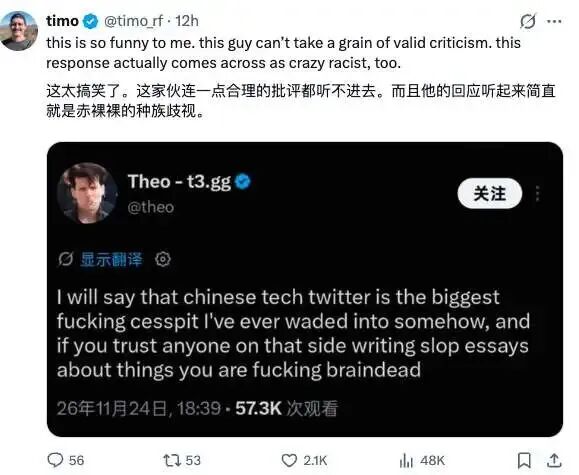
However, it was in this war of words about "who understands the open-source rules better" that Chinese developers represented by Chen Dahuang followed the clues and clicked into the original repository of T3 Code. They originally just wanted to check the boundary of the open-source agreement, but accidentally uncovered the privacy collection channel that had been running secretly for eight months. In the face of a series of hard evidence of source code and Issues thrown out by Chinese developers later, Theo did not respond positively to each specific technical doubt in multiple rounds of public replies, but repeatedly pulled the topic back to "Chinese developers' modified version violates regulations" and "maliciously leading public opinion", showing obvious rejection and contempt for the technical audit initiated by the Chinese community.
Unspoken Industry Rules and Deep Reflection: When AI Tools Take Over Local Permissions
Looking beyond the individual case of T3 Code, the reason why this storm can sting the entire developer group is that it has torn open the widespread "gray area" in data collection of current AI programming tools. In order to optimize product experience and track retention rate, almost all mainstream AI Coding tools will access basic telemetry mechanisms, but the industry's recognized bottom line is very clear: it must be "off by default" or "clearly pop up a window to obtain consent on first startup", the data must be completely desensitized and de-identified, and the collection scope must be strictly limited within the sandbox boundary of the software itself.
For example, mainstream commercial tools such as VS Code and Cursor will provide a prominent "Privacy Mode" or telemetry switch in the settings even when collecting crash logs and function usage frequency, and clearly promise not to read other software configurations on the host. Open-source AI programming plugins with good reputations such as Cline and Continue even take "zero hidden telemetry, all data stored locally" as their foundation. In contrast, T3 Code attracts privacy-focused programmers by putting up the sign of "zero telemetry" on the official website, while enabling commercial buried points by default in the background, rummaging through competitor configuration files across directories and even scanning the command lines of processes across the entire device, which has obviously crossed the boundary of normal product data analysis and slipped into actual privacy overstepping.
From a deeper perspective, this incident also sounded a wake-up call for the rapidly advancing AI Agent era. The traditional editors we used in the past are essentially just text tools waiting passively for input, with relatively limited permission boundaries. But today's AI programming consoles and local Agents are often granted extremely high system-level permissions in order to achieve automated execution: they can read and write the local file system freely, pull up terminals to execute commands, traverse system processes, and even directly access API keys in environment variables and enterprise intranet topologies.
When the permissions of tools expand infinitely, the originally fragile trust contract between developers and tool providers becomes extremely dangerous. At the same time, the increasingly rampant "internet celebrity orientation" and "one-man rule" phenomena in the open-source ecosystem are also dissolving the original intention of the open-source spirit. If "open source" is only regarded as a marketing label to obtain early traffic and avoid security reviews, and normal community audits have to face the founder's emotional blackmail and regional prejudice, what is damaged is not only the reputation of individual projects, but also the transparent cornerstone that the entire open-source community depends on for survival. For every developer who entrusts their code base and local environment to AI, maintaining awe and independent review of underlying permissions may be the most basic security line of defense in this era.