Falling below the issue price is not the most painful part. The fact that the core team of Claude Code is being frantically poached by OpenAI is the real heavy blow: Is Anthropic's programming throne now hanging in the balance?
Anthropic's record-breaking IPO hype is rapidly fading.
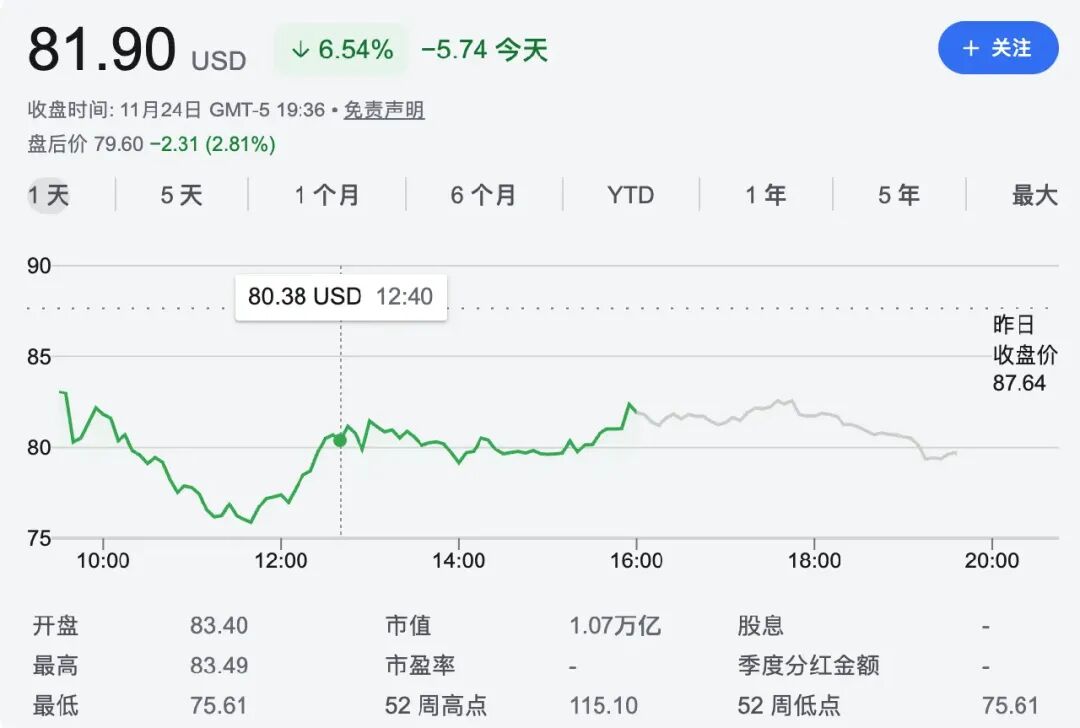
On November 24 local time, Anthropic's share price fell 12.6% to close at $76.60, falling below its IPO offering price of $83. Only a few trading days have passed since its listing on November 19, and its share price has fallen by about 31% from the opening price of $111.50 on the first trading day.
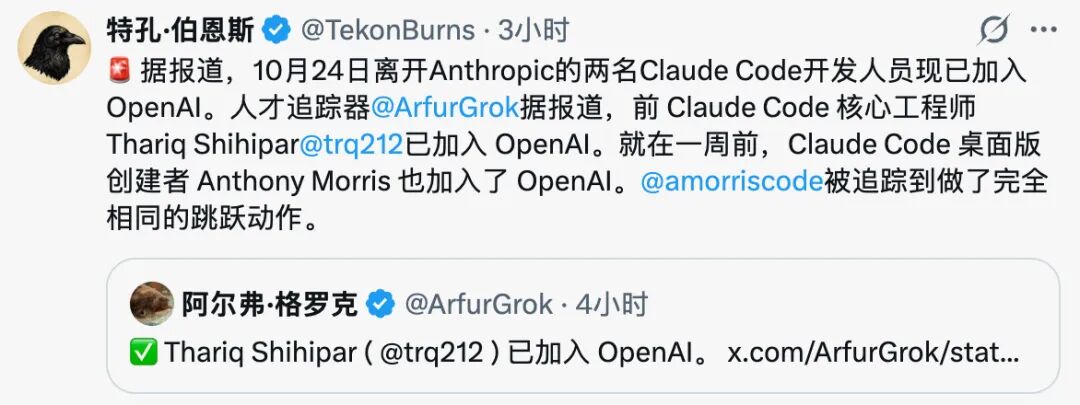
Meanwhile, notable personnel changes have emerged within the company. Thariq Shihipar, a former Claude Code development engineer, and Anthony Morris, creator of the Claude Code desktop version, who previously left their positions, have been revealed to have joined OpenAI, though neither they themselves nor OpenAI have confirmed the news. Cat Wu, who was previously in charge of the Claude Code product, has confirmed her move to OpenAI.
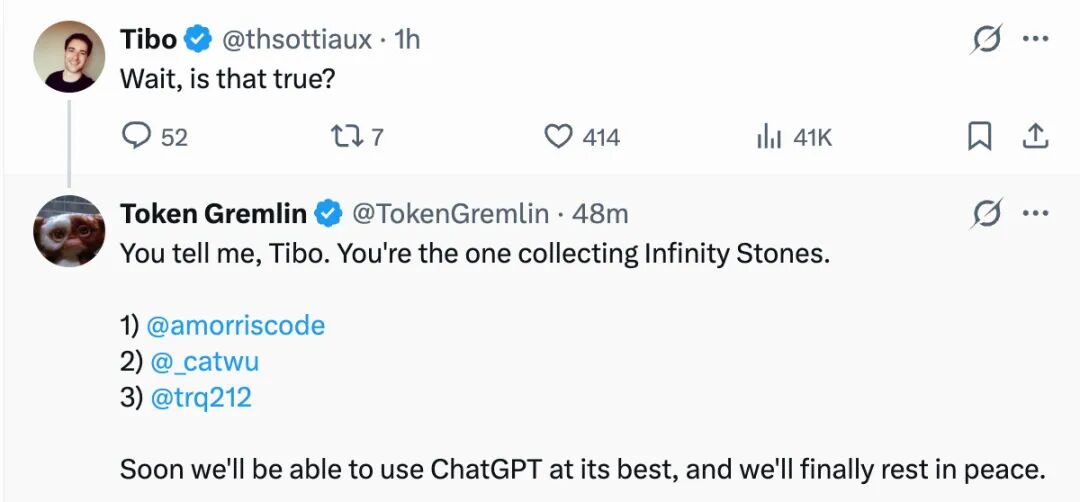
"No way! This guy quit Anthropic, played World of Warcraft for a few weeks, probably had a great time playing GTA 6, and then joined OpenAI," some netizens expressed surprise at the news, adding that "now OpenAI has recruited two former core employees of Anthropic: Anthony Morris, the creator of the Claude Code desktop version, and former Anthropic employee Tibo. The addition of these two people has immeasurable potential for improving Codex's capabilities. We believe obvious improvements will be seen soon."
Even without official confirmation, many netizens have already started "popping champagne" for OpenAI.
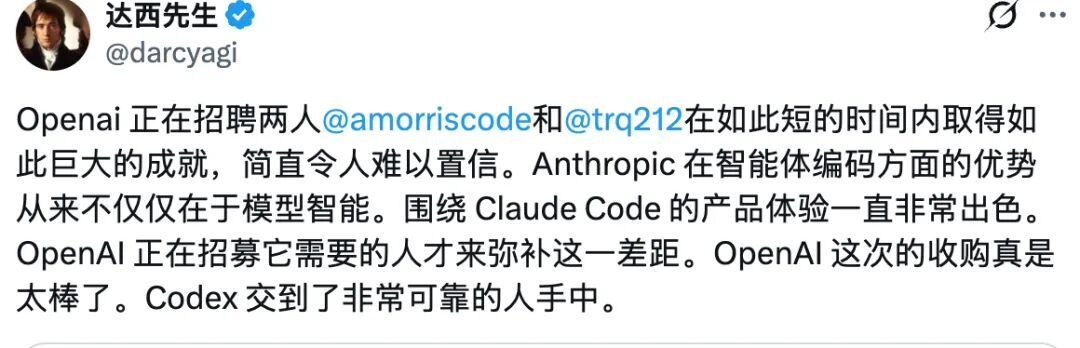
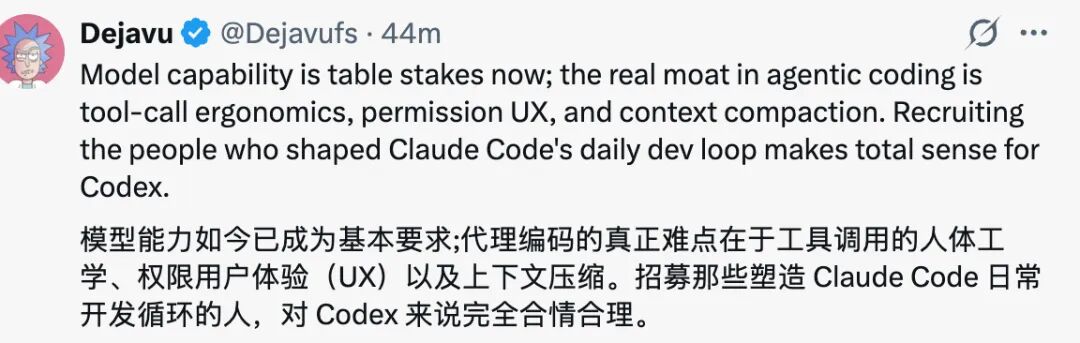
Claude Code is a key revenue growth engine for Anthropic, and also a critical lever for Anthropic to compete with OpenAI for the enterprise AI market. Now that the core members who helped it grow from an internal tool to a commercial product have left one after another, and OpenAI has absorbed the product lead among them, new changes may be brought to the competition between the two in the AI programming market.
Some people joked about Tibo, who once held the "reset button" of Codex, "You are the one collecting the Infinity Stones."
In One Month, Claude Code and Codex Accelerate in Different Directions
Since the end of October, there have been some comparable changes in the iterations of Anthropic and Codex: Claude Code focuses mainly on long-duration task execution, context maintenance, permission management and enterprise deployment; Codex pays more attention to multi-agent collaboration, workspace management, remote execution and interaction experience.
Claude Code: Let Agents Work Continuously and Run Safely in Enterprise Environments
On October 27, Claude Code improved the Write tool's handling of large CLAUDE.md and rule files, preventing the tool from overwriting the entire file after only reading the beginning of the file. On October 30, Claude Code added configurable write restrictions outside the working directory. When enabled, Write, Edit and NotebookEdit will refuse to modify files outside the working directory. At the same time, Anthropic added automatic context compression capabilities for idle sessions with more than 200,000 tokens in the VS Code and Claude Desktop Code tabs.
These two updates target the problems that must be solved when Agents enter complex engineering environments: when Agents need to continuously read and modify a large number of files, how to avoid damaging the original project structure? When tasks span a long period of time, how to retain the previous key information?
On November 6, Claude Code began to support background execution of MCP Tasks. When the MCP server runs a tool call as a task, Claude Code can immediately transfer it to the background without waiting for the tool to return results all the time. At the same time, Anthropic added permission control options, allowing to directly reject operations that require waiting for human authorization under specific circumstances, so that Agents can continue to execute according to pre-set security policies.
Later, Claude Code continued to improve enterprise management and task control capabilities. The new version added a confirmation mechanism before the GitHub App modifies the repository, improved the MCP configuration reading method, and centrally displayed abnormal Agents, Skills and command configurations on the status page. The version released on November 19 also expanded the support of Auto mode on platforms such as Amazon Bedrock, Google Cloud Agent Platform and Microsoft Foundry, and unified scheduled tasks, /loop wake-up records, task objectives and conversation branches into /tasks management.
On November 24, Anthropic further advanced the capabilities of MCP. Skills over MCP entered public beta, allowing MCP servers to provide professional knowledge, operation guidelines and multi-step workflows along with tools to Claude; Tasks and Elicitation were officially opened for use.
Among them, Tasks allows Claude to delegate time-consuming operations to the MCP server for background execution, and get the results after completion; Elicitation allows the MCP server to request additional information or operation confirmation from users during task execution, enabling Agents to pause execution and wait for user intervention when necessary.
This series of updates gradually forms a complete Agent execution mechanism: Agents can continuously run tasks in the background, load professional workflows on demand, request human approval at key operation nodes, and return results after the task is completed.
It is obvious that the product focus of Claude Code is shifting from improving the ability to complete a single programming task to solving how Agents can participate in real business processes for a long time, stably and safely.
Codex: Moving Towards a Multi-Agent Collaborative Workbench
In the same period, OpenAI is also accelerating the product iteration of Codex, but its public updates show another focus: how to let users manage multiple Agents at the same time and clearly grasp their execution status.
On October 26, OpenAI introduced GPT-6.1 Terra to Codex and ChatGPT Work. This model has visual understanding and computer operation capabilities, can understand screen and image information, and perform operations in browsers, desktops and applications. This also makes Codex's capabilities begin to go beyond the traditional code editing scenario.
On October 29, Codex CLI 0.166.0 added keyboard-driven conversation record selection, integrated search and shortcut key configuration. Subsequently, the Codex desktop further improved the session recovery mechanism after abnormal exit. When users re-open the application, they can choose to resume the interrupted task or keep it paused.
Codex CLI later added multiple Side Chat tabs, allowing users to switch between different conversation tasks, and re-open saved local conversations after restarting. This design eliminates the need for users to put all work in a single session, and provides a more direct interactive entry for parallel processing of different tasks.
On November 17, OpenAI introduced GPT-6.2 Astra and GPT-6.2 Sol to Codex. Among them, Astra is oriented to complex engineering tasks such as cross-codebase modification, implementation and testing, while Sol mainly handles daily programming and multi-step workflows. Through the division of labor of different models for different tasks, Codex begins to further cover different needs from daily development to complex engineering implementation.
The next day, Codex CLI added WebRTC negotiation capability for real-time voice calls, and began to support the use of MCP servers with the same name in different environments. The 0.171.0 version released on November 20 is a relatively important node: the TUI workspace becomes the default feature, where users can search documents, preview images and view Subagent execution records next to the main conversation. At the same time, Codex CLI added remote execution capability, which can connect to existing App Servers to start or resume non-interactive tasks.
On November 24, Codex CLI 0.172.0 continued to strengthen task navigation and multi-Agent management. Users can jump directly from search results and execution records to saved conversations and nested Agents, and can also switch between different task groups in the Agent Command Center. OpenAI also added the ability to specify approvers for individual connected application tools, enabling permission management to be further refined to specific tools.
It can be seen that Codex is integrating the execution process of multiple Agents into a unified workspace. Users can not only initiate different tasks at the same time, but also view the work records of sub-Agents, resume historical sessions, remotely control the execution process, and adjust permissions when needed.
The differences between the two products are gradually emerging: Claude Code emphasizes more on the reliability of the Agent execution environment, long task management and enterprise governance; Codex emphasizes more on the organization, visualization and remote collaboration of multi-Agent tasks. Of course, this does not mean that the two sides only develop in their respective fields, and the functional boundaries between the two are still constantly intersecting.
Talent Competition Begins to Affect Product Competition
For Anthropic, Claude Code is far more than an auxiliary programming tool for programmers. It not only directly brings subscription revenue, but also provides an important entry point for Anthropic to enter the enterprise market. Enterprises may initially purchase Claude Code for software development, and then gradually introduce products such as Claude API and Claude for Work into more business links.
The value of Claude Code to Anthropic also extends to the inside of the company. As of September 2026, more than 90% of the code contributions in the company's codebase were completed by Claude. The improvement of model capabilities drives the efficiency of Claude Code, and internal engineering efficiency in turn helps the company accelerate model R&D and product iteration, forming a mutually promoting cycle.
It is precisely because of this that the personnel changes of the Claude Code core team have attracted special attention.
On October 23, Anthony Morris ended his work at Anthropic. He said that he created the Claude Code desktop version, hoping to enable more people to become software creators. A day later, Thariq Shihipar also announced his departure. During his work at Anthropic, he participated in the development of Claude Code and shared the engineering practices behind the product in the developer community for a long time.
Subsequently, Cat Wu, the product lead of Claude Code, also left Anthropic. In this round of personnel changes, the key talent that OpenAI officially confirmed to obtain is Cat Wu. In early November, Cat Wu announced that she joined OpenAI to be responsible for product management in the Core Products team. She previously participated in the complete process of Claude Code from internal prototype to commercial product, and is familiar with developer needs, product iteration and enterprise usage scenarios.
Her joining has clear product strategic value for OpenAI. Cat Wu can bring her previously accumulated product experience to OpenAI. Compared with simply introducing an engineer, such talents are more directly related to product direction and user experience.
At the same time, Thariq Shihipar and Anthony Morris have also gained a lot of recognition in the developer community. Addy Osmani from the Google Chrome team thanked Thariq for helping a large number of developers use Claude Code more effectively; developer Christian Selig praised that the Claude desktop version created by Anthony has grown into a very excellent product.
Regarding the departure of the two, some developers believe that one of the important reasons for the success of Claude Code is the excellent team behind it; others believe that the codebase, engineering process and user base that the product has formed will not disappear immediately just because several members leave, and personnel mobility cannot be directly equated with a decline in product competitiveness.
However, the continuous loss of product leads, important engineers and desktop developers may still increase the pressure of team knowledge transfer and subsequent iteration. Especially in the stage of rapid evolution of Agent products, the understanding of developer needs, the judgment of product details and the accumulation of engineering practices are difficult to be completely replicated through code documents.
For OpenAI, absorbing talents such as Cat Wu provides Codex with the opportunity to further strengthen product experience and commercialization; Anthropic needs to ensure that the success of Claude Code has been precipitated into a sustainable organizational capability, rather than relying too much on a few key figures.
How Much Moat Does Claude Code Have Left?
Apart from talent competition, another pressure Claude Code faces comes from the AI programming market itself.
As AI programming tools such as Codex continue to upgrade their multi-agent collaboration, remote execution and complex task management capabilities, and open-source models continue to narrow the gap with cutting-edge closed-source models, competition among AI programming products is becoming increasingly fierce.
In the past, when developers chose AI programming tools, the most important thing was whether the model could accurately understand code and generate high-quality programs. But as model capabilities continue to improve, the pure advantage in code generation is becoming less and less solid. What really sets products apart is whether Agents can understand the entire codebase, independently complete cross-file modification, debugging, testing and code review, and maintain context and execution stability during long-running operations.
This is also the direction that Claude Code and Codex have continued to strengthen recently. The former improves the ability of Agents to perform complex engineering tasks through background tasks, MCP, Skills and long task management; the latter allows developers to schedule multiple Agents at the same time through the multi-agent workspace, task group management and remote execution. The two sides are shifting from competing on code generation quality to competing for the entry point of the entire software development process.
At the same time, open-source models are also bringing price pressure to this market. Some developers have proposed that with the continuous development of open-weight models and distilled models for specific programming tasks, enterprises may no longer need to pay high premiums for the limited capability advantages of closed-source models. As long as open-source models can complete most daily programming tasks, enterprises will be motivated to migrate part of their workload to lower-cost models.
In addition, model capability is not the whole of programming tool competition. Claude Code has accumulated developer usage habits, Skills, MCP connectors and workflows formed around the codebase. These experiences and ecosystems can constitute certain competitive barriers, but they are not necessarily unbreakable. As products such as Codex gradually improve similar capabilities, the cost for developers to migrate tools may also decrease.
For Anthropic, what really needs to be defended is not only the leading position of the Claude model in programming benchmark tests, but also the completion rate, stability and efficiency of Claude Code in real software engineering tasks. If Codex can provide similar engineering capabilities and form a better user experience with OpenAI's model and product ecosystem, the first-mover advantage previously established by Claude Code may be impacted.
The next competition in AI programming lies in who can make Agents take over software development work more reliably. From code generation to understanding projects, modifying code, running tests, and then delivering usable software, whoever can truly open up this entire chain will have the opportunity to build more lasting competitive barriers.
This article is from the WeChat Official Account "InfoQ" (ID: