How should the FDE respond when the boss asks to "add a feature as an afterthought"?
Having worked as a field delivery engineer (FDE) for algorithm projects for years, I have encountered a classic scenario in almost every single project.
It usually happens around the 8th week of the project, when the core workflow has just been debugged and connected, most of the data cleaning pitfalls have been resolved, and there are only about 10 days left before the initial acceptance. You are giving a phased demonstration in the client's large meeting room, the system on the big screen runs smoothly, the client's boss sitting at the main seat nods frequently, and his look is obviously much better than the previous two weeks.
Just as the meeting is about to come to a successful end, the boss picks up his thermos cup, takes a sip of tea, and says with a smile: "The performance is really good, very good. But look, can you add the cross-departmental contract comparison function by the way? I see your large model is so powerful, it must be a piece of cake for you, right?"
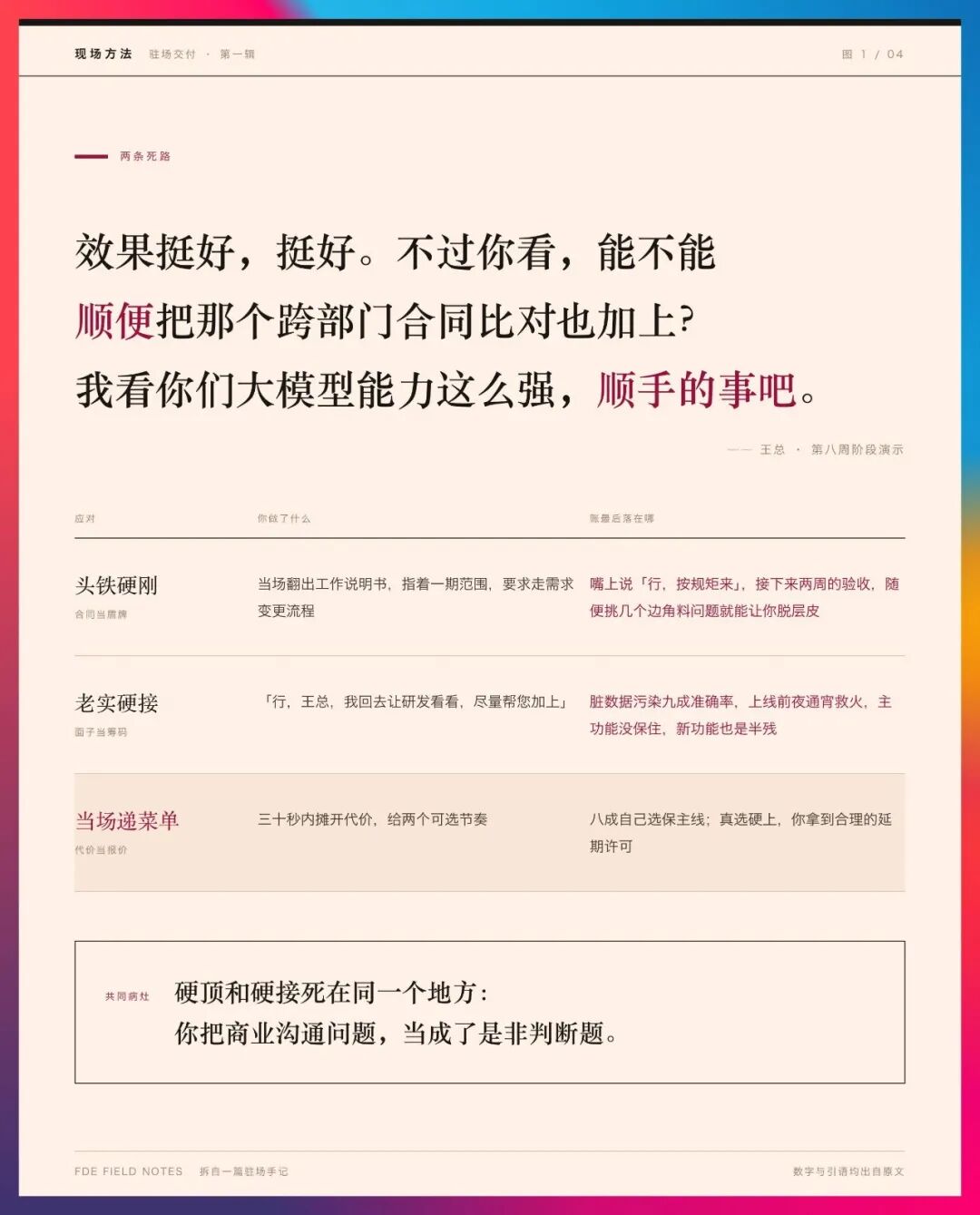
The air goes quiet for two seconds. The project manager of Party A next to you lowers his head and writes notes frantically, your delivery colleague behind you has already started to stare blankly, and the stable retrieval workflow and evaluation benchmarks in the backend flash through your mind in an instant.
In the first two years after I entered this industry, I have seen and personally experienced two most typical failure modes.
The first one is to confront the client head-on. You immediately take out the SOW in the contract, and tell the boss seriously: "Mr. Wang, this is not included in the Phase 1 delivery scope. If you want to add this function, we need to go through the requirement change process, and re-evaluate the construction period and cost." The words are correct and you are totally in the right, but the atmosphere in the meeting room drops to freezing point immediately. The boss says "OK, we'll follow the rules" out of his mouth, but he has already labeled you as "rigid" and "uncooperative" in his mind. In the next two weeks of acceptance, he can make you suffer a lot just by picking a few trivial edge issues.
The other mode is to take the request honestly without hesitation. You think it's inappropriate to reject the big boss face to face, so you grit your teeth and say: "Sure, Mr. Wang, I'll let the R&D team check it when I get back, and try my best to add this function for you." But after you break down the task, you find that the so-called "casual" function needs to connect to another set of old business database, where all the fields are unmatched dirty data. After you force this function in, the question-answering workflow that originally had an accuracy rate of over 90% is completely polluted. You work all night before the launch to fix the mess, finally the main function is not well preserved, and the new function is also half-broken, you end up getting no credit from either side.
After working as a FDE for a long time, I gradually realized one thing: Facing this "by the way" request, no matter you reject it head-on or accept it reluctantly, you have essentially fallen into the same trap — you treat a business communication problem as a true-or-false judgment question.
A truly experienced FDE never fights a defensive battle at this moment. You don't need to hold the contract as a shield in front of you, nor do you need to take the blame for the company aggrievedly. What you need to do is to translate the vague "by the way" request from the boss into a "trade-off" that he can understand within 30 seconds.
01 Figure out the subtext behind the "by the way" request
Many engineers get high blood pressure as soon as they hear "by the way", thinking that the boss doesn't understand technology and is giving random instructions. But from the boss's point of view, he really doesn't mean to deliberately make things difficult for you.
To non-technical managers, the system is just a black box. Adding one more button on the interface or one more column of analysis in the report only takes 1 centimeter of visual change, so he will naturally assume that the engineering workload behind it is also 1 centimeter. This illusion becomes even more serious in the large model era: the boss just generated an analysis report with a general chat tool on his mobile phone in 3 seconds yesterday, so today he will naturally wonder: why is it so difficult to add a function in the private deployment system that I spent millions on?
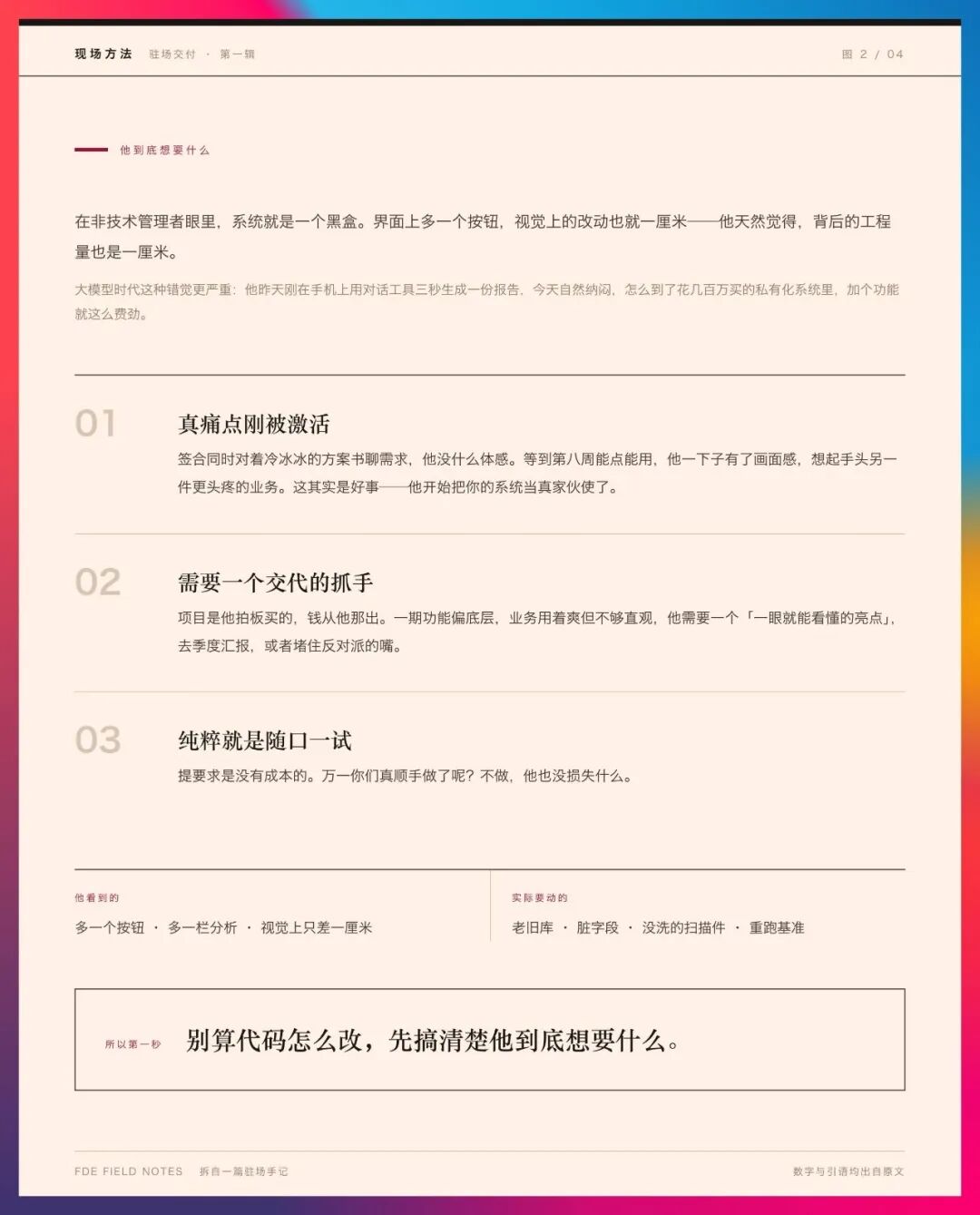
Apart from that, when the boss puts forward a "by the way" request on site, there are usually three real motives hidden behind it.
The first motive is that his real pain point has just been activated. When signing the contract, both parties discussed the requirements against the cold proposal document, and the boss had no real perception of the function. By the 8th week, when the usable system is really placed in front of him, he immediately gets a clear picture of the scenario, and suddenly remembers another more troublesome business he is handling, thinking that "this system seems to be able to help me solve this problem too". From a business perspective, this is actually a good sign, which means the client starts to take your system as a practical tool, not a decoration bought just to cope with the inspection from his superiors.
The second motive is that he needs a tangible handle to report to his superiors or internal teams. He is the one who approved the purchase of this project, and the money comes from his budget. Sometimes the originally planned Phase 1 functions are relatively underlying and efficiency-oriented, which are well received by the business department but not intuitive enough. The boss needs a "highlight that can be understood at a glance" to show to the senior management in the quarterly report, or to silence the opponents inside the company.
The third motive is just a casual test. In the business world, making a request costs nothing. He just asks casually, what if you really finish it easily? If you don't do it, he loses nothing.
As you can see, none of these three scenarios can be solved by reciting the contract terms. If you block him immediately with the scope boundary, or pour out all the technical hardships such as data governance, model fine-tuning and index reconstruction, the boss can't understand and doesn't want to listen. He will only think that you are making excuses to shirk the work.
Therefore, the first second you hear "by the way", don't rush to figure out how to modify the code, and don't rush to decide whether to accept or reject the request. Calm down first, bring the problem back to the business scenario, and make clear what he really wants.
02 Don't give a "yes" or "no" answer, give him a "menu"
The most taboo sentence for on-site response is actually "Mr. Wang, I have noted down this requirement, I will evaluate it and give you a reply later".
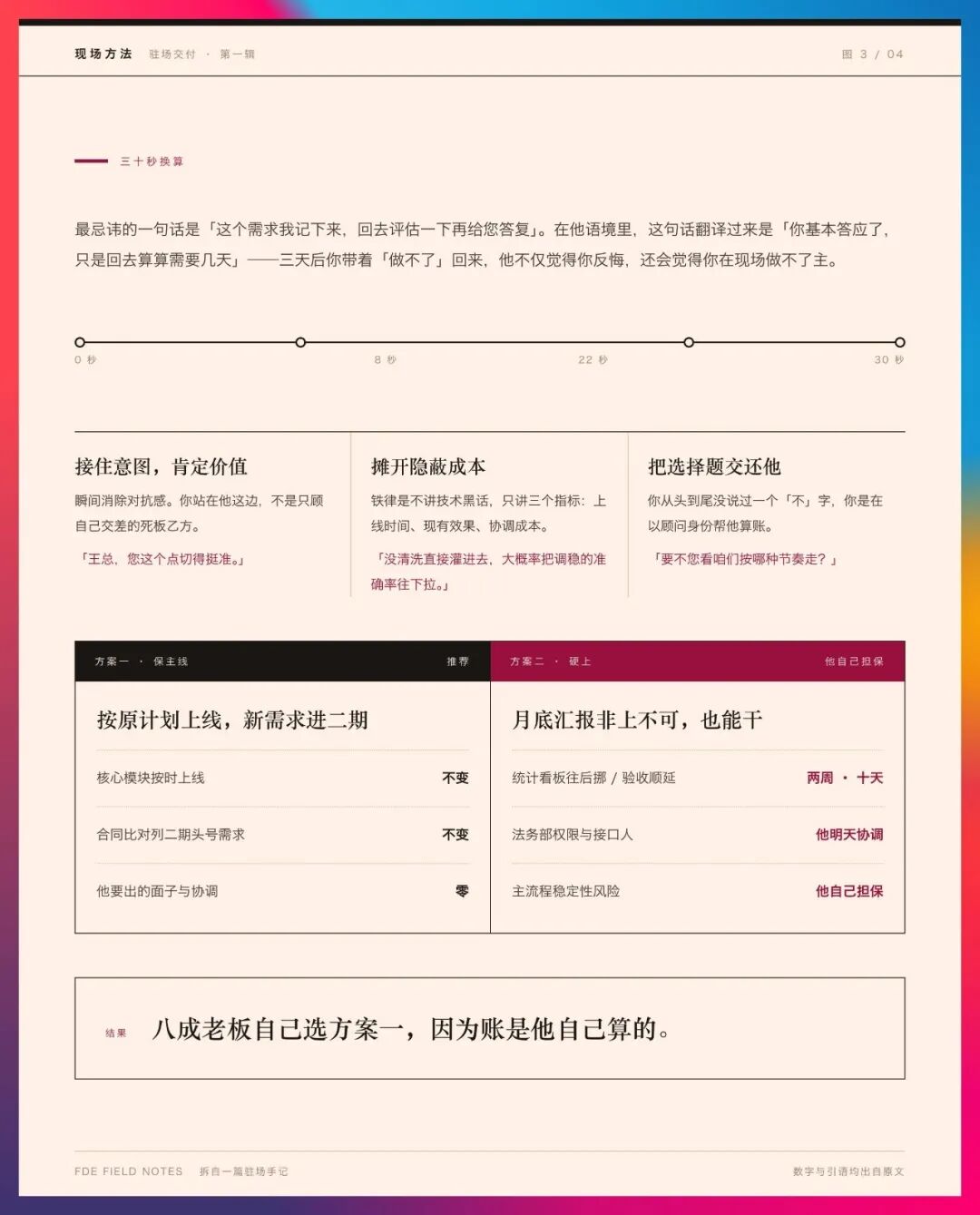
It sounds very safe, right? But in fact, you are burying a hidden danger for yourself. In the boss's context, "I'll evaluate it later" translates to "you basically agreed to this request, you just go back to calculate how many days it will take". When you come back to him 3 days later with the R&D team's objection and tell him "we can't do it", his psychological gap will be very large, he will not only think you are going back on your word, but also think you don't have the authority to make decisions on site, and later he will simply bypass you and directly put pressure on the senior management of your company.
My habit is that as long as it is not a very rare underlying architecture problem, I will give a response on the spot, but never give a closed answer of "yes" or "no", and directly hand over a "menu" to him.
It can be split into 3 specific steps, which can be finished in 30 seconds:
Step 1: Acknowledge his intention and affirm the value of the requirement
Just say: "Mr. Wang, you have pointed out a very accurate pain point. If we can connect the contract comparison function with the current approval workflow, it will be much more intuitive than just showing the contract terms during the report." The function of this sentence is to eliminate the sense of confrontation immediately. You stand on his side, prove that you understand his business demands, and you are not that rigid vendor who only cares about finishing delivery.
Step 2: Lay out the hidden cost on the table on the spot, but remember one iron rule — never use technical jargon
Don't say "we need to reconstruct the vector database", "the recall rate will drop due to noisy data", "the interfaces are too tightly coupled", the boss will get distracted as soon as he hears these words. You need to translate the technical cost into three indicators that the boss cares most about: launch time, existing performance and internal coordination cost.
I will say this: "However, this function seems to be just an extra comparison page, but in fact we need to pull the historical contracts from the old system of the legal department. The data formats of these contracts are not unified, and there are a large number of scanned copies. If we directly import them into our current knowledge base without cleaning, it will most likely reduce the already stable question-answering accuracy, and the main workflow will become unstable then."
After you make the situation clear and lay out the risks, the most critical third step comes: give the boss the right to make choices.
"How about we choose one of the following two plans?
Plan 1: We will follow the original plan first, launch the current stable core module on next Friday as scheduled, so that you can start using it as soon as possible; at the same time, I will mark the contract comparison function as the top priority of Phase 2, and I will check the data situation of the legal department for you next week, then output a clear construction period and solution.
Plan 2: If this function must be launched before the end of the month for your report, we can also make it, but we need to postpone the originally scheduled statistical dashboard for two weeks, or delay the overall acceptance for 10 days. In addition, we need you to help us coordinate the data permission and contact person of the legal department tomorrow.
Which one do you think is more appropriate?"
The beauty of this method is: you never said a "no" word from beginning to end, you are just helping him calculate the cost as a professional consultant.
Most mature bosses, after hearing these two options, will choose Plan 1 by themselves in most cases. Because once the costs such as main workflow delay, existing performance degradation, and the need for him to coordinate data permissions with other departments are laid out, he knows better than you which is more important. And the most important thing is, this is the decision he made after weighing the pros and cons, not forced by you with the contract, so he will be totally convinced.
Even in the worst case, if the boss grits his teeth and says: "Never mind, the end-of-month report is too important, let's go with Plan 2, I will call the legal department myself this afternoon!" Then you don't lose at all, on the contrary you gain a lot — you get the reasonable delay permission on the spot, you get the cross-department data permission that you could never push forward before, and you even raise your say in the project to a higher level.
03 The real tricky thing is not the boss, but the unfinished mess after "half-agreed" requests
Many times, everyone is happy after the discussion in the meeting room, but the real hidden danger is hidden after the meeting.
The first type of hidden danger is "message distortion". The boss clearly chose Plan 1 in the meeting, nodded and agreed to put the new function in Phase 2. But two days later, the business supervisor of Party A who is responsible for specific docking @ you in the project group: "How is the development of that contract comparison function Mr. Wang mentioned last time? We need it for the report next week."
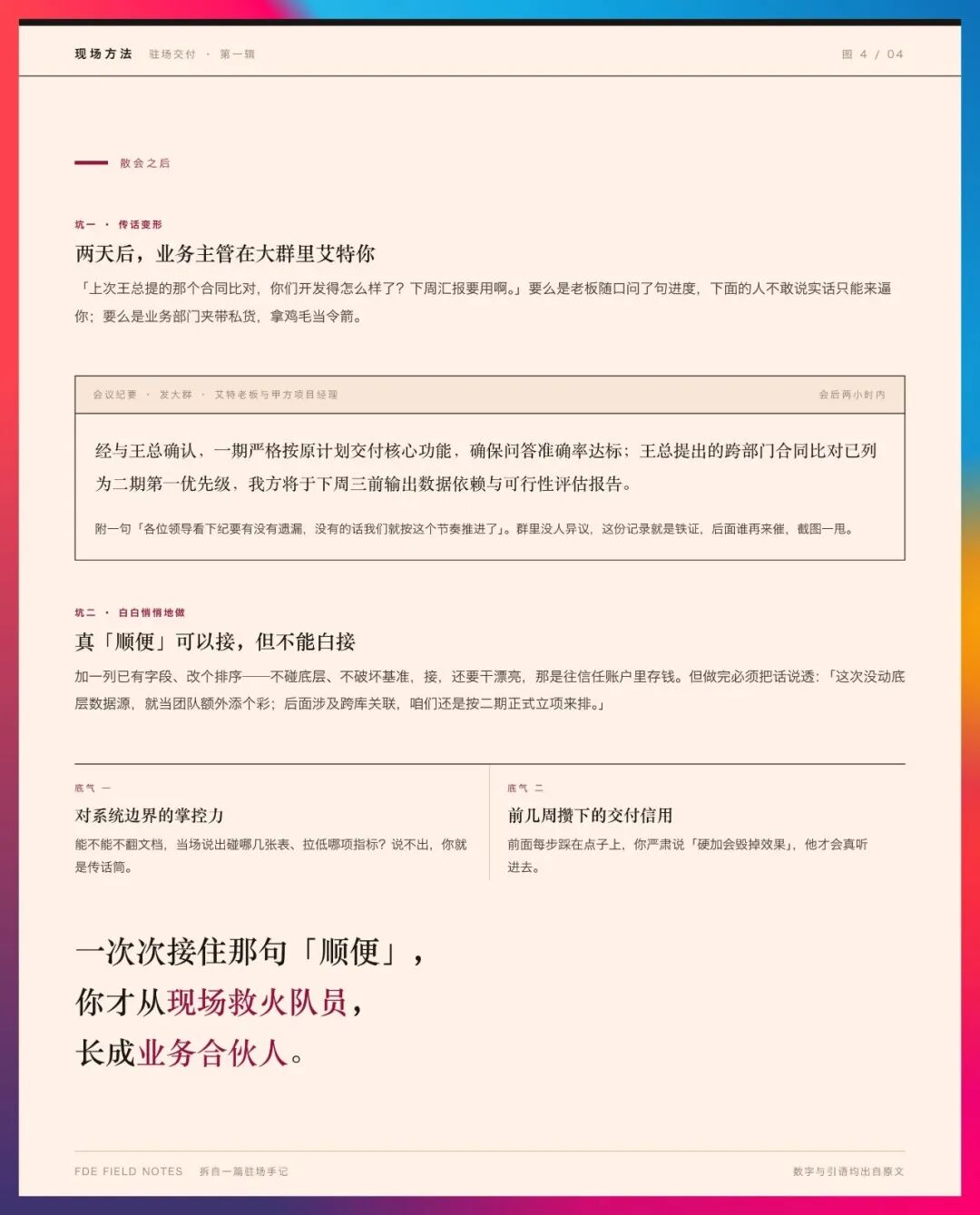
This kind of thing is very common in field delivery projects. Either the boss casually asked about the progress, and his subordinates dare not tell the truth, so they come to force you; or the business department takes the opportunity to add their own private demands, using the boss's words as a false mandate.
To prevent this kind of hidden danger, what you need is not to quarrel with others in the group afterwards, but the meeting minutes within two hours after the meeting.
Many FDEs are too lazy to write meeting minutes, thinking that it is the project manager's job; but at key nodes, the minutes are your amulet. You don't need to write a long document, just write 3 to 5 points, and clearly record the transaction structure reached on site in black and white: "Confirmed with Mr. Wang, Phase 1 will strictly deliver the core functions on [specific date] according to the original plan, to ensure the question-answering accuracy meets the standard; the cross-departmental contract comparison function proposed by Mr. Wang has been listed as the first priority of Phase 2, our team will output the data dependency and feasibility assessment report before next Wednesday."
Send it directly to the group, @ the boss and Party A's project manager, with a note: "Leaders, please check if there is any omission in the minutes, if not, we will move forward according to this rhythm." As long as no one in the group raises any objection, this record becomes ironclad evidence. Later, when anyone comes to urge you, you just send the screenshot of the minutes, which is decent and saves you a lot of trouble.
04 What if the requirement is really a small modification?
For example, just adding an existing field to the exported report, or modifying the sorting logic of the frontend display. It doesn't touch the underlying data, doesn't damage the evaluation benchmark, and the R&D team or even you yourself can finish it steadily in two or three hours. For this kind of real "casual" work, should you accept it or not?
My principle is very clear: accept it, and finish it perfectly.
Field delivery is not a one-off deal where both parties owe nothing to each other after signing. People need a "trust account" between each other. On the premise of not affecting the bottom line, you casually help the boss solve a small pain point, make him look good in the report, this favor will be returned to you double later when you encounter data delay, environment failure or payment collection urging.
But there is a strict rule here: you can do it, but never do it "quietly and for free".
Some engineers are too honest, they work overtime for 3 hours at night to finish the modification and launch it, and the next day they just send a light sentence in the group "it's done". There are two disadvantages of doing this: first, the boss doesn't know you paid extra cost at all, and he thinks "it really can be done casually"; second, you have opened the Pandora's box by yourself, all kinds of weird "by the way" requests will come to you like snowflakes later.
The correct approach is to make full use of this favor, and at the same time draw a clear boundary. After the function is launched, talk to the boss face to face or send him a separate message clearly: "Mr. Wang, that view adjustment you mentioned last time, we worked overtime last night to add it for you, you can use it directly for the report on Monday. Since we didn't modify the underlying data source this time, it won't affect the stability of the main system, so our team did this as an extra bonus for the project. Later, if it