The total size of A-share repurchase and stake increase plans has reached nearly 100 billion yuan, how will the funds be allocated?
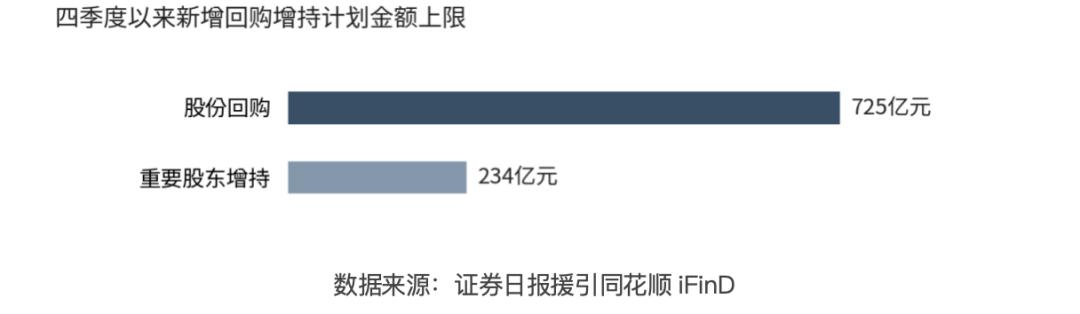
On November 25, *Securities Daily* cited data from Tonghuashun iFinD and reported that since the fourth quarter, 303 new share repurchase plans have been launched on the A-share market, with the proposed maximum repurchase amount reaching about 725 billion yuan; 242 new important shareholder share increase plans have been announced, with the proposed maximum share increase amount reaching about 234 billion yuan. The total of the two amounts stands at around 959 billion yuan.
This set of data comes against the backdrop of the continuous improvement of the A-share listed company share repurchase system and the further strengthening of the policy on re-lending for share repurchases and increases. Starting from November 4, the interest rate of the relevant re-lending has been cut to 1%, and the conditions for financial institutions to provide financial support to listed companies and their major shareholders have been improved.
However, the 959 billion yuan is neither capital that has already flowed into the stock market, nor a sum of money paid uniformly by listed companies. Share repurchases and share increases involve different capital contributors, changes to balance sheets and shareholder rights and interests respectively. For investors, what matters more than the planned scale is how these funds will be used in the end, and what they can bring to the long-term operation of the company and shareholder returns.
959 Billion Yuan Is Actually Two Separate Capital Accounts
According to the above statistics, the maximum amount of new repurchase plans in the fourth quarter accounts for about 75.6% of the total of the two items, and important shareholder share increases account for about 24.4%. Repurchase is the larger part of the two, but the two cannot be confused.
Listed company share repurchase usually refers to the company using its own funds or funds raised in accordance with the law to purchase its own shares. Purchasing shares requires cash payment, and the changes in capital cost and balance sheet are borne by the company, and the shares need to be disposed of later according to the purpose of the repurchase.
Important shareholder share increase means that the shareholder contributes funds to purchase shares of the listed company. If the transaction takes place on the secondary market, the funds are paid to the investors who sell the shares, and do not directly enter the operating account of the listed company. The company will not directly increase its registered capital or obtain new operating funds due to the shareholder's share increase.
Therefore, the 725 billion yuan corresponds to a series of capital allocation plans at the company level, and the 234 billion yuan corresponds to the own investment arrangements of important shareholders. For ordinary investors holding stocks, for repurchases, they mainly need to study the company's capital sources and share purposes, while for share increases, they need to pay attention to the entities that increase their holdings, the actual investment and the changes in shareholding ratio.
Another difference lies between the planned amount and the actual transaction amount. Some announcements set upper and lower limits for repurchase amount, upper price limits and implementation periods. After the plan is disclosed, the company still needs to implement it in accordance with the corresponding rules and disclose the transaction progress. Shareholders' share increase also requires actual purchase to form a real transaction.
Nearly Half of Repurchases Are For Cancellation, Where Does The Repurchased Money Finally Go?
On November 2, the China Securities Regulatory Commission (CSRC) disclosed that in the first 10 months of this year, 645 listed companies on the Shanghai and Shenzhen stock exchanges announced 700 repurchase plans, involving an amount of 237.7 billion yuan. Among them, the amount of repurchases for cancellation purposes was 115 billion yuan, accounting for about 48.4%. In the same period, 747 companies actually implemented repurchases totaling 134.5 billion yuan.
It is worth noting that the companies that actually implemented repurchases are not exactly the same as the companies that added new plans in the current period, and some actual transactions may correspond to the previously disclosed plans. Therefore, it is not possible to directly divide 134.5 billion yuan by 237.7 billion yuan to determine the completion rate of new repurchase plans in the first 10 months.
In accordance with the current *Rules on Share Repurchases of Listed Companies*, repurchased shares can be used for purposes including reducing registered capital, employee shareholding or equity incentive, convertible bond conversion, and maintaining corporate value and shareholder rights and interests for qualified companies.
Cancellation-based repurchases and incentive-based repurchases undertake different tasks. The former reduces the total share capital by canceling shares, so that the proportion of rights and interests corresponding to the remaining shares increases; the latter can provide a source of shares for employee shareholding or incentive plans, helping enterprises to establish a long-term incentive mechanism linked to operating performance.
For incentive-based repurchases, factors including vesting conditions, employee payment prices, performance assessment and share-based payment expenses need to be examined in the future. For cancellation-based repurchases, it is necessary to observe how many shares have been purchased, when the cancellation procedures will be handled, and how much funds the company has paid for this.
When The Number Of Shares Decreases, How Will Earnings Per Share And Net Assets Change?
Why do cancellation-based repurchases attract investors' attention? This can be illustrated through a hypothetical operating account.
Assume that a company has a total share capital of 1 billion shares, an annual net profit of 1 billion yuan, and shareholder equity of 100 billion yuan. In simplified calculation, the earnings per share is 1 yuan, and the net asset per share is 10 yuan.
If this company purchases and cancels 100 million shares, the remaining share capital becomes 900 million shares. Under the static calculation based on the number of shares after cancellation, assuming that the net profit is not affected by the capital expenditure, the earnings per share becomes about 1.11 yuan, about 11.1% higher than the original figure. However, the company has not earned an extra 100 million yuan for this, and the change comes from the reduction in the number of shares that share the profits.
The result of net asset per share depends on the purchase price instead. If the above repurchase is completed at 8 yuan per share, the company pays 800 million yuan, the shareholder equity is correspondingly reduced to 92 billion yuan, and the net asset per share is about 10.22 yuan. If the same number of shares is purchased at 12 yuan per share, the company pays 1.2 billion yuan, the remaining shareholder equity is 88 billion yuan, and the net asset per share is instead about 9.78 yuan.
This is a hypothetical calculation example that ignores transaction costs, other equity changes and financing impacts. The basic earnings per share in the actual financial report also needs to be calculated according to the weighted average number of common shares outstanding, and the time of share repurchase will also affect the current period indicators.
This example shows that the reduction of share capital does not mean that every financial indicator will improve. The repurchase price, repurchase scale and the cost of the funds used are all related to the economic benefits obtained by the remaining shareholders. The net asset per share itself is not equivalent to the intrinsic value of the company, and still needs to be judged in combination with future profitability.
If the company spends a sum of money that could have been used for high-return projects, the future net profit may be affected. On the contrary, if the company has sufficient idle cash, lacks suitable reinvestment opportunities, and can repurchase shares at a reasonable price, the repurchase will have the opportunity to improve capital use efficiency.
With The Re-lending Interest Rate Cut To 1%, What Accounts Should Enterprises Calculate When Borrowing Money For Repurchases?
The source of funds is another change worthy of attention for repurchases and share increases in the fourth quarter of this year.
The People's Bank of China announced on November 4 that from the same day, it will cut the interest rate of re-lending for share repurchases and share increases by 0.25 percentage points to 1%. The supporting targets include 21 national banks and 5 systemically important city commercial banks. The re-lending policy has previously been clearly transformed into a long-term institutional arrangement.
The central bank also disclosed that after the relevant symposium on November 2, the re-lending quota demand declared by banks to the central bank has exceeded 200 billion yuan. This is the capital demand put forward by financial institutions to the central bank, not the loans already obtained by listed companies, let alone the amount of stock purchases that have been completed.
*Securities Daily* reported on November 25 that according to its statistics, 125 listed companies (counted by times) have received special loan commitment letters for share repurchases and share increases, with a total maximum quota of 27.6 billion yuan. There is also a difference between the commitment letter and the actual loan disbursement, and the specific situation depends on whether the borrower meets the withdrawal conditions, the withdrawal scale and the progress of fund use.
The 1% interest rate is the rate at which the central bank provides re-lending to qualified banks, not the final borrowing rate obtained by each listed company or important shareholder. Banks can add appropriate point premiums, and the loan term and actual interest rate are determined by the relevant financing arrangements.
For listed companies, the reduction of financing cost helps to broaden the options for capital allocation, but borrowing for repurchases will still form the obligation to repay principal and interest. If the controlling shareholder borrows money to increase its shareholding, the debt repayment obligation is usually borne by the borrowing entity, and cannot be simply included in the interest-bearing liabilities of the listed company.
Therefore, to evaluate a repurchase supported by debt financing, it is necessary to study the actual loan cost, the company's profitability, operating cash flow and maturing debt arrangements at the same time. Even if the borrowing cost is relatively low, it is necessary to compare the value created by using this sum of money for other purposes such as investment in R&D, equipment upgrading, and repayment of existing debts.
What Matters More Than The Repurchase Amount Is The Company's Capital Allocation Capability
In November 2024, the CSRC issued the regulatory guidelines for market value management, taking improving the quality of listed companies as the basis for carrying out market value management, and requiring enterprises to use tools such as dividends, repurchases and equity incentives in accordance with the law in light of their own conditions. Repurchase is not an independent goal separated from the operating fundamentals.
The profits of enterprises need to be converted into cash to continuously support shareholder returns. For a manufacturing enterprise in the capacity expansion period, building new production lines and supplementing working capital may be more urgent; for an enterprise with mature operation and relatively stable capital expenditure demand, cash dividends or share repurchases may become the choice to distribute surplus funds.
Cash dividends directly provide shareholders with cash income; repurchases pay funds to investors who sell shares through market transactions, and repurchase cancellation may also change the proportion of rights and interests of remaining shareholders. Both are capital allocation tools, and there is no superiority or inferiority ranking separated from the specific situation of the enterprise.
Reading and understanding repurchase announcements can be carried out from four aspects. First, check the upper and lower limits of funds, price constraints and implementation period of the plan, to distinguish between the plan and the actual transaction; second, check the purpose of the shares and subsequent disposal, to pay attention to whether the arrangements for cancellation, incentive or other purposes are fulfilled; third, check the source of funds, and judge the operating cash flow, available cash and interest-bearing liabilities in combination with the financial statements; finally, track the repurchase progress, completion announcement and actual cancellation registration, to confirm what the company has finally implemented.
The nearly 1000 billion yuan of repurchase and share increase plans since the fourth quarter provide a new data node for observing the capital allocation of A-share listed companies and their important shareholders. What really needs to be tracked in the future is how much of the plans have been fulfilled, how many shares have been cancelled, and whether the cash generated from operations can continuously support these arrangements.
The most valuable commitment of a listed company to its shareholders is ultimately to continuously create operating profits and allocate limited capital to places that can generate long-term returns. Repurchase can be part of this process, but it cannot replace the profitability of the enterprise itself.