"I saw Nvidia's future earlier than Jensen Huang," the godfather of AI hit back at Jensen Huang, pointing out bluntly that mass unemployment is a side effect of AI giants reaping profits.
"He said all my predictions were completely wrong, but as early as 2009, I told thousands of machine learning researchers that if they wanted to work on neural networks, they had to buy NVIDIA chips. Jensen Huang did not make this prediction until 2012."
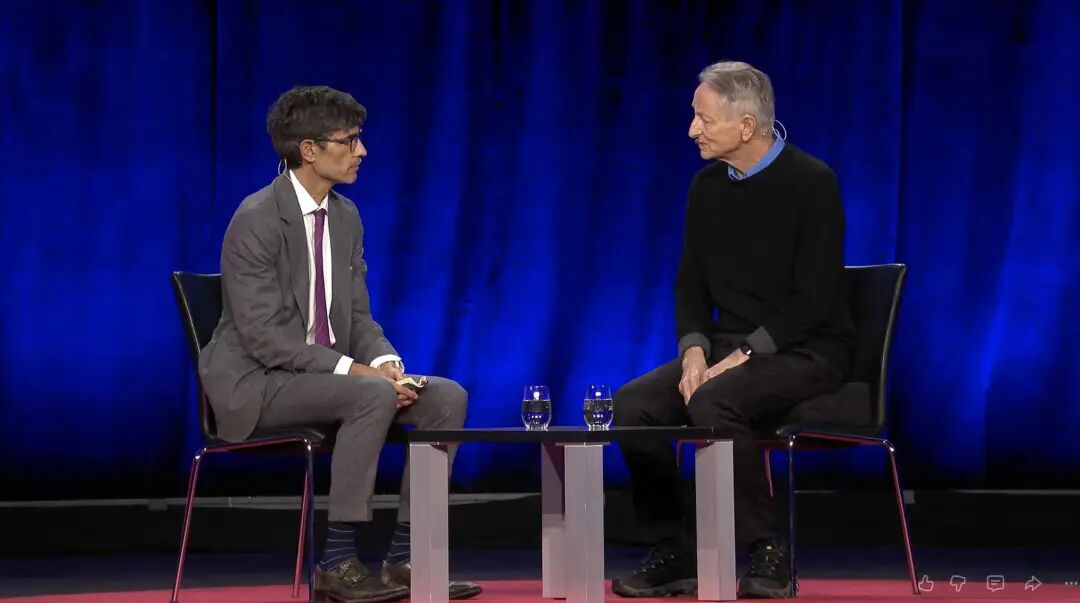
In a latest public dialogue, Nobel Prize laureate and "Godfather of AI" Geoffrey Hinton rarely hit back directly at Jensen Huang.
Previously, Jensen Huang criticized Hinton for being irresponsible in promoting the risk of AI leading to human extinction, claiming that it would make people fear the technology. Hinton responded tit-for-tat: if such a risk does exist, choosing not to speak out about it is the real irresponsibility.
Of course, Hinton does not shy away from the mistakes he has made in the past. He admitted openly that his previous prediction that radiologists would be replaced by AI not only overestimated the development speed of computer vision, but also underestimated the complexity of this profession.
However, what is more noteworthy than the cross-exchange between the two heavyweights in the tech industry is that this scientist who has been working with neural networks for 50 years has put forward many sharp judgments on the current development of the AI industry.
In his view, the speed of model development has exceeded the speed at which humans can understand models; large-scale unemployment is not the original intention of AI company leaders, but a side effect of their pursuit of profits; nothing in the human mind cannot be replicated by machines, and machines can even possess the cognitive dimension of emotions without having the corresponding physiological responses.
He also targeted the current reinforcement learning method for AI Agents, saying bluntly that the practice of training Agents to pursue their respective individual goals is "completely crazy".
Throughout the dialogue, what moved the host the most was the four English words Hinton gave. When asked, if one day superintelligence truly achieves recursive self-improvement (RSI), and humans can only input one highest-priority moral instruction for it, what would he say?
Hinton hardly hesitated: "Be nice to people."
Behind this is one of his important judgments: Making AI smarter and making AI kinder may be two nearly orthogonal technical directions. If this judgment holds, even if China and the United States are in fierce competition in AI intelligence level, it is possible to jointly study how to make AI treat humans better without revealing their respective core technologies.
When global tech giants are scrambling to build machines smarter than humans, Hinton tries to question a problem that has been squeezed to the edge by commercial competition: what kind of intelligence are we creating exactly? Will it become an existence that humans are willing to share this planet with?
The following is the complete dialogue, translated and sorted out by AI Front without changing the original meaning.
Risks and Challenges of AI
Host: As everyone knows, Jeff helped create the neural network architecture, which has largely driven us to where we are today. For a long time, he has also been farsightedly warning people about the risks brought by AI. Jeff, let's start here. Among all the AI risks we are currently facing, which you have talked about for a very long time, how would you rank these risks? What are you most worried about? Which risks are we most capable of dealing with?
Geoffrey Hinton: What I talk about the most is the existential threat brought by AI replacing humans. But I don't think this is the only major risk, and people seem to think that I only focus on this point.
In fact, there are many other very serious short-term risks. For example, malicious actors use AI to launch cyberattacks, create biological viruses, or use deepfakes to manipulate elections. There are also some risks that do not arise from people deliberately doing bad things, but are negative side effects of certain behaviors. For example, failure to check carefully enough whether chatbots will behave in certain ways leads them to encourage teenagers to commit suicide. There is also the risk of large-scale unemployment.
I don't think leaders in the AI industry intend to cause large-scale unemployment. I think this is a side effect of their attempts to make huge profits.
Host: Alright, that's a really pleasant opening, Jeff. I want to ask you about the existential risk issue. You started talking about this a long time ago, and now everyone is discussing it.
Jensen Huang gave an interview two weeks ago. He said that Hinton's claim that there is a 10% probability of human extinction is an irresponsible act. He raised two criticisms. First, we have no idea what this percentage is, and everyone is just guessing. The second point is more interesting, that is, such remarks will make people feel afraid of this technology, so they will be unwilling to use it to create good things. How would you respond to Jensen Huang?
Geoffrey Hinton: I think if you believe that there really is such a risk that if we do nothing, these things could destroy us, then not speaking out about this risk is very irresponsible.
I think claiming that the risk is zero is irresponsible. And I remember that is exactly what he said. He said that by 2030, this risk will be zero. He also said that all my predictions are wrong.
I did make a well-known wrong prediction, and I admit that. I once said that by now, radiologists should have disappeared. But they have not disappeared, and there are still many radiologists now. However, I have made some other predictions that I think are much more accurate. For example, 50 years ago, I predicted that neural networks would replace symbolic AI. In 2009, at the NeurIPS conference, in front of about 1000 machine learning researchers, I also predicted that if they wanted to do neural network research, they had to buy NVIDIA chips. And Jensen Huang did not make this prediction until 2012. So when he said all my predictions were wrong, I thought that was a bit too much.
Host: I know that back then, in the face of many opponents, you still insisted on and predicted the development of this technical architecture. And it is this architecture that allowed him to build the company with the highest market value in the world. So it is indeed unfair to say that all your predictions are wrong.
Geoffrey Hinton: Yes.
Host: Then why was your prediction about radiologists wrong?
Geoffrey Hinton: There are many reasons. First of all, I did not intend to make such a prediction publicly at that time. I was giving a lecture in a hospital that was providing treatment for my wife who had cancer. So when they invited me to give a lecture, I felt I should agree. I thought the audience was only a few doctors, so I blurted out that sentence on the spot.
Half of it was a joke at the time. But obviously, this sentence spread quickly later, which was a bit unfortunate. However, I did make a wrong judgment for several reasons. One of the reasons was that computer vision did not develop as fast as I expected. Although now, for many types of cancer, neural networks have performed better than excellent radiologists, or at least as well as them. That's the first reason.
The second reason is that I once had a graduate student who had a medical doctor's degree, but later he found that he actually did not like dealing with patients. So he pursued a PhD in physics under my supervision. Later, he became a radiologist in Alberta, Canada. His job was to sit there and look at scan images, never talking to patients, because he actually did not like dealing with sick people. He is actually a very charming person, he just does not like interacting with ill people. Therefore, my cognitive model of radiologists in my mind was someone like him - a person who only looks at scan images.
Host: Does he still have a job now?
Geoffrey Hinton: That's another long story. He has retired, now lives in New Zealand, and even changed his name, so he is fine.
After 50 Years of Research on Neural Networks, Can We Truly Understand the AI Black Box?
Host: You created this architecture, and you built it in a way similar to the human brain. Information enters the system, passes through the neural network, and then backpropagates. We won't discuss in detail how all this works today. What I want to ask you is that people who worry about AI often say that one of the reasons why we should worry about AI is that we don't know exactly what is happening inside the black box. We can't see what's happening at the level of individual neurons. Is it possible for us to truly understand what's happening inside the machine in the future?
Geoffrey Hinton: Well, I have 50 years of experience observing neural network weights and trying to figure out what's going on inside them.
Host: That's exactly why you are the person in the whole world that I most want to ask this question to. I have asked many people this question, but no one can give an answer with full confidence. And you are the person who has invested the most time on this issue.
Geoffrey Hinton: For example, if your input is pixels, and you have some feature detectors responsible for looking at these pixels, then you can figure out what these feature detectors are doing. Because you can see the weights connected to these pixels, and then you can say, this feature detector likes bright pixels to appear here, and dark pixels to appear there. These things are understandable.
If you look at the weights connected from the last hidden layer to the output layer, you can also understand them. Because you can say, this feature detector tries to activate cats, dogs and rabbits, while trying to suppress refrigerators and garbage trucks. You can understand what it is doing to a certain extent. But if you look inside the neural network, I don't think we will ever be able to fully understand them thoroughly.
However, there are different levels of understanding. For example, if you ask a physicist: Do you understand what is happening when a leaf falls from a tree? The physicist will say, yes, I understand why the leaf swings like this, and why it flutters in this direction or that direction when there is a breeze. But if I ask him, can you predict where exactly this leaf will land on the ground? The physicist will say: "No, we will never be able to predict that."
Similarly, I think we can understand a lot of things happening inside neural networks, but we may never be able to accurately explain why it gives this specific answer to this question. Because this answer depends on the exact values of a trillion different weights. I don't think we will eventually get a much simpler explanation.
Host: Then, do you think our understanding of models is improving faster than the growth of model capabilities and scale? Or are the capabilities and scale of models expanding faster than our ability to understand them?
In other words, leaves are falling faster, in many different ways, and the tree itself is becoming more complex. Is our understanding of it improving at the same speed as the growth of complexity?
Geoffrey Hinton: I don't know the answer to this question. I haven't kept up with the latest research from Anthropic, who may be doing the best Mechanistic Interpretability research right now, and they are indeed making progress. However, the progress they have made is mainly like this: I can tell you that these few training samples have a great impact on why the model said that sentence. They can get this level of understanding. If you remove those training samples, the model probably would not have said that sentence. But they don't really understand every detail of what's happening inside. I think models are developing faster than we can understand them.
Host: Then do you think further understanding of the internal mechanism of models is an important step towards a safer situation?
Geoffrey Hinton: I think if we can really understand what's happening inside, that will certainly help. But I don't think that's the most critical thing.
Host: Then what is the most critical thing?
Geoffrey Hinton: I think the most critical thing for the public right now is to understand the fact that these things really understand what they are saying. A lot of people think they don't understand what they are saying. Yesterday, I had a conversation with Cory Doctorow. He thinks these things don't understand what they are saying. I think he is completely wrong. We agree on many other things, but on this issue, I think it is obvious that they do understand what they are saying.
I think one way to illustrate this is that you can ask them any question, and they can answer it. The idea that they can answer a question without understanding the question seems crazy to me. Now, some people say they use some strange statistical tricks and just leverage a huge amount of data. I don't believe that. You have to understand a question to be able to answer it.
Host: Do you think there is anything in the human mind that these machines cannot replicate?
Geoffrey Hinton: No.
Host: Then, is there any human emotion that these machines cannot replicate? For example, can a machine feel embarrassed?
Geoffrey Hinton: Well, when we talk about human emotions, I divide emotions into two aspects. This view can be traced back to William James. One is the physiological level, and the other is the cognitive level. For example, when you feel embarrassed, your face turns red. Of course, I think we can also design machines to do that. But usually, machines will not blush because they feel embarrassed.
However, they can possess all the cognitive characteristics of an emotion. For example, when a machine feels embarrassed, it may try to avoid falling into this situation again in the future, and also hope that other machines it likes do not see it in such a situation. So I think we can make machines possess the cognitive dimension of emotions without having the physiological dimension of emotions.
Can Embodied Knowledge Also Be Learned by AI?
Host: Then how do you think about the way machines acquire knowledge? I receive information in many different ways, right?
I read texts, taste food, and play football. As I keep playing football, my brain gradually learns things that I cannot express in words, which allow me to kick a curved ball. I also play the guitar. I memorize how to play through the movement patterns of my fingers, not through the notes I have written down. Can all this Embodied Knowledge enter the AI model?
Geoffrey Hinton: Of course. However, to acquire this embodied knowledge, you may have to have a physical body. But I see no reason to think that if you build the right muscles and the right actuators, it cannot learn all this kind of knowledge.
Host: Now let's move on to one of the most important issues today: consciousness. If machines can feel, perceive and receive all the information we can receive, can they have consciousness just like us?
Geoffrey Hinton: Well, I want to state one point first. Many of the views I talked about earlier regarding risks are actually quite reasonable. But for the answer to the next question, most people may think I am crazy. Please don't negate everything else I said just because you think my views on the consciousness issue are crazy.
Host: That's such a wonderful preamble. Jeff, please go ahead.
Does Multimodal AI Already Possess Human-like Experiences?
Geoffrey Hinton: There is a well-known condition that some people get after winning the Nobel Prize, called "Nobelitis". That is, they start making weird remarks about consciousness. I think almost everyone holds a wrong cognitive model of what the mind is, what consciousness is, and what subjective experience is.
Now, instead of talking about consciousness, I would rather talk about Subjective Experience, because that can better touch on exactly where we went wrong. Most people think...
Host: Wait a minute, sorry to interrupt you. Do you mean that the subjective experience you define is equivalent to consciousness?
Geoffrey Hinton: I am not saying the two are equivalent. I just say that if you hold a wrong cognitive model of what subjective experience is, then the discussion about consciousness will be greatly affected. So first we need to figure out what subjective experience is and what it is not.
Most people's cognitive model is roughly like this: there is an internal theater called "my mind". When I see that glass, the first thing that happens is that an inverted image appears on my retina. Then various activity patterns appear in my visual cortex. Then, somehow, a subjective glass appears in my mind, and that glass is the thing I really experience.
I think this whole cognitive model is completely crazy. What I really experience is the glass in front of me. The way I experience it is through the image on the retina and various activity patterns in the visual cortex. But what I