General large models have already burst onto the scene. How much longer can embodied intelligence hold on, relying solely on "prolonging its lifespan via fine-tuning"?
Recently, the embodied intelligence industry has been in a state of unrest.
On November 13, OpenAI announced that it had disbanded its independent robotics research team and integrated the relevant personnel into the general-purpose model R&D system.
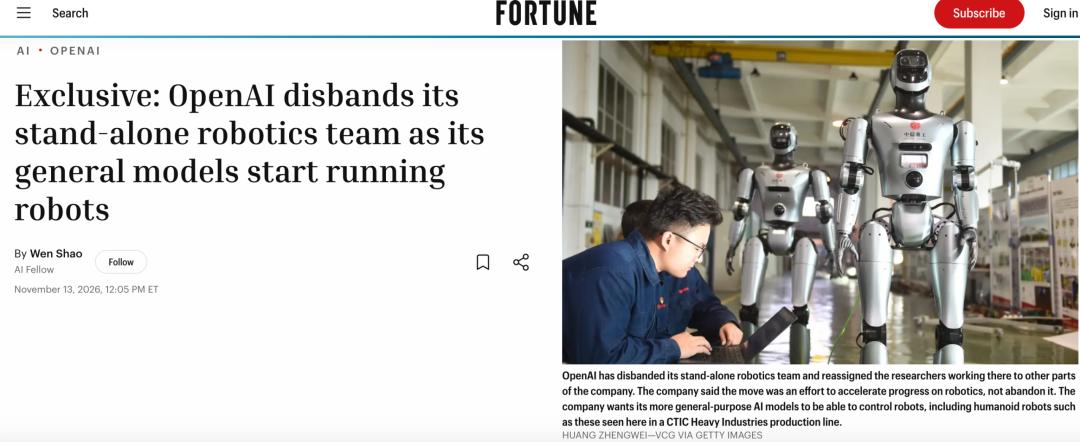
Back in September this year, OpenAI was still recruiting robotics engineers on a large scale, with some positions offering a base annual salary as high as 500,000 US dollars (equivalent to about 3.3 million RMB). How did the team suddenly get disbanded?

OpenAI's explanation is that general-purpose cutting-edge models such as GPT-6 Astra can already be directly applied to robotics tasks, so the integration of robotics research and general model R&D can speed up progress.
This is a positive disruption to the embodied intelligence industry. Over the past two years, the technical narratives of a large number of startups have been built on the same premise: the physical world requires an independent foundation model. VLA is one of the mainstream approaches in this technical route: the model is pre-trained on offline data first, and then fine-tuned with a large amount of demonstration data collected for each specific task before deployment. However, the industry is well aware of the problems such as weak generalization ability, high fine-tuning cost, and the need to start from scratch when switching to a new scenario, but there has been no better alternative so far.
Nowadays, general large models are constantly setting new records on robotics control benchmarks, and this premise is being shaken. Many embodied intelligence entrepreneurs admitted at the Bund Summit that the window of advantage for dedicated embodied models is limited, probably only one or two years, and active changes must be made.
Qian Wang, Founder and CEO of X2Robot, also responded to this wave of disruption. He judged that the possibility of general large models forming a "dimensionality reduction strike" on embodied intelligence is currently low, because the thresholds of physical world data collection, hardware adaptation and stable operation cannot be bypassed.
On November 23, X2Robot released the new-generation embodied foundation model WALL-OSS-1.0, as well as the supporting WALL-API-1.0.
API Application Link: https://x2robot.com/docs/quantax1pro/v1/model-development/wallx-api/api-usage-instruction
Technical Blog: https://x2robot.com/blog/wall-oss-1#robot-data
This model does not follow the fine-tuning route. It integrates vision, language and physical actions into the same framework for learning from the pre-training stage. A pre-trained single policy can directly perform tasks on never-seen objects, tools, scenarios and robot forms without any task-specific demonstration or fine-tuning, pursuing the real "zero-shot generalization" capability.
Experimental results show that its Lite version ranks first on the mainstream simulation benchmark RoboDojo (in the policy track that does not use the Agent system); in multiple real robot tests, the zero-shot success rate reaches 55.1%; the total score without fine-tuning is 70.8% higher than that of π0.5 which is fine-tuned with multi-task data.
What is really noteworthy behind this is a new technical route: can robots directly obtain transferable general manipulation capabilities through large-scale pre-training?
Pre-training Starts to Directly Output General Manipulation Capabilities
In the past, the training of mainstream models was usually divided into two stages: the model first learns visual understanding and language reasoning using large-scale image, video and text data, then introduces robotics manipulation data, and masters specific actions through post-training.
This method can quickly leverage the capabilities of existing vision-language models, but it also has a problem: before the model is exposed to physical actions, it has already formed a relatively fixed knowledge representation, and the subsequently added robotics data is mostly used for task adaptation.
X2Robot hopes to connect understanding and action from the very beginning of training. WALL-OSS-1.0 adopts native pre-training, which puts language, vision-language and robotics action data into the same autoregressive training framework. While learning objects, scenarios and spatial relationships, the model also synchronously learns how this information corresponds to physical actions in the real world.
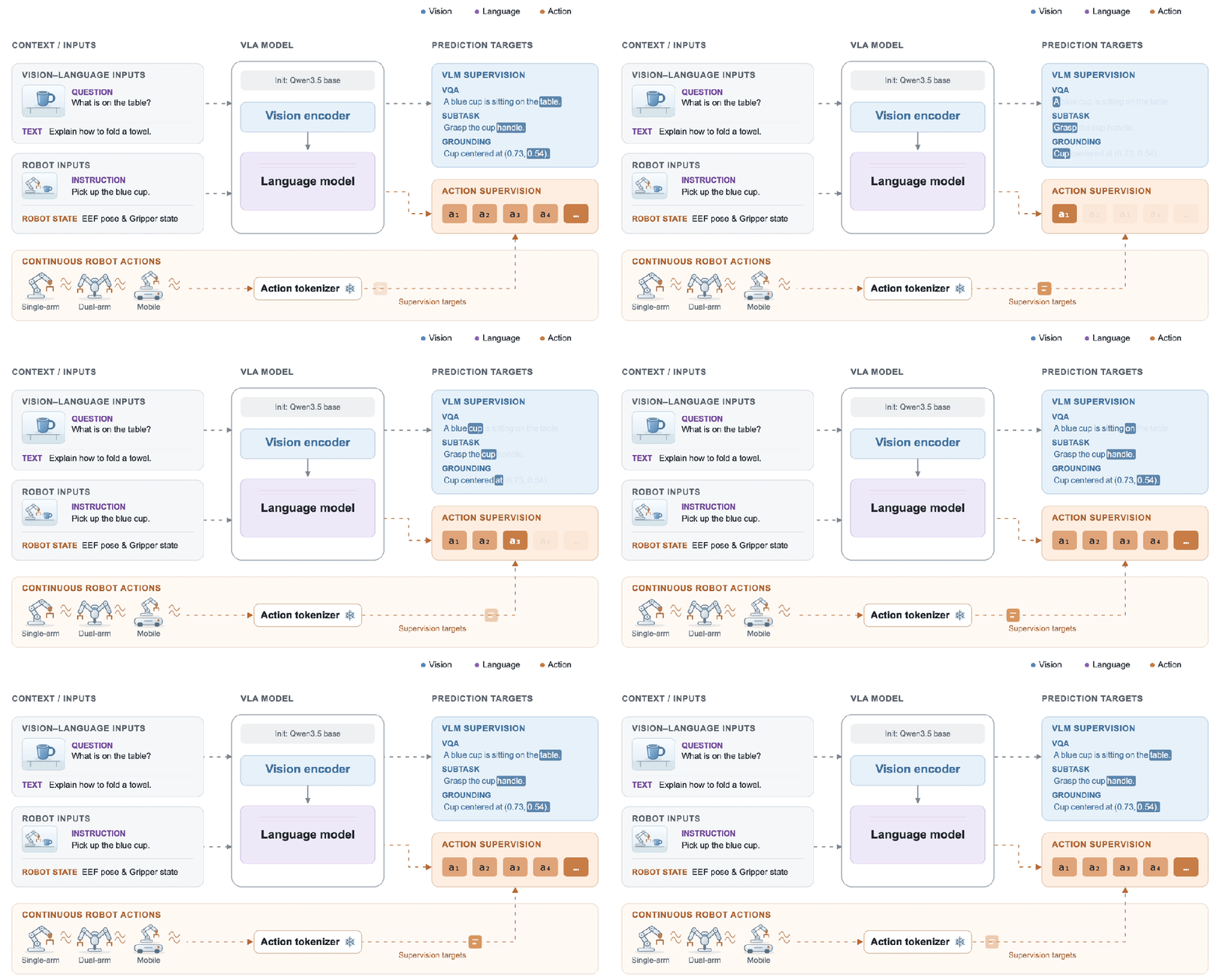
Language, vision-language and robot-derived data are trained together to share the backbone network under the next-token prediction objective.
To enable different robots to participate in training together, the first problem to solve is the unified representation of action data. Robot actions are continuous in nature, and the position, posture, joint state and gripper control of the robotic arm all need to be described by continuous numerical values. Different robots also have different control structures and action dimensions, making it difficult to directly fit into the Token sequence of language models.
To this end, X2Robot improved its self-developed action tokenizer X-Tokenizer, converting continuous motion trajectories into discrete action Tokens. After processing, the manipulation trajectories generated by different robots can participate in training in the form of unified action Tokens. The model can predict action sequences just like processing text, and learn manipulation experience between different robots under the same framework. This is equivalent to establishing a shared action language for robots of different forms.
Merely learning to predict actions is not enough. The team further designed a variety of training tasks to enable robotics manipulation data to undertake richer supervision functions: the model not only needs to generate actions based on historical observations and demonstrations, but also learns to recognize actions in videos, understand the semantics of motion trajectories, evaluate whether candidate behaviors are reasonable, and correct actions after detecting errors. The same piece of manipulation experience can therefore teach the model how to execute, understand, judge and correct errors.
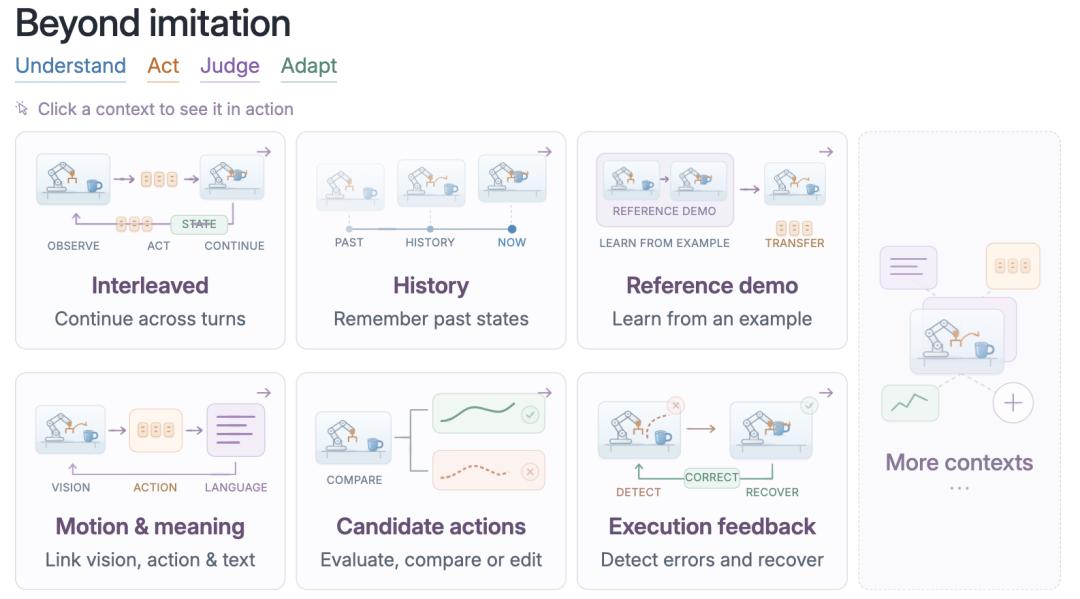
Diverse training contexts enable the shared autoregressive model to learn to generate, describe, evaluate and correct actions.
This design also has an important goal, which is to retain the original general capabilities of the foundation model.
A common problem faced by robotics models is that after adding action training, the original vision-language understanding capability may degrade. WALL-OSS-1.0 keeps different capabilities evolving together during the training process by continuously mixing language, vision-language and action supervision. In 8 tests of the VLA-VLM Benchmark Suite, the model after the first stage of training achieved a score of 79.2%, which is basically on par with the 79.4% score of the base model.
This indicates that while acquiring physical interaction capabilities, the model still retains strong visual understanding and language reasoning capabilities.
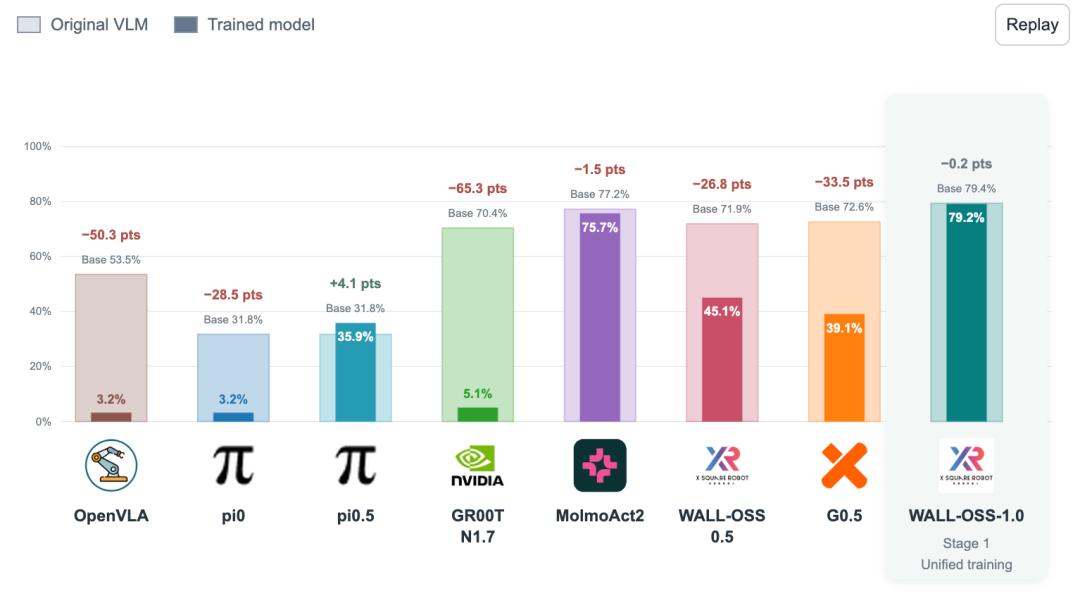
Unified training preserves general capabilities: the first-stage model of WALL-OSS-1.0 scores 79.2%, while the base model scores 79.4%. Evaluation protocols vary across different models.
The first stage solves the problem of joint learning of understanding and action, and the second stage further improves the accuracy and efficiency of action generation.
The team introduced the MoT (Mixture of Transformers) architecture on the pre-trained model, and added an Action Expert based on Flow Matching. The backbone model is responsible for understanding visual and language contexts, and the action expert is dedicated to generating continuous robot action trajectories, so that the two can convert semantic understanding into more precise physical control.
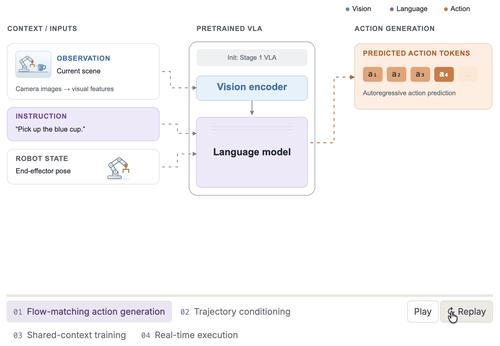
Four perspectives of the MoT model: flow-matching action generation, trajectory conditioning, shared context training and real-time chunking. All training blocks share one action expert.
There is also an engineering optimization here. The computational cost of vision-language context is relatively high, but action training needs to cover different historical lengths, prediction ranges and condition combinations. Recalculating vision-language features every time will cause a lot of redundant overhead. Therefore, the team allows multiple action training tasks to share the same vision-language context, so that the scenario only needs to be encoded once to support action training under different configurations.
In actual execution, RTC (Real-Time Chunking) further solves the problem of action connection. While the robot is executing the current action segment, the model can generate subsequent actions synchronously, and take the instruction that is still being executed as the condition for the next segment of prediction. In this way, action generation and robot execution can proceed in parallel, reducing waiting time and making continuous motion smoother.
Scaling Law Emerges in the Robotics Field
With a unified training framework, sufficiently rich physical interaction experience is also required. The scaling of large language models cannot be separated from massive text data, and robotics foundation models also need to continuously accumulate manipulation experience in the real world.
The training corpus of WALL-OSS-1.0 contains large-scale robotics manipulation trajectories, covering multiple types of tasks, scenarios and objects. Not all of these data come from the robot body, and a large part of them come from human operation demonstrations collected by operators using handheld UMI devices. The rest includes robot teleoperation, open source action data and human takeover data.
The value of UMI lies in reducing the dependence of data collection on the robot body. Operators can directly use handheld devices in daily environments to record operations such as grasping, moving objects and using tools, without deploying robots every time. The natural movement rhythm, two-hand coordination and contact process when humans operate objects can also provide rich manipulation experience for robots.
After the data scale expands, quality control becomes more important. A seemingly complete operation video may have problems such as discontinuous motion trajectories, inaccurate pose estimation or missing action information. If it is directly used for training, it may bring interference to the model.
X2Robot established an automatic quality inspection process with more than 20 verification indicators, covering inverse kinematics feasibility, motion smoothness, high-frequency jitter, pose continuity and 6-DOF pose accuracy. After screening, action processing and semantic annotation are carried out, so that the original experience can be converted into reliable training data.
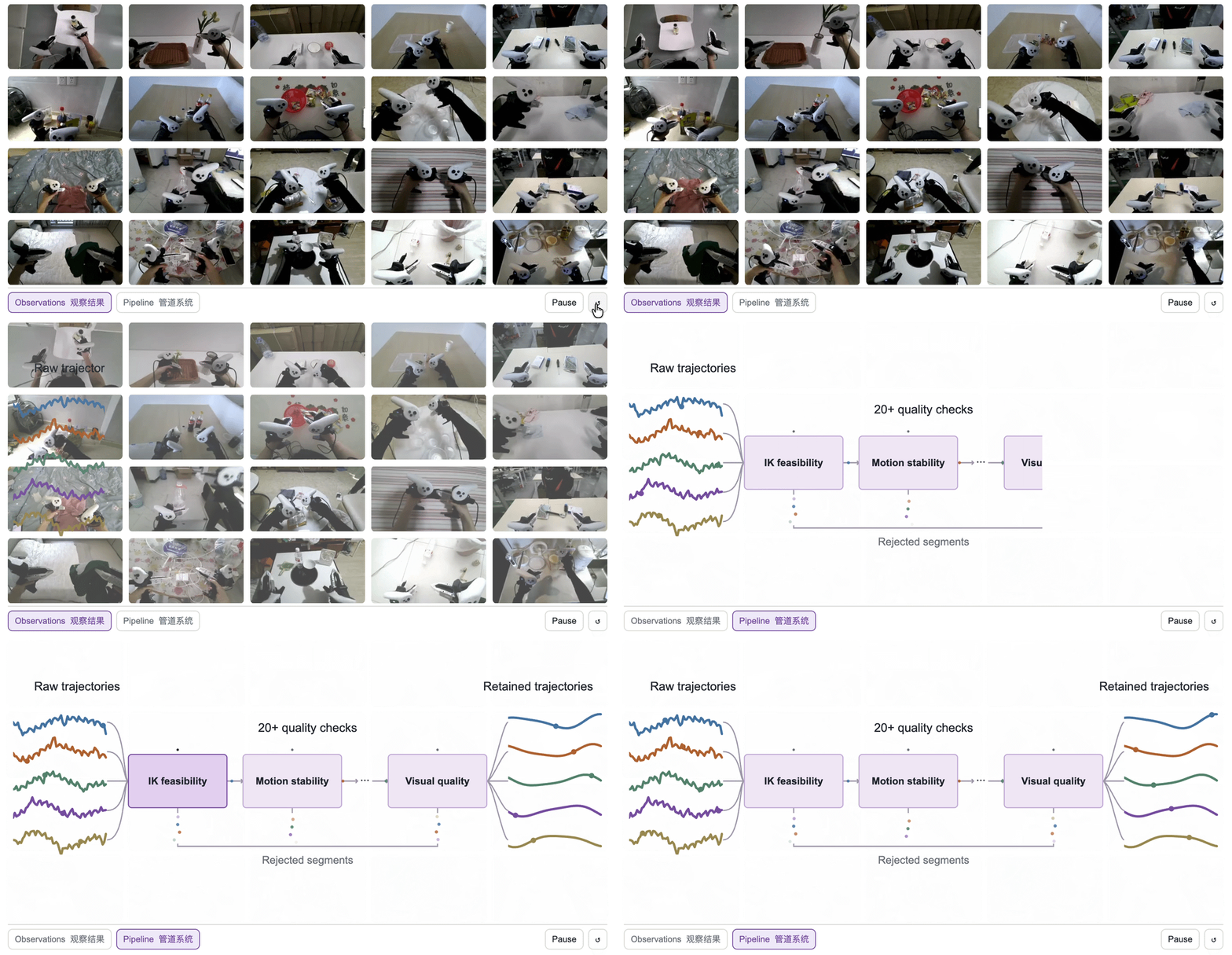
Diverse UMI demonstrations: from observations to trajectories. Real-world observations are converted into schematic raw trajectories, which then go through more than 20 automatic quality checks to remove unreliable segments before action processing and annotation.
The team also established a set of Agent-driven human takeover mechanism. The core idea is to let the robot execute autonomously first, and then concentrate human error correction resources on the links that the model has not yet mastered.
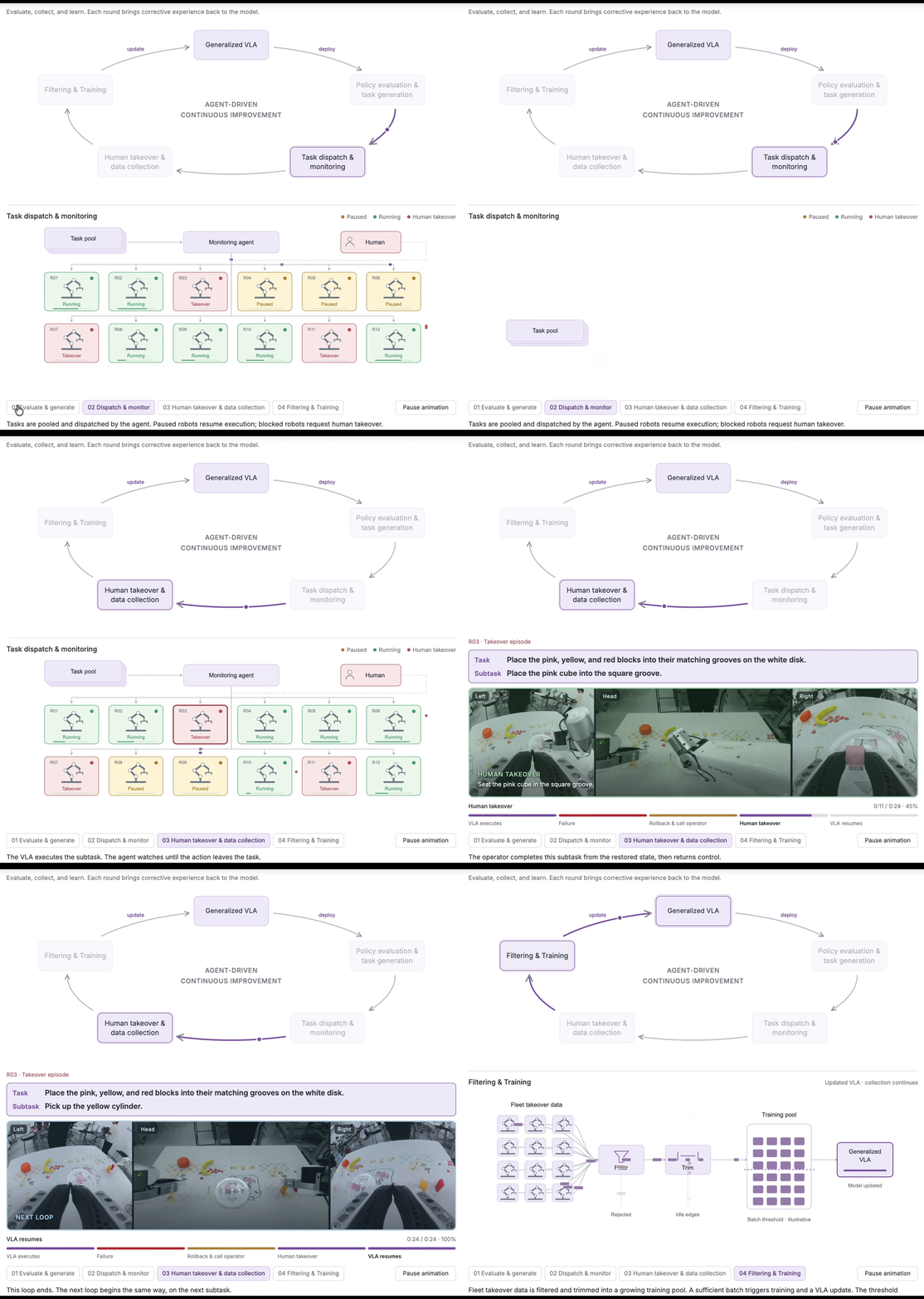
Agent-coordinated strategy evaluation, targeted human takeover collection and data filtering. The sorted data is used to train and update the strategy, and then enter the next round of evaluation.
When the robot executes a task, the Agent will continuously evaluate the model performance, detect the current capability boundary, and arrange new tasks according to the weak links. If the robot can complete the task smoothly, it will continue to execute; when the task is stagnant or execution fails, the Agent will request a human operator to take over, let the human complete the current subtask, and then record the corrected operation. For recoverable errors, the system can also return to the state before the error occurred, and record the original execution process of the robot and the corrected process by human respectively. In this way, the model can see both how the error occurs and the correct recovery method.
Up to now, this takeover system has been mass-producing human takeover experience.
The collected data will go through quality inspection and screening before re-entering the training corpus. After the model is updated, it will be evaluated again to find new capability gaps, thus forming a continuous cycle: the stronger the model is, the more complex tasks it can undertake, and the deeper capability boundaries it can expose.
This mechanism also improves the efficiency of human data collection. Compared with repeatedly recording actions that the model has already mastered proficiently, concentrating operator time on failure and recovery links can obtain more targeted training experience.
Before the data enters the model, it is also necessary to establish the corresponding relationship between language and actions. X2Robot divides each manipulation trajectory into four levels: task, subtask, action and action segment. For example, "tidy up the table" belongs to the task-level instruction, "put the cup on the shelf" belongs to the subtask-level instruction, and more detailed action and segment descriptions further clarify the specific operation and its movement process.
This layered annotation enables the model to understand both the macro goal and local actions at the same time. It knows not only what to achieve in the end, but also which object to operate, where to move, and what constraints there are.
Data scale, quality and semantic supervision jointly determine how much the model can learn from physical experience.
X2Robot also specifically verified the Scaling Law of action modeling. The team trained a series of autoregressive Transformer models with parameter scales ranging from 10 million to 1 billion, expanding the computational volume by more than 4 orders of magnitude.
The results show that as the training computational volume increases, the validation loss of the model's action prediction continues to decline, showing a relatively stable power-law relationship. This indicates that robot action sequences also have sustainable scaling potential, and increasing computational investment can continuously improve the model's action modeling capability.