Embodied intelligence has reached a commercialization inflection point: robots are entering factories, bidding farewell to the era of "manual handcrafting".
From a thousand hours to ten hours, embodied models are beginning to reshape the deployment mode and cost of production lines.
"We have been working on this project for almost a year, and it is finally ready for delivery now, but the cost has far exceeded the project budget."
At an industrial embodied intelligence forum held this year, an industry insider shared his experience of a robot implementation project at a factory he participated in, with deep feelings. It was a flexible, high-precision operation task. The team deployed a large number of engineering personnel, and after nearly a year of customized development and repeated debugging, they finally met the delivery requirements, but the cost was far higher than expected.
In his view, one important reason is the lack of sufficiently good embodied foundational models. If the model itself has stronger general capabilities, it can reduce the training data and manpower investment required after entering specific production processes.
2026 is regarded by some enterprises as the first year of industrial implementation of embodied intelligence, but there is still a considerable gap between technical demonstration and actual delivery. For robots to become real industrial productivity, enterprises need to check whether the comprehensive cost and efficiency can keep up with the rhythm of the production line, whether they can work stably for a long time, and the manpower and material resources required for re-adaptation after crossing different scenarios. These issues have also become the thresholds that must be crossed for the large-scale implementation of embodied intelligence.
Dilemma: Why do most embodied projects get stuck in PoC
"More than 80% of embodied intelligence projects are still in the PoC or Demo stage." In September, an industrial embodied intelligent robot enterprise stated the current dilemma of embodied intelligence implementation at a technology conference. It believes that there are three main bottlenecks: after robots enter the production line, they often face the problems of high comprehensive cost, low rhythm efficiency, and weak abnormal response capability at the same time.
A person in charge of an automobile production line told Digital Intelligence Frontline: "When we consider embodied robots, we first look at the cost. After all, the automotive market is extremely competitive this year. How much labor can I save by using your robot?" He said that a humanoid robot costs at least 200,000 to 300,000 yuan. Including operation and maintenance, the actual total cost may reach 500,000 to 600,000 yuan, and the payback period takes five years, which is close to or even exceeds the depreciation assessment cycle of many production line automation equipment. Therefore, some enterprises set "the total ownership cost of the robot is lower than that of a single worker within 3 years" as one of the acceptance indicators.
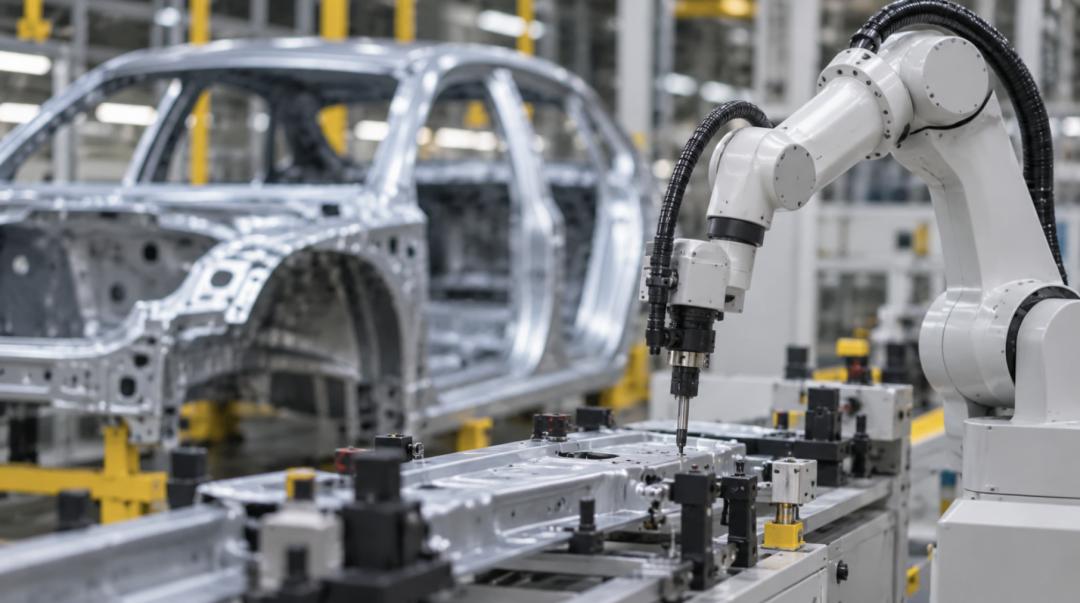
The "hand" is also one of the major cost items. A person in charge of R&D of robots told Digital Intelligence Frontline that they will use dexterous hands only for tasks that cannot be completed by grippers. "Grippers have higher maturity and stability, and the price of the entire actuator ranges from hundreds to thousands of yuan. A mid-to-high-end dexterous hand costs 100,000 yuan each, and some products we tested need to be repaired after 30 consecutive hours of use. If it is used for 5 hours a day, it will break down in a week, be sent for repair the next week, come back the following week, and break down again after another week of use." In his view, many industrial grasping tasks can be solved with two-finger grippers, and there is no need to blindly pursue complex hardware.
Rhythm is the second threshold. In a wheel hub bearing factory, after a year of running-in, the loading success rate of the humanoid robot is stably above 98%, but each loading takes 35 to 40 seconds, while a skilled worker only takes about 15 seconds. The production line rhythm is set according to human workers, so if the robot moves half a beat slower, it will become the bottleneck of the entire production line.
The abnormal response capability is directly reflected in the operation success rate. Assuming that the success rate of a single operation is 95%, there may be an average of 500 failures after 10,000 executions; even if the success rate is increased to 99%, there are still about 100 failures. If the robot cannot handle these situations independently, continuous manual intervention is required, which makes it difficult to meet the requirements of continuous production.
In addition, many projects are still in the stage of "working behind closed doors". In May this year, Li Xiang, founder of Li Auto, said in a podcast that robot companies all want to help factories tighten screws, but screw tightening has long been automated, and "very few robot companies have asked us what we need". "Our factory has more than 10,000 employees, of whom more than 3,000 are responsible for loading materials to machines." Li Xiang admitted that many precision processes in automobile manufacturing already have mature dedicated automation equipment. What is really worthy of attention for robot enterprises is material handling, loading and unloading, and the work that still requires manual connection between production links.
Logistics sorting is such a type of position. According to on-site reports, the working environment for logistics sorting is usually very harsh, with noise exceeding 85 decibels, and colleagues have to shout to talk to each other; in summer, the closed cargo compartment is extremely hot and stuffy. To facilitate scanning, the barcodes of parcels need to face the scanning equipment. When encountering a whole box of mineral water, workers have to rely on the dexterous force of their arms to flip it the moment they lift it. After continuous operation, some workers said their arms were so tired that they were shaking. People who have been to the production line introduced that even if working at full capacity, the maximum sorting volume per hour is only 1,200 pieces. This kind of repetitive and heavy position is where robots are expected to create value.
The deeper problem is that the manufacturing industry has increasingly urgent demand for flexible production. An integrator who has worked in the automotive industry for more than 20 years said that in recent years, new energy vehicle new models and facelift models have been released intensively, breaking the traditional rhythm of "facelift every 3 years and generation update every 5 years". With frequent model changes, production lines often need to be readjusted or even replaced, and traditional rigid automation is increasingly unable to adapt.
Flexible production was originally the opportunity for embodied robots to exert their value. But in reality, the generalization ability of robots themselves is not sufficient, and a lot of training and debugging are still required when entering new production lines. Chen Qing, General Manager of Wuxi Data Group, once mentioned that one of their projects went through a lot of on-site customized development to meet the delivery requirements. He believes that one of the cruxes is the lack of sufficiently good embodied foundational models, which requires a lot of manpower to collect data for adaptation on site. Moreover, it is not easy to collect real industrial data, as factory owners are worried about the leakage of production processes and trade secrets.
From 1000 hours to 10 hours, the threshold for robots to start working is getting lower and lower
Against this background, on November 23, the embodied intelligence enterprise Zili Bianliang released the new generation of embodied foundational model WALL-OSS-1.0, and officially launched WALL-API-1.0, which is open to researchers and enterprises for invocation. Different from laboratory demonstrations, before its release, this model has been deployed in the real sorting production line of a leading domestic logistics enterprise, undertaking tasks such as flipping parcels, aligning barcodes, and screening abnormal parcels.
On the sorting line, parcels vary in size, shape and placement angle. Robots need to identify the items, judge where to grasp and how to flip to make the barcode face the scanning equipment. They also need to adjust their movements when encountering abnormal situations.
In fact, as early as August, Zili Bianliang had held a fully autonomous logistics sorting live broadcast. Without human intervention, it completed the sorting of 1,911 parcels in one hour with an accuracy rate of over 98%. This result is 53% higher than the 1,248 pieces/hour previously publicly demonstrated by a US embodied intelligence enterprise. According to estimates, its system cost is about 30% of that of the overseas reference solution. At that time, the company's existing equipment had been running in real logistics scenarios for several months, and was continuing to expand applications and improve efficiency.
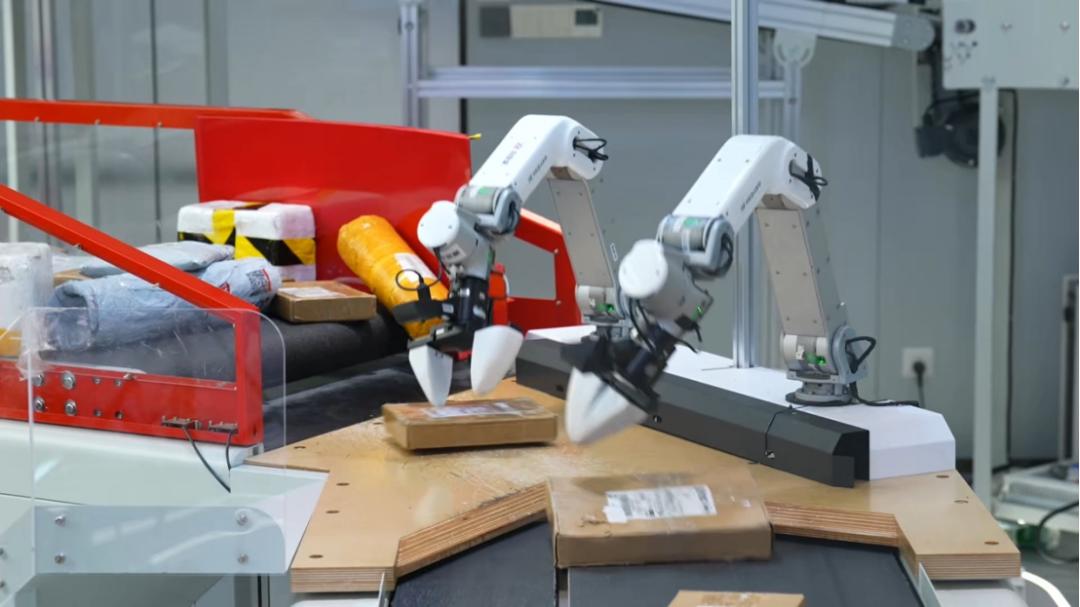
Interestingly, the logistics sorting solution of Zili Bianliang does not use humanoid robots and five-finger dexterous hands, but uses robotic arms and ordinary grippers. Thanks to the model's better understanding of physical laws, simpler hardware can also achieve more efficient sorting. At the stage when both embodied models and complex dexterous hands are not fully mature, mature hardware can not only reduce costs, but also reduce the difficulty of control and adaptation.
In terms of computing power, Zili Bianliang also adopts a lightweight solution. WALL-OSS-1.0 has launched models of different scales, including two lightweight versions, Nano and Lite, with 2B and 4B parameters respectively. For scenarios with relatively clear tasks that require continuous and repeated execution, such as logistics sorting, small models can reduce inference overhead and are more convenient for on-site deployment. Under its deployment configuration, a single computing power card can drive 18 robots to run at the same time, allowing multiple devices to share inference resources.
What is more noteworthy is the adaptation cost of the model entering the production line. According to the disclosure of Zili Bianliang, based on pre-training, WALL-OSS-1.0 only requires about 10 hours of task data for fine-tuning to reach the usable level for logistics sorting tasks; while the control solution without pre-training requires more than 1000 hours of task data. The data demand between the two differs by two orders of magnitude.
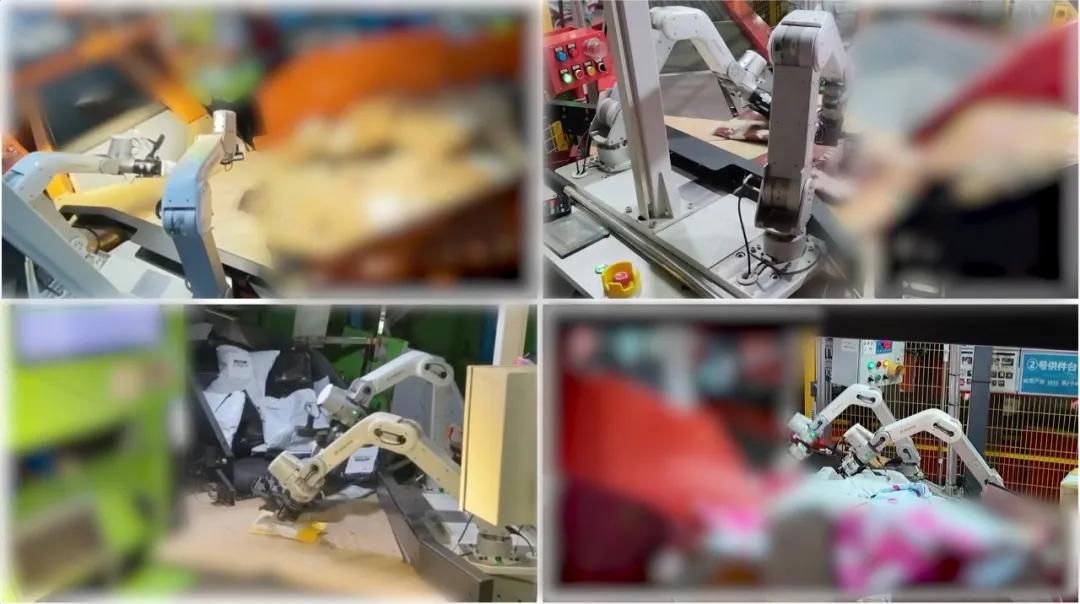
At the same time, even when switching to different production lines with different lighting, workbenches, conveyor belts and parcel distribution, WALL-OSS-1.0 can still retain more than 90% of the original sorting speed and success rate; while for the control solution without pre-training, the success rate after cross-production line drops by more than 90%.
What supports these changes is that Zili Bianliang has moved more operation capabilities to the pre-training stage.
Traditionally, many VLA models first complete vision-language pre-training, and then add robot motion data for post-training. In this way, the model's understanding of the world is basically finalized before it comes into contact with motions, and the physical operation capability mainly depends on subsequent training to make up for it.
In the pre-training stage of WALL-OSS-1.0, language, vision and motion data all participate in learning together, so that the model can learn how to operate objects while identifying objects and understanding instructions.
This first needs to solve a problem: since robots with single arm, dual arms, and mobile bases have different control structures and motion dimensions, it is difficult to learn data together. Zili Bianliang improved its self-developed motion tokenizer X-Tokenizer, compressing continuous motion trajectories into discrete codes, which is equivalent to translating the data of different robots into a set of shared "motion language".
To support this kind of pre-training, Zili Bianliang has cumulatively used massive operation trajectories, covering multiple types of tasks, scenarios and objects. A large part of them are UMI data collected by operators holding equipment without the participation of the robot body, followed by robot teleoperation data. The data collection without the robot body has relatively low cost and is easier to cover diverse scenarios, which is the key to the rapid expansion of data scale.
In the test, WALL-OSS-1.0 achieved a zero-shot success rate of 55.1% in 312 open real-machine tasks without task fine-tuning; in another real-machine standard evaluation, WALL-OSS-1.0 can get a high score of 1101/1500 only through pre-training, which is 70.8% higher than π0.5 after multi-task fine-tuning.
Most notably, the lightweight Lite version also won the first place in the single model track of the RoboDojo simulation evaluation, surpassing the Agent solutions of 10-billion-parameter models such as Astra and Opus 5.5. This shows the whole industry that the upper limit of embodied model pre-training is much higher than previously expected.
This technical path also echoes the increasingly widespread voices from the industrial front line this year: a good embodied foundational model should master more general capabilities, so as to reduce the training investment after entering specific factory processes. From the practice of logistics sorting, part of the training work that used to rely on on-site engineers is being moved forward to the pre-training stage of the general model.
Can embodied intelligence be delivered at scale like software
The tasks of logistics sorting are relatively clear, while there are more complex tasks in the industry, with long processes, variable techniques and materials, and sometimes robots need to understand abstract instructions and complete multiple steps continuously. The newly emerging solutions that use Agents to drive embodied models to complete tasks this year open up a path for this new application method.
In response to this, Zili Bianliang proposed a layered solution: the upper layer Agent driven by a large language model is responsible for understanding tasks and disassembling steps, and the lower layer WALL-OSS-1.0 is responsible for specific actions. The company also launched the XR Harness framework for task planning and scheduling, and officially launched WALL-API-1.0, providing the latest WALL-OSS-1.0 and other models for researchers and enterprises to call openly.
In a demonstration of "tidying up the table", XR Harness splits the task into steps such as collecting fruits, organizing small items, and stacking plates. WALL-OSS-1.0 not only needs to find "the remaining black binder clip" according to the on-site environment, but also follow the constraint of "keeping the white plate still" when stacking plates.
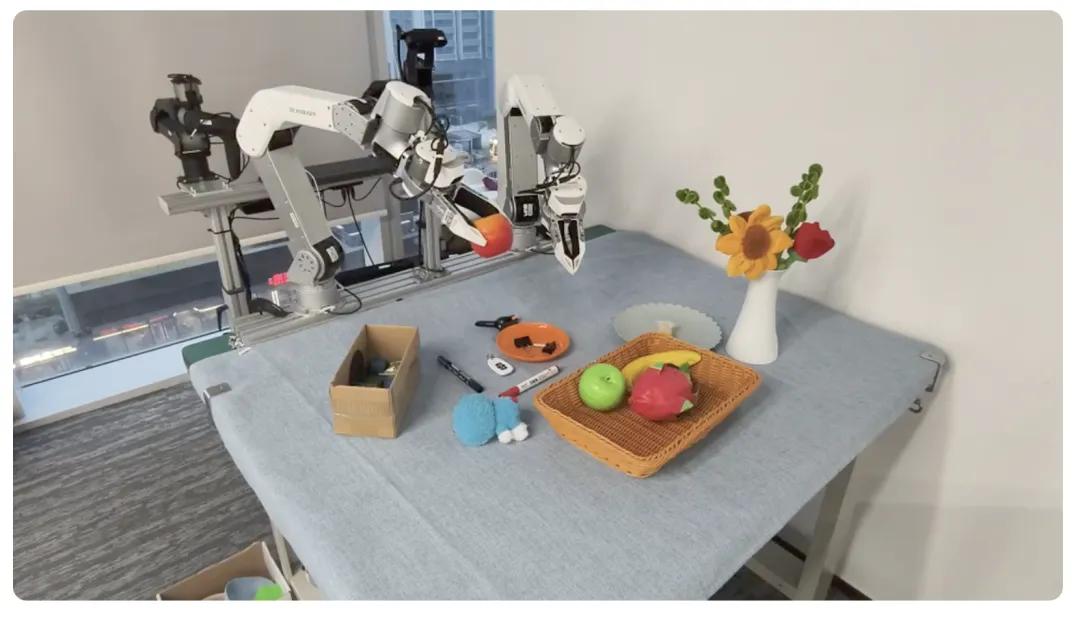
This division of labor gives full play to their respective strengths. General large models have strong understanding and planning capabilities, but when directly used for robot motion control, they often have slow response speed and high inference cost; embodied models are good at motion execution, but may not be good at disassembling complex tasks.
To realize this layered solution, Zili Bianliang carried out multi-level language annotation on the operation trajectories during pre-training, so that the model can not only understand the overall goal such as "tidying up the table", but also execute specific instructions such as "pick up the cup", so as to better cooperate with large models and Agents.
It is worth noting that opening APIs is becoming a new direction for embodied foundational model enterprises to explore commercialization.
In October, US embodied foundational model company Physical Intelligence opened Pi API Beta, allowing customers to upload robot data, fine-tune the model on its infrastructure and call inference services. Robot enterprise Almond completed the part deburring operation of the dual-arm robot after four days of API iteration. In the same month, another robot foundational model company Dream Labs launched Dream API, exploring a service mode of charging by robot operation time, and its Dream-1 basic version is priced at 3 US dollars per hour.
