36Kr New Trends | Nvidia places heavy bets, Jensen Huang is bullish, and another major hotspot has broken out in the semiconductor track.
Image source / Visual China
This article contains approximately 4700 words, with a recommended reading time of 12 minutes
Author | Ou Xue
Editor | Yuan Silai
Many investors may occasionally recall how they missed that optical chip company valued at tens of billions of yuan.
It was 2023, the young man sitting across from them had met hundreds of investors, and his voice was already slightly hoarse. "We are very interested and will follow up on this," the investors said politely, knowing clearly in their hearts that they would not make the investment. It was the coldest period of the capital winter, and this company did not have any "safe" labels, such as an academician-led team or proven commercialization potential.
Three years later, this optical computing chip company's valuation exceeded 20 billion yuan.
But it must be admitted that when a company with a valuation of 100 billion yuan emerges in the optical computing chip track, the entire industry is still in a very early stage. In fact, according to the financial report of leading company Lightelligence, its optical computing revenue in the first half of 2026 was 19.08 million yuan, while the optical interconnection revenue reached 60.7 million yuan, more than three times the former. More than one investor told Hard Krypton that many companies have very small optical computing revenue and have to rely on optical interconnection to generate income first. Although everyone wants to invest in optical computing, its large-scale application is far away, so they invest in optical interconnection first.
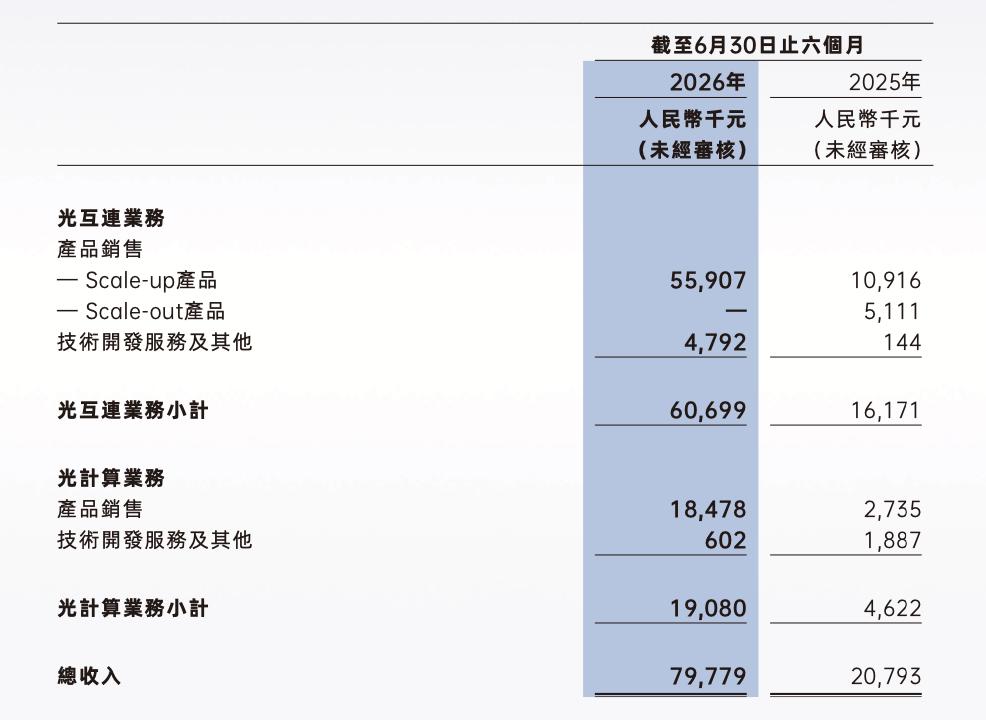
Lightelligence's mid-2026 revenue (Image source / corporate financial report)
The so-called optical interconnection refers to using light as the medium for data transmission. The transmitting end first converts electrical signals into optical signals, transmits them to the receiving end through optical fibers, and the receiving end converts the optical signals back into electrical signals before data processing can be carried out. Electro-optical and photoelectric conversions are performed at both ends of the link, with optical fibers in the middle.
As a connection technology, optical interconnection is becoming a rigid demand for interconnection between AI computing power cluster cabinets. Jensen Huang even said at the Computex conference in his characteristic exaggerated tone that interconnection chip giant Marvell is "the next trillion-dollar company, ladies and gentlemen". As a result, optical interconnection has become one of the few continuously heating tracks in hard technology financing in the past two years.
According to data from ZERONE, as of October 26, 19 domestic optical interconnection enterprises have completed equity financing, with a total amount of about 4.055 billion yuan, a year-on-year increase of 69.2%.
Financing rounds are accelerating and the amount is rising. Jiuwei Photonics entered the market with phase-change silicon photonic OCS, and has received nearly 100 million yuan in cumulative seed round and angel round financing; Lankun Micro completed two consecutive rounds in October with a cumulative amount of hundreds of millions of yuan; Guanglian Xinke completed a nearly 1 billion yuan Series A+ round in August, with a post-investment valuation exceeding 1 billion US dollars, becoming the first unicorn in the domestic inter-chip optical interconnection track.
In the secondary market, concepts related to "light" have also seen a sharp surge. On May 28, leading optical module stocks "Yi Zhong Tian" (NeoPhotonics, Innolight, TFC) hit all-time highs, among which Innolight rose by more than 7%, ranking first in A-share market in terms of trading volume.
But soon, they found that in addition to the rising valuations, the commercial progress of optical interconnection did not keep up with the financing pace. In the second half of the year, the primary market began to allocate funds to the upstream sector with stable orders and actual supply and demand. "In the first half of the year, projects related to indium phosphide or silicon photonic integration were basically invested blindly," an investor told Hard Krypton.
Investing in AI computing power infrastructure is the current consensus. After the marginal effect of computing power and memory gradually weakens, everyone is looking for next-generation chips and connection technologies. The optical computing and optical interconnection technologies that have continued since the 1970s have once again been brought into the spotlight.

To invest in optical computing, start with optical interconnection
Optical interconnection is not a new concept.
In the past, optical interconnection kept light "outside the door". When transferring data between GPUs, copper cables were used inside the cabinet for short distances; optical fibers were used across cabinets when high bandwidth was required. However, with the sharp increase in AI's demand for computing power, copper interconnection has increasingly struggled to meet the requirements of bandwidth, distance and power consumption at the same time.
But optical fibers cannot be directly plugged into GPUs, and a "translator" is needed in the middle — a module that converts electrical signals into optical signals and then back into electrical signals, which is the pluggable optical module. It is inserted on the front panel of the server, like a USB flash drive, separated from the GPU by PCB copper traces of dozens of centimeters. Electrical signals have to travel from the GPU to the front panel, enter the optical module to be converted into light and then flow back. This section of copper trace is the source of loss, delay and power consumption.
This loss is an obstacle that needs to be solved in this era of hunger for computing power. Now, the new generation of technology is moving light "inside the door". The path is a straight line: pluggable optical module (front panel) → NPO (near-packaging, the optical engine is moved next to the chip but still pluggable) → CPO (co-packaging, the optical engine and the chip are packaged in the same package) → OIO (light is directly fabricated at the edge of the chip, directly connected to the computing die like a chiplet).
It can be seen that optical interconnection is undergoing a structural position migration, which is also an important reason why it has attracted so much attention now.
In the past, optical interconnection served operators for long-distance interconnection between cities, with small volume, slow iteration, and equipment manufacturers as purchasers. Now it serves ByteDance, Alibaba, Tencent, as well as Google and NVIDIA across the ocean. The scenario has changed from "between data centers" to "inside data centers", and it exists between every node's GPU and GPU.
According to the calculation of the founder of an optical interconnection enterprise: in a data center, in addition to the interconnection between hundreds of nodes, optical interconnection can also be used inside each node, directly amplifying the demand hundreds of times. Optical computing is too far away, but optical interconnection can bring continuously growing orders right now.
Part of the popularity of optical interconnection also comes from optical computing chips. Although they both belong to the large optical chip track, optical interconnection is the end that can deliver products and recognize revenue. Optical computing is the end of valuation stories, and the two are at least one full step apart in pace. Lightmatter, which started with optical computing, will still focus on optical interconnection for commercialization from 2026 to 2028, while the complete optical computing technology stack is scheduled to be launched after 2030.
From the perspective of underlying technology, optical computing needs to solve the problem of "directly performing matrix operations with light", which has been repeatedly demonstrated in academic circles in principle, but engineering is another matter — light is naturally weak in nonlinear computing, and operations such as absolute value calculation and exponential operation still need to be supported by electrical chips, so both technical routes and commercialization landing are more difficult than optical interconnection.
Optical interconnection solves the problem of "how to transmit" without touching the hard bone of "how to compute", with a relatively clear engineering path and faster customer onboarding. The effective transmission distance of copper cables at high rates is limited. Once the super-node breaks through the boundary of a single cabinet, a larger cluster cannot be formed without light, the demand is clear, and the products can match the scenarios faster.
Once optical computing is realized, it will be the starting point of another technological revolution. But back to the present, optical interconnection is not only part of the future narrative, but also can deliver short-term performance, so capital is obviously more willing to pay for certainty.

What are investors optimistic about?
Although optical interconnection is the end that can deliver products, the capital market is also optimistic about the grander narrative behind it.
The first driving force of the financing boom is that the capital expenditure of AI infrastructure has pushed "light" from a supporting role to a bottleneck. As AI computing power clusters expand, the demand for optical interconnection has been brought to the forefront.
The founder of an optical computing company told Hard Krypton: This year, large manufacturers are all deploying GPUs, building infrastructure, and training larger models, driving the entire market. Another investor mentioned that many early-stage companies did not start to tell the optical computing narrative until a certain company went public, but what can really be implemented is still optical interconnection.
The second driving force is NVIDIA's "vote with its feet". Public information shows that NVIDIA has used real money and PR support to boost the "light track". In the first quarter of 2026, NVIDIA invested 2 billion US dollars each in Marvell, upstream companies Lumentum and Coherent, with tens of billions of dollars in procurement commitments and production capacity usage rights attached, to lock in production capacity in advance. For the primary market, this provides a referable timetable for the industrialization pace of optical interconnection, and investors are naturally willing to take positions in advance.
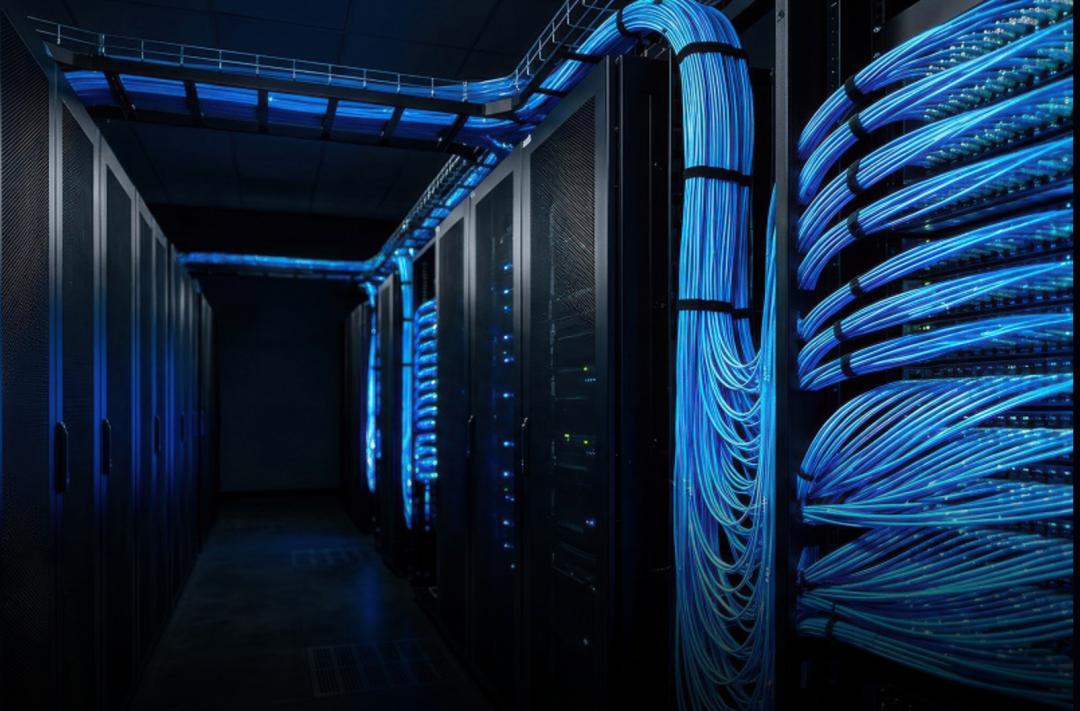
Schematic diagram of Marvell's interconnection solutions (Image source / Marvell official website)
The third driving force is the emergence of valuation anchors. An industry insider mentioned that when a certain optical computing company went public, the secondary market gave it a very high valuation, forming an anchor point for the primary market, and the financing pace accelerated significantly. But this anchor point ostensibly prices the optical computing narrative, but in reality it is benchmarked against the revenue of optical interconnection.
The fourth point is the scarcity on the supply side. An investor with state-owned capital background mentioned that there are not many investable directions now. Optical interconnection follows the AI line, extending from 800G to 1.6T and then to 3.2T, and there are still opportunities in upstream chips and materials. As the track narrows, funds naturally concentrate on directions with higher certainty. Optical interconnection is not only on the AI track, but also undertakes the heat brought by the optical computing narrative.

Orders exist, but large-scale production is still far away
Although the optical interconnection track is hot in financing, when it comes to commercialization, the industry is still at the stage where "orders have appeared, but mass production has not arrived".
An early-stage investor observed very directly: most of the projects he follows are relatively early-stage, and currently they are basically still in the stage of scientific research plus small-batch application, not server-level mass production.
The founder of an optical interconnection company also admitted that the company has not really signed formal customer orders yet, and only has many intended customers.
In the engineering implementation of optical interconnection, the more real bottleneck than the route dispute between NPO, CPO and OIO is actually yield.
A product leader in the industry gave a very practical ranking: electrical chips have the highest yield, followed by optical chips, and packaging currently has the lowest yield. Moreover, packaging needs to be viewed by different paradigms — the yield of 2D and 2.5D packaging is quite high, but once it is pushed to aggressive packaging such as 3D and 3.5D, the yield is not that good.
The data from an industry research report is more specific: the comprehensive yield of silicon photonic chip R&D samples is only 50%~60%, and mass production requires a yield of more than 85%; the maturity of domestic silicon photonic PDK is far lower than that of CMOS logic technology, and the deviation between tapeout results and design performance is relatively large, often requiring multiple iterations to meet the standards.
Overall, yield ramp-up is a huge challenge. For complex chips integrating dozens of modulators and hundreds of optical channels, any micro-ring wavelength drift may lead to the failure of the entire chip, and hidden defects are exposed late with high rework costs — this cannot be bypassed by simply discussing technical routes.
More critically, the yield problem is not an isolated link. Industry data shows that for a CPO system equipped with 32 optical engines, even if the yield of a single optical engine reaches 95%, the overall system yield is only about 19%. This means that the yield loss in the packaging link will be amplified at the system level, and single-point breakthroughs cannot solve systemic problems.
A product leader said: Whether silicon photonics has reached the large-scale commercialization node is written in the joint R&D demands of customers. The NPO, CPO, and high-density OIO products for GPUs under development must be aligned with clear downstream demands, and cannot be developed behind closed doors.
But this also leads to another underestimated hidden worry in the industry — buyers are more dominant. Founders of optical interconnection enterprises and investors have frankly expressed relevant concerns to Hard Krypton: downstream buyers in this industry are relatively strong, they have abundant capital and demands, and in many cases startup companies have to cooperate with them to do adaptation, with little say in technology.
In other words, startup companies have very limited control over whether they can get orders, how many orders they can get, and on what terms. Customers care about area, power consumption, heat dissipation and cost, but the industry is still relatively early, and it is not time to talk about specific prices. This is an opportunity, but it also means low bargaining power.
Because downstream mass production and yield ramp-up still take time, a lot of capital is starting to flow upstream. An investor with state-owned capital background said: Since the valuations of many enterprises have risen sharply, we can look to the upstream. For example, materials and devices such as indium phosphide substrates, thin-film lithium niobate, and CW chips have relatively solid mass production and simpler commercialization paths.