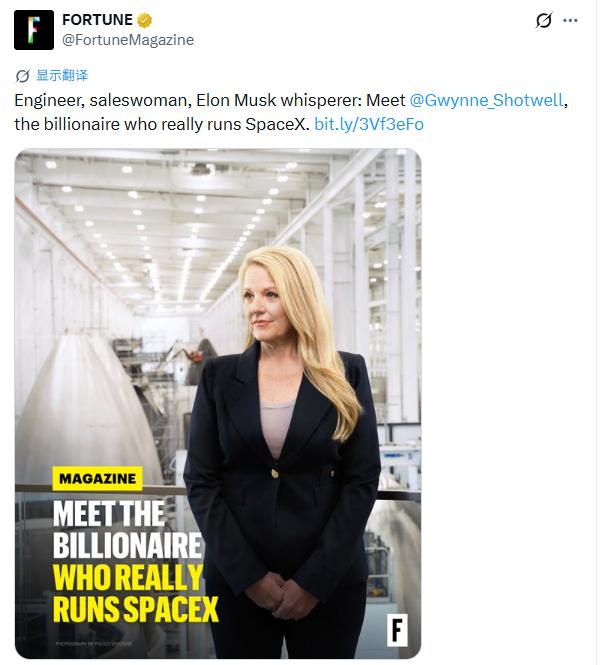
The "woman pulling the strings" behind Elon Musk is facing her toughest battle ever.
At SpaceX, Elon Musk is responsible for envisioning the future, while Gwynne Shotwell is tasked with turning that future into a viable business.
Over the past 24 years, from reusable rockets to the Starlink network, this rarely interviewed SpaceX President and Chief Operating Officer has always stood behind Musk, responsible for sourcing clients, securing contracts, controlling costs, and translating technical concepts into revenue.
After SpaceX went public, the 12.6 million shares held by Shotwell were valued at approximately 2 billion U.S. dollars. Compared to Musk, she has little appetite for public exposure, yet she is the core of the company's actual operations.
Now, she is facing the trickiest challenge of her career.
Musk is transforming SpaceX into an AI company, planning to send data centers into space, and setting a target of 1 trillion U.S. dollars in annual revenue by 2030. But the reality is that SpaceX's own AI model Grok still lags behind industry competitors, and the company has instead begun to lease computing power to enterprises such as Anthropic and Google.
In the past, Shotwell excelled at turning Musk's technical dreams into profitable businesses. This time, she needs to prove she can still do it.
01 A Lunch That Changed Her Destiny: Starting as the 7th Employee
In 2002, 38-year-old Shotwell had already worked in the aerospace industry for a decade, but she was disappointed by the slow pace of innovation at that time.
She initially studied at the McCormick School of Engineering at Northwestern University in the United States. When she graduated in 1986, she was one of only three women among the 36 graduates. In 1988, Shotwell joined the Aerospace Corporation to participate in satellite system research. Ten years later, she transferred to the rocket startup Microcosm and began to work on low-cost launch vehicle projects.
It was a lunch that truly changed her career trajectory.
At that time, a former colleague invited her to meet at an Austrian restaurant in El Segundo, Los Angeles. After the meal, the colleague suggested she visit the new company he had just joined, and introduced her to the company's boss — Musk, who had just accumulated his "first bucket of gold" by selling PayPal.
Musk introduced his plan to Shotwell: to manufacture rockets at a cost far lower than traditional space agencies, secure commercial satellite launch orders, and further reduce prices through rocket recovery and reuse.
Shotwell soon found that what the company lacked was not dreams, but clients. She told Musk directly that the company needed a head of business development to secure customer contracts even before the product was fully formed, so as to fund the R&D process.
A few days later, Musk extended an invitation to her. Shotwell immediately joined SpaceX and became the company's 7th employee.
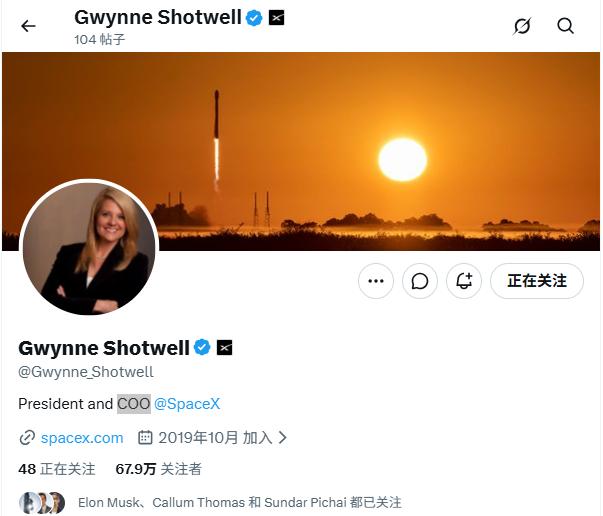
Shotwell's X page
Shotwell's work was not just about selling rockets. Since SpaceX did not have mature products at that time, what customers really needed to trust was the team's technical capability and whether Musk could keep his promises.
Shotwell once recalled that the most important part of early sales work was to demonstrate the team's strength to customers, especially Musk's technical capability, and ensure that technical questions raised by customers could be resolved in a timely manner. She would even personally clean the conference room before customer meetings.
In 2008, SpaceX faced the most difficult moment since its establishment. The first three launches of the Falcon 1 rocket all failed, and both capital and customer confidence were rapidly draining.
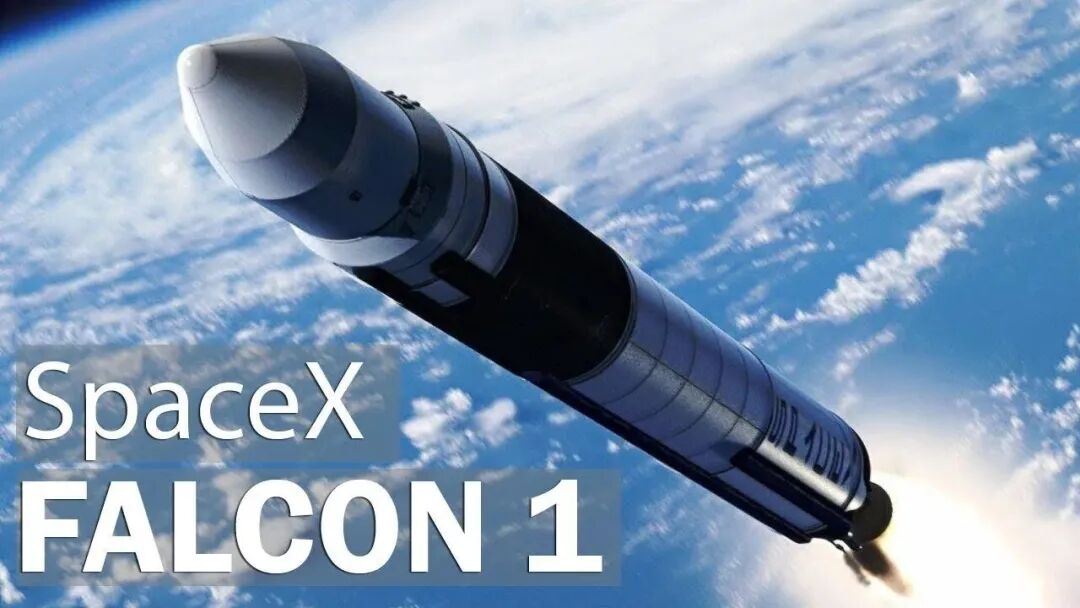
SpaceX's Falcon 1 rocket
Musk believed that the company still had enough funds for two more attempts, but Shotwell reminded him that if the next launch failed again, SpaceX might not get another chance.
In September of the same year, the fourth launch of Falcon 1 finally successfully entered orbit. Shortly afterwards, SpaceX secured a 1.6 billion U.S. dollar cargo contract from NASA.
This contract became the most important commercial support for the company in its early days. At the end of 2008, Musk invited Shotwell to serve as President. She initially thought the position was a bit strange, and even her first reaction was to refuse, but she soon accepted the invitation.
From head of business development to company president, she began to be truly involved in the operation and management of SpaceX.
Tom Mueller, the first employee of SpaceX and developer of the Merlin engine, once commented that he built the rocket, but Shotwell built the company.
02 The Most Special Capability: Making Musk Change His Mind
Shotwell's greatest contribution to SpaceX is not just finding customers, but her ability to understand both engineering technology and business needs at the same time.
During the development of the Falcon 9 rocket, SpaceX did not choose to develop a brand new engine completely from scratch, but combined nine Merlin engines used on the Falcon 1 to reduce R&D costs.
In some specific links, the company also used mature commercial products as much as possible. For example, for the cooling system of the Falcon 9 rocket's payload fairing, if the traditional solution was adopted, the cost might exceed 3 million U.S. dollars. SpaceX finally purchased commercial air conditioning equipment priced at only a few thousand U.S. dollars and then modified it.
This cost control idea allowed SpaceX to compete for launch orders at a lower price.
Douglas Loverro, a former senior official of the U.S. Air Force space program, negotiated with Shotwell for many years. He recalled that in 2007, he wanted SpaceX to use the Falcon 1 rocket to launch a battlefield imaging satellite. The two sides negotiated for a whole year, and when the contract was about to be finalized, Shotwell suddenly informed him that the company was preparing to stop producing the Falcon 1.
Later, Loverro still chose to trust her. When the U.S. Air Force provided a 50 million U.S. dollar budget for an experimental satellite launch project, he asked Shotwell if she could accept a fixed-price contract, and she agreed directly.
Even after SpaceX later had a lawsuit with the U.S. Air Force, government business continued to flow to the company, and Shotwell played an important role in maintaining the relationship between the two sides.
But what is more difficult than business negotiation is working with Musk.
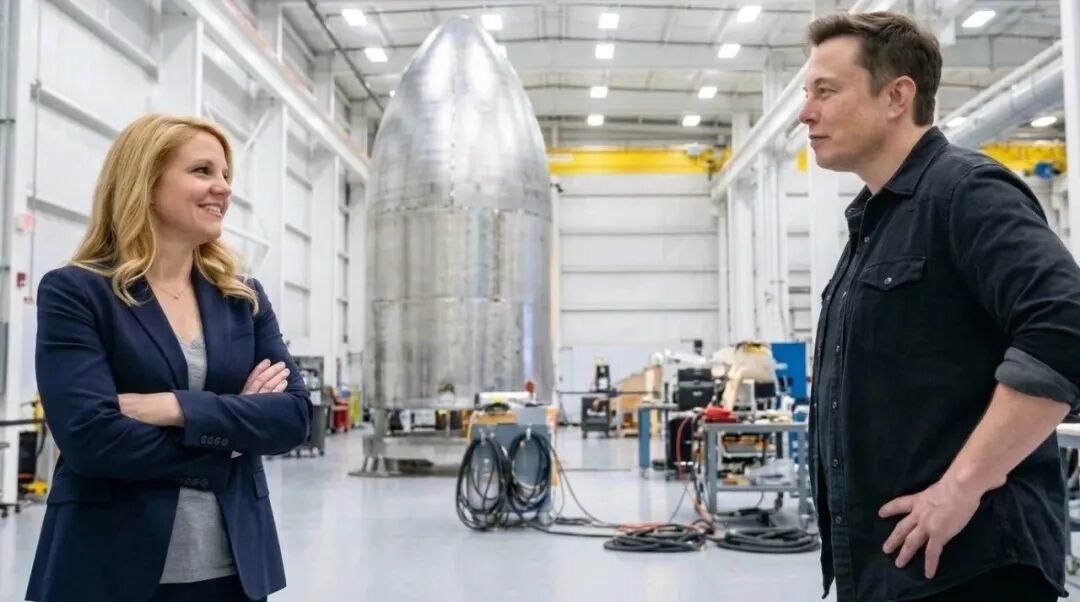
Shotwell dares to say "no" to Musk
In the biography written by Walter Isaacson, Musk is described as a leader who is not good at sharing power. He is used to pushing the team with extremely high goals, and often requires employees to execute in a tough way. Shotwell, however, was able to gain his trust in this management environment.
In 2019, Musk once decided to cancel the Falcon Heavy rocket project. Shotwell quickly found him, reminded him that the company still needed this rocket to fulfill important military contracts, and finally made Musk change his mind.
On another occasion, Musk once proposed that the U.S. Department of Defense should be allowed to use Starlink services for free. Shotwell opposed it in person, arguing that the company should not bear this cost, and pushed for Starlink to receive corresponding remuneration.
Isaacson believes that Shotwell is an irreplaceable partner for Musk. She can not only understand his technical goals, but also dare to point out problems in the plan and adjust his direction when necessary. Mueller, SpaceX's first employee, also believes that her capabilities perfectly complement the technical team Musk has assembled.
However, Shotwell is not a lenient manager.
She also requires employees to accept high-intensity work and continuous feedback, and SpaceX persuades about 10% of its employees to leave every year. She believes that if employees cannot adapt to the continuous challenges and fast-paced work rhythm, they are not suitable to stay in the company.
03 From Starlink to AI, SpaceX's Profit Model Is Changing
One of Shotwell's most successful business judgments in the past was helping SpaceX turn Starlink into a large-scale business.
Satellite communications has always been one of the few areas in the aerospace industry that can continuously generate large-scale revenue. With its low-cost launch capability, SpaceX has deployed low-orbit satellites on a large scale, and gradually built an space-based network that competitors cannot easily replicate.
As of the third quarter of 2026, the number of Starlink users reached 13.6 million, almost doubling in the past 12 months, and revenue from connectivity business increased by 57% over the same period. This business model also allowed Shotwell to prove her operational capability: Musk provides the technical direction, and she is responsible for finding customers and revenue sources.
But as SpaceX acquired xAI, the company's business focus began to shift to AI.
In 2024, xAI built the Colossus data center in the Memphis area in only about 122 days, and continued to invest a lot of money to purchase NVIDIA GPUs. Musk originally hoped to use this computing power to catch up with OpenAI, Anthropic and Google. However, Grok has never been among the industry's leading models, and part of the computing power of the data center has not been fully utilized.
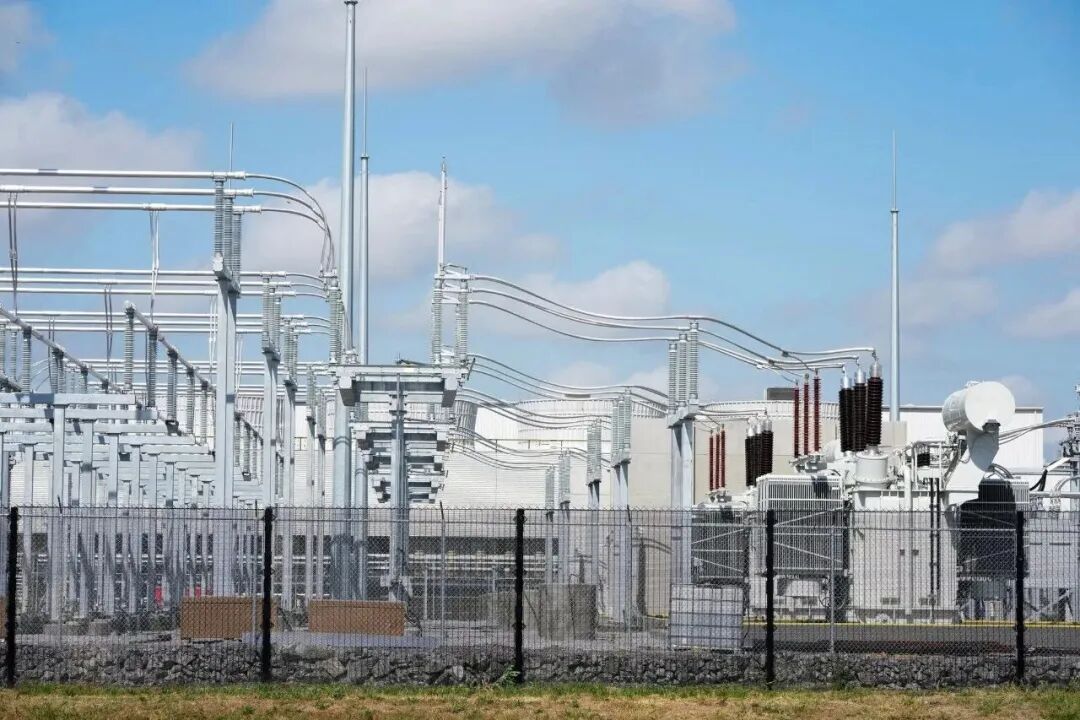
SpaceX's Colossus data center located in Memphis
Starting from May this year, SpaceX has successively reached computing power leasing agreements with companies including Anthropic and Google. Public information shows that the value of the relevant agreement with Anthropic is about 3.1 billion U.S. dollars per month, and that with Google is about 800 million U.S. dollars per month, and both parties can terminate the contract 90 days in advance.
Fortune previously reported that SpaceX's computing power leasing business with customers such as Anthropic, Google and Reflection AI can bring in about 3.4 billion U.S. dollars in revenue per month.
This gives Shotwell a new source of income, but it also brings an awkward situation: SpaceX is helping its own AI competitors to develop.
It is reported that Musk has admitted to employees that SpaceX lags behind its competitors in AI R&D. He once asked engineers in the internal group chat to explain the GPU usage, and even changed the group chat name to "Rent out computing power because we can't compete".
As external customer demand grows, SpaceX has begun to adjust its internal AI projects.
In September this year, the company shut down the AI Companion project; part of the resources of the Digital Optimus project were reallocated; this month, the Grok Imagine team of about 60 people was also disbanded. Mike Nicolls, who is in charge of the AI business, emphasized many times in internal meetings that SpaceX is falling behind Anthropic.
This also puts Shotwell in a new operational dilemma.
In the past, her job was to secure orders for SpaceX, so that R&D investment could be converted into commercial revenue as soon as possible. Now, although the company can obtain huge revenue by leasing computing power, it may help competitors expand their leading advantages as a result.
Computing power leasing contracts can bring cash flow, but they cannot directly improve the model capability of Grok. For a listed company that needs to prove its growth potential to investors, this trade-off is not simple.
04 Space AI: Can Dreams Turn Into Business Again?
More radical than ground data centers is Musk's vision of sending AI computing power into space.
SpaceX plans to use Starship to deploy orbital data centers, arguing that space can provide sufficient solar energy and heat dissipation conditions, reducing the constraints on land, power and cooling for ground data centers.
Shotwell publicly supports this concept. In an interview in June this year, she said that space could be a more efficient place for AI computing. In September, she emphasized again at the All-In Summit that ground data centers are restricted by land, power and approval, while space has a much broader deployment space.
She also brought forward the first launch time of orbital AI satellites to 2027.
However, the technical and cost challenges of this business far exceed those of traditional satellite projects. There is no atmosphere in space, so chips cannot dissipate heat through air and water like ground data centers, and must rely on large radiators to radiate heat outward. Satellites also need to withstand equipment aging caused by radiation, and it is difficult to repair them in time like ground facilities after failures occur.
Researcher Andrew McCalip estimated that the cost of a 1GW-capacity orbital data center could reach 51.1 billion U.S. dollars in the first five years, three times that of a ground facility of the same scale (about 15.9 billion U.S. dollars).
Launch cost is also a difficult problem. At present, SpaceX estimates that the launch cost is about 2700 U.S. dollars per kilogram, and Musk and Shotwell hope to reduce it to less than 200 U.S. dollars per kilogram through Starship.
Aswath Damodaran, a professor at the Stern School of Business at New York University, is most worried that SpaceX will invest too much capital in orbital AI data centers.
Adam Jonas, an analyst at Morgan Stanley, predicts that this business may not generate significant revenue until 2032. According to his forecast, SpaceX may continue to burn cash by 2030, and will need about 390 billion U.S. dollars in debt financing to support capital expenditures in the next 8 to 9 years.
Shotwell is obviously aware of the risks involved.
Musk once proposed to expand the number of Starlink satellites to 100,000 in the next five years, while Shotwell set a target of 12,000 to 15,000. Compared with Musk, she has a more realistic judgment on the project's advancement speed and commercial feasibility.
Over the past 24 years, she has proven time and time again that she can turn Musk's radical ideas into real businesses. But this time, what is in front of her is not just technical R&D and customer negotiations, but also huge capital expenditures and the return expectations of shareholders of the listed company.
Whether she can persuade Musk to adjust his direction again, and whether she can make SpaceX maintain the profitability of its existing business while pursuing space AI, will determine whether this behind-the-scenes operator can complete the most difficult commercialization task of her career.
References:
https://fortune.com/2026/11/24/gwynne-shotwell-spacex-president-elon-musk-orbital-ai-data-centers-starlink-capex-ipo/
https://www.nytimes.com/2026/11/23/business/elon-musk-ai-anthropic-google.html?unlocked_article_code